
Everyone remembers the vinyl seats sticking to the backs of their legs and the radio fading in and out between towns. But ask anyone who actually lived through a 1970s road trip what they remember most, and it’s never the car. It’s the sign glowing up ahead – the one that meant the fighting in the backseat was finally about to stop.
Some of these chains had over a thousand locations at their peak, and almost none of them exist today. A few names still ring a bell. Others vanished so completely that even lifelong road-trippers forget they were ever real, until someone mentions a free birthday sundae, a pecan log roll, or an orange roof that meant “we’re almost there.” Here’s what actually happened to them.
#19 – Carrols Drive-In: The Burger Chain That Quietly Became Something Else
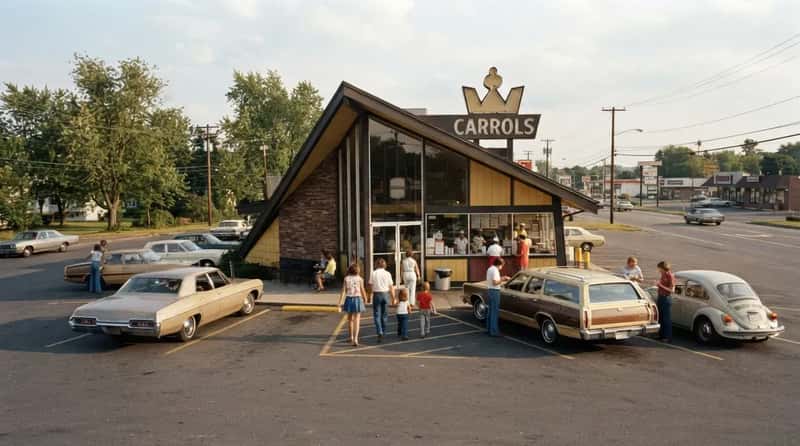
Before most families ever heard the name “Burger King” outside the Northeast, they were pulling into a Carrols Drive-In without realizing what they were looking at. Carrols started as its own hamburger stand chain in upstate New York, built on the same cheap-burger, quick-stop formula every roadside chain chased in the 1960s. Families barely noticed the branding – they just wanted fries in the car before the next three hours of driving.
What most travelers never realized is that Carrols was secretly buying up Burger King franchise rights the entire time. By the mid-to-late 1970s, the company had converted almost all of its locations to the Burger King name, quietly erasing its own identity in the process. It’s one of the few chains on this list that didn’t fail – it just disappeared into a bigger brand, which somehow feels sadder.
#18 – Shakey’s Pizza Parlor: The Loudest Stop on the Highway
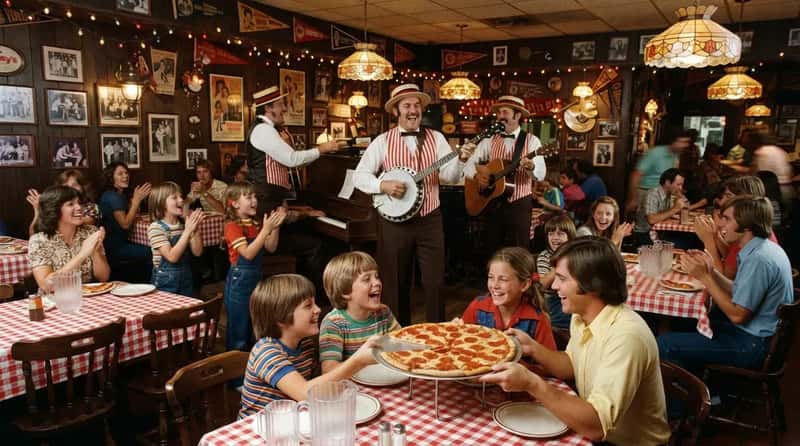
Long before family-friendly pizza chains became a genre of their own, Shakey’s was the original template, complete with banjo players and barbershop-quartet energy. Families pulling off the interstate would hear it before they saw it – live music, sing-alongs, and a dining room that felt more like a party than a pit stop. For kids stuck in a car all day, it was pure sensory overload in the best way.
The chain leaned hard into nostalgia even in the 1970s, decorating dining rooms with old photographs and vaudeville-style decor that made every location feel like a time capsule. Many travelers today insist Shakey’s invented the “eatertainment” concept decades before anyone gave it that name. It rarely makes roadside diner nostalgia lists, but for thousands of families, it was the loudest, most memorable stop of the entire trip.
#17 – Woolworth’s Lunch Counter: The Diner Hiding Inside a Department Store
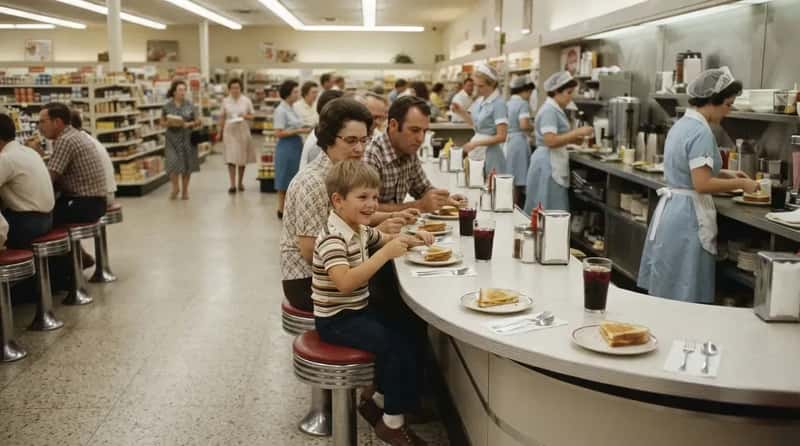
It wasn’t technically a standalone diner, but F.W. Woolworth’s lunch counters were often the only sit-down meal in small highway towns without a proper restaurant. Families would duck in for a five-and-dime shopping stop and end up ordering grilled cheese and cherry Cokes at a long counter lined with spinning stools. For a lot of kids, the stool itself was the main attraction.
What most people forget is how central these lunch counters were to American life beyond food – they were sites of major civil rights history in the decade before, and by the 1970s they’d settled into a quieter role as small-town road-trip staples. As shopping malls pulled customers away from downtown five-and-dimes, the lunch counters faded fast. By the time Woolworth’s closed its U.S. stores for good in the late 1990s, most of these counters had already vanished.
#16 – Krystal: The South’s Answer to the Tiny Square Burger
If your family vacation ever cut through the Southeast, there’s a good chance you stopped at a Krystal without knowing its backstory. Founded in Chattanooga, Krystal built its identity on small, steam-grilled square burgers served in stacks – the kind of food built for eating four or five at a time. Truckers and traveling families both treated it as a reliable, cheap refuel stop.
What made Krystal stand out on Southern highways was its consistency: the same tiny burgers, the same layout, the same 24-hour lights, no matter which state you were in. Many families didn’t even realize it was a regional chain rather than a national one, assuming every state had a Krystal just like theirs. That regional loyalty is part of why it survived decades longer than flashier competitors that expanded too fast and collapsed.
Fast Facts
- Founded in Chattanooga, Tennessee, decades before it became a Southern highway fixture
- Built around small, steam-grilled square burgers meant to be ordered by the sack
- Many locations kept lights on around the clock for overnight travelers
- Stayed a regional chain instead of chasing national expansion
#15 – Shoney’s: The Big Boy Cousin Nobody Talks About
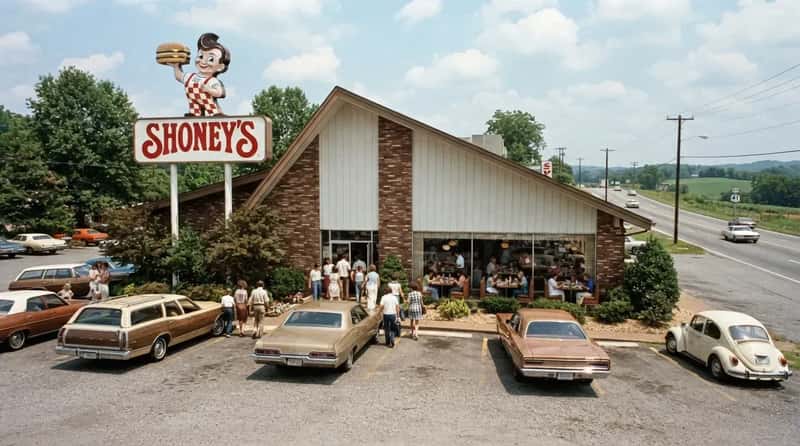
Shoney’s has a strange origin story most families never knew while eating there: it actually started as a Big Boy franchise before splitting off into its own Southern-fried identity. The strawberry pie and the all-you-can-eat breakfast bar became the real draw, turning it into a favorite stop for families driving through Tennessee, Georgia, and the Carolinas. Vacationers often planned entire route detours just to hit a Shoney’s breakfast bar.
The chain leaned hard into a homestyle, “Big Mama’s kitchen” vibe that felt different from the fast-food boom happening everywhere else. While many travelers today assume it was always a distinctly Southern brand, its roots as an offshoot of the Big Boy system are rarely mentioned. That quiet identity crisis – a Southern soul food chain built on a Midwestern burger franchise – is exactly the kind of detail that makes 1970s roadside dining so weird in hindsight.
#14 – IHOP: The Blue Roof That Meant Pancakes at Any Hour
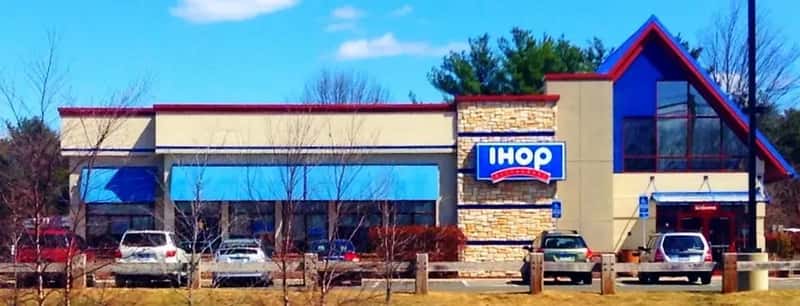
The International House of Pancakes opened with a very specific pitch: breakfast food, available whenever your road trip schedule demanded it, day or night. That blue A-frame roof became a beacon for tired families pulling off the highway at odd hours, desperate for something that wasn’t a vending machine sandwich. Kids specifically remember the syrup caddy – a lineup of flavors that felt like its own attraction.
What set IHOP apart from diners built around burgers was its refusal to treat breakfast as a morning-only meal, which was still a fairly radical idea for a roadside chain in the 1960s and ’70s. Families driving overnight to save on motel costs relied on it as one of the few guaranteed stops that wouldn’t be dark and locked at 2 a.m. That 24-hour reliability quietly built one of the most enduring brand loyalties on this entire list.
#13 – White Castle: The Tiny Square Burger That Started a War
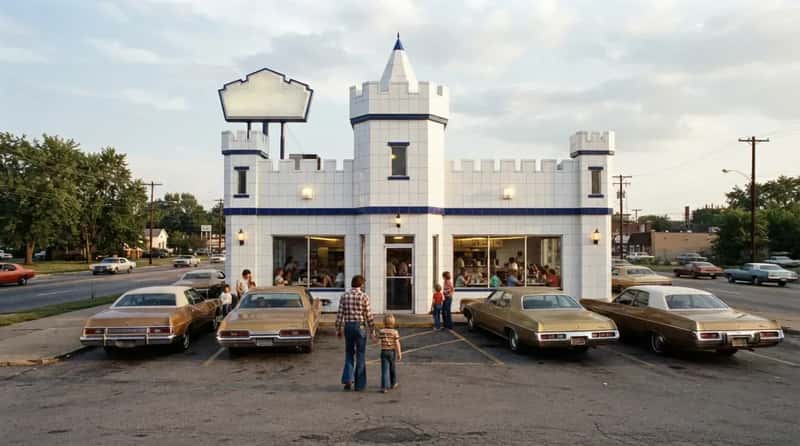
White Castle predates the 1970s by decades, but its steam-grilled, onion-studded sliders were still a road-trip fixture for families driving through the Midwest and Northeast well into the decade. The chain’s stainless-steel, castle-shaped buildings were designed to look sanitary and modern at a time when hamburgers had a reputation problem. Parents trusted the look; kids just wanted a sack of the tiny burgers to themselves.
Most travelers don’t realize White Castle essentially invented the fast-food burger format that everyone else – Krystal included – copied outright. The chain’s refusal to franchise kept it smaller and more regional than its imitators, which is exactly why it never reached the thousand-location scale of some names on this list. That stubborn independence is also why it’s one of the only diners here that never went bankrupt or got sold off piece by piece.
#12 – Nathan’s Famous: The Hot Dog Stand That Turned Into a Circus
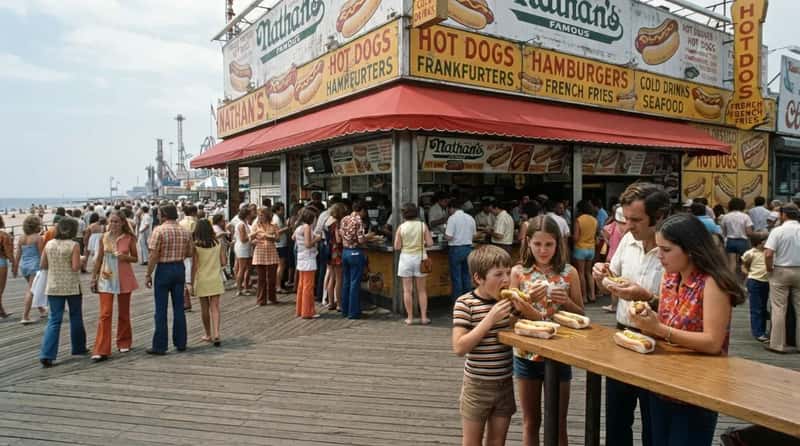
For East Coast families, a beach vacation wasn’t complete without a stop at a Nathan’s Famous stand, usually eaten standing up with mustard dripping onto a boardwalk. What started as a nickel-hot-dog stand on Coney Island had, by the 1970s, become a full-blown roadside institution stretching along highways well beyond New York. The smell alone was enough to make kids beg for a detour.
Few families realized at the time that the annual hot dog eating contest – now a massive televised event – had only just become an official yearly tradition in the early ’70s. What was once a scrappy local quirk quietly turned into a national spectacle happening right at the same stands families visited every summer. It’s a strange bit of trivia: the diner stop you remember for the crinkle-cut fries also happened to be building a competitive-eating legacy in the background.
#11 – Steak ‘n Shake: “In Sight It Must Be Right”
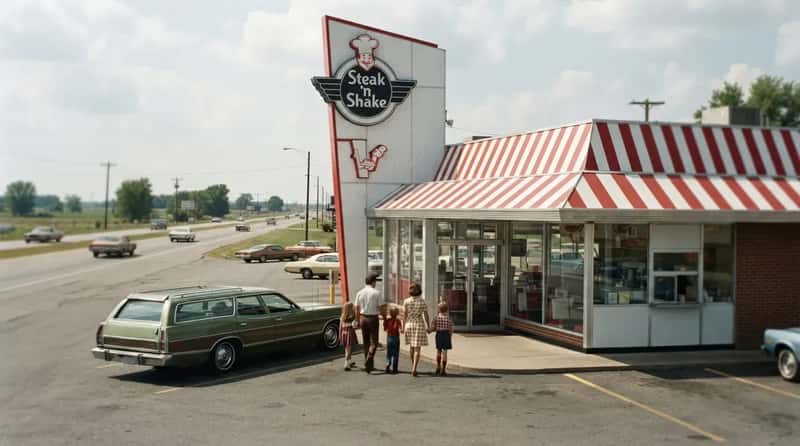
Steak ‘n Shake built its entire brand promise on transparency, literally grinding steak in full view of customers so families could watch their burger meat before it hit the flat-top. That slogan – “In Sight It Must Be Right” – sounds almost quaint now, but it was a genuine selling point when fast-food quality scandals were common conversation topics at dinner tables. The hand-dipped milkshakes were the real reason kids remembered the stop, though.
What made the chain stand out on long highway drives was its round-the-clock consistency: the same red-and-white signage, the same steakburgers, the same shake flavors whether you were in Illinois or Florida. Many families treated it as a “safe bet” stop specifically because it never seemed to vary from state to state. That predictability is a big reason it outlasted flashier, more theatrical competitors from the same era.
#10 – Dairy Queen: The Cone That Meant the Trip Was Almost Over
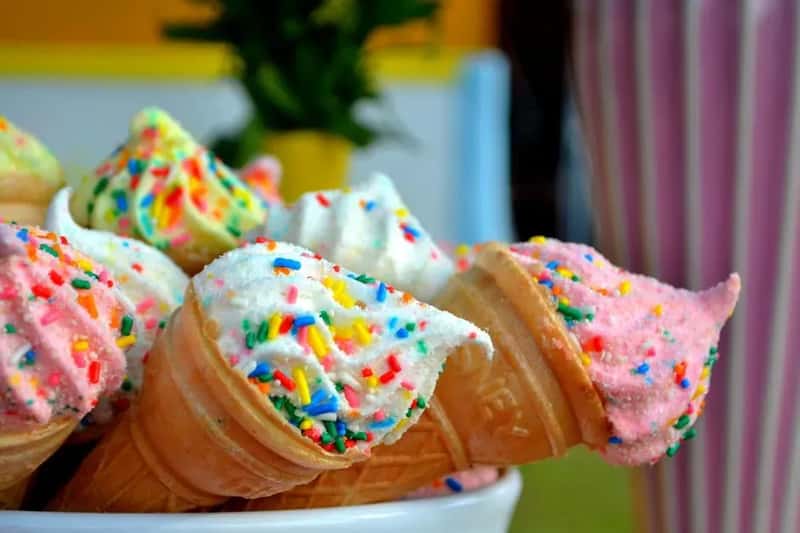
Dairy Queen wasn’t really built as a sit-down diner, but for 1970s families it functioned as one anyway – the mandatory stop after a long stretch of highway, right before everyone got back in the car for the final leg. The soft-serve cone with the signature curl became a kind of finish-line reward system parents used shamelessly to keep kids quiet for the last hundred miles. Nobody questioned it; everybody wanted it.
What’s easy to forget is how many DQ locations doubled as the only air-conditioned building in small highway towns during brutal summer heat, making it as much a relief stop as a treat stop. Families would stretch a fifteen-minute cone break into forty-five minutes just to sit in the cool dining room. That dual purpose – dessert and refuge – is part of why DQ nostalgia runs so much deeper than “it had good ice cream.”
#9 – A&W: The Drive-In That Made Root Beer a Destination
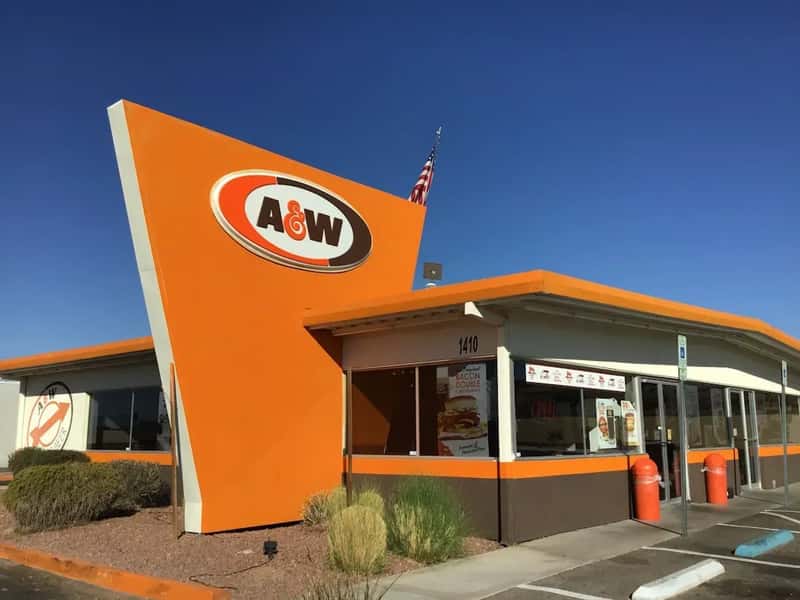
A&W turned a simple root beer recipe into a full roadside experience, with frosty mugs served straight to the car by carhops on roller skates at many locations well into the 1970s. Families treated it less like a meal stop and more like a mini event – kids climbing halfway out the window to watch the tray get hooked onto the door. The chilled glass mug alone was half the appeal.
What made A&W different from the burger chains crowding the same highways was its refusal to abandon the drive-in format even as fast-food counters became the industry standard. That old-fashioned carhop service felt nostalgic even in its own decade, which is exactly why families sought it out specifically instead of settling for whatever burger stand was closest. It sold an experience first and a root beer float second.
Worth Knowing
- Built its identity around a root beer recipe that predated the drive-in boom by decades
- Kept carhop service on roller skates long after most competitors switched to walk-up counters
- Served drinks in chilled glass mugs instead of paper cups, a small detail families remembered for years
- Sold the stop as an event first, with the food and drink almost secondary
#8 – Denny’s: The Donut Shop That Became a 24-Hour Institution
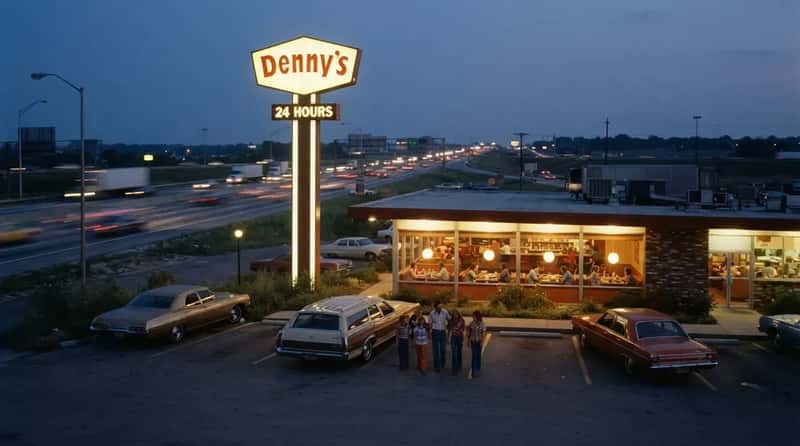
Denny’s didn’t start as the all-night diner families remember – it began as a donut stand before rebranding and expanding into full-service, round-the-clock restaurants that became a staple of interstate exits nationwide. That 24-hour promise mattered enormously to families driving overnight to cut a day off a long trip, especially before smartphone maps made it easy to know what was open. A lit-up Denny’s sign was a genuine relief signal on a dark highway.
What made it stick with kids specifically was the laminated menu with photos of every item, letting even a five-year-old point at a picture instead of reading a word. Parents appreciated something else entirely: a guaranteed hot meal at 3 a.m. without needing to gamble on an unfamiliar small-town diner. That reliability, more than any single menu item, is what built Denny’s into a genuine highway landmark.
#7 – Waffle House: The Yellow Sign That Never, Ever Closed
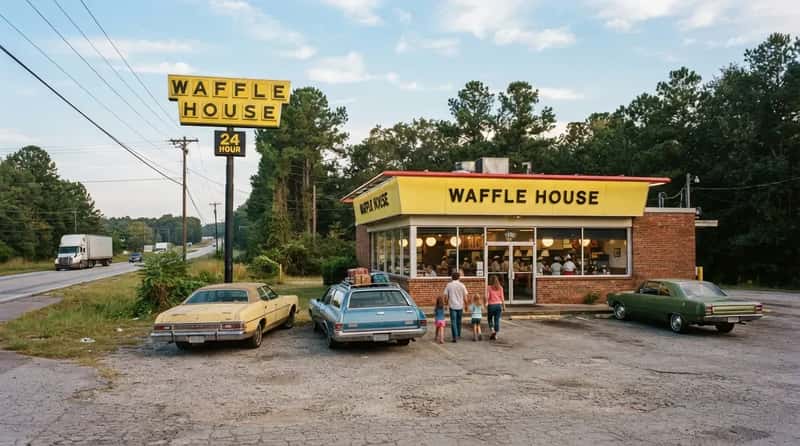
Waffle House earned its reputation the hard way – by staying open through literally everything, a policy so consistent that emergency management agencies now unofficially gauge storm severity by whether the local Waffle House stayed open. For 1970s families driving through the South, that yellow sign meant certainty in a way few other diners could match. You could set your watch by it.
The scattered, smothered, and covered hash browns became a road-trip ritual long before the chain had any national name recognition outside its home region. Families driving through Georgia or the Carolinas would specifically time meals around finding a Waffle House rather than settling for a gas station snack. That fierce regional loyalty, built almost entirely on dependability rather than flash, is part of why the chain still feels untouched by time today.
#6 – Bob’s Big Boy: The Statue That Watched Every Family Pull In
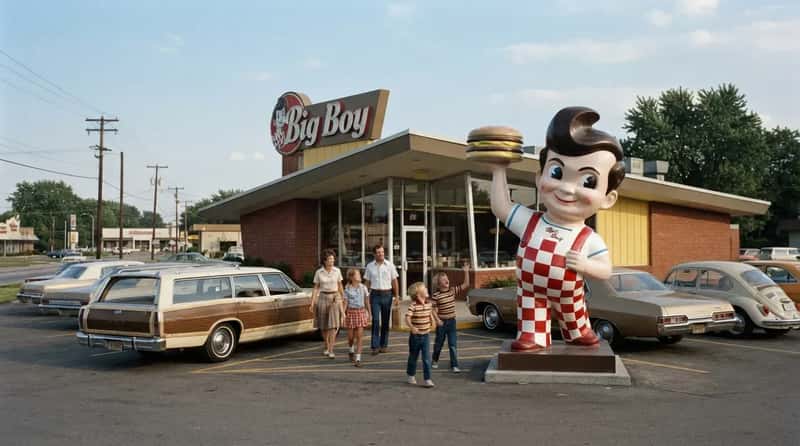
Long before fast-food mascots became a marketing science, Bob’s Big Boy began in 1936 when a young owner reopened a small hamburger stand and, after a customer asked for “something different,” invented the now-famous double-deck hamburger by cutting a bun into three layers. That accidental invention became the blueprint for double-deck burgers everywhere, including chains most families would never connect back to Bob’s. The checkered-overalls statue out front became a landmark kids searched for from the backseat.
The Big Boy hamburger inspired and became the model for other double-deck hamburgers, including McDonald’s Big Mac, Burger King’s Big King, and Burger Chef’s Big Shef. Most travelers had no idea that nearly every “double burger” they ordered elsewhere owed a debt to this one roadside stand. The chain’s massive neon signage, sometimes towering 70 feet, was specifically designed to be visible from a moving car – an early example of architecture built for road-trip families rather than pedestrians.
#5 – Burger Chef: The Fast-Food Chain That Invented the Kids’ Meal First
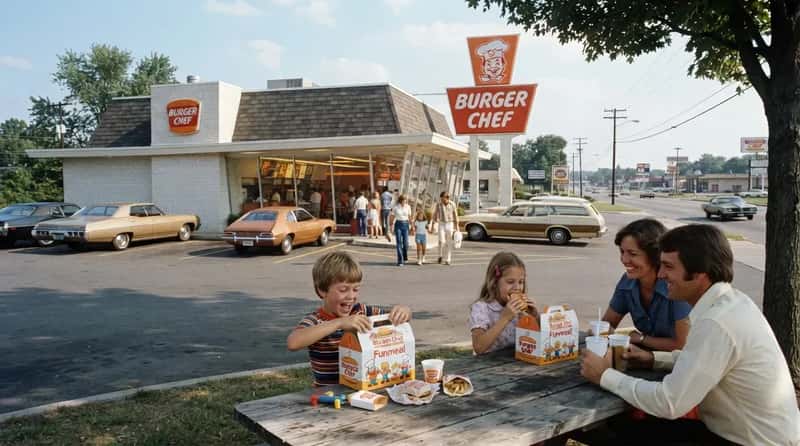
Here’s the fact that surprises almost everyone: the Happy Meal wasn’t invented by McDonald’s – it was invented by a chain most people have never heard of, Burger Chef. In 1972 Burger Chef introduced the Funburger, and the following year came the Funmeal, the first kid’s meal to include a burger, fries, a drink, a cookie, and a toy, wrapped in packaging featuring characters like the vampire Count Fangburger and the witch Cackleburger. Families lined up specifically for the storytelling packaging, not just the food.
When McDonald’s launched its own Happy Meal in 1979, Burger Chef actually sued them over it – and lost. That legal defeat, combined with corporate mismanagement after being sold to a cereal company, quietly erased one of the most genuinely innovative chains of the decade. At its 1973 peak, the chain had 1,050 locations, proof that inventing the idea first doesn’t guarantee you get remembered for it.
Why It Stands Out
- 1972: launched the Funburger, its first push toward kid-focused meals
- 1973: introduced the Funmeal, the first kids’ meal bundled with a toy
- 1973 peak: reached 1,050 locations nationwide
- 1979: sued McDonald’s over the Happy Meal concept – and lost
#4 – Farrell’s Ice Cream Parlour: The Loudest Sundae in America
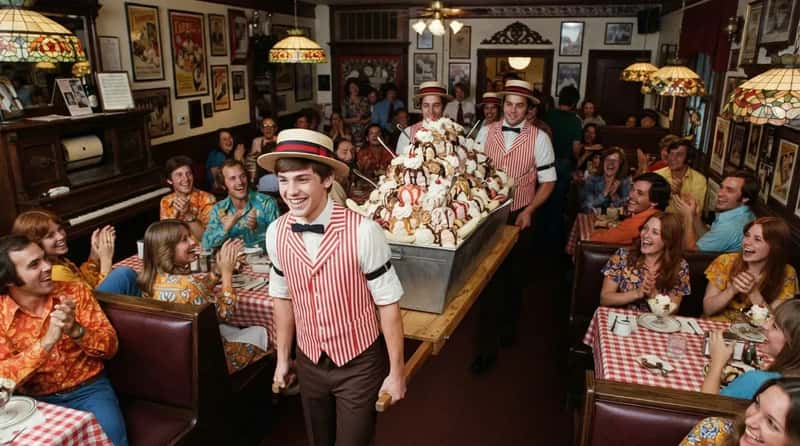
Farrell’s became famous for offering a free ice cream sundae to kids on their birthday, all served inside parlors decorated with an early 1900s theme, player pianos, and staff in period straw boater hats. But the real spectacle was the “Zoo” sundae – an enormous 50-scoop sundae carried around the restaurant on a stretcher by multiple employees, accompanied by wailing ambulance sirens. Entire dining rooms would stop eating just to watch it go by.
Marriott purchased the chain in 1972, and by 1975 there were 120 Farrell’s locations nationwide, a genuine road-trip destination in its own right. What most families never knew was darker: in 1972, a small plane crashed directly into a Sacramento Farrell’s during an air show, killing 22 people. The chain survived that tragedy for decades, but slowly faded until its final location closed for good.
#3 – Sambo’s: The Chain That Grew Huge, Then Collapsed Under Its Own Name
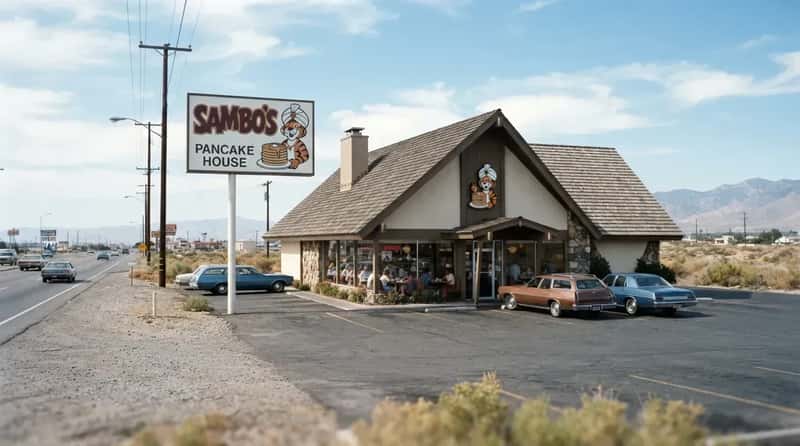
By 1976, Sambo’s was doing $380 million in sales, equal to roughly $1.6 billion today, making it one of the biggest full-service restaurant chains families encountered on any 1970s road trip. During its most successful years, the chain leaned directly into its name’s connection to the racist children’s book “Little Black Sambo,” decorating locations with murals inspired by the story before eventually switching to a tiger mascot. Kids loved the pancakes; almost nobody questioned the branding at the time.
As the chain expanded east through the 1970s, concerns over the name grew, and organizations filed lawsuits against it. Sambo’s tried renaming some Northeast and Midwest locations “No Place Like Sam’s” and “Jolly Tiger,” but it did little to fix the brand’s image. Financial mismanagement unrelated to the name ultimately forced most units to close or sell by 1982, a controversial ending most families driving past those pancake houses never saw coming.
#2 – Stuckey’s: The Teal Roof That Meant “We’re Stopping, No Arguments”
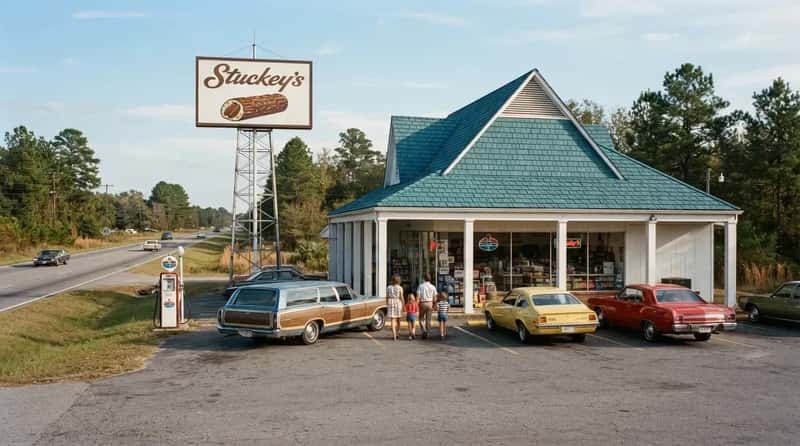
For families traveling Southern highways in the ’60s and ’70s, Stuckey’s was everywhere, a teal-roofed beacon offering a place to rest, refuel, and satisfy sweet cravings. By its boom years, the company had expanded to 368 stores across more than 30 states, offering restrooms, gasoline, meals, and souvenirs including rubber snakes and Elvis memorabilia. The pecan log roll wasn’t just candy – it was the entire reason kids begged parents to pull over.
The mid-to-late 1970s marked a turning point, though: the 1973 oil embargo pushed gas prices higher and discouraged the long family road trips Stuckey’s depended on. By the time the founder died in 1977, a corporate buy-out and mass closure of stores signaled the end of the classic roadside experience most families remembered. Most of those teal roofs are gone now, but the pecan log roll, somehow, survived the collapse.
#1 – Howard Johnson’s: The Orange Roof That Meant You’d Made It
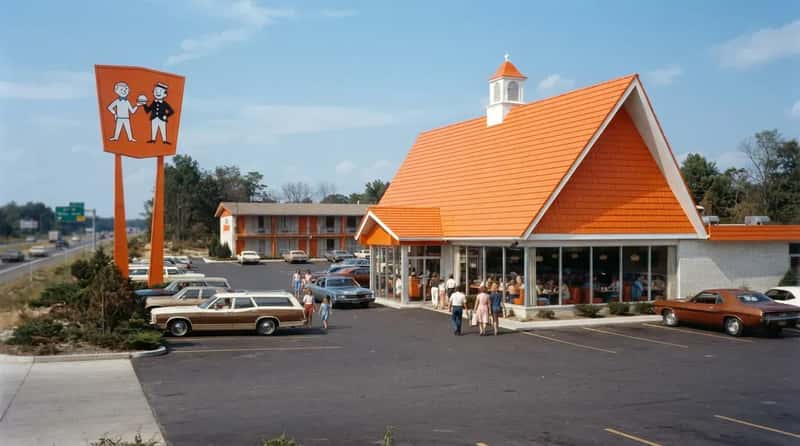
Once the largest restaurant chain in the U.S., Howard Johnson’s was something close to paradise for families traveling the highways of America, with a children’s menu, a birthday club, and a quest to eat all 28 flavors of ice cream. By 1975, the company had more than 1,000 restaurants and more than 500 motor lodges in 42 states and Canada, an almost unbelievable footprint for a single chain built entirely around road-tripping families.
In a move that quietly annoyed loyal customers, the chain introduced “Hojo Cola” and other private-label sodas, disappointing travelers who wanted familiar brands like Coca-Cola or Pepsi. The 1973 oil embargo hit especially hard, since the restaurants and motor lodges received 85% of their revenue from travelers who suddenly couldn’t afford long trips. The last true Howard Johnson’s restaurant finally closed its doors in Lake George, New York, in 2022, meaning the orange roof that meant “we’re almost there” for millions of families quietly disappeared just a few years ago, and most people never even noticed it was gone.
At a Glance
- 1975 peak: over 1,000 restaurants and 500+ motor lodges across 42 states and Canada
- Signature challenge: a quest to try all 28 ice cream flavors
- 85% of revenue came from traveling families, making the chain especially vulnerable to gas shortages
- 2022: the last true Howard Johnson’s restaurant closed in Lake George, New York
What’s most striking about this list isn’t how many diners disappeared – it’s how differently they went out. Some, like Howard Johnson’s and Stuckey’s, got crushed by the same oil embargo that ended the golden age of the family road trip itself. Others, like Sambo’s, collapsed under the weight of their own branding decisions. And a few, like Burger Chef, quite literally invented the idea that made McDonald’s a household name and got nothing for it.
None of these places exist the way they used to, but for anyone who grew up in the back seat during the 1970s, the names alone still trigger a very specific kind of homesickness. Which one of these stops do you remember most – and did we miss your family’s go-to diner? Drop it in the comments.