For decades, the retirement math seemed simple: head south, skip the income tax, and let the sunshine do the rest. That math looks a lot messier in 2026, with insurance bills, home prices, and shifting migration patterns forcing retirees to look past the old slogans and into the actual numbers.
Florida and North Carolina both show up on nearly every “best states to retire” list, but they get there in very different ways. One leans on zero income tax and endless warmth, the other on lower everyday costs and a milder, more varied climate. Comparing them honestly means digging into taxes, insurance, healthcare, and the kind of daily life you can actually afford to live.
State income tax: Florida’s clearest advantage

Florida’s biggest selling point has not changed. Florida has no income tax (including on retirement income) and no estate tax, making it highly attractive for retirees. That means Social Security, pensions, IRA withdrawals, and 401(k) distributions all arrive untouched by the state.
North Carolina taxes differently, though the gap has been narrowing. North Carolina has a flat 3.99% income tax rate for 2026, having declined aggressively from 5.25% in 2022 to 4.75% in 2023 to 4.5% in 2024. Importantly, North Carolina does not tax Social Security or railroad retirement benefits when those benefits are included in federal adjusted gross income. For retirees living mostly on Social Security, the tax gap between the two states shrinks considerably.
Property taxes and senior exemptions

On paper, property taxes are close to a wash. North Carolina averages 0.78% property tax vs Florida’s 0.83%, which is a small enough difference that it rarely tips a decision on its own. Both states also offer real relief for older homeowners rather than just a flat rate.
Florida gives residents a homestead exemption of up to $50,000, and Florida’s Save Our Homes rules cap annual assessment increases for qualified homesteads at 2.7% in 2026. North Carolina’s version works a bit differently: qualifying homeowners who are 65 or older or totally and permanently disabled can qualify for an exclusion equal to the greater of $25,000 or 50% of the appraised value if they meet income rules, with a Circuit Breaker program that can defer taxes above 4% or 5% of income depending on income level. Both systems reward long-term homeowners, just through different mechanics.
The Florida insurance problem is real, and it is not over
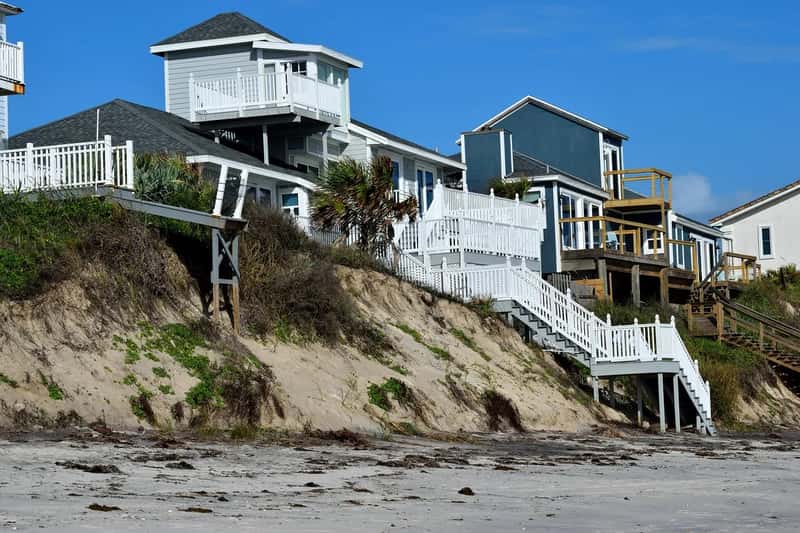
This is where the two states genuinely diverge. Florida’s average annual cost of home insurance hit $8,292 in 2025, an 18% increase over 2024, according to Insurify’s 2026 Insuring the American Homeowner Report. That is not a typo, and it is roughly 2.8x the U.S. average of $2,948.
There is some good news buried in the data. Regulators approved an 8.7 percent average statewide rate decrease for Citizens Property Insurance at renewals beginning in spring 2026, with more than 330,000 policyholders across all 67 counties seeing reductions. Even so, rebuild and labor costs, premiums that remain among the highest in the nation, tight scrutiny of older roofs, and coastal wind exposure remain stubborn problems that no statute can legislate away. North Carolina is not immune to rising premiums either, but the scale is different.
North Carolina’s own insurance pressures

It would be misleading to paint North Carolina as insurance-proof. In late 2025, the North Carolina Rate Bureau requested a statewide average 68.3% increase for dwelling policies, a jump that rattled a lot of coastal homeowners. Wind and flood exposure along the Outer Banks and Wilmington area can push costs up meaningfully.
Still, the baseline numbers tell a clearer story. Florida home insurance averages around $4,200 a year versus North Carolina’s $2,180, and car insurance averages $1,540 a year in North Carolina versus $2,560 in Florida. Even accounting for North Carolina’s recent rate requests, most retirees are starting from a much lower baseline there than in coastal Florida.
Cost of living: a wider gap than most people expect

Beyond insurance, everyday costs favor North Carolina by a noticeable margin. Cost of living in North Carolina is about 22.8% lower than Florida when including rent, and 19.0% lower excluding rent. That spread covers groceries, services, and general household spending, not just housing.
Florida’s affordability has actually slipped in recent rankings. The Sunshine State ranked 31st in cost of living during the first quarter of 2026, with affordability concerns fueled by increased costs of housing, insurance, and utilities. For retirees on a fixed income, that kind of erosion matters more than a favorable tax code on its own.
Housing prices and where the money actually goes

Home prices in North Carolina have stayed comparatively grounded. Redfin puts the statewide median at $378,000 in February 2026, up 2.4% year-over-year, with plenty of markets well below that figure outside the hottest metros. Popular retirement spots like Asheville have gotten pricier, with home prices up 1.3% compared to the same period last year, selling for a median price of $507K, but that is still the exception rather than the rule statewide.
Florida’s housing costs vary wildly by region, and coastal properties carry a premium that goes beyond just the purchase price. The insurance escrow alone can rival a mortgage payment in some hurricane-exposed counties, and buyers are increasingly told to budget accordingly rather than assume a flat monthly number.
Climate: sunshine year-round versus four real seasons

Florida’s pitch here barely needs explaining. Warm winters, humid summers, and a coastline that stretches for miles make it a natural draw for anyone tired of shoveling snow. The tradeoff is a climate that comes bundled with hurricane season every year without exception.
North Carolina offers something different. North Carolina’s mild winters, with lows in the high 20s to mid-30s, and warm but not extreme summers make it one of the most comfortable year-round climates in the US. Retirees who miss actual seasons, or who simply want a break from constant heat, tend to gravitate toward this middle ground rather than Florida’s unbroken warmth.
Healthcare access: strong in both, but different in character

Florida’s advantage here comes from scale. The state has a dense, well-established Medicare Advantage market and a huge network of retiree-focused medical services built up over decades of serving an older population.
North Carolina counters with concentrated excellence rather than sheer size. North Carolina’s healthcare strength is concentrated in the Research Triangle, where Duke University Health System and UNC Health in the Durham and Chapel Hill area are nationally ranked academic medical centers offering specialist care comparable to Boston or New York facilities. Coastal and mountain regions are served by solid regional systems, though the state’s Medicare Advantage market is well developed in the Triangle and Charlotte but thinner in rural and mountain areas.
Hurricane exposure and the growing weight of climate risk

Florida’s geography is both its biggest attraction and its biggest liability. With nearly 8,500 miles of coastline, Florida is particularly susceptible to severe weather events, and since 2020 the state has experienced at least 34 billion-dollar weather events, including severe storms, floods, and tropical cyclones. That exposure is exactly what drives the insurance costs discussed earlier, and it is not something legislation can fully undo.
Analysts are increasingly blunt about this tradeoff. Rising insurance costs in hurricane-prone states are eroding part of the tax savings that made Florida so attractive, and climate risk is becoming a real financial consideration, not just a lifestyle one. North Carolina’s coastal counties face some storm risk too, but nothing on the scale or frequency of Florida’s exposure.
Migration trends: where retirees are actually moving

The population numbers tell their own story. North Carolina added nearly 150,000 people in 2025, ranking third nationally behind only Texas and Florida, and the state ranked number one for domestic migration, meaning more people moved there from other states than anywhere else in the country. Much of that inflow includes retirees and near-retirees drawn by lower costs and milder winters.
Florida still pulls plenty of newcomers, but the shine has dulled for some. Insurance premiums have exploded and home prices in once-affordable Florida towns have climbed, while states that used to be afterthoughts on retirement lists, including the Carolinas and Tennessee, are suddenly holding their own or even beating Florida in national rankings. National surveys reflect that shift too, with one recent ranking putting Florida second behind a lower-cost state for overall retirement quality.