In the first part of my stay in Bristol, I approached the city as a sequence of moods—stepping into its industrial ambition, its quiet landscapes, and its refined eccentricities. That framework defined the way I moved through the city, making each choice intentional rather than incidental.
But I soon found out that there was more. So I kept going, following new instincts, new atmospheres, and new ways of feeling. This second part picks up exactly where the first left off: guided by moods, and feeling very immediate and choral. If you missed it, you can read Part 1 here.
When I Wanted to Feel Cosmopolitan and Completely Contemporary

Whenever I needed to reconnect with Bristol’s present tense, I followed the trail of Banksy. I did it systematically: several up-to-date Banksy maps exist online, and there are public Google Maps lists that pin known works across the city, constantly revised as pieces disappear or reappear. You can save one directly to your phone and let it guide you loosely, without turning the hunt into a checklist.
I used it more as a compass than an itinerary—and it made me feel modern, alert, and very much inside a living conversation rather than a curated one.
When I Wanted to Look Up With Everyone Else

August brought the Bristol International Balloon Fiesta, and with it, a completely different version of the city. The Fiesta is quite recent, it began in 1979, almost accidentally, as a small gathering of balloon enthusiasts. Over time, it grew into one of Europe’s largest hot-air balloon events, but it never lost its local soul.
For Bristolians, this isn’t a tourist spectacle—it’s a fixed point in the calendar, something woven into personal memories and family routines. People talk about their first Fiesta, remember specific balloons, specific mornings, specific skies. Families bring blankets and flasks, children know exactly when to look up, and entire neighborhoods quietly reorganize themselves around launch times. I loved it because I could feel it was a moment of communal belonging written into the sky.
When I wanted to look Directly at Bristol’s Past
Bristol was one of Britain’s major slave-trading ports in the 17th and 18th centuries. Enormous wealth flowed through the city thanks to ships that carried enslaved Africans across the Atlantic and returned with goods produced through forced labor. That money shaped Bristol’s architecture, institutions, and social hierarchy—and pretending otherwise would make the city easier, but far less honest. I felt that Bristol was actively and honestly working through its past.
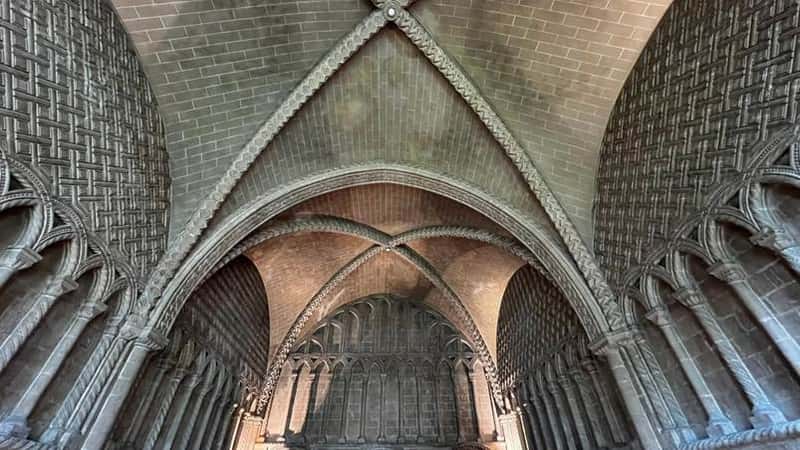
I learned all that inside Bristol Cathedral, where an exhibition explained it all not with a sense of denial, but the opposite. There are clear, explicit narratives explaining how the Church, the city, and powerful local families were entangled in slavery. To connect beauty and violence. Faith and profit. Grandeur and exploitation. Having said that, the cathedral itself is stunning: founded in the 12th century as an Augustinian abbey and later elevated to cathedral status, it combines Romanesque solidity with Gothic lightness—an architecture shaped over centuries of power, faith, wealth – and greed, we must add.
When I Wanted Cultural Context
On a slower day, I went to the Bristol Museum & Art Gallery. Not to rush through it, but to wander—and that’s exactly how it wants to be experienced. Opened in its current Edwardian building in 1905, the museum reflects Bristol’s long-standing role as a port city: outward-looking, curious, and shaped by global connections, not always comfortable ones.
There’s archaeology from Egypt and Assyria, natural history displays that feel almost Victorian in spirit, and fine art that includes works by Turner, Constable, and the Bristol-born painter Edward Bird. One moment you’re standing in front of a Roman mosaic, the next you’re face to face with a taxidermy gorilla that has become something of a local icon. It’s eclectic, but never random. It mirrors Bristol itself: intellectually ambitious but socially relaxed, deeply layered without being intimidating.
How to Get There (and Move Around Like a Local)
Reaching Bristol is refreshingly straightforward, which partly explains why it feels so plugged into the world. The city has its own airport, Bristol Airport, with direct connections to many European cities and easy links via London for international travelers. From the airport, buses and taxis bring you into the city center in about 30 minutes. Coming from London, the train is often the most pleasant option. Direct services from Paddington Station reach Bristol Temple Meads in roughly 90 minutes, delivering you straight into the heart of the city. Temple Meads itself is an architectural statement—industrial, historic, and very much in character.
Once you’re in Bristol, the best way to move around is on foot. It’s a city of hills, yes, but also of walkable distances, especially if you’re staying centrally. Buses cover most areas efficiently, and for longer stretches, ride-hailing apps are widely used. I walked a lot—up to Clifton, down into the Avon Gorge, across neighborhoods—and that, more than anything, helped me feel anchored. If you want to explore the surroundings—Ashton Court, the gorge, or nearby countryside—having a car can help, but it’s not essential. Bristol rewards slow movement. The more you move through it at human speed, the more it opens up.
Time to Go

I had learned Bristol’s pace. I knew where to walk when I needed air, where to look when I wanted inspiration, where to slow down when the city felt generous. By the time it was time to leave, I was genuinely sorry to go as one is when they have finally figured out how a place works. Before heading out, I stopped one last time by the harbor to salute the replica of the Matthew. Somehow, in its absurdity, it made the whole idea of continuity more tangible. Like that ship, I was setting off again, carrying something reconstructed but still real: a sense of direction shaped by history. Thank you, Bristol, for giving me that weight.