The café is full at noon. You are the only one sitting alone.
Or so it appears.
The croissant flakes onto a plate no one else is touching. The wine arrives. You didn’t need to ask your companion if it was too early.
There is no companion.
There is only you – and the slow, radical realization that this is not a tragedy.
Here’s the thing about modern travel: we pack our bags with clothes and our heads with borrowed identities. The version of ourselves that gets photographed in front of the Eiffel Tower is often not the version that woke up at 3 AM wondering who we actually are beneath all the noise.
The Identity Gap is this: the distance between the self you perform for others and the self that exists when the audience disappears. Most people never sit inside that gap. They fill it with itineraries, group dinners, curated Instagram stories, and the comfortable noise of other people’s opinions.
But solo travel can challenge these long-held beliefs about identity, particularly for people who navigate across cultures. And Paris – that impossibly beautiful, brutally indifferent city – has a way of stripping the performance right off you.
1. The Arrival Lie
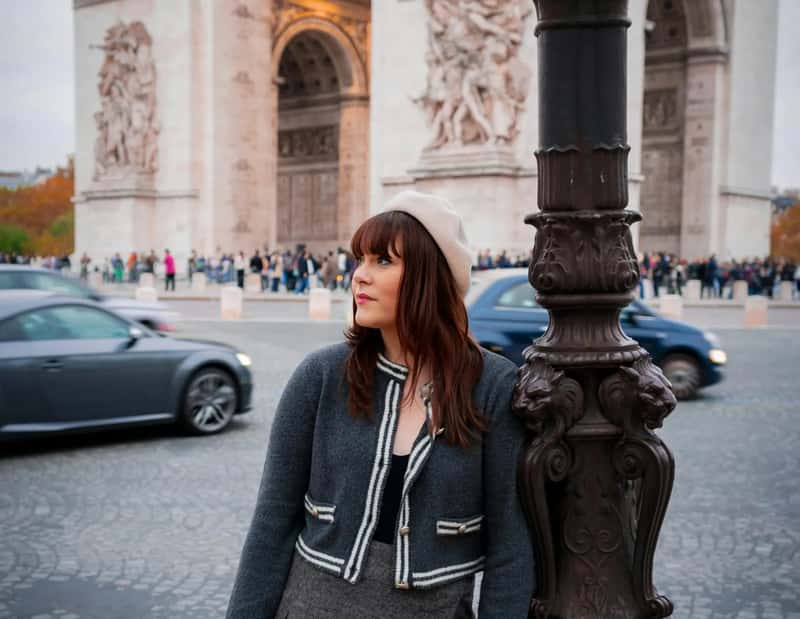
You land. You wheel your suitcase through Charles de Gaulle. And somewhere between passport control and the RER train, a quiet lie surfaces: I should have someone to share this with.
That thought isn’t longing. It’s conditioning.
During solo travel, we are free from all kinds of expectations. The self is relational – formed by our relations with others. Who we are is not only who we decide we are, but how others formulate that conception. Strip away the audience and suddenly the performance has no stage. Paris doesn’t care about your performance. It never did.
The arrival lie tells you that experience requires a witness to be valid.
It doesn’t.
The light over the Seine at dusk is real whether you photograph it for someone else or simply let it land on your face and stay there. Travelling alone encourages mindfulness and mental clarity, as you’re often more attuned to your surroundings without the distraction of conversation or companionship.
The lie fades. Give it an hour. Maybe two. Let Paris do its cold, beautiful work.
2. The Temporary Identity
Every city you visit hands you a new mask. Paris hands you something heavier – a mirror.
This form of independent travel strips away the daily roles you play at home – employee, partner, parent – allowing your core identity space to breathe and be re-examined.
That’s unsettling at first. It should be.
We become so fluent in our assigned roles that we mistake them for personality. The dutiful colleague. The available friend. The person who always orders what sounds least inconvenient to everyone at the table. In Paris, alone, nobody needs you to be any of those things.
When travelling solo, travellers remove themselves from the continual negotiation that is often difficult with group dynamics. They have control of the decisions and actions – what to eat, what to do, when to have a break. Having this control removes perceived obligation and makes preferences resurface that might have become obscured by social obligation.
The temporary identity is the one you borrow from other people’s expectations. Set it down at the baggage carousel. You can always pick it back up when you land home.
But maybe you won’t want to.
3. The Silence That Teaches
There is a specific kind of quiet that exists inside a Parisian bookshop on a Tuesday morning when it’s raining. You are not expected to say anything. You are not expected to be anywhere.
This silence is not empty. It is instructive.
Solo travel extracts you from a world of expectations and comparisons, letting the negative internal dialogue fall silent. In the silence, the process of self-discovery has space to take place.
Most of us are terrified of that silence. We fill it with podcasts and texts and the low hum of someone else’s presence. Because silence asks questions we aren’t sure we want to answer.
What do I actually want?
What have I been avoiding?
Who am I when no one is watching?
As you travel solo, you can see how you operate when no one is looking. You have more time to look at the intentions behind your thoughts, words, and actions. Because you are outside of your normal life, you can see these intentions, assess them, and tweak them to create the life that you want.
The silence doesn’t punish. It reveals. Learn to receive it.
4. The Exit Strategy
Here’s a dark truth about modern travel: many of us use it as an exit strategy from ourselves, not a journey toward ourselves.
We book the flight to outrun the job, the relationship, the version of ourselves we’ve grown tired of. We think geography is the antidote to psychology.
It isn’t.
Solo travel’s psychological value lies not in escaping life but in engaging more fully with it – confronting challenges, embracing uncertainty, connecting across differences, and discovering one’s capabilities and values.
Paris doesn’t let you escape yourself. It simply changes the lighting under which you see yourself. The cobblestones, the grey skies, the formidable politeness of Parisians who owe you nothing – all of it becomes a kind of pressure that squeezes out what’s authentic and what’s theatre.
Solo travel across unfamiliar cultural contexts can create the psychological conditions for listening to an inner voice rather than external expectation.
The exit strategy fails. And that failure is the beginning of something real.
Don’t board the flight running from yourself. Board it running toward yourself. The destination is the same. The arrival is entirely different.
5. The Tuesday in the Marais
I need to tell you about a Tuesday.
It was my fourth day alone in Paris. No agenda. I wandered into the Marais district at 10 AM with no map open, no plans made, no one to compromise with. I sat in a small gallery for forty minutes looking at a painting I couldn’t name. A woman beside me was crying quietly. We did not speak. We did not need to. The painting held us both.
I left and had coffee at a corner table facing the street. I watched people. I did not perform watching people for an audience. I simply watched. And then a thought arrived – calm and clean and utterly unannounced:
I am enough company for myself.
This is what the research eventually catches up to confirming. Solo travelers typically experience chosen solitude interspersed with social interactions, creating a self-directed balance that differs fundamentally from chronic loneliness. Studies indicate that solo travelers report high life satisfaction and low loneliness despite extended alone time.
The Tuesday in the Marais didn’t give me a revelation. It gave me something quieter and more durable: recognition. I recognized myself, perhaps for the first time in years, without the noise of other people’s perceptions layered over the signal.
6. The Fear of Being Seen Alone
Let’s talk about the table for one.
In certain restaurants in certain cities, it is still a loaded image – the solo diner, slightly too still, reading a book or staring at a phone. We project onto that person. We assume sadness. We assume failure. We assume they are waiting for someone who is never going to arrive.
Going solo in a paired-up culture may lead to some self-critical judgments that feel painful – like the time one traveler presented themselves solo for dinner in a Paris restaurant and the maître d would not seat them without a companion.
The fear of being seen alone is not really about being alone. It’s about being perceived as someone who has failed at belonging.
But belonging is an inside job.
While we often view happiness as a shared experience, solo travel is a powerful psychological tool for self-care. It isn’t about loneliness; it’s about prioritizing your relationship with yourself.
Order the wine. Take the table by the window. Sit with your own presence long enough to realize it doesn’t need to be supplemented. Eventually, the fear stops sitting across from you. And you stop saving it a seat.
7. The Social Media Ghost
There is a version of your trip that lives only on your phone screen. The curated one. The golden-hour one. The one where you are always mid-laugh, always mid-discovery, always mid-becoming.
That version is a ghost.
Consciously limiting social media scrolling is crucial. Comparing your real, raw journey to others’ curated highlights can distort your experience and trigger feelings of inadequacy.
The ghost doesn’t eat cold crêpes at 7 PM because you got lost. It doesn’t sit on a bench near Notre-Dame and cry for no reason you can articulate – or for every reason you can. It doesn’t have blisters or jet lag or the low-grade disorientation that comes from existing in a language that isn’t yours.
The ghost performs. You live.
Social media plays a multifaceted role in shaping solo travel experiences, serving as a tool for information gathering and memory preservation. However, an emerging trend of minimal social media use reflects a desire among some travelers for greater mindfulness and immersion in the present moment.
Put the phone in your pocket. Let Paris be real and unfiltered and yours alone. The memories that form without an audience are often the ones that last longest.
8. The Loneliness That Lies
Loneliness will visit. Don’t pretend otherwise. It usually arrives around day three, when the novelty has worn off and the novelty of novelty has worn off too. It sits with you at dinner. It follows you through a museum. It makes the hotel room feel very large and very still.
But here is what loneliness doesn’t tell you: it’s lying about what it means.
Loneliness is a signal, not a sentence. It might be prompting you to reach out to someone new, or it might be inviting you to sit deeper with yourself. Learning to distinguish between the two is a critical piece of emotional intelligence gained from the solo travel experience.
Loneliness happens when our relationship to ourselves is incomplete – when we’re not our own best friend, when we talk in negatives to ourselves instead of appreciatively, and when we don’t listen carefully to the quietness inside us. Thinking of being alone as lonely is very different from perceiving it as solitude.
The loneliness that visits Paris is not the same as the loneliness that lives in your apartment while you’re surrounded by people who don’t quite see you. Learn to tell them apart. One is geography. The other is identity.
9. The Return to Yourself
Somewhere during the week – maybe on a bridge, maybe in a garden, maybe in the middle of a sentence you were saying only to yourself – something shifts. A quiet internal seismic event. Small enough to miss. Too significant to forget.
Solo travel allows you to honour your inner voice, listen to the desires you have long muted, and discover that home is not a fixed physical place. Home is the moment you return to yourself – the groundedness you can carry within you, even in the most foreign place.
This is the return to yourself. Not a dramatic conversion. Not a revelation on a mountaintop. Just a quiet, bone-deep recognition that you have been here all along – patient, waiting, slightly obscured by the accumulated weight of other people’s versions of you.
Perhaps the most profound realization that many solo travelers experience is the fact that the inner strength and self-reliance they develop in the course of their travels stays with them once they return home.
Paris doesn’t make you new. It makes you visible – to yourself, which is the only audience that was ever required.
The return to yourself is not a destination. It’s a practice. And solo travel is one of its sharpest teachers.
10. Your Own Safest Harbor
Here is the hardest and most necessary thing.
We spend our entire lives searching for safe harbors in other people. We look for them in partners, in friendships, in families, in the reflexive warmth of being known. And those harbors are real and valuable and worth protecting. But they are not the only harbor available to you.
You are a harbor.
You have always been.
The philosophy of solo travel hinges on the simple, yet profound truth that all true growth happens from within. When one travels alone – into fear, isolation, and uncertainty – the traveler is able to trust themselves and the abilities that exist. They become more resilient, self-sufficient, and closer in harmony with their personal identity.
To be your own safest harbor is not a self-help platitude. It is a muscular, daily practice. It means making decisions from your own center of gravity rather than the gravitational pull of other people’s comfort. It means sitting with your own silence long enough to hear what you actually think. The stark line between solitude and loneliness is drawn by agency and intention. Solitude is an embrace, a decision; loneliness is an unwanted visitor.
I spent seven days alone in Paris. I ate at tables for one. I walked without direction. I sat in rain and didn’t take a photograph of it. I cried once – on a bench near the Luxembourg Gardens – and couldn’t tell you exactly why, except that it felt clean, like something releasing its grip.
I didn’t miss out on anything.
I was entirely, radically, quietly present – for myself.
And that was the whole point.
There is a version of you that exists only when no one else is in the room. When the performance is suspended. When the identity you wear for other people’s benefit hangs quietly in the wardrobe and you stand in the light of a foreign city with nothing but your own heartbeat for company. That version of you is not a diminished version. It is not the default, residual, leftover version. It is the original.
When you venture out alone, you’re thrust into an environment that challenges your sense of self and encourages introspection. This process of self-exploration often leads to a deeper understanding of personal values, beliefs, and aspirations. But it requires something most of us have been culturally trained to avoid: the willingness to be alone with ourselves without immediately reaching for a distraction. Paris rewards that willingness. It also punishes the avoidance of it.
You don’t need to go to Paris to find what I found on that Tuesday in the Marais, or on that bench in the rain, or in that gallery in front of a painting whose name I still don’t know. The geography was incidental. The interiority was the destination. You can board a train to the far edge of Europe, or you can simply sit in your kitchen at 6 AM before anyone else wakes up and offer yourself the same quality of attention you so readily give to everyone else. The harbor is not in Paris. The harbor has always been in you. You just needed the silence to hear it.
Learn to be your own safest harbor – not because no one else will hold you, but because you were always the one person guaranteed to stay.