The common room is empty. You paid for this. You still hesitate at the door.
You scan the kitchen like you’re entering someone else’s home. You wait. You calculate.
Nobody told you to wait. Nobody is watching. The voice doing that is very old.
It was installed long before this hostel. Long before the backpack. Long before the passport stamped with all the places you’ve run to.
There is a particular kind of traveler who moves through the world feeling fundamentally illegitimate – not lost, not confused, but quietly convinced that their presence requires justification. They perform confidence in foreign cities, navigate bus terminals in languages they don’t speak, leap from cliffs into turquoise water for the photograph. But put them in a shared kitchen at 9 PM and they freeze. They apologize for breathing. They eat standing up near the sink, just in case. This is the Identity Gap: the space between who you’ve convinced the world you are, and who you still are when the room gets quiet.
1. The Original Room
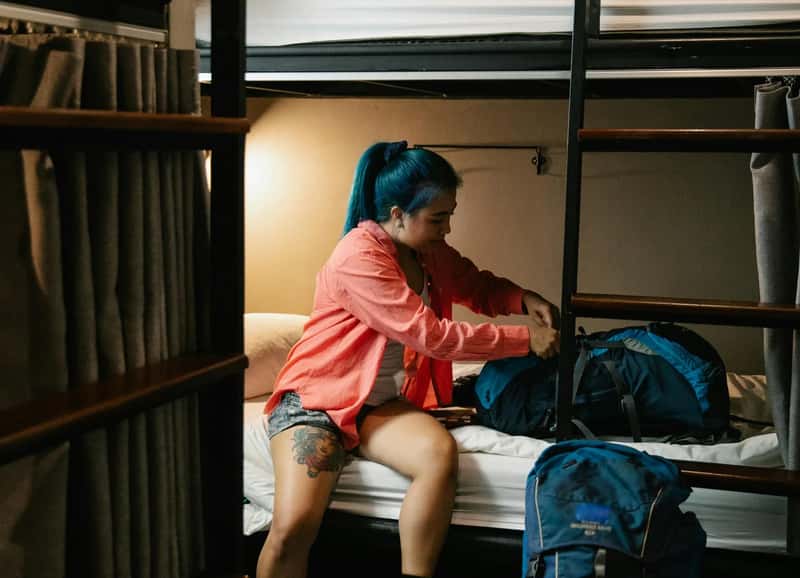
Before the hostel, there was a house. And in that house, you learned the rules.
Not the written rules. The other ones.
Don’t take up too much space. Don’t need too much. Don’t be loud when the air in the room is already heavy with someone else’s mood.
Self-worth begins in childhood. How your parents or caregivers treated you became the template for your self-worth. Not a lesson. A blueprint. One that gets laid beneath the floor of every room you’ll ever walk into.
If your parents were attentive and comforting, you probably learned that you matter. However, if your parents were absent, inattentive, inconsistent, or harsh, you learned that others couldn’t be trusted, that your needs don’t matter, and that you don’t deserve to be cared for and loved.
That is not a belief. That is a nervous system.
And nervous systems do not check out at borders. They travel with you. In the bottom of the bag, beneath the currency you don’t yet know how to read.
2. The Fawn Print
You’ve heard of fight. You’ve heard of flight. You’ve heard of freeze.
There is a fourth response. It is quieter. It looks, from the outside, like kindness.
Coined by therapist Pete Walker, the fawn response refers to a trauma-driven pattern of people-pleasing behaviors designed to diffuse danger when the brain senses threat, especially social or relational threat.
It is the person who apologizes for ordering coffee. Who says “sorry” when someone bumps into them. Who, in a hostel common area, orbits the room’s edges rather than claiming a seat at the table that is, technically, theirs.
The fawn response was first proposed by therapist Pete Walker, who described it as follows: “Fawn types seek safety by merging with the wishes, needs, and demands of others. They act as if they unconsciously believe that the price of admission to any relationship is the forfeiture of all their needs, rights, preferences, and boundaries.”
Read that again. Slowly.
The price of admission. To any relationship. To any room.
Even the ones you booked and paid for.
3. The Childhood Training Ground
Here is what happened. Specifically. In the body of a child.
The home was unpredictable. The caregiver was volatile, or distant, or simply gone in the way that people can be gone while standing right in front of you.
When caregivers are unpredictable, emotionally volatile, or narcissistic, children quickly learn to read the room. A child who can sense a parent’s shifting mood and adjust their behavior accordingly avoids conflict, criticism, or worse.
That child became an expert. A specialist in the micro-detection of danger.
The child is constantly scanning the environment for perceived danger. They become acutely aware of subtle changes in how the abuser is acting. It might be a change in the tone of voice or a hand gesture.
That scanning didn’t stop when childhood ended.
It just migrated. To hostels. To offices. To dinner tables in countries you’ve never been to before.
You are still reading the room. You have always been reading the room. You just forgot you learned it under duress.
4. The Permanent Alert
The technical term is hypervigilance. But what it feels like is this: the inability to simply exist anywhere without running a threat assessment first.
Hypervigilance is a persistent state of heightened alertness where an individual is constantly scanning their environment for potential threats. This trauma-related hyper-awareness often stems from the brain’s attempt to protect itself after experiencing a threatening or unsafe situation.
In the hostel kitchen, it looks like this: You check if anyone is already at the stove before you go in. You time your movements to avoid overlap. You wait until the room clears before you make your tea.
Children who grow up in environments where they must constantly be on guard may carry these learned behaviors into adulthood. These experiences can result in a heightened sensitivity to perceived threats, even when the person is no longer in an unsafe environment.
The hostel common room is safe. Your body does not know that yet.
Your body is still in the house.
5. The Internalized Verdict
I remember standing in the kitchen of a hostel in Lisbon. It was 7 AM. The light was the color of weak tea. I had woken up early specifically to have the kitchen to myself, so I wouldn’t have to navigate the social choreography of existing alongside strangers.
Someone else came in. A German man, large and unbothered, filling a pot with water, not thinking once about whether he was allowed to be there.
I watched him and felt something I could only later name as grief.
That ease. I had never once inhabited it. Not in a kitchen. Not in a room. Not in my own life.
Young children don’t understand that being abused or neglected isn’t their fault. Children who’ve experienced trauma tend to grow up thinking they caused the abuse or neglect because they were bad, difficult, needy, stupid, ugly, or defective.
That verdict – that your presence is the problem – does not dissolve when you buy a one-way ticket. It gets a window seat.
6. The Conditional Love Architecture
Some childhoods teach you that love is unconditional. That your presence is welcome. That you do not have to earn your right to sit at the table.
Other childhoods teach you the opposite.
When the real self and the ideal self align, individuals experience psychological well-being. However, a significant gap between them, often reinforced by conditional love or societal pressures, can lead to incongruence, resulting in self-doubt and low self-esteem.
Conditional love is an architecture. You build your whole personality around its load-bearing walls. You become who you had to be to keep the peace, to earn the warmth, to not be too much.
If your parents or caregivers didn’t feel good about themselves, they couldn’t teach you to feel good about yourself. Instead, they may have taught you to be ashamed of who you are and what you do; they may have encouraged perfectionism and used harsh punishments to control you.
And now you travel. Carrying that architecture in your chest. Wondering why every new place feels simultaneously like freedom and like a room you haven’t been invited into yet.
7. The Permission Loop
There is a very specific loop that runs in the mind of someone who grew up feeling like a burden.
It goes: Is it okay if I’m here? Am I taking up too much space? Should I wait? Should I ask?
Early experiences may result in unhealthy patterns of behavior, such as people-pleasing, overcompensation, or emotional withdrawal. Adults who struggle with low self-esteem due to past wounds often find it difficult to set healthy boundaries, speak up for themselves, or recognize their own worth.
In a hostel, this loop is activated by the most ordinary things.
The shared television. The communal bathroom. The couch by the window. The coffee machine that belongs to everyone, which means, to a nervous system trained in scarcity of welcome, that it possibly belongs to you least of all.
Needs can feel illegitimate. You might believe you should handle stress alone. You might wait until you are overwhelmed before you ask for help.
You are not asking for permission to use the kettle. You are asking for permission to exist.
Those are not the same question. But they feel identical when you are still inside the original wound.
8. The Travel Escape That Isn’t Quite
Here is the honest thing about long-term travel that nobody posts on their Instagram grid.
You can go everywhere. You can become fluent in the art of departure. You can collect passport stamps like evidence that you are free.
And still arrive in every new city as the same person who hesitated at the kitchen door.
Childhood trauma can have a profound and lasting impact on an individual’s mental health well into adulthood. The effects of childhood adversity can shape a person’s life trajectory significantly. Traumatic events experienced during those formative years can leave deep emotional scars that continue to influence thoughts, feelings, and behaviors long after the trauma has ended.
Travel is extraordinary medicine. But it is not a surgeon.
It can show you the wound. It cannot remove it. What it can do – if you’re paying attention – is show you the exact shape of the thing you’re carrying, because foreign environments strip away the familiar habits that usually hide it.
The hostel common room does this brilliantly. It holds up a mirror. It asks: Do you believe you are allowed to be here?
9. The Body That Remembers
Your mind may have accepted that you are an adult. That you are independent. That no one in this hostel has any power over you.
Your body is slower to update.
Repeated interactions can reshape neural pathways. The amygdala, responsible for detecting threats, becomes hypervigilant, perceiving any potential conflict as a danger to emotional safety. Meanwhile, the prefrontal cortex, which governs rational thought and self-regulation, may become less active in moments of stress, leading to instinctive, people-pleasing behaviors. Over time, the brain learns to equate “keeping the peace” with survival, reinforcing patterns of fawning.
This is why logic doesn’t fix it. You can know, intellectually, that the common room is yours. You can recite every rational argument for why you have as much right to sit on that couch as anyone else.
Your nervous system will still whisper: But are you sure?
Traumatic experiences in childhood were associated with emotional regulation difficulties in adults. The emotional regulation difficulty, in this case, is not rage or despair. It’s the quiet, constant effort of managing your own existence in shared spaces.
That effort is exhausting. And invisible. And mistaken, by almost everyone including yourself, for introversion.
10. The Weight and What It Costs
Here is the heaviest truth of this entire thing.
The permission-seeking is not just a social anxiety quirk. It is not just shyness. It is not a personality type you were born with and should simply accommodate.
It is the residue of a time when your presence – your actual, physical, needing, wanting, breathing presence – genuinely did cause a problem for someone who was supposed to love you unconditionally.
Rooted in complex trauma, the fawn response emerges when a person internalizes that safety, love, or even survival depends on appeasing others, especially those who hold power over them.
That internalization cost you something enormous.
It cost you the casual confidence of simply being somewhere. The German man at the stove in Lisbon had it. You watched it and recognized it as something that had been taken from you before you had the language to name the theft.
Understanding where this pattern came from can help you recognize that you weren’t born a people-pleaser. You learned to become one because, at some point, it kept you safe.
And here is what that costs, compounded over years of travel, over years of hesitating at every threshold: it costs you the experience of actually being where you are.
You are in Lisbon. You are in Bangkok. You are in a 12-bed dorm in a city that smells like rain and diesel and something frying in the alley below. And you are spending a portion of every moment there calculating your right to occupy the space. Running the old threat assessment on a room that contains no threat. Apologizing to strangers who weren’t waiting for your apology.
In a world that often rewards performance over authenticity, the act of unlearning fawning becomes a radical return to self. It is not a dramatic return. It is not a breakthrough in a therapy session or a revelation on a mountaintop. Most of the time, it looks like this: standing at the door of the hostel kitchen, noticing the hesitation, recognizing it as ancient and not situational, and walking through anyway. Not because you’ve healed. Not because the weight is gone. But because you are beginning, finally, to suspect that the room was always yours – that the door was never locked, that the lock was always inside you, and that it was put there by hands that had no right to hold the key.
The kettle is already boiling. Someone left it for the next person.
That person is you.
It has always been you.