It’s 9 AM.
Checkout is at 11.
You’ve already stripped the bed, wiped the counters, and reorganized the throw pillows into their original configuration.
You paid a cleaning fee. You know this. You paid it, confirmed it, and watched it appear on the receipt. And yet here you are – on your knees, scrubbing a stovetop in a stranger’s kitchen, erasing every trace that a human being with a body, a hunger, and a history ever passed through.
This is the distance between the person you invoice and the person you actually are when nobody is watching. The gap between the traveler who books confidently and the one who checks the bathroom mirror one final time – not for lipstick, but for evidence. Evidence that you were here. Evidence you’re now busy destroying.
1. The Rented Self
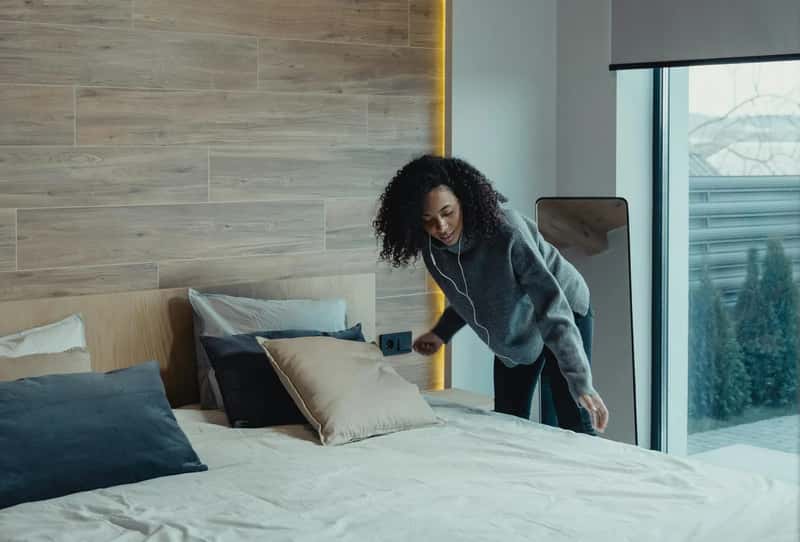
There’s something particular about the Airbnb as a psychological arena.
It is not a hotel. It never pretended to be.
A hotel is transactional, clean, indifferent. An Airbnb is someone’s home – someone’s couch cushions, someone’s curated art, someone’s specific brand of olive oil left half-full on the counter. You are a guest in the most intimate anthropological sense. And for some of us, that word – guest – carries a freight of obligation that no cleaning fee can offset.
The rented self is the version of you that believes you must earn your right to exist in any space you didn’t build yourself. Every detail of a temporary space reminds you that you are a passenger inside someone else’s carefully engineered system. And the passenger, historically, is taught to leave no footprint.
You are not being polite. You are being prosecutorial – gathering and destroying evidence of your own existence.
2. The Childhood Blueprint
The scrubbing started long before this Airbnb.
It started in a kitchen that wasn’t yours to mess up. In a house where the unspoken rule was: shrink, smooth, cause no disturbance.
Chronic apologizing – and its physical cousin, chronic over-cleaning – is often the manifestation of deeper emotional or psychological pain shaped by early life experiences, family upbringing, or environment. If you grew up in a household full of noise, conflict, and chaos, or felt unsafe, you can develop a deeply ingrained need to avoid these triggers at all costs.
The stovetop you’re scrubbing is a palimpsest.
Underneath this one is every surface you were afraid to leave dirty as a child.
In clinical practice, excessive apologizing is seen more often in trauma survivors whose abuse started young, was prolonged, and whose perpetrator was within the family. As a survival mechanism, they learned to make themselves small and cause as few problems as possible.
You were good at that. Disturbingly good.
3. The Fawn in the Foyer
Let’s name the mechanism.
It has a clinical name. It is not weakness. It is, in fact, a form of intelligence – intelligence born under duress.
The fawn response is a survival strategy where a person instinctively appeases, placates, or people pleases in response to a perceived threat. Instead of fighting back or running away, the nervous system decides: make them happy and you’ll be okay.
The Airbnb host is not a threat. You know this logically. But your nervous system didn’t get the memo. It sees a rating system – a five-star tribunal – and it activates the old protocol.
The fawn response is most commonly associated with people who experienced childhood trauma, particularly emotional neglect, unpredictable caregivers, or environments where love felt conditional. In simple terms: if you learned early on that keeping other people happy kept you safe, your nervous system built an entire operating system around that strategy.
You are not cleaning a kitchen. You are regulating a nervous system that hasn’t updated its threat assessment in years.
4. The Low-Maintenance Mythology
You probably wear it like a badge.
“I’m low-maintenance.” The phrase falls out of your mouth easily, cheerfully, pre-emptively.
But interrogate it. Who taught you to value that? Who benefited most from your smallness?
Fawning behavior frequently involves traits like perfectionism, as individuals strive to meet others’ expectations. People who fawn often see themselves as low-maintenance and easy to get along with, which reinforces their people-pleasing tendencies. These behaviors can stem from childhood experiences in abusive or neglectful environments, where children learned to prioritize caregivers’ emotional needs over their own.
Because fawning looks so socially acceptable, most people don’t recognize it in themselves for a long time. Sometimes decades. It gets mistaken for kindness, flexibility, or being low maintenance.
The low-maintenance identity is not a personality trait. It is a survival costume worn so long you forgot it was ever a costume at all.
5. The Guilt That Travels With You
I want to be honest here.
I have stood in more than one Airbnb bathroom, re-folding towels I already folded, telling myself it was just consideration. Just good manners. Just the right thing to do. I made the bed with hospital corners on the day I was leaving – not arriving. I wiped a mirror that was clean when I got there. I stood in the doorway doing a final scan like a detective at a crime scene, except I was the crime.
That’s the tell. The guilt that travels. The guilt that books flights, checks in, unpacks, and still cannot settle – because settling feels like an imposition.
Over-apologizing – and the compulsive behaviors that accompany it – is when “sorry” becomes a placeholder for emotions we’ve never had the space or safety to express. These emotions may include uncertainty, the fear of being judged, or the sense that we’re taking up more space than we’re “allowed.”
Allowed. That word.
Who issued your permit for existing, and when did you start believing they could revoke it?
6. The Five-Star Tribunal
The Airbnb review system is a masterpiece of ambient anxiety for the guilt-prone traveler.
It is a mutual rating platform. Symmetrical, technically. But not psychologically – not for you. You are not worried about the host’s behavior. You are worried about your own.
When someone has low self-esteem, they may feel they’re taking up too much space, asking too much, or being disruptive. In this case, they often apologize profusely as they feel they aren’t worthy of time, space, or attention.
The review becomes a verdict. Not on the property. On you.
On whether you were, as you always feared, too much. Too messy. Too needy. Too human.
Psychologists define excessive apologizing as a form of self-erasure. It’s often rooted in a fear of being perceived as difficult, selfish, or “too much.” But in reality, it signals low confidence and undermines your own authority.
The mop is not cleaning the floor. The mop is managing the verdict.
7. The Disappearing Act
Here is the paradox of the Airbnb deep-clean.
You want to disappear, yet you are the most present you’ve been all trip.
The act of unpacking and rearranging is the nervous system’s way of trying to collapse the timeline – to achieve belonging through the placement of objects, since it cannot achieve it through time and memory. The reverse – the re-packing, the erasing, the undoing – is the nervous system performing its own disappearance trick. A magic act rehearsed since childhood.
Many people – especially those raised in environments where they had to manage others’ emotions or avoid conflict to feel safe – develop the habit of shrinking themselves through apology. It’s not just about saying “sorry.” It’s about asking for permission to exist.
The checkout clean is a permission slip you’re writing for yourself, addressed to a host who will never read it, for a debt you never actually owed.
You are leaving the scene of a life well-lived.
The scene didn’t need cleaning. It needed witnessing.
8. The Identity That Moves
Travel reveals you, but not always in the romantic way the guidebooks promise.
Sometimes it reveals the architecture of your anxiety.
The traveler who is perpetually low-maintenance, perpetually grateful, perpetually trying not to be a bother – they carry the most luggage. None of it is checked. All of it is internal.
When fawning becomes your default, it can affect your identity. Your preferences start to feel optional. Your opinions become flexible. Your voice may only appear when you’re alone – and even then it can feel faint.
The temporary space of an Airbnb strips away the familiar props of your home identity. You are left with only you – your habits, your compulsions, the things you do when you think nobody is assigning meaning to them.
Turns out you are always assigning meaning to them.
The identity that moves is the only identity that can be truly interrogated.
9. The Currency of Smallness
There is a transactional logic buried in all of this.
If I stay small, I will be liked. If I am liked, I will be safe. If I am safe, I can afford to exist a little longer in this borrowed space.
Taking responsibility and blaming ourselves can sometimes be seen as a way to regain control. This is known as the “fawn response,” which pushes us to appease, soothe, and avoid conflict at all costs. In these situations, apologies become the currency that keeps us safe.
The cleaning is a payment.
But the debt isn’t real.
Sometimes, people who over-apologize feel guilty about factors that aren’t in their control. This is sometimes referred to as false guilt – the kind of guilt that is passed down through outside influences in our lives, like parents and family members.
You inherited this debt. You didn’t incur it.
The checkout clean is you paying a bill that arrived before you were old enough to question the invoice.
10. The Space You Were Always Allowed to Take
Here is the heaviest truth in the room you just cleaned.
You were allowed to be here.
You were allowed to make coffee and leave a ring on the counter. To push the couch two inches to the left for better morning light. To use every pillow on the bed and leave three of them on the floor by midnight. To exist in a space with the full, unedited weight of a human being who sleeps, eats, thinks, and takes up room.
Fawning is not about being nice – it’s about being safe. Survivors may feel discomfort when praised for being “so easy to work with” or “always willing to help,” because somewhere inside, they know the behavior isn’t truly a choice.
The fawn trauma response develops when being agreeable and useful was literally your best option for managing an unpredictable or threatening environment. Maybe you grew up with a volatile parent and learned that anticipating their mood and meeting their needs kept you safer. Maybe you experienced early relationships where having needs led to rejection or punishment. Maybe you were in environments where being low-maintenance and high-performing was the only way to get positive attention.
Work on the fawn response is not about becoming harder, colder, or less caring. It is about staying connected to your kindness without using it to disappear.
That is the destination nobody books a flight to. The one that requires no packing. The one where you arrive already knowing you are allowed to be there.
The mop goes back in the closet. The surfaces gleam with the particular brightness of erasure. You do one last sweep of the room – not for forgotten chargers, but for the ghost of yourself you are leaving behind. Tidier than when you found it. Quieter than when you found it. A room that looks, to the untrained eye, like nobody came at all.
But someone came. Someone with a complicated history and a checkout compulsion and a heart that is genuinely trying to figure out when “considerate” became “compulsive.” Someone who spent two days in a borrowed city, in a borrowed apartment, learning the borrowed grammar of a life that almost felt like their own. That someone existed here. They ate here. They dreamed in this bed with full, raucous, unbothered sleep. They took up space.
The question that rides home with you, lodged between the window seat and your carryon, is not whether the host will leave five stars. It is quieter than that. It is whether you can learn – not all at once, not perfectly, but incrementally, achingly, bravely – to stop filing for permission to occupy the rooms you have already paid for, in buildings, in cities, and in the wider, more permanent architecture of your own life.