The cab smells like old coffee and freeway rain.
You don’t recognize the skyline yet.
You are already comparing.
There is a version of you that travels well – passport stamped, eyes forward, chronically unbothered. Then there is the version that stands on a foreign corner at dusk and whispers, quietly, almost guiltily: This isn’t as good as home. Or worse: This reminds me of nothing.
That gap – between the person you perform when you move through the world and the person quietly auditing every new street against an internal blueprint – is the Identity Gap. It is the distance between the traveler you project and the child still inside you, measuring safety in inches of familiarity.
1. The Incomplete Map
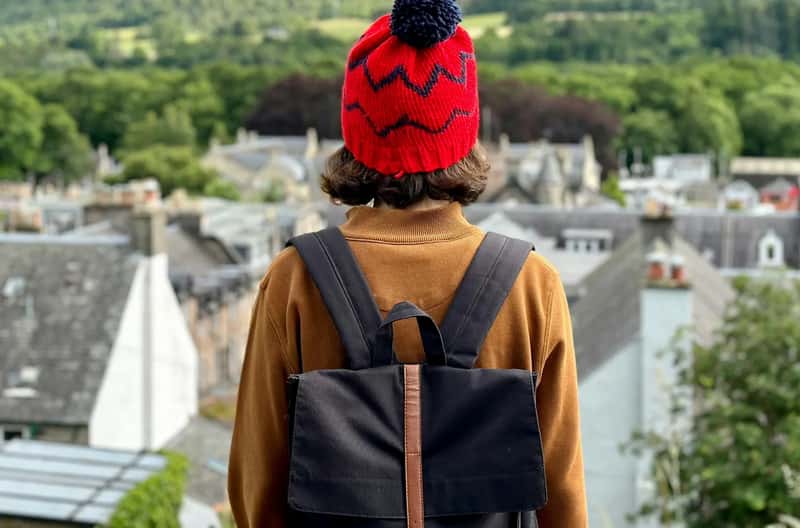
Research consistently shows that people feel more comfortable and less stressed in environments that resemble the landscapes of their childhood. The brain doesn’t wander randomly when you arrive somewhere new. It runs a search.
It is looking for the map it was given early.
But what if that map was incomplete? What if childhood felt more like a series of exits than a home base – a place defined by what was missing rather than what was there?
The brain compensates. Every new city becomes a test. You walk the streets the way a detective works a crime scene – looking for clues that something, somewhere, finally adds up.
Place identity occurs when a physical environment becomes part of a person’s self-concept – when someone describes themselves as a “Kolkata person” or a “mountain person,” the landscape has merged with their sense of who they are. When no place was ever allowed to merge like that, the search never ends.
You are not being critical of every city you visit. You are cartographing the self. Quietly. Obsessively. Without meaning to.
2. The Sensory Debt
Smell it first. You always smell it first.
The bread from a corner bakery. The diesel exhaust off the morning boulevard. The specific, undefinable green of a park that catches light the way a childhood park once did.
Our senses act as anchors when navigating new environments, and familiar sensory details often explain why certain places feel like home. The smell of bread from a bakery, the sound of laughter in a marketplace, or the sight of tree-lined streets can awaken memories from your past. These cues trigger associations with comfort, creating an emotional bridge between where you are and where you’ve been.
This is not nostalgia in the sentimental sense. This is the brain running biological debt collection.
When comfort was inconsistent in childhood, the sensory impressions that coincided with safety become sacred. They get locked in. They become the standard against which every new place is silently, mercilessly measured.
You aren’t chasing a city. You are chasing a feeling that briefly existed before everything got complicated.
3. The Security Protocol
Your nervous system is older than your ambitions.
Another reason to prefer the familiar has to do with our evolved psychology. Our minds are designed, among other things, to keep us safe from potential environmental threats. Generally, a place, a person, or a food we’ve encountered repeatedly without being harmed should be preferred compared to new ones whose potential to help or hurt us is unknown.
This is the security protocol running quietly beneath your wanderlust. It is ancient. It does not care about your itinerary.
For people who lacked predictable safety in childhood – where the environment at home was volatile, emotionally unpredictable, or simply cold – the nervous system never received a clear signal of what “safe” looked like.
So it searches. Every neighborhood assessed. Every noise catalogued. Every street corner quietly ranked. You are not paranoid. You are compensating for a system that never received its baseline calibration.
The comparisons you make are not aesthetic judgments. They are survival logic, dressed up in the language of preference.
4. The Ghost Architecture
There are buildings you have never entered that feel like home. There are streets you have never walked that feel like grief.
Memory often influences feelings of comfort more than we realize. A café that resembles a childhood haunt or a park that mirrors the landscape of your hometown can evoke emotions tied to the past.
This is ghost architecture – the phantom structure of a home you either had and lost, or never had and quietly invented.
The brain builds composite memories. It takes the warmest fragments of every place it has ever known and assembles a ghost version of ideal safety. That ghost home then becomes the silent benchmark.
Sensory familiarity does not require exact matches. A café in Lisbon might remind you of afternoons in your grandmother’s kitchen, while a bustling square in Marrakesh might echo childhood fairs.
You walk into a new city and see the ghost first. The real city comes second. That is not a flaw. That is the cost of having built something beautiful out of not quite enough.
5. The Rootlessness Reflex
I remember standing in a city I had moved to for a fresh start, watching the local families eat at outdoor tables on a Saturday evening. They weren’t doing anything extraordinary. They were just there. Settled. Unquestioning about their right to belong to that particular square of concrete and lamplight.
I felt the comparison land hard: They know where they’re from.
One factor affecting our preference for familiarity is how much we’ve moved around. Compared to those who’ve moved less frequently, people higher in “residential mobility” are more likely to prefer national chains over independent businesses or regional ones. The rootless seek the familiar in franchise logos, in recognizable rhythms, in anything that signals continuity.
Displacement – whether voluntary or forced – often triggers nostalgia, grief, or a sense of rootlessness. When people relocate, their emotional bond with their previous home may actually intensify in contrast to their unfamiliar new setting.
The reflex is involuntary. The comparison is the brain’s attempt to plant a flag, however temporarily, in something solid.
6. The Attachment Audit
Every comparison you make is a form of auditing.
You are asking: Does this place meet the criteria? But the criteria were written in childhood. And if childhood attachment was insecure – unpredictable love, absent caregivers, emotional inconsistency – the criteria are impossible to meet cleanly.
Attachment is the emotional bond that forms between infant and caregiver, and it is how the helpless infant gets primary needs met. It then becomes an engine of subsequent social, emotional, and cognitive development.
Abuse and trauma in childhood may hinder the development of secure attachment and may be predictive of attachment insecurity later in life.
That insecurity doesn’t stay in the body. It maps onto place. The traveler who can never quite commit to a city, who always has one eye on the exit, who finds subtle reasons why every destination falls short – they are not picky. They are practicing the only emotional language they were taught.
The audit never reaches a final verdict. Because the verdict was never about the city.
7. The Nostalgia Rewrite
The hometown you are comparing against may not exist.
The thing that ties nostalgia’s functions together is that it is an emotional experience that unifies. One example of this is it helps to unite our sense of who we are, our self, our identity over time.
But here is the darker truth: when childhood lacked consistent warmth, nostalgia performs a quiet rewrite.
The brain selects fragments – a single good summer, one dependable smell, the particular color of a childhood kitchen wall – and inflates them into a mythology of home. The mythology becomes the standard. Every new city is then measured against a place that, in its full reality, was far more complicated.
Nostalgia is like a tuning fork – a musical resonator that, when struck, produces a perfect tone to which one’s life can be tuned. All other undertones and overtones, false notes and high notes of our lives die out for a moment, and in that moment, it is pure you.
You are not comparing cities to your hometown. You are comparing them to the edited version. The director’s cut. The one where childhood had more of what it needed.
8. The Identity Cartography
When you say, “This city doesn’t feel like me,” you are not making a geographic statement. You are making a self-definition.
“Faces and locations can have really deep meanings for us, in terms of how we think of ourselves, and who we are, and how we situate ourselves in the world.”
Place and self are not separate systems. They are co-authored. You are partly made of the streets that raised you, the sounds that surrounded your formative silence, the light quality of the neighborhood where you first understood that the world was a particular kind of place.
Affective bonds often arise from experiences that fulfil fundamental needs such as safety, comfort, and belonging. Cognition involves the schemas people build around familiar environments – this is why people describe themselves as “city people” or “small-town people.”
When that early co-authoring happened in an unstable environment, the identity map has gaps. So you keep traveling. Writing. Revising. Looking for the city that finally reads like a complete sentence.
9. The Belonging Threshold
Belonging is not arrival. It is a threshold.
Experiencing belonging – knowing where and with whom you belong – is integral to human existence. Children belong first to a family, a cultural group, a neighborhood and a wider community. When any of those layers were absent or unreliable, the threshold was never clearly marked.
So the adult traveler keeps approaching new cities with the unspoken question: Is this where I finally cross over?
Place nostalgia increases social connectedness, meaning in life, self-continuity, self-esteem, and authenticity. This is why the comparison isn’t idle. It is genuinely functional. The brain is running the belonging algorithm, trying to trigger those outcomes through geography.
Some individuals thrive in this fluidity, constructing flexible identities that draw from multiple places – they feel at home in several cities, or they locate their identity in relationships and experiences rather than geography. Others struggle with a persistent sense of displacement, especially when they leave behind places that were central to their self-concept.
The threshold is real. But it is not a city. It is a moment of internal permission you give yourself – and it cannot be found on any map.
10. The Quiet Permission
This is the heaviest one.
All nine patterns before this one – the sensory debt, the ghost architecture, the rootlessness, the attachment audit – they are all expressions of a single unresolved question that formed somewhere in childhood and has been traveling with you ever since.
The question is not Which city is best?
The question is: Am I allowed to belong somewhere?
Understanding one’s sense of belonging is a central part of identity formation and self-awareness; feeling safe somewhere, with specific people is identified as a basic human need. When that need was not safely met in the developmental years – when safety was conditional, when warmth had to be earned, when the environment said you are temporary here – the permission to belong is never fully internalized.
The strongest attachments originate during childhood. And the absence of those attachments leaves a specific kind of wound – not dramatic, not easily named, but chronic. It shows up in the comparison. In the restlessness. In the way you are always half-watching the exit, even in a place you love.
The bond with a place is not merely a preference but a psychological anchor essential for self-identity and emotional regulation. You are not comparing cities because you are ungrateful or difficult or impossible to please. You are comparing them because you are still looking for evidence that you are allowed to stay.
There is a particular kind of exhaustion that only travelers of this type know. It is not physical. It is the exhaustion of running a background process that never terminates – the constant, low-hum audit of every new street, every new kitchen window light, every new set of neighbors who seem so effortlessly rooted in the soil of wherever they are.
The work is not to stop comparing. The work is to understand what the comparing is asking for. Because underneath every “this city isn’t as good as home” is a more honest sentence: “I am still looking for the place where I first felt like I was enough.” That place may not be geographic. It may be a version of yourself you have not yet been given permission to inhabit. But the search itself – restless, relentless, conducted across time zones and taxi windows and unfamiliar morning light – is not a flaw in your wiring. It is the brain’s loyal, imperfect, tireless attempt to close a gap that opened long before you ever bought a ticket.
And maybe the city you are looking for is not a destination at all. Maybe it is the moment you stop mid-stride, on some unremarkable street in some city you forgot to compare, and notice – quietly, without fanfare – that you are already there.