You land in a new city.
You don’t know a single soul.
You find a bar, pull up a stool, and open your mouth.
But what comes out isn’t a conversation. It’s a questionnaire.
Travel, at its most honest, is about defying the monotony of routine life and seeking something authentic – and researchers note that tourists are not only searching for the “other,” but are also on a quest for self-identity. The problem is that many of us board the plane looking for ourselves, then spend the entire trip hiding from the very people who might help us find out who that is.
When you travel, especially alone, the mirrors are removed. Stripped of your usual context, your brain must generate a sense of self from within – a period of solitude and self-referential processing that allows for a re-evaluation of your personal narrative. You are no longer defined by your relationships or responsibilities, but by your immediate actions and choices. That should be liberating. For most of us, it is terrifying.
The Interrogator’s Armor
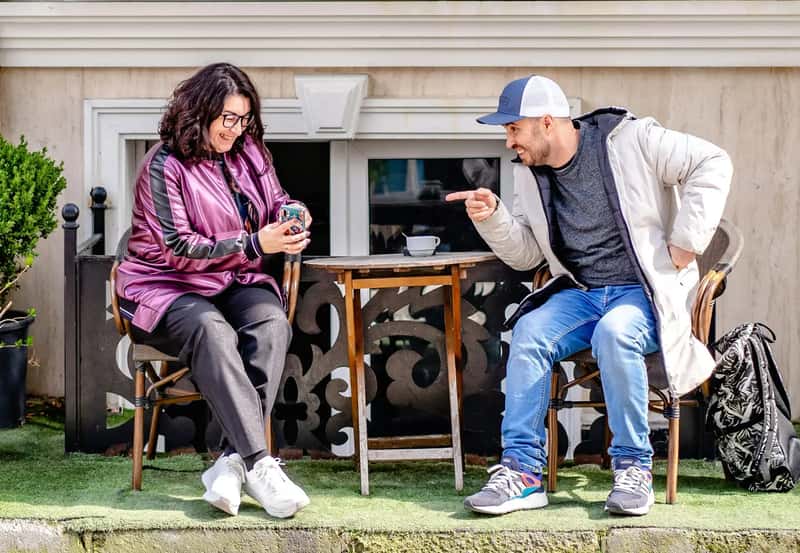
You have been in this conversation before.
You ask where they’re from. What they do. Whether they love this city or merely tolerate it.
They answer. They smile. They ask the same back.
And you pivot. You deflect. You hand them another question like a baton in a relay race you never plan to finish.
If you’re afraid of being emotionally or physically vulnerable, you may use hyper-independence as a defensive strategy to avoid letting others in – operating from the belief that as long as you don’t need anyone, you can’t be let down. The interview format is the social version of this. It is curiosity weaponized as a shield. You appear warm. You appear interested. But the arrangement is asymmetrical by design, and you engineered it that way before you even sat down.
The armor is invisible. That’s what makes it so effective.
And that’s what makes it so costly.
The Permanent Tourist
Some people never stop being a tourist, even when they live somewhere for years.
They observe. They document. They keep the local color at a studied, clinical distance.
The depth of identity alteration is often related to the nature of the travel experience. A short, insulated vacation may offer temporary novelty, but deep cultural immersion precipitates more lasting change – and this is where a distinction arises between being a tourist and a sojourner. The sojourner engages with the host culture, attempting to understand its internal logic, which can lead to significant shifts in self-concept. The Permanent Tourist never becomes the sojourner. They hover at the threshold of every culture, taking notes on the door frame, never crossing it.
The habit is this: they treat every local as a subject rather than an equal.
The local becomes a character in the traveler’s story, never a co-author.
The conversation becomes research. And the researcher never has to be researched back.
It feels safe. It looks like curiosity. It is, at its core, an elegant refusal to be known.
The Curated Biography
Ask them about their work, but only mention yours in passing.
Ask them about their family, but answer questions about yours with a sentence and a redirect.
Ask them about heartbreak, then laugh yours off as ancient history.
Staying closed off is predictable. Being open means losing control over how people react to you, which feels terrifying. So the defensive traveler curates. They construct a biography that is technically true but architecturally impenetrable. The apartment tour where every door that might reveal something real is locked.
The curated biography is smooth. Interesting, even.
It has good stories, sharp wit, and the occasional calculated admission of a “minor flaw” – something charming, nothing real.
The real costs are buried deeper. The grief. The doubt. The years you spent in the wrong city doing the wrong thing for the wrong person.
Those rooms stay locked. The key goes in the overhead bin. You land without having unpacked anything.
The Exit Strategy Disguised as Freedom
Travelers love the romance of impermanence.
“I’m only here for a week.” “I leave on Thursday.” “Nothing is permanent.”
These phrases do real psychological work. They pre-emptively close every door that might require genuine follow-through.
Humans have survived and evolved partly through successfully avoiding existential harm – a survival response that can associate vulnerability with feeling existentially threatened, producing a powerful desire to escape. And being a hypersocial species, we have always been deeply fearful of rejection by our tribe or social group. The departure date is a socially acceptable form of that ancient escape hatch. You don’t have to be rejected if you’re the one who is already leaving.
It is not freedom. It is scheduled disconnection.
Real freedom would be staying. Real freedom would be saying, “I don’t know how long I’m here,” and letting that land without a plan.
Most of us can’t do it. So we book the return flight early and call it adventure.
The Notebook That Never Gets Opened
I remember a night in a small port city, a bar with three stools and a bartender who spoke just enough of my language to be dangerous.
He asked me something I wasn’t ready for. Not what I did, or where I was from. He asked what I was afraid of.
I laughed. I turned it back on him. “You first,” I said, and pulled out my metaphorical notepad.
He answered. Honestly. Completely. Without armor.
And I sat there, full notebook, empty chest, watching someone do the thing I had crossed an ocean to learn how to do.
Travel experts note that facing novelty helps us discover our own strengths and personal limits, and that engaging with new experiences reinforces the sense of “I can,” while adapting to unknown challenges stimulates new ways of thinking. But none of that works if you are taking notes on someone else’s bravery instead of practicing your own.
The notebook never gets opened. The fear stays sealed.
And you fly home having written a very thorough field report on everyone else’s interior life.
The Performance of Presence
You look like you’re there.
Phone away. Eyes forward. Nodding at all the right moments.
But presence without reciprocity is surveillance, not connection.
As profoundly social beings, we need connection with others just as we need food to survive. The disconnection goes further because being disconnected from our own experience means we can lack self-understanding and reject hearing or learning from our experience – which can leave us struggling to deal with life’s problems or knowing how to make ourselves happy. The Performance of Presence is the defensive habit of appearing engaged while remaining categorically unavailable. You are warm. You are curious. You are, in the truest sense, nowhere to be found.
The local across from you feels it.
They can’t name it, but they feel it.
Something in the conversation is lopsided. Something is being withheld. They leave feeling like they talked at a mirror that smiled back and offered nothing of its own reflection.
The Intellectual Override
When a conversation gets close to something real, the defensive traveler intellectualizes.
They pivot from feeling to analysis. From story to theory. From the personal to the anthropological.
“That’s fascinating. It reminds me of something I read about collective identity in post-industrial cultures.”
The overarching goal of vulnerability is “to stay in the room” when your brain is telling you to hide. The Intellectual Override is the brain’s most sophisticated hiding technique – because it doesn’t look like hiding. It looks like depth. It looks like engagement. It is, in fact, a trapdoor.
Every time a conversation threatens to become intimate, the intellectual override fires. A book title. A theory. A comparison to somewhere else you’ve been.
The local nods along, impressed maybe, but disconnected.
And you’ve successfully turned a moment that could have changed you into a lecture that confirmed everything you already believed.
Smart people are the best at this. They have the most elaborate trapdoors.
The Controlled Confession
This one is subtle. This one almost fools you.
The defensive traveler learns, eventually, that total silence is suspicious. So they offer a confession.
But it’s calculated. A difficulty from five years ago. A relationship that ended cleanly. A struggle that has a tidy resolution and a lesson you’ve already learned.
Talking about fears or insecurities instead of hiding them – naming the insecurity without using anger or sarcasm as a shield to dull the impact – is what genuine vulnerability actually looks like. The controlled confession uses the vocabulary of vulnerability without the risk. It is a decoy. You hand someone a small, wrapped package of apparent honesty, and while they’re opening it, you quietly move the real things further out of reach.
Real vulnerability doesn’t have a resolved ending.
It doesn’t come with a lesson that proves you’ve grown. It sits in the present tense, uncomfortable and unresolved, and trusts the other person to hold it without dropping it.
The controlled confession is the counterfeit. It spends the same as the real thing but is worth considerably less.
The Comparative Traveler
Every city this person visits is measured against every city they’ve already been.
“It’s nice, but it reminds me of Lisbon in 2019.” “The food here is good, but you should have tasted the version I had in – “
The comparative habit is a defense mechanism wearing the costume of experience.
Unlike surface-level tourism, truly immersing yourself in different cultures creates profound shifts in how you see yourself and others – when we step into another culture, we encounter different ways of thinking, different problem-solving strategies, and different values that can turn our worldview upside down. But that only happens when you let the place be itself. The comparative traveler doesn’t allow that. They immediately file the new thing under an old category, neutralizing its power to surprise them.
It is the psychic equivalent of meeting someone and immediately deciding who they remind you of.
The comparison forecloses the discovery.
And the discovery is the only reason any of this is worth doing.
Vulnerability builds trust, deepens relationships, and helps people feel less alone – and it can be uncomfortable, but that discomfort is often a sign of growth. The one who always leaves first will log ten thousand miles and gather ten thousand observations about the world’s people. They will have photographs. They will have anecdotes. They will return home with a very full passport and a very guarded heart, and they will plan the next trip before the jetlag has even lifted, because the movement is easier than the stillness.
But here is what the movement costs. Every city you interview instead of inhabit. Every conversation you redirect instead of surrender to. Every local who opened something real and watched you close it gently, politely, with a question about where they recommend for breakfast.
This approach does not encourage traveling more, but rather traveling better – with intention, with emotional awareness, and with respect for others. From this perspective, even short everyday journeys can become opportunities for personal growth, if they are lived with openness and reflection. The armor doesn’t have to come with you. You could check it at the gate. You could walk into that bar in that city with no questions pre-loaded, no deflections rehearsed, no departure scheduled prematurely.
You could just be a person. In a place. With other people.
And when someone asks you something that reaches past your curated biography and touches the thing you’ve been carrying since before you started traveling – you could let them.
That’s not vulnerability. That’s arrival.