You are standing in a foreign terminal at dawn.
Your partner is asleep on a bench, bag unzipped, passport fanned open like a paperback novel.
And you are somewhere between rage and terror.
Not because anything has gone wrong. Because anything could.
That is the gap. The one between who you think you are – a relaxed, adventurous traveler who “goes with the flow” – and who you actually are when the floor disappears beneath familiar ground. When home is a time zone away and every stranger is unaudited. When your nervous system stops pretending it ever clocked off.
The anger at your partner is a misdirected letter. The real recipient is the version of you that decided, somewhere along the way, that staying safe was a job only you could be trusted to do properly. That everyone else’s ease was a risk you had to absorb on their behalf.
1. The Ancient Alarm System
Before there were boarding passes, there were open fields and predators and the very real arithmetic of survival.
Your body hasn’t forgotten.
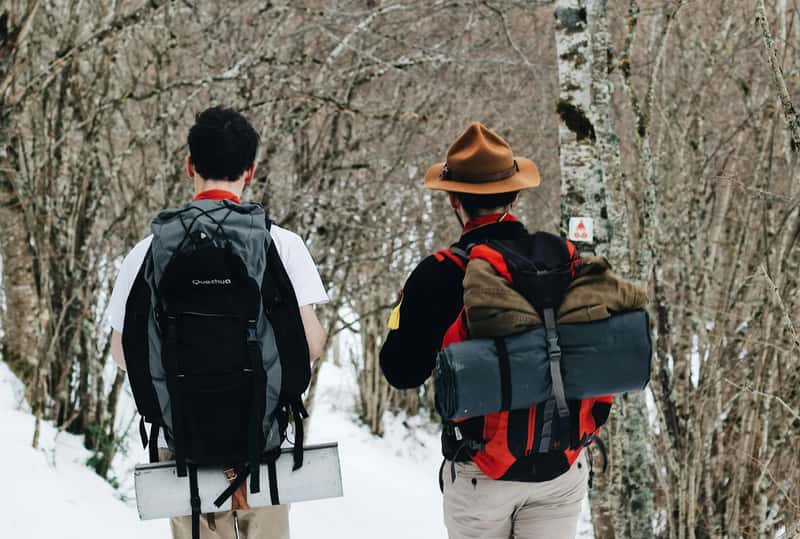
Long before boutique hotels, our hunter-gatherer ancestors navigated unpredictable dangers while traveling through difficult terrain, and they preferred certainty above all else. That preference did not dissolve with the invention of luggage tags.
This is not metaphor. This is biology still running in the background of your nervous system like software that was never updated.
So when your partner shrugs off a warning sign you caught from across the room – that man watching your bag, that alley that doesn’t feel right – you aren’t being paranoid. You are being exactly what evolution designed you to be.
The problem is not your alarm system. The problem is that it now fires in airport lounges instead of open savannahs, and the target of its signal is the person you love most in the room.
2. The Shared Perimeter
Travel creates something invisible between two people: a perimeter. A bubble of shared safety that both parties are silently expected to maintain.
You didn’t negotiate this contract. Neither did they.
But it exists. And the moment they drop their guard, you feel the wall thin.
Distance from home intensifies vulnerability. The absence of familiar cues makes it harder for the brain to assess safety accurately. So your brain compensates. It compensates by doubling its surveillance, scanning the room harder, reading every face in the queue with sniper precision.
And then it looks to its right and sees your partner laughing at a pigeon.
The anger you feel is not disproportionate. It is arithmetic. If you are doing double duty, their ease is not a gift. It is an imbalance in a load you both agreed – silently, wordlessly, instinctively – to carry.
3. The Cortisol Translation
Your anger has a chemical passport.
It was issued by your own adrenal glands without your permission.
When the brain perceives a threat, the sympathetic nervous system is activated to initiate the “fight or flight” response. Cortisol is released, a hormone that increases blood sugar and suppresses the immune system so energy can be redirected toward the perceived threat.
And then it comes wearing a mask.
Your body, flooded with cortisol, does not come with a label that reads: this is anxiety, handle gently. It comes looking like irritability. Sharpness. An edge in your voice that you cannot entirely explain.
You say: “Can you please just pay attention for five minutes?”
What you mean is: “I am frightened and I cannot hold this alone.”
The translation between those two sentences is where most travel arguments actually live. Not in the words exchanged. In the biochemistry underneath them.
4. The Illusion of Control
Here is what vigilance is really trying to do. It is not trying to prevent disaster. It is trying to sustain the feeling that disaster is preventable.
Those are different things. Critically different.
Because the brain seeks certainty, it values autonomy – a sense of being in control of circumstances and our destiny. Travel punctures this illusion more aggressively than almost any other human activity.
Your hypervigilance is a performance of control. A ritual. A way of telling your nervous system that you are not helpless in an unfamiliar world.
When faced with the perceived threat of unpredictability or vulnerability, hypervigilance often leads to attempts to exert an unrealistic level of control. This is a desperate effort to impose order on what feels chaotic, but it ultimately backfires.
Your partner’s ease is not recklessness. It is, in a cruel irony, evidence that the threat response you are performing is optional. And that knowledge – that someone is living unbothered inside the same airport you have surveilled into a war zone – is its own kind of wound.
5. The Internalization Point
I know this one personally.
I was once standing outside a train station in an unfamiliar city, backpack straps white-knuckled, watching my travel companion take forty photographs of a decorative fountain. And I felt something rise in me that I couldn’t name until much later. It wasn’t irritation. It was abandonment.
Not literal abandonment. Perimeter abandonment.
In that moment, I was holding the map, the time, the threat assessment, the exit strategy, the contingency. And they were photographing water.
Even if you’re used to managing a lot in everyday life, travel can stir up unique stressors. You’re not only handling your own nerves, but often absorbing the emotional weight of others.
What I understand now is that my anger was a form of grief. Grief for the version of travel I couldn’t access. The easy, fountain-photographing version. The version that doesn’t scan the room every forty-five seconds and keep one thumb near the bag zipper at all times.
6. The Attachment Beneath the Anger
Travel doesn’t create new dynamics between people. It accelerates existing ones.
Travel compresses everything. The intimacy is closer. The friction is louder. What might take months to surface in the comfortable routine of home can appear within seventy-two hours of shared airport terminals and misread maps.
The anger at a relaxed partner is almost always about attachment before it is about safety.
Time apart – or emotional distance – can trigger anxiety, especially if one or both partners struggle with anxious attachment. Anxious attachment means you might feel especially worried about your partner pulling away or not caring as much as you do. It often shows up as needing reassurance or feeling uneasy when there’s emotional or physical distance.
Their calm is not indifference to you. But your nervous system has already made the case against them.
It filed the brief, assigned the verdict, and is now waiting for you to deliver the sentence. That sentence usually starts with: “I just can’t believe you didn’t notice – “
7. The Asymmetry Problem
Two people. One threat environment. Radically different threat assessments.
This is not a character defect on either side.
Risk perception is a person’s subjective assessment of potential risks, influenced by various psychological and emotional factors. Which means two people standing in the same train carriage can be living inside entirely different psychological weather systems.
One sees a pickpocket opportunity. One sees a commute.
Uncertainties can increase consumers’ negative experiences and emotions, causing stress, worry, frustration, and anxiety. A lack of information in the decision-making process can initiate cognitive efforts to reduce perceived uncertainty, which in turn causes negative emotions.
The asymmetry is the problem. Not the gap in personality.
When one person is running active threat detection and the other is entirely offline, the vigilant partner does not experience their partner’s calm as “nice to be around.” They experience it as a gap in the fence. A failure in a system they believed was bilateral.
The rage is logical. It just has the wrong address.
8. The Neuroception of Danger
There is a layer of safety processing that operates entirely below conscious thought. You did not choose it. You cannot override it with a deep breath and a mantra.
Our brain’s ability to detect these signals is called neuroception – a term used to describe how our nervous system relies on feelings in the body to assess level of risk and safety. This awareness lies outside of conscious thought. Our brains are wired to provide a continual analysis of information through our senses.
When we perceive safety through neuroception, our social engagement systems can function and help us create warmth and connection. When we perceive danger, all our resources move toward assessing the level of danger and protecting us from it.
This is why you can be in the most beautiful city on earth, sitting outside a café with someone you adore, and still feel the low-grade electrical hum of threat behind your sternum.
Your neuroception filed a different report than the view in front of you. And your partner’s relaxed posture – the slouch, the open bag, the unbothered scrolling through their phone – just triggered another round of assessment. Not because they are reckless. Because your wiring does not accept their calm as evidence of safety.
9. The Unspoken Safety Contract
Nobody sits down before a trip and says: “I will be the one who watches the bags at the café. I will be the one who memorizes the exits. I will be the one who keeps half a mind on the room at all times.”
But someone always becomes that person.
And once that role calcifies, the resentment crystallizes right alongside it.
If you’re someone others rely on during trips, the pressure to “hold it all together” can make anxiety worse. It creates a feedback loop where the more you hold, the more alert you become, and the more alert you become, the more your partner’s ease reads as negligence.
Common psychological responses in high-vigilance states include hypervigilance, distrust, and anger – reactions that reflect disruption to core psychological needs for safety and control.
The contract was never written. That is precisely why it feels so violating when the other party doesn’t honor it. You cannot renegotiate terms that were never put into words. You can only feel the breach and call it by the wrong name.
10. The Weight You Were Never Meant to Carry Alone
Here is the heaviest thing.
The vigilance you feel is real. The threat assessment is not entirely irrational. The world is genuinely unpredictable, and travel amplifies every variable that your nervous system has ever catalogued as dangerous.
But the weight was never meant to be a solo performance.
Exposure to chaos or loss of control can overwhelm regulatory capacity. Healing – and we might say, sustainable travel – does not require forgetting what happened. It requires restoring regulation, agency and a sense of safety within the body and the mind.
The truth is that shared safety requires shared language. Not argued into existence at a crowded gate. Not extracted through frustration. But spoken quietly, before the departure, before the cortisol arrives with its mistranslations.
The gap between two people on the same trip is not always about the trip. It is about the internal architecture each person built long before they booked the flight – the early lessons about who watches the door, who stays alert, who is permitted to rest.
Some of us were taught, very early, that inattention costs something. We don’t remember the lesson. We only carry its tuition. And then we travel with someone who was taught something different, and we call their inheritance recklessness, and we call our own inheritance responsibility, when really both are just old survival strategies wearing new luggage tags.
The most useful thing you can do – before the next gate change, before the next unfamiliar street, before the next moment you feel the perimeter thinning – is to say the quiet, true thing out loud: I am afraid, and I need us to hold this together. Not as an accusation. Not as a performance. Just as the thing you have always needed someone else to hear.