You pack your bag the night before.
You check it twice. Then a third time.
You are already gone before the taxi arrives.
There is something particular about the way immigrant kids move through the world as adults. A hypervigilance that looks, from the outside, like competence. An efficiency that is actually an old escape mechanism wearing a new coat. You know how to blend. You learned early. You learned because you had to.
The identity gap – the chasm between who we perform and who we actually are – is widest in the immigrant child’s biography. Wherever their parents were born, children of immigrants are often straddling two cultures, raised with values inside the home that can be completely different from those they are experiencing outside of it. That gap does not close when you get a passport and a rolling suitcase. It simply travels with you, stowed quietly in the overhead bin.
1. The Costume Change
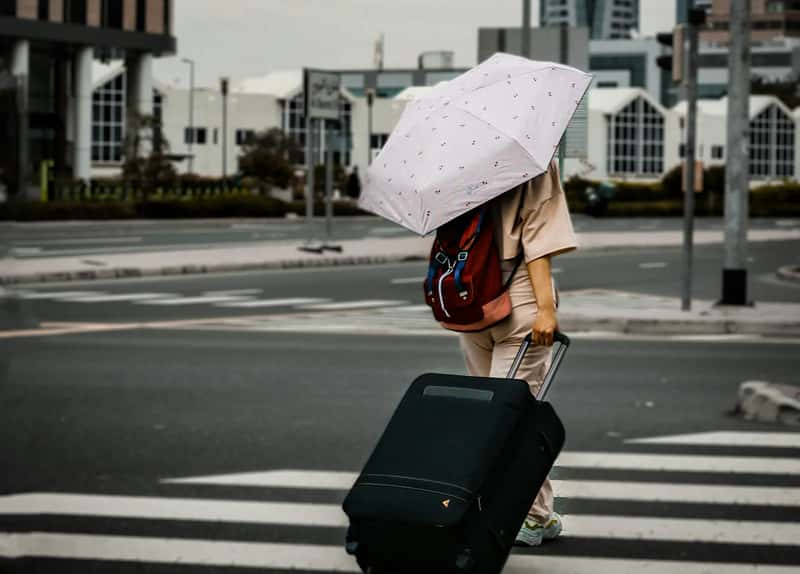
You learned it before you had a word for it.
Code-switching. Shape-shifting. Being whoever the room needed you to be.
You became the queen – or king – of code-switching, becoming the person you needed to be in order to stay safe. Pretend. Assimilate. Hide. Shame was at the very core of the immigrant child experience.
In airports and hotel lobbies, you do this without thinking. You watch the room. You read the dress code before you unpack. You adjust your accent slightly, just enough. It is not deception. It is a survival skill so deeply grooved into your neural pathways that it now looks like social ease.
But underneath the easy smile at the check-in desk is a kid who once stared at a lunch box full of food that smelled like home and prayed no one would ask what it was.
The costume changes. The shame does not.
Not right away. Not without deliberate, patient work.
2. The Invisible Luggage
Every traveler carries weight they never declare at customs.
For the immigrant kid grown up, that weight has a specific texture.
Internalized shame and societal oppression are painful sources of difficulty for second-generation immigrants and can lead to an identity crisis. You might have experienced institutional discrimination, microaggressions, and racism as a child if you were born into an immigrant family.
That history travels. It shows up when a hotel concierge looks through you. When a border officer’s tone shifts. When you over-explain yourself to a stranger who didn’t ask. The invisible luggage is heavy not because of what it contains, but because you’ve never been allowed to set it down and sort through it properly.
You zip it back up. Every time. You’ve been doing it since the third grade.
Travel doesn’t cure that. But it does, sometimes, give it room to breathe.
3. The False Self Abroad
There is a version of you that only exists in transit.
Confident. Unbothered. Slightly mysterious.
When immigrant parents constantly try to mold their children to an ideal, it can lead to what psychologists call a “false self” – a personality developed and maintained to cater to others’ expectations. Even as an adult, you may end up with only your “persona” and no real sense of identity.
The traveler you become – the one who orders confidently in broken Italian, who tips correctly, who knows how to look like they belong – is another performance of that learned persona. It is not entirely fake. But it is not entirely yours either. It is the version of you that was never ashamed. The self you were always rehearsing for.
The tragedy is that you are often more relaxed in a city where no one knows your last name than in the home where everyone does.
That is not freedom. That is still the old costume. Just a better-fitting one.
4. The Overachiever at the Gate
You are always early.
Not punctual. Early. Dangerously, compulsively early.
The immigrant child experience can result in compounded guilt – “I did not do enough” – or even deeper shame – “I am not enough/defective.” The latent belief was that you could not put your immigrant parents out of their misery, that they may have suffered because of you.
So you overcompensate. Always have. You studied harder. You were more prepared. You never let yourself be caught without a backup plan. In travel, this manifests as an almost neurotic level of organization. Itineraries printed and digital. Two forms of currency. A backup credit card in a separate bag. You are not Type A. You are a child who once watched their parents navigate a system that was not built for them, and decided – somewhere deep and wordless – that they would never be caught unprepared again.
The gate agent doesn’t know any of this. She just sees someone who arrived ninety minutes early.
5. The Lunch Box Moment, Replayed
I remember the specific quality of silence.
The school cafeteria. The smell of my mother’s cooking rising from a container that was decidedly not a sandwich. The pause before I decided, again, whether to eat it openly or find a corner.
I always found the corner.
Worries about fitting in and consciousness of differing identities compared to peers were consistently observed, contributing to the development of shame about one’s identity.
That corner-finding instinct is alive in my travels. I choose tables facing the wall in restaurants. I watch how locals behave before I move. I translate menus twice – once for language, once to check whether ordering a particular dish will mark me as an outsider. The cafeteria never fully leaves us. Its architecture just changes. It becomes the Airbnb neighborhood you’re not sure about. The restaurant where the host’s expression shifts. The tour group where you are, again, the one who is slightly different from everyone else.
You’ve been practicing for this your whole life. That is both the wound and the gift.
6. The Exit Strategy
You always know where the door is.
This is not paranoia. This is pattern recognition honed over years of needing to leave rooms – conversations, situations, identities – quickly and cleanly.
Fear of rejection was reported frequently among immigrant-background adolescents. They described hiding parts of their identity out of fear of exclusion.
That same instinct drives the travel behavior. You book refundable tickets when you can. You keep the taxi app ready. You never fully unpack, even for a two-week trip. Something in you remains in a state of pre-departure. Not because you are restless – though you may be – but because “ready to leave” was your default setting for so long that staying feels, paradoxically, like the riskier move.
You confuse the ability to leave with freedom. They are not the same thing.
Real freedom requires the option to stay. And staying, for a long time, felt like the most dangerous thing of all.
7. The Gratitude Trap
You feel guilty for complaining about anything travel-related.
The delayed flight. The bad hotel. The tour that didn’t deliver. You swallow it.
Children of immigrants often think, “I should just be grateful, because my parents had it worse.” One therapist calls it gratitude shaming – where we shame ourselves into feeling grateful.
The gratitude itself is not the problem. Gratitude is clean and real. The trap is in its weaponization – the way it is turned inward as a silencer. You have seen what real hardship looks like. You have watched your parents navigate systems designed to diminish them. So a delayed flight seems like an obscene complaint. You become the traveler who never sends food back. Who smiles at the rude customs officer. Who tips over-generously to compensate for being seen as other.
This is not generosity. This is appeasement dressed up as grace.
There is a difference, and learning to feel it is part of the work.
8. The Language of Belonging
You speak differently in different countries.
Not just in foreign languages. In your own.
You may have been conditioned to behave a certain way toward your relatives but a very different way toward your friends. You have not had the opportunity to explore and solidify your identity if you constantly hide one or more aspects of your personality to fit in, like a chameleon.
This linguistic shapeshifting is a superpower that costs something. In Paris, your English becomes slightly clipped, more international. In your grandmother’s country, you perform a heritage you are still learning to claim. On the group tour, you modulate into something generically pleasant. None of these versions is a lie. All of them are partial. The immigrant child grew up speaking fluently in registers, code-switching between the language of home and the language of the world outside. That skill is real. The exhaustion of deploying it constantly is also real.
You are multilingual in ways no dictionary captures. And sometimes, in a quiet bar in a city where no one knows you, you get to be wordless for a moment. Just a person. No translation required.
9. The Rootless Comfort
There is a particular peace that comes from having no history in a place.
No one here knows what you used to hide. No one knows your mother’s accent, or your father’s job, or what your house smelled like.
Children of immigrants must work harder to establish their ethnic identity after living in the liminal space of “never truly belonging ‘here’ or ‘there.'”
The road offers temporary relief from that in-between ache. In a new city, everyone is slightly displaced. Everyone is reading maps and mispronouncing things. The immigrant kid – the one who spent years being the only person mispronouncing things – finds this anonymous equality intoxicating. For a few days, you are not marked. You are just a tourist. The shame has no address here. No one can find it.
But you bring it with you nonetheless. It is in the way you apologize before asking directions. The way you laugh too quickly at your own mistakes. The familiar weight of trying to read whether the person in front of you has decided you belong here.
The geography changes. The internal weather does not. Not on its own.
10. The Arrival That Never Quite Arrives
Here is the heaviest thing.
You have been in transit – psychologically, emotionally – your entire life. Not between countries. Between selves.
When you hide your true feelings and thoughts from others, and yourself, you feel hollow, lifeless, inauthentic – as if you are living someone else’s life rather than your own.
For second-generation migrants, childhood and adolescence years were detrimental to their mental health. Those who encountered discrimination and social exclusion reported experiencing shame over their differing identities. Even in adulthood, embracing their identities brings challenges and mental health burdens, often due to the pressure to uphold – or deny – their heritage.
Every destination promises, quietly, to be the place you finally arrive. Not just geographically. Internally. The place where the two versions of you – the one who was never ashamed of the lunch box, and the one who hid in the corner – finally occupy the same body without conflict. You keep traveling. The arrival keeps deferring. Not because the places aren’t right. But because no latitude or longitude can complete the internal reckoning that childhood shame interrupted and left unfinished.
The reckoning has to happen at a table you can’t book in advance. It happens in the quiet. In the conversation you finally have with yourself about what it cost to perform belonging your entire life.
There is something that happens, occasionally, to immigrant kids who travel long enough and honestly enough. They stop arriving at destinations. They start arriving at themselves. The process is not dramatic. It is more like unpacking, slowly, a bag you’ve been carrying since you were nine years old and didn’t know the word for what was in it. Each trip peels back a layer. Each moment of letting yourself be a little lost in a foreign place, without scrambling to perform competence, is a small act of reparation to the kid who never got to be confused out loud.
Shame tells us to hide and become small – so it makes sense that the antidote to that is to be truly and deeply seen. Not by the city. Not by the other passengers. By yourself. The traveler who finally sees themselves clearly – accent, lunch box, code-switches and all – is not wandering. They are, for the first time, going somewhere real.
Somewhere between the departure board and the window seat, if you get quiet enough, you might hear the sound of a child who was always more than enough, finally getting told so by the one person whose voice they were always waiting for.