You land in a new city.
The air smells different. The food is wrong. The people are too loud, or too cold, or just – off.
You tell yourself it’s the place.
It’s never the place.
There is a gap that lives inside every traveler, every expat, every person who has ever packed a bag hoping geography would fix something internal. It is the space between the self you perform – the curious wanderer, the open-minded adventurer, the one who posts serene captions about “embracing the unknown” – and the self that actually shows up at arrivals: guarded, hypervigilant, already cataloguing everything that is lacking.
That gap has a name. It has a history. And that history almost certainly began before you ever owned a passport.
1. The Wound Travels With You
This is the first truth, and the hardest one.
You did not leave it behind at the departure gate.
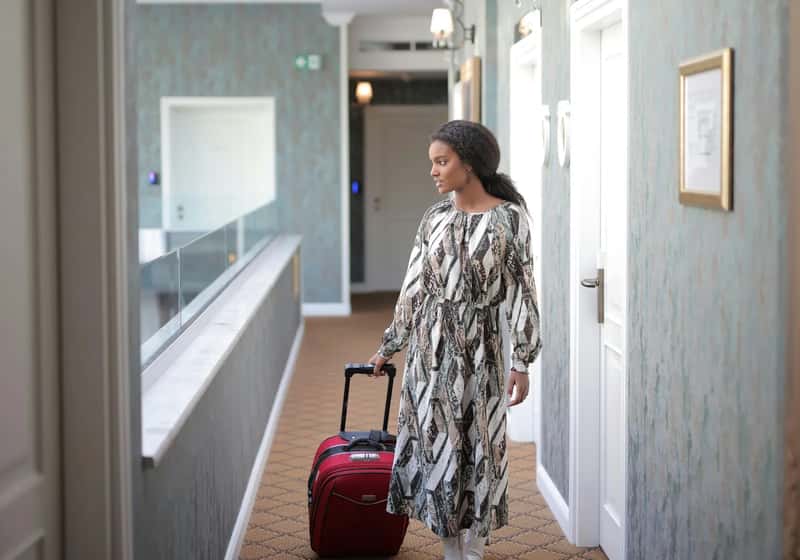
Your unresolved trauma doesn’t check itself at the border. It boards the same flight. It sits in the middle seat. It whispers in your ear during the cab ride through a new city, narrating everything through the lens of old hurt.
Major life transitions like relocation can amplify emotional wounds, leaving many expats struggling with unexpected stress, anxiety, and emotional exhaustion.
The negative outlook you carry about a new culture – the food is bland, the people are rude, the customs are backwards – is rarely about the culture.
It is about the story you arrived with.
The story is old. It was written in a childhood bedroom, at a dinner table that felt unsafe, in a classroom where you were made to feel small. Every new place you enter becomes the stage on which that story is performed again, with different actors but the same plot.
Until you name it, you will keep staging the same tragedy in every time zone on earth.
2. The Projected Rejection
You walk into a local market. Someone doesn’t smile at you.
You decide the entire culture is unwelcoming.
That is not a travel observation. That is a wound talking.
Early wounds shape our beliefs about ourselves, our relationships, and the world. When one of those core wounds is rejection – being unseen, being excluded, being made to feel like an outsider in the very place that was supposed to be home – it becomes the template through which all new social environments are filtered.
Emotional wounds chip away at a child’s sense of stability and self, damaging their self-worth and later producing feelings of guilt, shame, lack of belonging, and disconnection from others.
So you walk into a foreign market and your nervous system, trained by years of feeling unwelcome, reads neutrality as hostility. It reads difference as danger.
The culture didn’t reject you. Your nervous system remembered a time when you were.
And it ran that old program in a new country.
3. The Control Illusion
Somewhere inside the traveler who hates everything about a new place is a person who is terrified of losing control.
Criticism is control in disguise.
When everything is wrong – the traffic, the bureaucracy, the social norms, the architecture of daily life – you are the only fixed point in a spinning world. You become the standard. The measure. The one who knows better.
Your body may remain in a state of constant anticipation, making it difficult to relax or feel safe. You may find yourself quick to anger, tearful, or emotionally numb – this difficulty regulating emotions may stem from an overwhelmed nervous system that never learned how to return to a calm baseline after being triggered.
That overwhelmed nervous system was likely first wired in childhood. In a home where chaos reigned. Where love was inconsistent. Where safety was never guaranteed.
Criticism became survival. If you could identify the threat before it arrived, you could brace for impact.
You are bracing now. In a café in Lisbon. In a market in Chiang Mai. In a plaza in Buenos Aires.
You are bracing in places that never meant to hurt you.
4. The Hypervigilance Habit
Your eyes scan a new space like a security camera.
Nothing escapes notice. Every slight, every perceived rudeness, every cultural norm that conflicts with yours is logged, filed, and added to the case against this place.
This is not discernment. This is hypervigilance.
Childhood trauma survivors often experience a frequent misperception of perceived danger. These misperceptions result in increased levels of cortisol and stress hormone levels, leading to immune system suppression, neurotoxicity, and chronic physiological strain.
The body remembers what the mind has tried to forget. It runs threat assessments in restaurants. It flags the unfamiliar as dangerous. It translates cultural difference into personal affront.
Culture shapes how individuals experience, understand, and express distress. But trauma shapes the lens through which culture is received in the first place.
When the lens is cracked, everything looks broken.
The hypervigilant traveler doesn’t need a different destination. They need to examine the lens before they pack their next bag.
5. The Mirror Moment
I need to be honest here, because theory without confession is just performance.
I spent two years living in a city I told everyone I hated. I had a list. The drivers were aggressive. The vendors were dismissive. The social culture felt impenetrable, cliquey, closed off to outsiders.
I was so certain the city was the problem.
It took a therapist approximately four sessions to reflect back to me that what I was describing – the aggression, the dismissiveness, the impenetrable social circles – was almost word for word how I had described my childhood home.
I wasn’t critiquing a city.
I was relitigating a family.
Even in cases where the conscious brain cannot recall the experience, the anxiety caused by it continues to be felt by the body. This is why emotional wounds come up later in life, particularly in relationships that mimic the ones in which they were caused – they can only stay hidden for so long.
Every city I had ever hated looked, in some emotional register, like home.
6. The Belonging Issue
Some people don’t hate new cultures because they feel superior.
They hate them because they desperately want to belong and don’t know how.
The criticism is armor. The cynicism is a preemptive strike. If I declare the place unworthy first, it cannot declare me unworthy second.
Childhood wounds can undermine an individual’s sense of safety, worth, and identity. When that happens early enough, belonging stops feeling like a right and starts feeling like a prize you have to earn – and might never deserve.
Increased vulnerability can arise, particularly when discrimination, social exclusion, and isolation are experienced. On the other hand, successful acculturation can also allow for a broader horizon of experience, a multicultural orientation, and the development of dynamic and multiple identities.
The pathway to that broader horizon, though, requires first understanding why belonging feels so fraught. Why every new culture feels like an audition. Why the fear of being rejected by a new place is so visceral, so personal, so completely disproportionate to the actual stakes.
A new culture is not your mother. A new city is not your childhood home.
But your nervous system hasn’t received that memo yet.
7. The Identity Ambush
Moving into a new cultural space doesn’t just change your address.
It detonates your identity.
Suddenly the social scripts you relied on don’t work. The humor lands wrong. The body language you use to signal friendliness reads as aggression, or coldness, or something else entirely. The version of yourself that functioned perfectly well back home is now malfunctioning in real time.
Acculturation problems contribute to confusion of cultural identity. This confusion is disorienting even for the psychologically secure.
For someone carrying unhealed childhood wounds – wounds that are fundamentally about identity, about whether the self is acceptable, whether the self is enough – this disorientation is catastrophic.
During the postmigration acculturation phase, migrants can display several modes of thinking, feeling, and behaving that resemble maladaptive personality traits – occurring in the process of developing a new hybrid cultural identity and forming close relationships.
The self that was already shaky doesn’t survive an identity ambush gracefully.
It retreats. It attacks. It condemns the new culture for failing to accommodate a version of the self it was never asked to accommodate.
8. The Intergenerational Frequency
Here is something that will unsettle you.
The wound you carry into new spaces may not even be entirely yours.
Experiences of trauma and violence repeat over the course of several lifetimes through social interactions, genetics, behavioral patterns, values or attitudes, sneaking from one generation to the next like a soul wound without the survivor’s or their descendants’ awareness.
You may have inherited the lens.
A parent who taught you that the outside world was hostile. A grandparent whose displacement made trust feel like a luxury. A family system in which outsiders were viewed with suspicion, and cultural difference was treated as threat rather than invitation.
Clinicians and researchers have recognized that individual traumas such as interpersonal violence, emotional abuse, or neglect can contribute to the intergenerational transmission of trauma. Trauma does not have to be experienced at a community level to affect later generations. Any individual trauma can disrupt a generational system in ways that travel through time.
You land in a new city carrying not just your own history, but the unprocessed history of the people who raised you.
That is a heavy bag to carry through customs.
9. The Numbing Exit Strategy
There is a particular kind of traveler who moves constantly and feels nothing.
Not wonder. Not curiosity. Not even the negative charge of genuine dislike.
Just – nothing. A flatness. A faint, persistent boredom with every new place the moment its novelty wears off.
Avoidance behaviors – excessive distraction through work, travel, or social media to escape difficult emotions – are common signs. So is persistent loneliness: struggling to connect with others even when surrounded by people. And imposter syndrome: feeling like you don’t belong, no matter how successful or integrated you become.
Travel becomes the anesthetic.
Traumatic experiences are not only stored in the mind but are biologically embedded in the body’s very wiring. Van der Kolk explains that trauma, especially when experienced in childhood, can reshape the brain and disrupt the nervous system, leaving survivors feeling stuck in a constant state of fight, flight, or freeze, even after the immediate danger has passed.
The constant mover is often fleeing. And when you are always fleeing, every new destination is just the next failed escape. The culture doesn’t disappoint you. You disappoint yourself, again, in a different city, with better lighting.
10. The Threshold Is You
Every new culture you enter is a doorway.
What it opens onto depends entirely on who is walking through it.
Psychological suffering is shaped not only by individual biography but also by sociocultural transitions. The traveler who has done their inner work knows this. They can hold both truths simultaneously: this new culture has real limitations, and my perception of it is being filtered through history I need to examine.
Before any deep therapeutic work can begin, the most critical – and often most difficult – step is to face your pain with acknowledgment and self-compassion. Healing starts with acknowledging the impact of your past without judgment.
The negative outlook on local culture is not a character flaw. It is a symptom. It is the nervous system doing what it was trained to do in an environment where negativity was a survival skill.
But you are not in that environment anymore.
Emotional wounds run deep and have a profound impact on our beliefs and behaviors as adults, specifically on our self-image and relationships. These traumas, whether big or seemingly small, fracture our foundation and can taint our perception of what is normal and true.
The threshold is not the arrival gate. It is not the border crossing. It is not the moment you step off the plane into humid air that smells like somewhere new.
The threshold is the moment you decide to stop outsourcing your healing to geography.
There is a particular silence that settles over you when you realize that every place you have ever hated was, in some way, a portrait of something you have not yet forgiven. Not the place. Not the people. Something older than all of it – an atmosphere you learned to breathe inside a childhood home, now mistaken for the climate of the world.
The work, then, is not to become a better traveler. It is to become a more honest inhabitant of your own interior. To stop auditing cultures with the ledger of an old wound. To understand that curiosity and contempt cannot coexist in the same nervous system at the same time – and that the one you feed is the one that navigates.
One day you will walk into a new city with nothing but the weight of your own feet, and you will be surprised by how open everything suddenly seems – not because the world changed, but because you finally put down what you were carrying.