You are standing at a crossroads.
Literally.
The street sign is corroded. The GPS is spinning. Someone five feet away knows exactly where you need to go.
You do not ask.
You turn left and hope.
There is a name for this. It is not stubbornness. It is not confidence. It is something quieter and more corrosive – the belief, worn smooth by years of reinforcement, that needing help means something is broken inside you. That the moment you open your mouth and say I don’t know, the architecture of who you are begins to collapse.
This is the Identity Gap. The distance between the person you perform for the world – competent, oriented, self-sufficient – and the person standing alone on a corner, chest tight, refusing to ask a stranger for thirty seconds of their time. One of them is real. One of them is armor.
1. The Competence Costume
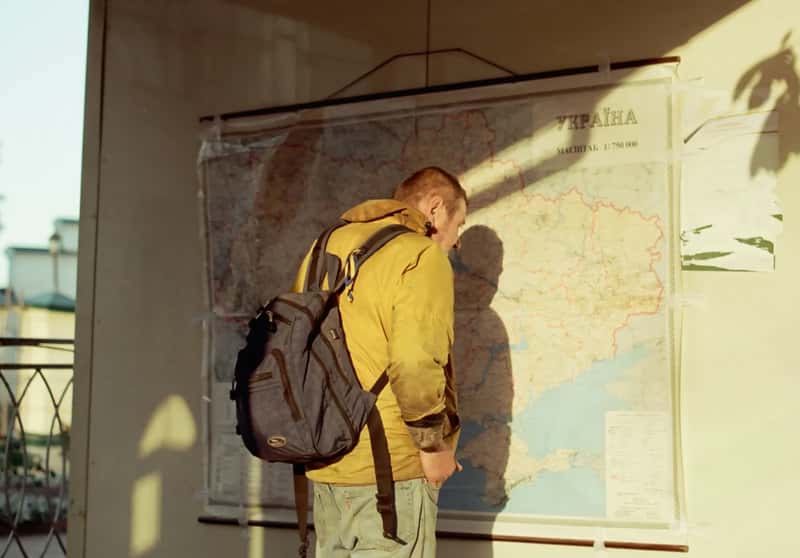
You built it early.
The identity of the one who figures things out. The capable one. The one who doesn’t need a map because they already know, or will know, or will die before admitting otherwise.
Many people grew up in environments where vulnerability was either discouraged or outright punished. From a young age, they learned that crying was weak, fear was dramatic, and that only certain emotions were acceptable. The directions problem is just where that lesson shows up on a Tuesday afternoon, in a rental car, three blocks from the restaurant.
The costume fits perfectly from the outside. Pressed. Confident. Moving with purpose.
Inside, the person wearing it is sweating through the fabric.
They would rather loop the same block four times than speak two sentences to a stranger. Because those two sentences would pull at a thread. And they are terrified of what unravels.
This is not about directions. This is about identity as performance. And the performance must never have gaps.
2. The Pride Tax
Pride extracts a toll. You pay it every time you choose the long route.
It is the part that needs to appear in control, hates to be vulnerable, and prides itself on independence – the part that is afraid to test the tensile strength of friendship, afraid it might give out under too much strain.
You pay the toll in minutes. In miles. In the low-grade anxiety of pretending you are not lost when you clearly, measurably, are.
The tax compounds over a lifetime. Every time you circle the parking lot rather than ask the attendant. Every time you read the same paragraph four times rather than ask a colleague. Every time you sit in a restaurant confused by the menu and order something wrong.
You tell yourself this is efficiency. Independence. Resourcefulness.
It is none of those things.
It is the hidden fee attached to a fear you have never bothered to name. You are paying for the illusion of self-sufficiency with the currency of connection. And the ledger is never in your favor.
3. The Childhood Blueprint
Somewhere, there is a moment. You can probably find it if you sit still long enough.
A room. A parent. A teacher. A peer. And the sharp sting of being seen needing something.
You may have internalized that if you had complex feelings, you needed to deal with them on your own – that expressing yourself to others was burdensome. If genuine vulnerability was never shown to you, the odds are you have a faded blueprint for what showing up authentically really looks like.
The blueprint is faded. But it is still the one you build from.
Every adult behavior around asking for help traces a line back to that original room. The child who was laughed at for not knowing becomes the adult who will drive forty minutes out of the way before admitting they took the wrong exit.
The geography changes. The wound does not.
You are navigating the present with a map drawn in childhood. It was never accurate. It was never meant to last this long.
4. The Armor of Hyper-Independence
Hyper-independence is not a personality trait. It is a scar dressed as a virtue.
If you are afraid of being emotionally or physically vulnerable, you may use hyper-independence as a defensive strategy to avoid letting others in. You may think that as long as you don’t need anyone, you can’t be let down.
There is a cold logic to it. Almost beautiful in its brutality.
If you never lean, you never fall. If you never ask, you are never refused. If you never open the door, nothing can come through it – including the kind of help that might genuinely change your afternoon, or your year, or your life.
The armor works. That is the problem. It deflects disappointment with remarkable efficiency. It also deflects warmth, ease, and the quiet relief of being helped by another human being who was simply happy to help.
The person who will not ask for directions is often the same person who has never let anyone fully in. The street corner is just where the pattern becomes visible.
5. The Moment I Stopped Moving
I was in a city I did not know. A city with narrow streets and an indifferent afternoon light that made everything look like a painting of itself. I had been walking for forty minutes. My feet knew it. My phone had died. A man selling newspapers on a corner looked at me with the expression people reserve for the obviously lost.
I did not ask him.
I walked another ten minutes in what felt like the right direction. It was not the right direction. I was late. I was embarrassed. And when I finally stopped – really stopped – and asked a woman outside a café, she smiled, pointed left, and said “Oh, it’s just there, about two minutes.”
Two minutes.
I had spent fifty walking in circles to protect something I could not even name in that moment. I know its name now. It is the belief, installed so early I thought it was just my personality, that this difficulty is about more than being independent – it’s about the beliefs and experiences that told me to minimize my needs, stay in control, and avoid being vulnerable.
The woman with the directions was not judging me. She was just pointing left.
6. The Performance of Certainty
Certainty is its own addiction.
To move through the world with the appearance of knowing – where you are, where you are going, why you made the choices you made – is to experience a particular kind of high. It is steady. It is clean. It requires almost nothing from other people.
Vulnerability is often inaccurately equated with weakness. Many individuals, not wanting to appear weak, spend their lives avoiding and protecting themselves from feeling vulnerable or being perceived as too emotional.
The performance of certainty is exhausting. The performer knows this intimately. They are tired in a way that sleep does not fix, because the fatigue is not physical. It is the fatigue of maintaining a fiction across every room they walk into.
They do not ask for directions because the character they play does not get lost.
And dropping character, even briefly, even for something as small as a street name, feels like more exposure than they have budgeted for that day.
7. The Fear Underneath the Fear
Peel it back far enough and you will find it.
Not the fear of looking lost. Not even the fear of judgment. Something older and more fundamental: the fear that if someone sees your need – really sees it – they will decide you are not worth helping. Or worse, that they will help you, and you will feel the terrible weight of owing someone something you are not sure you can repay.
For some, the difficulty is internal – feeling embarrassed to admit confusion or worrying that asking for help might change the way others see them. Underneath the surface, they may crave the support but not know how to express it, or feel weak for admitting they need the help. These mixed emotions can leave a person feeling isolated, exhausted, or unsure about why simply asking for a helping hand feels so overwhelming.
That is the texture of the fear. Layered. Contradictory. Intimate.
It is not a simple phobia. It is a worldview. The world is not a place where help is freely given. The world is a transaction. And vulnerability is a debt instrument with unfavorable terms.
This belief keeps you walking in circles. On the street. In relationships. In every room you have ever been too proud to navigate honestly.
8. The Cultural Conditioning
We did not arrive at this alone. The culture handed us the script.
Many cultural messages equate independence with strength. Men, specifically, are often socialized not to show weakness, so they may have more stigma around seeking help. At the same time, caregivers and women are usually expected to meet everyone else’s needs before their own. These norms can create shame around needing anything at all, even when support is reasonable and deserved.
The script is spoken in the language of admiration. We praise the self-made. We mythologize the lone navigator. We frame needing others as a character flaw dressed in the language of virtue.
We seem to naturally resist help and advice, with its implication of our shortcomings, and this may be especially so for men, because vulnerability is generally bred out of us at an early age.
But this is not nature. It is instruction. And it is instruction that costs us – in connection, in efficiency, in the quiet joy of being helped by another human who asked nothing in return but a brief moment of your time.
The map was always there. We were just taught that needing it was shameful.
9. The Ego’s Last Stand
The ego is not the enemy. But it is a terrible navigator.
Ego fragility refers to the vulnerability or instability of one’s sense of self-worth and identity. When the ego is fragile, self-esteem feels easily threatened by criticism, rejection, correction, or failure. This often leads to defensiveness, denial, or overcompensation as a way of protecting the self-image.
The person who refuses to ask for directions is running a protection operation. Every moment of not asking is a moment the ego remains intact. Safe. Unconfronted. The self-image – competent, capable, oriented – does not have to update itself against the reality of being lost.
A German study found that vulnerability feels like weakness when it’s experienced on the inside, but looks like courage when it’s viewed from the outside.
There it is. The precise inversion that keeps us circling.
The person who asks is not diminished by the asking. They are made more human. More accessible. More real. The ego, however, cannot process this data. It has already decided what the asking means. And it means weakness. So you keep walking. The ego stays intact. You stay lost.
10. The Turn You Have Not Made Yet
This is the heaviest point. So hold it carefully.
The refusal to ask for directions is not really about geography. It never was. It is about the belief – ancient, pre-verbal, coded into the nervous system before you had language to question it – that your need, exposed to another person, will cost you something you cannot afford to lose.
Vulnerability is the core of emotions and feelings. If we prevent ourselves from being vulnerable, we foreclose on experiencing our emotions. Our attempts to prevent shame, embarrassment, and sadness also prevent us from experiencing love, belonging, joy, and empathy.
The cost of the armor is everything it keeps out.
Vulnerability is not weakness, nor is it danger. It is the moment your longing bumps against your limits to make your desires come true. And asking for directions – truly asking, without apology, without the performance of already knowing – is one of the smallest and most radical acts of self-acceptance available to a human being in an ordinary afternoon.
Vulnerability is uncomfortable, but taking risks, accepting responsibility, being honest, expressing empathy, and facing uncertainty are not weaknesses. Vulnerability is about acknowledging truth and showing courage.
You have been carrying the wrong definition for a very long time. Vulnerability is not the crack in the wall. It is the door.
The street corner does not care about your reputation. The stranger with the directions is not keeping score. The only one running the tribunal is you – and you have been sitting in judgment of your own need since before you can remember.
What changes when you ask is not just your route. What changes is the quiet internal agreement that you are allowed to not know. That not knowing is not a verdict. That the world, on an ordinary afternoon, is full of people who are simply waiting to point you left.
The map has always been there. You just needed to believe, for one unguarded moment, that asking for it did not make you less. And maybe – if you stand still long enough in the space between lost and found – you will notice that it never did.