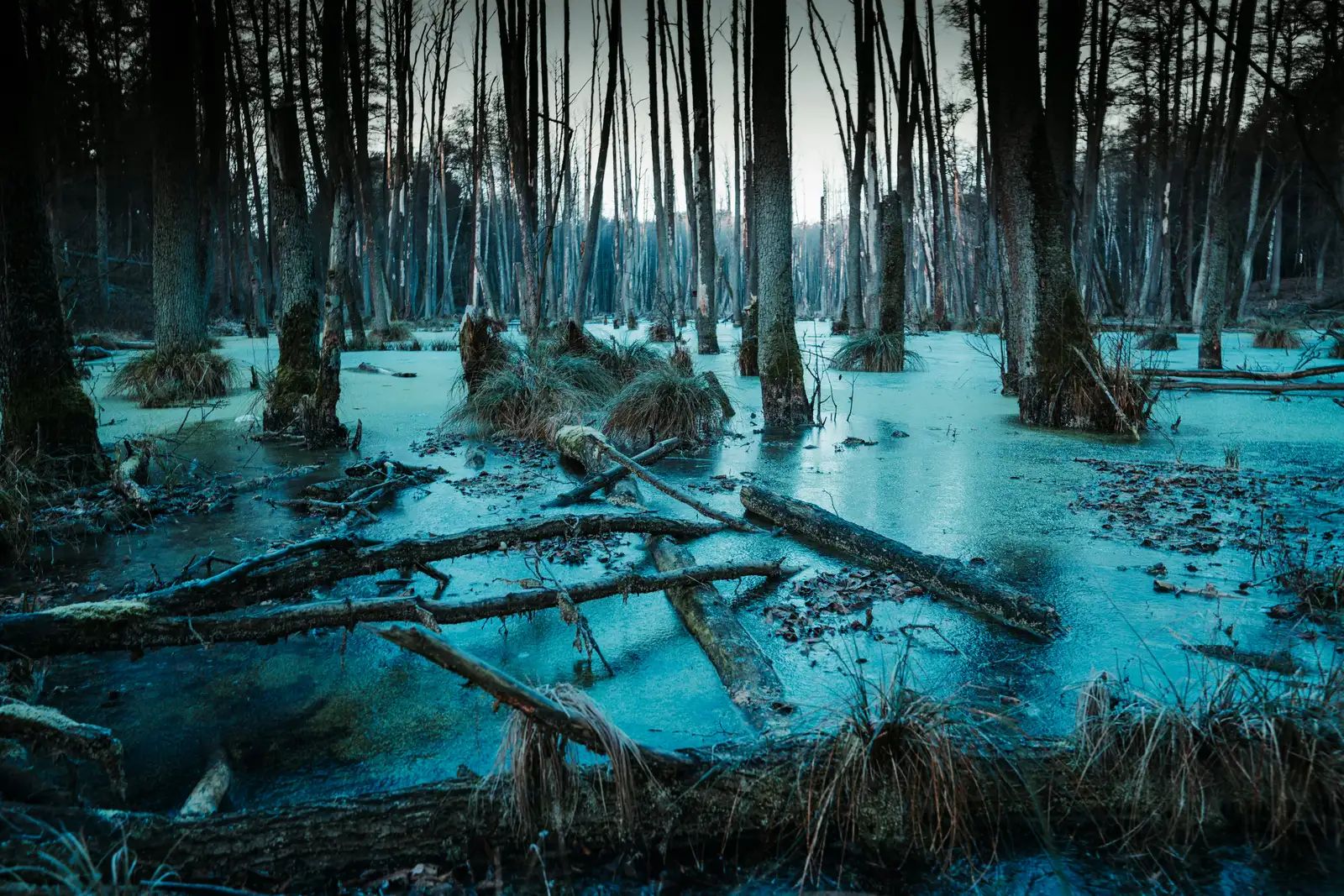
Poland – Along the eastern edge of Europe, where the Białowieża Forest meets the border with Belarus, military planners and scientists are examining how the landscape itself might contribute to security. The ancient woodland, one of the continent’s last primeval forests, features dense stands of trees and extensive wetlands that could slow or channel ground movements. At the same time, efforts to maintain or restore those features align with long-standing conservation goals for the ecosystem.
A Landscape Shaped Over Millennia
The Białowieża Forest spans roughly 140,000 hectares across the Poland-Belarus frontier and has persisted for thousands of years with minimal large-scale human alteration in its core areas. Its mix of old-growth stands, bogs, and seasonal flood zones creates terrain that is difficult for heavy vehicles to traverse. Military assessments note that such natural obstacles can complement engineered barriers without requiring extensive new construction in sensitive zones. Recent border security initiatives in Poland have included plans for concrete obstacles and drainage works along parts of the eastern flank. Scientists from institutions such as the Polish Academy of Sciences have pointed out that preserving or rewetting certain wetlands could achieve similar defensive effects while avoiding some of the ecological disruption associated with conventional fortification. The approach draws on observations that saturated peatlands and thick forest cover limit the mobility of armored units more effectively than many artificial structures in comparable conditions.
WarWilding as a Practical Option
The concept of integrating ecological restoration with defense planning, sometimes referred to as WarWilding, has gained attention in discussions between Polish defense officials and conservation experts. Rather than draining wetlands or clearing vegetation to install fixed barriers, the strategy favors maintaining or enhancing existing natural features. This can include targeted rewetting of drained peatlands and protection of forest corridors that already impede cross-country movement. Officials have indicated that roughly half the length of the relevant border sections already passes through forested or wetland terrain that meets basic military criteria for difficult passage. In these areas, the emphasis shifts toward avoiding actions that would reduce that natural resistance. The Ministry of Defense has expressed openness to coordinating with environmental agencies on such measures, viewing them as compatible with broader security objectives.
Benefits Beyond Security
Restoring or protecting wetlands in the region also supports the forest’s overall resilience. Decades of drainage, drought stress, and fragmentation have placed pressure on the ecosystem, affecting species that depend on moist habitats. Maintaining water levels can help sustain biodiversity while simultaneously reinforcing the terrain’s defensive qualities. The dual-purpose aspect appeals to planners seeking cost-effective solutions. Natural barriers require less ongoing maintenance than some engineered alternatives once established, and they avoid the need for extensive new infrastructure in a UNESCO World Heritage site. Uncertainty remains about the precise scale of any defensive contribution, as outcomes would depend on specific hydrology, vegetation density, and seasonal conditions.
Looking Ahead
Discussions continue on how best to balance security requirements with the long-term health of the Białowieża Forest. The short article on Mongabay highlights the potential for wetlands and dense forest to function in both roles. ([1]) Further field assessments and modeling will help clarify the limits and opportunities of this approach in the years ahead.