The alarm doesn’t go off. You’re already awake.
Your bag has been packed for three days.
The mountain doesn’t know your name. That’s precisely why you’re going.
There’s something that happens in the space between the person you are at your kitchen table and the person you become when the air thins and the ground falls away beneath you. Psychologists call it a lot of things. The self-discrepancy. The identity gap. The quiet war between your actual self and the version of yourself you keep promising yourself you’ll become. Most people manage that war with a promotion, a new relationship, a better apartment. Some people manage it with a mountain.
1. The Identity Gap Is Real, and It Pulls Like Gravity
It starts small. A Sunday afternoon that feels hollow. A Monday that feels exactly like the last one. A creeping sensation that the life you’re living is somehow narrower than the life you were supposed to have.
The gap between your self-image and your ideal self is one of the most influential forces in your psychological life. When that gap is small, you tend to feel good about yourself. When it is large, dissatisfaction, self-criticism, and low self-esteem can follow.
For the altitude-seeker, that gap doesn’t close in a therapy office.
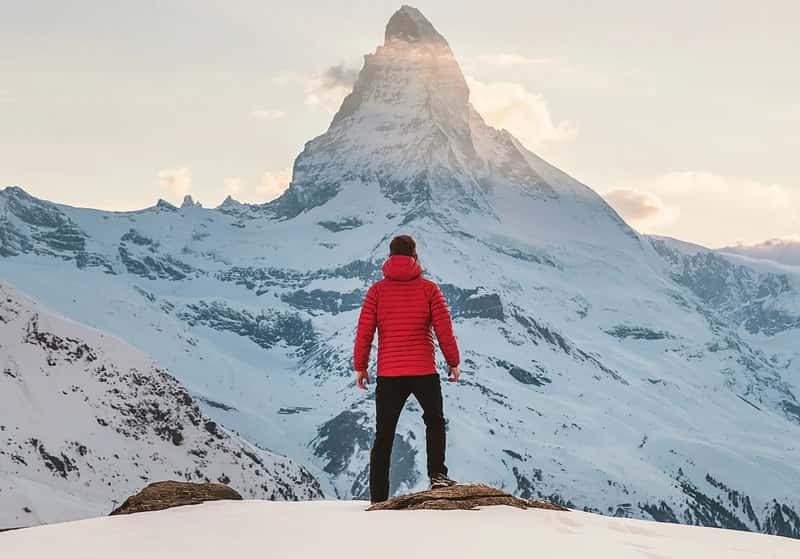
It closes – briefly, magnificently – on a ridge at 6,000 meters where the wind is indifferent and the world below looks genuinely small.
The pull toward extreme heights isn’t recklessness. It’s geometry. The architecture of a self trying to expand beyond the walls it’s been placed in.
Discrepancies between self-concept and reality can cause incongruence, leading to psychological tension and anxiety. The wider the gap, the more severe the emotional consequences tend to be. The mountain, paradoxically, is the relief valve.
2. The Escape Theory Nobody Wants to Admit
There’s a clinical framework for this. It’s called Escape Theory. And it’s uncomfortable reading for anyone who has booked a climbing expedition during a bad year.
Escape Theory, introduced by Roy F. Baumeister in 1990, is a pivotal framework within social psychology that elucidates why individuals engage in behaviors to flee from negative self-perceptions when their identity fails to meet personal or societal expectations. Unlike physical escape, this psychological escape involves shifting attention to the immediate environment to avoid confronting unflattering aspects of the self.
But here’s where altitude diverges from the textbook.
Most escape behaviors are passive. Scrolling. Drinking. Disappearing into a screen. Altitude-seeking is the opposite of passive. It demands everything. Your lungs. Your focus. Your fear.
The person first has a severe experience in which they realize that current outcomes fall below societal or self-imposed standards. Then they blame these disappointing outcomes on internal aspects of the self. Then they recognize that current outcomes portray the self as inadequate, incompetent, or guilty.
The mountain doesn’t let you be inadequate. It makes you adequate or it sends you home.
3. The Novelty Brain Is a Hungry Machine
Not everyone who climbs is running from something. Some are running toward something their nervous system requires.
To encourage novelty seeking – which is evolutionarily advantageous – the body produces less dopamine for repeated exposure to a stimulus. Research has demonstrated that novel exposure is positively associated with well-being.
The daily life that feels small isn’t necessarily a bad life. It may simply be a familiar one. And familiarity, neurologically speaking, is the enemy of aliveness.
The altitude-seeker is often someone whose nervous system demands more signal than everyday terrain provides. The commute, the inbox, the routines – they register as noise, not information. The mountain, by contrast, is pure signal.
Numerous motives beyond risk-seeking theory or surpassing personal boundaries could explain participation in extreme sports. These include connecting with the flow or quality of experience.
The altitude doesn’t just challenge the body. It floods the brain with data it hasn’t processed before. Every step is new. Every breath is earned. That is the antidote to smallness.
4. The Personality Profile of the High Climber
Psychology has spent considerable time trying to map the interior of a person who voluntarily goes to places where the air is insufficient.
Overall, extreme sport participants demonstrate emotional stability, conscientiousness, energy, novelty-seeking, self-directness, an adventurous profile, self-control, organization, openness, agreeableness, and grit.
These are not, notably, the traits of someone fleeing in chaos.
They are the traits of someone who has found that the only environment large enough to contain them is one that most people consider inhospitable.
These populations are adventurous in temperament with “the right stuff” – high novelty-seeking, low harm-avoidance, and reward-dependence – compared to low-risk sports participants and the general population. They are also highly self-controlled and organized in character.
The climber is not reckless. The climber is precise. The elevation is not an act of self-destruction. It is an act of self-definition.
5. The Summit I Didn’t Reach, and What It Told Me
I stood at just under 5,000 meters once, on a slope in the Andes that had decided, midway through a grey afternoon, that it was done cooperating with my ambitions. The guide turned around. The weather closed. We descended in silence.
I spent the next two days at a hostel table trying to identify the specific texture of what I was feeling.
It wasn’t disappointment. It was something more revealing. It was the recognition that the person I had been at sea level – efficient, composed, quietly dissatisfied – had no authority up here. The mountain had stripped that person away without asking permission. And in the gap that was left, something more honest had briefly appeared.
There’s a peculiar terrain we all pass through at least once, often many times. It’s that foggy, liminal space between identities, where you’ve outgrown one version of yourself but haven’t quite stepped into the new one.
The altitude didn’t give me clarity. It gave me evidence. Evidence that I was larger than my daily life had been allowing.
6. The Peak Experience Psychology Has Been Chasing
Abraham Maslow spent years trying to name what happens to a person at the outer edge of their capacity. He found it in the reports of self-actualized individuals – people who had reached beyond the ordinary scaffolding of their lives.
These transformational peak experiences were described by Maslow as “powerful, meaningful experiences in which individuals seem to transcend the self, be at one with the world, and feel completely self-fulfilled.”
The mountain is a peak experience machine.
Literally. Architecturally. The physiological stress, the reduced oxygen, the singular focus required to place one foot in front of the other – all of it conspires to strip the mind of its usual noise.
This moment of feeling wholly and completely the true self makes the peak experience an essential component of identity. The aftereffects of the peak experience leave the individual to see themselves and the world in a new way. They view themselves more positively, view life as worthwhile and meaningful, and most importantly, seek to repeat the experience.
This is why once is never enough.
7. Flow at Altitude: The Silence That Replaces the Noise
Mihaly Csikszentmihalyi built his entire career on the question of what it feels like to be fully alive. His answer – the flow state – maps with remarkable precision onto the interior experience of the high-altitude climber.
Flow has been described as a state of mind when one is completely immersed in their current activity: a subjective state that people report when they are completely involved in something to the point of forgetting time, fatigue, and everything else but the activity itself. In states of flow, a person is functioning at their fullest capacity.
At altitude, flow is not optional. It is the only mode of operation.
The daily self – the one that monitors emails, manages appearances, worries about its adequacy – cannot survive above 4,000 meters. It requires too much oxygen. What remains, stripped clean by thin air and physical demand, is something that feels like the truest version of who you are.
Research indicates that perception of challenge among recreationists has a positive impact on flow experience and, by extension, on satisfaction and psychological well-being. The mountain doesn’t give you happiness. It gives you the conditions under which your real self can briefly operate without interference.
8. The Self-Transcendence Paradox
Here is the strange mathematics of the altitude-seeker: they go up to become larger, but what the mountain actually does is make them feel smaller in the most liberating possible way.
One of the key personality traits studied in extreme sport athletes is Self-Transcendence, which is associated with spiritual ideas and experiences, such as searching for something elevated and greater than one’s individual self. High Self-Transcendence can motivate people to act altruistically even if that requires personal sacrifices and hardship.
The altitude-seeker is often searching for exactly this.
Not dominance over the mountain. Not conquest. Something closer to dissolution. The moment when the self-preoccupied narrative – the running inner monologue about inadequacy, performance, and social comparison – simply stops broadcasting.
At such times, individuals feel detached from the mundane particulars of their individual lives and sense that they are at one with a fully integrated universe. They perceive things in a nonjudgmental way, and they transcend their particular ego needs, becoming selfless or indeed “egoless.”
The summit is not the destination. The dissolution of the daily self is the destination. The summit is just the address.
9. The Calling That Doesn’t Clock Out
For many high-altitude climbers, this isn’t a hobby. It’s a compulsion that resists rational justification. Partners, finances, physical safety – none of it seems to be sufficient argument against going back.
A calling is defined as “a meaningful beckoning toward activities that are morally, socially, and personally significant.” The concept of calling can provide an interesting perspective into why experienced mountaineers engage in climbing regularly despite its heavy psychological, physical, and financial burdens.
The calling is the gap made audible.
It is the sound of a self that has experienced fullness and cannot return to smallness without resistance. As George Mallory, the iconic early Everest climber, explained his mountain fascination, he likened it to “the struggle of life itself upward and forever upward” to which man has an inherent need to respond.
He died on that mountain. But he died moving in the right direction, by his own accounting. The calling doesn’t promise safety. It promises alignment.
10. The Return Is the Hardest Part
Nobody writes about the descent with the same reverence they give the ascent. But psychologically, the return to sea level is where the real work begins.
Task-orientation, personal triumph, self-determination, and accomplishing goals important to oneself are much more important in motivating and enhancing the performance of experienced climbers across all ability levels. This suggests that climbers who push their limits are often those who have moved beyond esteem and toward self-actualization.
But self-actualization is not a permanent address. It’s a direction.
You come down from the mountain carrying something. A residue of the larger self you briefly occupied. And then the familiar compression begins. The inbox. The routine. The quiet smallness that reasserts itself with remarkable efficiency.
We live in perpetual pursuit of something we can’t quite grasp, all the while we’re engaged in the work of someone else’s design. We get the job, the house, the husband or wife, the business, the bank account, but gratification doesn’t seem to last.
This is why the climber is already planning the next climb before their boots have dried. Not because the last mountain failed them. Because it succeeded – and now they know the difference.
The difference between the life they are living and the life they are capable of living is measured, for some people, in meters above sea level. This is not a delusion. It is one of the more honest pieces of self-knowledge a person can carry. The altitude doesn’t lie. It doesn’t manage your feelings or soften its feedback. It simply presents conditions – and in those conditions, a version of you appears that your living room has never met.
The question the mountain leaves you with is never about the mountain. It is about the gap – the persistent, luminous gap between who you perform yourself to be and who you actually are when the performance is stripped away by thin air and physical necessity. The altitude makes that gap visible. And visibility, no matter how uncomfortable, is the beginning of something.
Maybe you don’t need a summit. Maybe you just need a moment high enough that the noise stops and something quieter, and truer, can finally be heard.