You book the jump three weeks out.
You don’t tell anyone at work.
You barely sleep the night before.
And when you finally step out of that plane – over a country where no one knows your name – something cracks open inside you that hasn’t moved in months.
That crack. That’s the point.
Modern life is engineered for comfort and chronically hostile to feeling. We live in temperature-controlled rooms, scroll through algorithmically curated dopamine drips, and call it living. We become performance artists of normalcy – telling the world we’re fine, telling ourselves we’re fine, and quietly wondering why nothing lands anymore. The “Identity Gap” is that gulf between the self we perform in fluorescent-lit conference rooms and the self who needs, desperately, to feel the wind at 120 miles per hour.
1. The Numb Baseline
It starts slowly. Imperceptibly.
You stop flinching at bad news. You stop leaning in during good news. The texture of a Tuesday becomes indistinguishable from the texture of a Saturday.
Chronic stress floods the body with cortisol, which over time dulls emotional responsiveness – a state known as “stress-induced anhedonia.” Prolonged high cortisol can even alter brain structures like the hippocampus and prefrontal cortex, areas crucial for emotional regulation.
This isn’t sadness. It’s quieter than that.
Numbness differs from sadness: sadness is an active emotion, whereas numbness reflects a shutdown of the brain’s emotional response system, often linked to neurotransmitter changes and chronic stress.
You are still functional. You are still showing up. But something behind your eyes has gone still, and you can feel the stillness even when you can’t name it. The vacation itinerary isn’t about escaping the city. It’s about escaping the flatline you’ve become.
2. The Dopamine Drought
Here is the chemistry nobody talks about at brunch.
Dopamine is more about motivation, energy, focus, and reward-seeking behavior. So while low serotonin might lead to deep sadness, anxiety, or irritability, low dopamine tends to manifest as apathy, fatigue, and disinterest in life.
Your brain isn’t broken. It’s depleted.
Some research suggests thrill-seekers may experience lower levels of dopamine and serotonin. The resulting constant search for these chemical surges makes sense.
The body knows what it needs before the mind catches up. When the morning coffee doesn’t register, when the promotion feels hollow, when the compliment slides off you like water – the nervous system starts sending a different kind of signal. It begins to look for something big enough to feel real.
That something, for a growing number of people, is the edge of an airplane door.
3. The Sensation Seeking Blueprint
There is a name for this drive. There has been for decades.
Sensation seeking is defined as “the tendency to seek novel, varied, complex, and intense sensations and experiences and the willingness to take risks for the sake of such experience.”
It isn’t recklessness. It isn’t stupidity.
Zuckerman’s basic proposition is that sensation seeking is based on individual differences in the optimal level of sensation caused by biological nervous-system differences.
Some nervous systems are calibrated to need more. More noise. More texture. More proof that existence is still unfolding in real time. When those nervous systems are denied, they don’t go quiet. They go searching. They pull up vacation booking sites at 11 PM and start comparing drop zones. They are not impulsive. They are responding to an interior alarm that has been ringing, politely, for quite some time.
4. The Anhedonia Connection
There is a clinical word for the world going grey.
Anhedonia: the inability to feel pleasure from things that once delivered it reliably. Food loses flavor. Music loses shape. Laughter becomes a performance rather than a reflex.
French scientists, based on skydivers research, found that sensation seeking can be an adaptive response to anhedonia – an inability to experience pleasure.
This reframes everything.
The person booking the bungee jump isn’t chasing adrenaline for sport. They are attempting a self-prescribed neurological correction. They are trying to override a system that has quietly ceased to respond to ordinary stimuli. The extreme experience isn’t the escape. It is the intervention.
Chronic stress, in return, affects the dopamine levels and dopaminergic neuronal activity, ultimately generating a “dopamine low” or anti-reward brain state linked to anhedonia and depression.
5. The Traveler in the Mirror
I booked a solo trip once – no plan, one bag, a destination chosen for the sole reason that the flight was the cheapest departing before dawn.
I didn’t know I was numb until I wasn’t.
Somewhere over the Atlantic, the cabin lights dimmed and the silence of 35,000 feet sat on my chest like a clean weight. I felt something stir – not joy, not grief, just presence. The specific, irreducible sensation of being a body in space, temporarily unmoored from every identity I’d been performing.
It wasn’t the destination that did it. It was the disorientation. The forced confrontation with an unscripted self.
That, I understand now, is what the jump is for. It isn’t the fall. It is the five seconds before the fall – when the mind, stripped of every distraction, finally has nothing left to do but feel.
6. The Nervous System as Navigation
Your nervous system is not just a biological system. It is a compass.
When we encounter a perceived threat or exciting situation, our adrenal glands release adrenaline, triggering a cascade of physiological changes. Your heart rate increases, your breathing quickens, and your senses sharpen.
In that moment, the fog lifts.
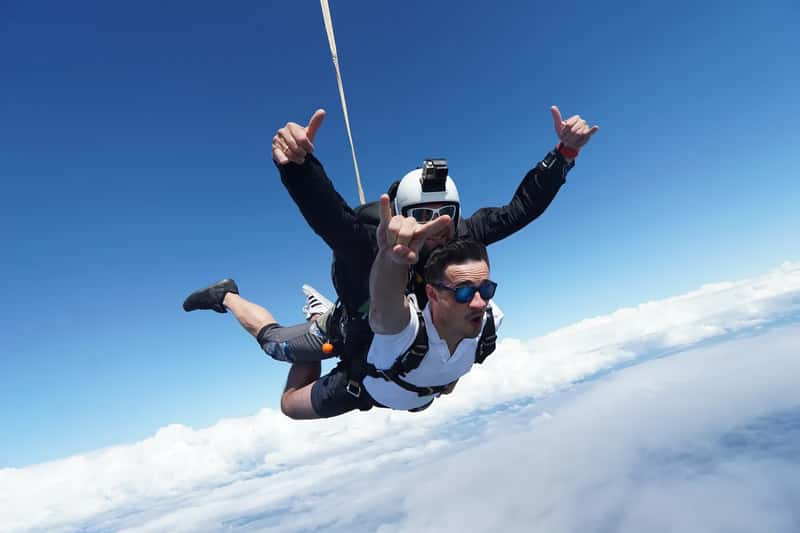
Skydivers often describe a profound sense of freedom and clarity that comes with freefalling through the air. It’s as if the noise of everyday life fades away, leaving only the present moment and a heightened awareness of one’s own existence.
What the numbed self is seeking, at its core, is not danger. It is signal. Undeniable, unignorable, chemically authentic signal. In a world that has taught us to suppress, medicate, and optimize our emotional lives, the nervous system staging its own coup – via skydiving harness – is, in a strange way, the most rational thing a person can do.
7. The Tolerance Trap
There is a shadow side to this that must be named.
While participating in extreme sports can help some people with emotional regulation and fear management, this may also lead to an increased tolerance or almost numbness to fear and danger.
The irony is surgical.
The very mechanism used to break through numbness can, over time, manufacture a new and more resistant numbness. The nervous system adapts. The threshold rises. The jump that once cracked everything open begins to feel routine. So you climb higher. Book the more extreme itinerary. Sign up for something the old version of you would have considered insane.
A natural reward at first decreases the reward threshold, while the chronic addiction to a substance or a behavior increases this threshold, hence the need to consume more of a given drug to reach it.
The pursuit of sensation is a spectrum. Understanding where you are on it – and why – is the more important journey.
8. The Identity Held Aloft
There is something specific that happens to identity when you are mid-air.
Every role you carry disappears. The job title. The relationship status. The carefully maintained persona of someone who has things together.
Beyond the rush of adrenaline and the thrill of freefall, skydiving offers a unique opportunity for personal growth and self-discovery. Many skydivers report that the sport has had a profound impact on their lives, extending far beyond the dropzone.
What remains when the roles are stripped away?
That is the question high-pressure travel is really asking. Not “can I survive this?” but “who am I when I am only surviving this?” The temporary identity – the one that exists purely in the present tense – is often more honest than the one maintained through years of careful social construction. You go up as one person. You tend to land as someone slightly more legible to themselves.
9. The Exit Strategy Disguised as Adventure
Not everyone books the jump because they love the sport.
Some book it because they need a door.
When you experience prolonged stress, your brain can shift into a conservation mode. Instead of staying hyper-alert forever, it may begin to shut down responsiveness. This is sometimes referred to as emotional blunting. Your nervous system essentially says: “If everything feels overwhelming, let’s turn down the volume.”
The vacation becomes a workaround. A sanctioned permission slip to feel things the ordinary week has decided are too inconvenient to accommodate. And there is nothing shameful in that. The desire to exit – even temporarily – the conditions producing your numbness is not weakness. It is intelligence. It is the psyche doing what the psyche does best: finding a way through when the direct route has been sealed.
In our modern world, where many of us spend our days in front of screens, the allure of intense, real-world experiences can be strong. Adrenaline-pumping activities offer a stark contrast to the monotony of everyday life, providing a sense of excitement and vitality that many find lacking in their day-to-day existence.
10. The Body Knows Before You Do
This is the heaviest point. Sit with it.
You did not decide, rationally, to jump out of a plane. Something in you decided first – something older than language, older than the part of you that reads productivity articles and answers emails at 10 PM.
After emotional trauma or prolonged psychological strain, the brain may protect itself by numbing. This isn’t weakness – it’s a defense mechanism.
And the body – the patient, insistent body – knows it needs the opposite of protection. It needs exposure.
Your brain has several chemicals that all contribute to your overall sense of happiness and well-being, like endorphins, dopamine, and serotonin. The release of these chemicals can give you a rush or natural high. New adventures that have an element of fear, like skydiving or roller coasters, cause your brain to release several of these “feel good” chemicals, some of which linger in your body for quite a while, creating a natural feeling of great happiness.
The body is not chasing danger. It is chasing proof. Proof that the system still works. Proof that joy is still mechanically possible. Proof – urgent, kinetic, undeniable – that it is still alive.
There is a version of you that sits very still in a very comfortable chair and feels nothing in particular. That version is not your failure. That version is your response to a world that asked too much for too long and offered too little in return. The numbness was a solution before you even knew there was a problem.
And so you board the plane. Not as an escape artist, but as someone attempting, with great sincerity and some amount of terror, to renegotiate the terms of their own feeling life. The altitude is incidental. The harness is incidental. What is not incidental is the choice – the active, embodied, trembling choice – to interrupt the static long enough to hear what’s underneath it.
The ground comes up fast. And for a few extraordinary seconds, every version of you that you’ve ever performed simply ceases to exist – and what’s left, breathless and blinking in the sudden stillness, is the one that was always true.