The flight lands at midnight. You don’t sleep.
You’ve booked a ticket to somewhere old. Somewhere broken. Somewhere that has already fallen apart and somehow survived the falling.
The modern city outside your window glows too hard. It asks nothing of you except consumption. It offers no wound to press your finger into.
But the ruins – they ask everything.
There is a version of you that functions perfectly in the present tense. Answers emails. Attends meetings. Laughs at the right moments. And there is another version – quieter, older, more honest – that only surfaces when you are standing inside something that has already collapsed. That version recognizes the stones. That version feels, inexplicably, at home in the wreckage.
This is the self you actually inhabit. Between the glass tower you live inside and the crumbling amphitheater where you finally breathe. Between who you tell people you are, and who you become when everything around you is already, irrevocably, temporary.
1. The Permission to Be Broken
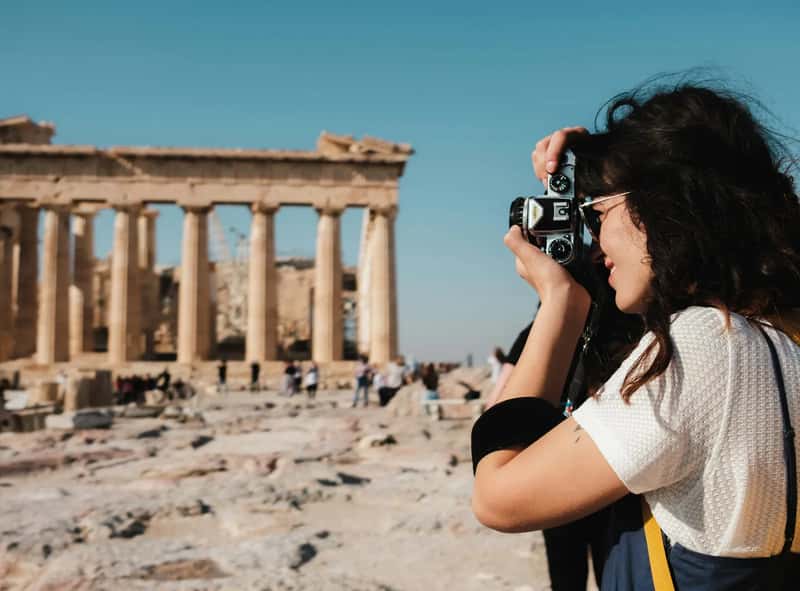
Ruins carry a kind of beauty that doesn’t beg for attention. It’s not polished. It’s not airbrushed. It’s been through something. That’s part of why we connect with them. Because we’ve been through something too.
Modern cities demand performance. Glass and steel require you to be reflective, sharp, unblemished.
Ruins do not. They are already cracked. Already missing their roofs.
And something in you recognizes that as mercy.
The person who is drawn to ancient places is often someone carrying an invisible fracture – a grief they haven’t named, a failure they haven’t forgiven, a version of themselves they quietly abandoned somewhere along the way. The ruins don’t ask them to fix it. They just stand there, broken and magnificent, whispering that broken things can still be worth crossing continents to see.
This is the first psychological gift of the ruin: permission. Permission to be imperfect in a world that has run out of tolerance for imperfection. You walk through the collapsed archway and feel, just for a moment, that your own collapse is not a disgrace. It is, perhaps, even beautiful.
2. The Mortality Mirror
A ruin is a deadline made visible.
It is the evidence that everything – every empire, every certainty, every carefully constructed identity – eventually turns to dust and ivy.
Our mental abilities facilitate an awareness of inescapable mortality, creating the potential for debilitating anxiety about death. And so we run from that awareness. We build faster cities. We optimize harder. We scroll past anything that makes us feel small.
But sometimes, we board a plane and go stand inside a coliseum.
Ruins speak to the passage of time. From the tangled gardens of the Roman Colosseum to the towering summit of Machu Picchu, ruins inspire evocative melancholy and force us to pause – to regain moments of stillness – amidst the rush of modern life.
There is a psychological release in that stillness. The person who gravitates toward ruins isn’t morbid. They are, in fact, more honest about the human condition than the person who has never once looked directly at an ending. To stand in a ruin is to rehearse impermanence without the terror. It is mortality management disguised as tourism.
3. The Nostalgia That Isn’t About the Past
Here is the strange paradox: the nostalgia you feel at ancient ruins is rarely for a time you actually lived.
You were not there. You did not walk those streets when they were whole.
And yet you grieve them.
During heritage tourism, when people experience vicarious nostalgia triggered by ancient ruins, they fantasize that they are living in past eras and experiencing historical events. Psychologists call this vicarious nostalgia – a longing not for your own past, but for a past you’ve constructed in your imagination.
What you are actually mourning is the version of yourself that felt continuous. Whole. Legible.
Researchers have identified four components of nostalgia: self-reflection, autobiographic memory, emotion regulation, and rewards. Each one fires when you stand inside something ancient. Your brain is not just sightseeing. It is performing deep, involuntary maintenance – searching the rubble for the self it misplaced somewhere in modernity.
The ruin becomes a mirror. And the face looking back is one you forgot you missed.
4. The Awe Reset
Modern cities are impressive. They are not awesome. Not in the original, psychological sense of the word.
Awe requires scale. It requires you to feel small.
We want to feel small. We want to feel ancient. Ruins let us do both.
And that smallness is not humiliation – it is relief. The tyranny of modern selfhood is the belief that you must be the center of your own narrative at all times. Social media has weaponized this tyranny. Your worth is measured in metrics. Your identity is a product. Your presence is content.
Then you walk into the shadow of a 2,000-year-old temple and your personal brand suddenly feels very, very small.
We experience awe, which quiets the default mode network and evokes mindfulness. That quieting – that brief, blissful silencing of the self-obsessed mind – is what ruins actually offer. Not history. Not culture. An exit from yourself. A temporary, merciful dissolution of the ego that modern life keeps inflating.
5. The Identity Archaeology
I have a confession. I have stood at the edge of Pompeii at dusk, after the tour groups left, and felt something I can only describe as recognition. Not nostalgia. Not wonder. Recognition. As if the ash-preserved city was showing me something about my own interior that I had spent years trying not to look at directly. The city had been frozen mid-collapse. And I had been too.
As one researcher put it: “Every ruin is a place where a physical object was torn apart, and that happened because of some historical force… it’s because huge historical forces have washed over it. So, each ruin is a window into a particular historical moment where something changed.”
That is what ruins do to the identity-seeker. They externalize the internal. They give form to the formless grief of being a person in transition.
You are not just visiting the ruins of Rome. You are visiting the ruins of a self that no longer exists. The job you left. The relationship that ended. The version of you that believed certain things and doesn’t anymore. The rubble is yours. The ivy growing through it is also yours. Psychologists confirm that memory serves an identity function: using memories to clarify one’s self-concept. Ancient ruins simply make that process physical – and somehow, finally, bearable.
6. The Exit Strategy
Not all wanderers are running away. But many are.
And that’s not a character flaw. It’s a survival strategy.
Modern life tells us to move fast, scroll past, optimize. But ruins ask something different: Stay. Be. Feel. They offer a kind of slow reverence we rarely grant ourselves.
The person who chooses crumbling columns over gleaming skyscrapers is staging a quiet exit. Not from life – from pace. From the grinding, compulsory velocity of modern existence. They are choosing a geography that enforces slowness. You cannot rush through Petra. You cannot scroll past the Parthenon. The scale demands your full presence.
Psychologically, this is significant. When someone is overwhelmed by the demands of the self they’ve constructed – the career, the relationships, the obligations that have piled up until they constitute a kind of identity prison – they seek environments that offer temporary amnesia. Not forgetting who they are. Forgetting who they have to be. The ruin offers both the exit and, paradoxically, the way back in.
7. The Continuity Thread
There is a quiet terror in feeling discontinuous.
In feeling that the person you were at twenty has no relationship to the person reading this now.
There is a unique linkage between nostalgia and self-continuity. In studies, participants who reflected on nostalgic occasions showed an amplified effect on self-continuity, reporting feeling more connected to their past.
Ancient ruins provide that thread through sheer temporal audacity. They have outlasted everything. Kingdoms. Languages. Gods. And they are still standing – cracked, reduced, but present.
When you stand inside that continuity, something in your nervous system relaxes. If these stones survived, your story might too. If this civilization’s collapse was not its final word, perhaps yours isn’t either. Researchers have documented nostalgia’s beneficial functions, including strengthened social connectedness, continuity of self, enhanced self-esteem, and comfort in the face of threatened mortality. The ruin is nostalgia made architectural – a three-dimensional proof that things which fall apart can still, over centuries, tell a coherent story.
8. The Scale of Suffering
Your pain has a context problem.
Inside the modern city, your private collapse feels enormous. Unique. Uniquely unfair.
But stand at the base of a wall that witnessed the fall of an empire and something recalibrates.
Visiting ancient ruins creates a growing awareness that what you’re seeing is more than just stones: they were testimonies to individuals who had once lived, loved, laughed, and been very much alive. They were long gone, but thousands of years later they still told a story.
The people who built these structures suffered. They lost wars. They lost children. They lost entire civilizations. Their gods failed them. Their economies collapsed. Their languages died and took entire worlds with them. And yet – here are their walls. Their columns. Their carved, dancing figures still frozen mid-movement on temple facades.
There is a specific, profound psychological relief in the scaling of suffering. Your divorce, your grief, your quiet daily dread – it does not diminish in the shadow of a ruin. It becomes, instead, part of something larger. Older. More human.
9. The Unfinished Self
Ruins are memory made visible. They are the bones of architecture: the body long gone, but the shape of life still lingering.
The person drawn to ruins is almost always someone mid-construction.
Not broken beyond repair. Not finished. Mid-construction.
They are drawn to things that are also mid-construction – partially destroyed, partially preserved, the original blueprint visible in what remains. The ruin says: you do not have to be complete to be meaningful. Incompletion is not failure. It is evidence of process.
As one researcher framed it: “Everyone who comes to a ruin brings a different perspective and a different story and a different meaning. And all the time, the ruin is just sitting there, kind of meaning nothing. It doesn’t mean anything by itself. It needs somebody to come along and give it meaning.”
That is the transaction. The unfinished person presses their incompletion against the ruin’s incompletion – and in the friction of that contact, something clarifies. The ruin absorbs the projection. It becomes a canvas for the part of yourself you haven’t yet been able to articulate aloud.
10. The Surrender
This is the heaviest one. This is the one they don’t put on the travel brochure.
The deepest psychological draw of ancient ruins is not beauty. It is not history. It is not even meaning.
It is the evidence of surrender.
Existential threats – including meaninglessness, mortality awareness, social exclusion, and stress – intensify our search for nostalgia; and in turn, nostalgia alleviates the impact of that threat, assuaging existential anxiety and repairing interpersonal isolation.
The ruins are the physical proof that even the greatest human endeavors eventually let go. The Roman Empire did not cling to its own rubble. The Maya cities did not refuse to fall. They fell. Completely. Without apology. And in that falling, they became something more enduring than they ever were when standing.
Nostalgia strengthens approach orientation, raises optimism, evokes inspiration, boosts creativity – and far from reflecting escapism from the present, it potentiates an attainable future.
The person who stands at the edge of a collapsed civilization and feels peace – not despair, not pity, but peace – is the person who is finally, quietly, practicing their own surrender. They are rehearsing the release of the self that no longer serves them. They are standing inside the proof that collapse is not the end of the story. It is, often, where the most interesting part begins.
There is a particular kind of silence that settles over you when you are the only person standing in a place that once held thousands. The wind moves through broken columns. The grass reclaims the floor of what was once a throne room. And you realize that every civilization that ever fell believed, right up until the end, that it wouldn’t.
You are no different. Your internal empire – the carefully maintained story of who you are, what you’ve built, what you’ve survived – is also subject to the same forces. Time. Change. The slow, patient pressure of becoming someone you haven’t met yet. The ruins don’t warn you about this. They simply demonstrate it, without judgment, in stone and moss and late afternoon light.
Perhaps that is why we keep going back. Not to learn history. Not to photograph columns against golden-hour sky. But because something in us already knows what it is to have been magnificent, and to have come undone – and we need to see, with our own eyes, that what comes undone can still, centuries later, be worth the journey.
The city you came from will still be there when you return. The notifications. The pace. The performance. But you will carry, somewhere just below the sternum, the quiet knowledge that you stood inside something that fell completely apart and called it beautiful – and in doing so, gave yourself permission to call your own falling apart beautiful too.