The drawer is right there.
Empty. Waiting. Completely harmless.
You don’t touch it.
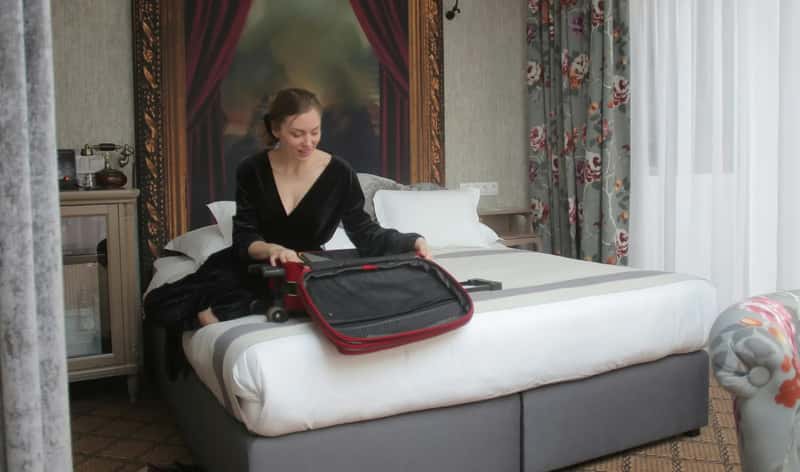
Your suitcase stays zipped on the luggage rack like a soldier standing at attention. Your clothes stay folded inside it. Your toiletries stay in their pouch. You live out of that bag for five days like you’re expecting someone to knock on the door at 2 AM and tell you it’s time to leave.
Nobody knocks. But you stay ready anyway.
This is the silent distance between the person who books a hotel room and the person who actually inhabits it. One version of you is a traveler on a trip. The other is a child who learned, somewhere deep in the marrow of a formative year, that getting too comfortable is the first step toward getting hurt. Childhood is a critical period for the development of identity and a sense of belonging, and stability – both in physical environment and social connections – plays a crucial role in that process. When children move frequently, especially during formative years, it can disrupt the continuity needed for stable identity formation.
The drawer isn’t just a drawer. It’s a test you’ve been failing since you were eight years old.
The Temporary Identity
You have a whole personality built around not needing things.
You travel light. You adapt fast. You pride yourself on being someone who can land in a new city, orient quickly, and function without fanfare. It reads like resilience. It feels like freedom. But underneath that fluid, frictionless exterior is something older and more anxious.
It is an identity constructed entirely around impermanence.
For many people, navigating developmental challenges leads to the emergence of hyper-independence – a rigid form of self-reliance that resists not only support but also the vulnerability that comes with genuine connection. The hotel room is where that hyper-independence becomes architectural. You don’t unpack because unpacking means admitting you’re here. And admitting you’re here means something can be taken away.
This is not a travel preference.
This is a survival strategy wearing a carry-on bag.
The temporary identity protects you. It keeps you mobile, non-committal, always one zip away from departure. It also keeps you from ever truly arriving anywhere – in a hotel room, in a relationship, in yourself.
The Exit Strategy
Every unpacked suitcase is a subconscious exit strategy.
Think about what it means to keep your clothes inside that bag. It means you can be gone in four minutes. Grab it. Roll it. Leave. No drawer to empty, no forgotten sock, no evidence you were ever really there. The room stays a room. You stay a ghost passing through.
Fear plays a significant role in our inability to let go of possessions and behaviors. Common fears include the worry that we might need something in the future, fear of losing memories associated with objects, and anxiety about wasting money or resources. But in the context of the non-unpacker, the fear runs in reverse. It is not the fear of losing things. It is the fear of having things. Of building anything, even temporarily, that will cost something to dismantle.
The exit strategy is not about the hotel.
It was rehearsed in a childhood bedroom that got packed up too fast. In a house that stopped feeling like home before the boxes were even gone. The body remembers. The body keeps the bag packed.
The Childhood Architecture
Somewhere, a child decorated their room.
Posters on the wall. A specific arrangement of stuffed animals. A windowsill that belonged to them. Then one evening, a conversation filtered through a closed door. Words like “transfer” and “lease” and “by the end of the month.” And suddenly, that decorated room was just a room.
Many people in psychotherapy report that some form of moving during their childhood and teenage years – from school to school or from house to house – felt traumatic to them. Psychologists suggest the culprit is an unmooring range of negative feelings: loss, grief, loneliness, fear of the unknown, lack of social support, frustration, stress, and helplessness.
The child who lived through that learned a brutal lesson.
Investment is risk. Settling is exposure. The more you make a place yours, the more it will cost you when it’s taken.
That lesson didn’t stay in the old house. It packed itself quietly into the nervous system and moved with you. It still shows up every time you stand in front of a hotel dresser and decide – instinctively, automatically, without even thinking – to leave the drawer untouched.
The Neuroscience of Not Belonging
The brain is a prediction machine.
It runs constantly on pattern recognition, scanning the environment for threats based on what happened before. In a move, the brain loses its working map of its life and has to start from square one. It’s hard. That loss of familiarity is what makes moving so stressful and traumatic.
Now bring that same brain into a hotel room.
The pattern recognition fires. The room is temporary. The tenure is brief. The emotional precedent says: don’t invest. And so the behavior follows. The drawer stays closed not because of hygiene or practicality, but because the amygdala – your ancient, hair-trigger alarm system – has already filed this room under “transitional space” and issued a quiet order to stay light.
Our relationship with physical possessions goes far deeper than mere ownership. Neuroscience research has shown that when we form attachments to objects, the same areas of our brain activate as when we form connections with people. By that logic, refusing to place objects into a space is refusing to attach to it. The closed drawer is a neurological boundary. A border between self and place.
The First Hotel Room I Remember
I was eleven. We were between houses – a phrase my parents used that I now understand meant we had lost one before we had found another.
We stayed in an extended-stay motel for six weeks. I remember the carpet was the color of dried mustard. I remember my mother hung one thing on the wall – a single framed photograph of our old backyard – and then stared at it every morning with a cup of coffee like she was trying to climb back through it.
I never unpacked my bag once. Not even my toothbrush. I kept it in the front pocket, accessible. Ready. A suitcase holds everything together and gives a solid border to an emotional and powerful story. You travel through life and pack and unpack your emotional baggage in your own way. I didn’t know that then. I just knew my bag felt safer closed.
I still can’t open a hotel drawer on the first night. Something in me won’t allow it. The logic is thirty years old and completely irrational and absolutely immovable. The body remembers what the mind has long since explained away.
The Performance of Readiness
There is a type of traveler who looks effortlessly prepared.
Everything is curated. The packing cubes are color-coded. The itinerary is loose but confident. They move through airports like water. They look like someone who has mastered the art of going.
But watch them in the room. Watch how they live out of the suitcase. Watch how they never quite settle. Psychologists and travel experts suggest that persistent travel habits have more to do with psychology than logistics. Anxiety, attachment, and past experiences all play a role. “Travelers often pack for their fears instead of their needs.”
The performance of readiness is exhausting.
It requires constant maintenance of the illusion that you are fine with leaving at any moment. That you have no roots in this room, this city, this life. The performance is convincing. It convinces everyone, including you, right up until 3 AM when you’re lying in a hotel bed staring at a closed drawer and wondering why you feel so perpetually in transit.
The Attachment You Never Made
Psychologists talk about secure attachment – the bedrock confidence that a place, a person, or a situation will still be there when you return to it.
Moving can be very disorienting to a young child. They are tiny creatures in a world full of giants and much confusion. They rely on predictability and attachment to caretakers to generate a sense of security. When that predictability is violated by a sudden move – especially a move the child had no say in – something in the attachment circuitry misfires.
The child learns that places are not permanent.
That lesson metastasizes. Places become temporary. Rooms become waypoints. And the hotel drawer – that small, humble wooden rectangle – becomes the precise object against which thirty years of attachment disruption finally presses.
You don’t open it because opening it means belonging here. Belonging here means this place matters. And the six-year-old still running the emotional switchboard learned a long time ago that places that matter disappear.
The Weight of the Suitcase
Consider what you’re actually carrying.
Fresh out of a childhood, the people caring for you start to fill your metaphorical suitcase with everything they think you’re going to need. They pack the beliefs that have always worked for them, and the values they consider most important. You pack heavy emotions like hurt, fear, and sadness caused by harsh words, physical or emotional abuse, parental neglect, or unstable environments.
The physical suitcase and the emotional suitcase are the same object.
The refusal to unpack one is inseparable from the refusal to unpack the other. Fear of forgetting something essential, attachment to comforts from home, and unpredictability – like sudden weather changes or unexpected events – often lead travelers to carry more than they realistically need. But the heaviest items in the bag are invisible. They are old decisions. Old losses. Old rooms left behind.
The suitcase stays packed because the grief never got unpacked either.
The Identity Gap in the Room
Here is the gap, drawn in sharp relief.
The person you present to the world is adaptable, self-sufficient, easy with change. The person standing in that hotel room at 10 PM, bag untouched, is still waiting for the next disruption. Adults who moved frequently during childhood were significantly more likely to suffer from depression than those who grew up in stable environments. Individuals who moved more than once between the ages of 10 and 15 were 61 percent more likely to experience depression in adulthood. This increased risk can be attributed to the cumulative stress of relocating during critical developmental stages.
The gap between those two people is not filled with resilience.
It’s filled with vigilance. Chronic, low-grade, background vigilance that never got the all-clear signal. Emotional habits can be understood as automatic reactions that were instilled through repetition of exposure to situations that share common qualities. The habit of not unpacking is one of those reactions. It was instilled through repetition. Through bedrooms packed up too quickly. Through schools left without a proper goodbye.
The identity gap is the distance between who you had to become and who you actually are.
The Drawer as Mirror
The drawer is still there.
On the last night of the trip, you finally open it. Not to use it. Just to look. It’s empty, of course. Nobody leaves anything in hotel drawers. The cleaners would have found it anyway. There is nothing in there except the faint smell of cedar and other people’s brief residencies.
Psychologists who study memory and attachment note that tangible objects often help anchor experiences emotionally. When we touch or see those objects later, our brain replays the original feeling in subtle ways. But you aren’t putting anything in here. You’re just looking at the space.
The space that represents everything you never let yourself have. Permanence. Rest. The quiet confidence that you are allowed to be here, to take up room, to put your things away and trust they’ll still be there in the morning. Children in early development are just in the process of separating from their parents and adjusting to new authority figures and social relationships. Relocation can interfere with that normal process of separation by causing them to return to a more dependent relationship. That interference echoes. It echoes in the unopened drawer of a hotel in a city you’ll leave tomorrow.
You close the drawer again. Softly this time.
Not because you’re afraid. Just because the room is fine as it is.
Somewhere between the person who couldn’t open it and the person who finally could, there is a quiet reconciliation taking place – not loud, not dramatic, not the stuff of therapeutic breakthroughs. Just a hand on a wooden handle. Just the simple, radical act of considering that you might, someday, be somewhere long enough to put something down.
Maybe that’s enough for tonight. The drawer can wait. So can the settling. There is no rush, and no one is coming to make you leave before morning. The suitcase will be there when you need it. But so, for once, will you.