The concrete is cold to the touch.
You press your palm against it anyway.
Something recognizes something.
You’ve been in three countries in nine days, and still – this grey slab of a building in Belgrade is the first thing that has felt honest.
Here is the difference between the curated self you pack into a carry-on and the raw, inarticulate self that follows you through customs. We polish our surfaces. We ornament our social edges. We arrive in new cities wearing the fiction of who we’re supposed to be. But something happens when the scenery refuses to participate in that fiction. Something happens when the architecture doesn’t bother to flatter you.
1. The Architecture Doesn’t Lie
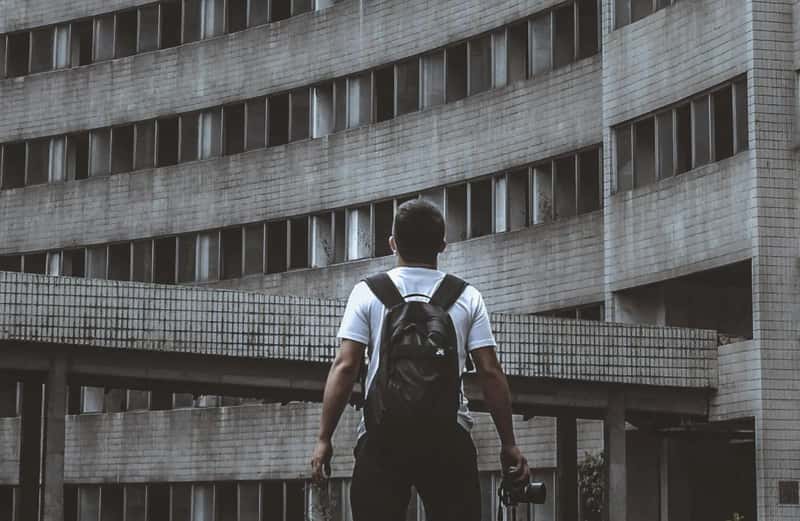
There is a reason brutalism makes people react so strongly.
Brutalist architecture often elicits strong reactions – discomfort, awe, indifference, or affection – because its formal language and social history activate sensory, cognitive, and cultural responses.
It doesn’t seduce you. It doesn’t try.
The deeper idea behind brutalism was honesty in construction and expression. The building is what it is. The concrete is exposed. The structure is visible. There is no decorative veil draped over the skeleton. And for certain travelers – the ones who’ve spent years constructing elegant facades over their own internal damage – that radical honesty is not ugly. It’s a revelation. The traveler who stands before a brutalist monument in Bratislava and feels something shift inside their chest is not experiencing aesthetic confusion. They are experiencing recognition. The building looks the way they feel on their most private days.
That is not a small thing.
2. The Weight That Holds You Down Also Holds You Up
Exposed, monolithic concrete, large geometric masses, and heavy cantilevers create a sense of visual gravity.
That weight is not accidental.
For post-war Eastern Europe, the weight was the point. Despite the intrinsic differences of each work examined, the brutalist structures aimed to appear imposing, solemn, giant and massive. The main idea was to communicate solidity and strength in a critical moment for European and world history: the years following the Second World War. These buildings were not built to be charming. They were built to endure. And people who have survived their own private wars – grief, fracture, the slow collapse of a version of themselves they’d clung to – respond to endurance. Deeply. The traveler drawn to Eastern European concrete is often someone who knows what it means to hold themselves upright when the weight feels unbearable. They recognize the structural logic in it. The brutalist block is not just a building. It is a lesson in load-bearing.
3. The Communist Ghost and the Personal Ghost
There are two histories layered into every brutalist wall in Eastern Europe.
There is the political history. And there is yours.
With socialist history drilled deep into their stark forms, the soaring 1950s and 1960s residential blocks and civic centres of the Serbian capital were once thought of as bold, visionary and futuristic in communist-era Eastern Europe. That ideology – the attempt to build a better world through radical simplicity, the utopian impulse crashing into hard reality – echoes in the bones of anyone who has ever believed deeply in something that didn’t survive contact with the world. Brutalism’s historical link to austere postwar welfare-state institutions, prisons, and modernist utopian projects can prime emotions – cold bureaucracy, surveillance, or decay. But the traveler who seeks these buildings isn’t fleeing into dysfunction. They’re standing inside someone else’s ambition and rubble, and finding, quietly, that it rhymes with their own.
Both ghosts haunt the same corridor.
4. The Mirror Made of Stone
Psychology has long explored the idea of the external world as mirror.
Environments don’t just contain us. They reflect us.
Architecture is more than just the creation of buildings and spaces; it’s an art form that profoundly influences how we feel, interact, and even perceive the world around us. From the sweeping curves of a grand staircase to the sharp lines of a modern skyscraper, every design element in architecture has the potential to evoke emotions, shape experiences, and guide human behavior. This interplay between architectural forms and human psychology is what we call “emotional design.” The traveler who photographs a brutalist monument at dawn is not just framing a composition. They are framing a version of themselves. The structure’s sharp geometry, the unapologetic heaviness, the refusal of ornament – the angular lines of brutalist architecture convey strength, functionality, and a rejection of ornamentation – all of this becomes a self-portrait for the person standing before it. Not who they pretend to be. Who they actually are.
5. The Moment I Understood It Personally
I remember the morning I stood beneath the Buzludzha monument in Bulgaria. The fog hadn’t lifted.
The House of the Bulgarian Communist Party is Bulgaria’s largest brutalist monument. Standing on Mount Buzludzha in the Balkan Mountains, it casts a dramatic – if desolate and desecrated – picture today.
I had been traveling for six weeks. I was running from the version of myself I’d been at home.
I expected to feel like a tourist. Instead, I felt seen. The building was cracked. Rain had stained the concrete. Someone had broken out the windows years ago. But it was still standing. The dome still cut the sky. I understood, in a way I couldn’t have articulated at the time, that the building and I were having the same conversation. About what survives deterioration. About what keeps its shape when everything else has fallen away. The tension between the physical and the psychological, whereby corporeal struggle intertwines with an abstract, aesthetic admiration of the brutalist objects, was no longer an academic concept. It was standing in my chest, cold and immovable and unmistakably mine.
6. Imperfection as a Form of Radical Honesty
The perfectly preserved building makes you feel inadequate.
The weathered, imperfect building makes you feel accompanied.
The ImperfectCity initiative uses the psychology of brutalist architecture to free young people from an unrealistic “culture of perfection” and help them thrive. There is deep liberation in a building that doesn’t apologize for its cracks. As one project manager puts it, “Architecture physically represents imperfection – both in terms of buildings and cities and, more importantly, acknowledges that we humans are not perfect.” For travelers who carry invisible damage – the quiet accumulation of loss, failure, and reinvention that defines a lived life – Eastern European brutalism offers something almost therapeutic. The building has sustained damage. The building is still standing. It does not hide what happened to it. That is not a weakness. That is, in psychological terms, the most honest form of strength available to any structure, human or otherwise.
7. The Body Knows Before the Mind Admits
The body responds before the brain can make an argument.
You stand in front of the Genex Tower in Belgrade. At 36 storeys and 505 feet high, the brutalist Genex Tower is the Serbian capital’s tallest building. Your nervous system processes scale before your intellect processes aesthetics. And something in the body – the part that operates below language – registers: this is not decorative. This is load-bearing. This was built to take pressure. Despite researching brutalist architecture for years, one researcher noted being unprepared for the true corporeal experience of exploring these buildings – reading back through journals revealed an evident conflict between stylistic admiration and physical uneasiness. That unease is important. It is the body processing the building’s honesty, the way it resists comfort. And there are people who are drawn precisely to that resistance. Because they recognize it. Because it is how they have survived.
8. The Pilgrim Who Travels Toward Difficulty
Not all travelers are running away from something.
Some are running toward it.
Some architectural tour operators now offer immersive cultural tours that explore how post-World War II politics shaped the design, identity, and urban landscape of the newly formed socialist state of Yugoslavia. These tours are selling out. The people booking them are not just architecture enthusiasts. They are identity pilgrims. People who need to stand inside a history of difficulty to understand their own. A Belgrade architecture tour was described as more than just an exploration of buildings; it was an exploration of identity, both personal and collective – a journey that left a deeper understanding of a city and its people. The brutalist landscape of Eastern Europe has become, for a certain kind of traveler, what the cathedral was to medieval pilgrims. Not comfort. Not beauty in the conventional sense. But a place where the soul can stand upright in the presence of something that understands difficulty.
9. The Phenomenon of Uncanny Recognition
Psychologists call it the uncanny. Architects call it atmosphere.
Travelers just call it the moment the hair rises on your arms.
Scholars have sought to illuminate the emotional qualities of brutalist constructions through a neo-phenomenological perspective – using the concept of atmosphere not only to highlight the emotional qualities of brutalist constructions but to prove their affectivity as one of the possible solutions to the problem of lost resonance in contemporary society. Lost resonance. That phrase cuts deep. We live in an age of surfaces – algorithmic feeds, curated aesthetics, the relentless optimization of the presentable self. And then you arrive in Sarajevo and stand before something that was built with zero interest in your approval. Perhaps brutalism succeeds because its materiality allows us to experientially retrieve something impossibly deep in our collective human memory, something that goes beyond styles and fashion. That retrieval is not intellectual. It is older than thought. It is the part of us that remembers we were built, like the building, to endure.
10. The Building That Survived Everything
Here is what the brutalist monuments of Eastern Europe have in common with the travelers who seek them.
They have both been through a great deal.
They are both still standing.
Few building styles have made an impact on a region, or caused as much controversy, as brutalist architecture in the former Communist Bloc. These structures absorbed ideology, neglect, regime change, the gaze of generations who despised them, and decades of weather. And they remain. Scarred, streaked, sometimes shattered – but architectural facts in the landscape that cannot be unseen or easily undone. The earthy and resilient nature of brutalist materials – usually concrete – rooted heaviness, and untreated surfaces make brutalist edifices age at a different rate than other constructions, and therefore be felt as belonging to another time, if not timeless. For the traveler who has rebuilt themselves after profound loss – who carries the watermarks of what they’ve been through on surfaces most people never see – that timelessness is not an architectural attribute. It is a kinship. The building has survived everything that was thrown at it. You recognize that survival with something more than your eyes.
There is a particular quality of silence that exists between a person and a building when genuine recognition occurs. It is not the silence of emptiness. It is the silence of two things that have both been tested, resting briefly in the same space, not needing to explain themselves to each other.
The pilgrim of brutalism is not, as the postcards would have you believe, some cold aesthete obsessed with grey geometry. They are someone who has learned, through the hard education of lived experience, that the most honest things are often the ones that refuse to disguise what they are made of. They travel toward the concrete because the concrete does not pretend. It does not soften its edges for the sake of your comfort. It asks you, simply by existing, whether you are willing to stand before something real.
And somewhere in the long eastern light falling across a cracked facade in Belgrade or Warsaw or Tirana, the traveler who pauses – who doesn’t photograph immediately, who just stands – is answering that question with their whole body. They are saying: yes. I know what it is to hold weight. I know what it is to show the structure without the ornament. I have been raw. I am still here. The building looks at them from across the plaza, ancient and immovable, and for one quiet moment, it agrees.