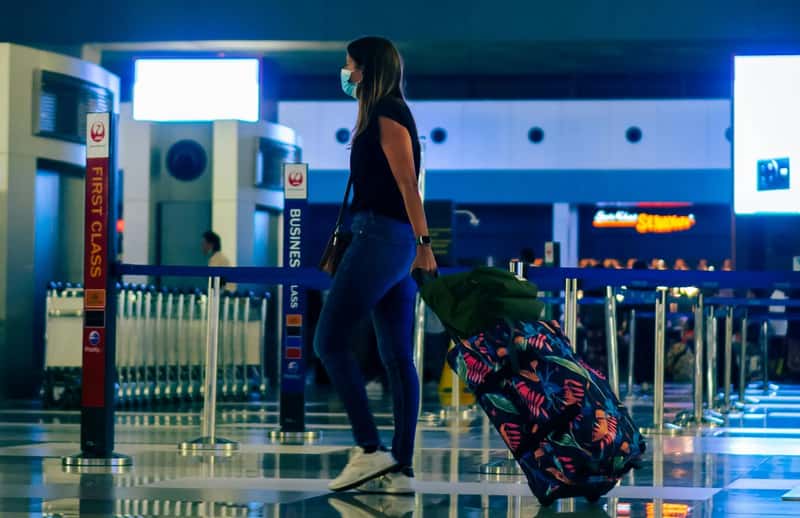
The terminal is empty at 2 AM.
The fluorescent lights don’t flicker. They just stare.
Your flight landed forty minutes ago. Your bag came out last.
And now you’re standing here – rolling luggage clicking against polished concrete, the smell of stale coffee and recycled air, a destination that isn’t quite real yet – and something in your chest won’t slow down.
Here’s the identity crisis nobody talks about: there is the version of you that books the flight, packs the bag, and tells everyone you’re “a seasoned traveler.” And then there is the version of you that stands alone in a midnight arrivals hall, suddenly unsure of your own name.
The airport creates a sense of disorientation rooted in haziness of time and place. We define ourselves in terms of time and place – we know who we are in relation to our daily routines and our familiar environments. Strip those away at 2 AM, under artificial light with no one to witness you, and what’s left?
1. The Trained Nervous System
Not every nervous system was raised on stillness.
Some were raised on noise. On unpredictability. On the particular electricity of not knowing what came next.
Our nervous systems learn through repetition. If you grew up in an environment full of unpredictability or emotional volatility, your body may have learned to interpret chaos as normal – and peace as unsafe.
That’s not a character flaw. That’s a blueprint.
The midnight airport is not objectively dangerous. But it pulses with uncertainty. Departures boards go dark. Staff thin out. The architecture of the day dissolves into something rawer.
And for the nervous system trained on chaos, that rawness feels like home. The hum of the HVAC system becomes a lullaby. The echo of your own footsteps becomes rhythm.
Some of us don’t just survive chaos – we seek it out. Not because we like the pain, but because it’s familiar.
The midnight airport doesn’t test your logistics. It tests your wiring.
2. The Temporal Vacuum
Time behaves differently here.
It always has. But at midnight, the distortion is sharper.
Airports distort the normal rhythm of life. There are no clocks in sight. You’re surrounded by artificial lighting. You’re in a transitional space with no natural cues for routine. Psychologists call this a temporal vacuum – a place where time feels simultaneously fast and slow.
In a temporal vacuum, the nervous system loses its anchors.
It can’t tell if it’s been here for twenty minutes or two hours. It can’t calibrate threat levels without the usual scaffolding of daylight, meals, or other humans moving with purpose.
So it defaults to vigilance. It scans. It listens.
Your brain, deprived of normal signals, becomes hyper-attuned to anything that could indicate a change.
Every distant announcement becomes a potential emergency. Every shadow in a corridor deserves a second look. The nervous system, untethered from time, becomes its own worst surveillance system.
The midnight arrival forces you to sit inside that vacuum. With yourself. With no clock to rescue you.
3. The Engineered Helplessness
You did not choose this lighting.
You did not choose the queue. The baggage carousel. The bottleneck at customs that somehow feels personal at this hour.
The psychology of airport stress is primarily driven by “Engineered Helplessness,” a concept rooted in behavioral psychology. From the moment of entry, your agency is dismantled: you are told where to stand, when to disrobe, and how much liquid you may possess. This state of “liminality” – the psychological discomfort of being in a transition zone with no personal control – triggers the sympathetic nervous system.
At midnight, that helplessness intensifies. The staff are skeleton crew. The systems are slower. Nobody is optimizing your experience right now.
And the person who needs to feel in control – the one who color-codes packing cubes and screenshots the gate number three times – starts to fray at the edges.
This is the moment. Not the turbulence. Not the delay. This standing-still surrender to a system that was never designed around you.
In chaos, we often feel powerless. Finding small ways to regain a sense of agency can be incredibly regulating.
The question is whether you reach for regulation – or whether the chaos finally feels like enough.
4. The Identity Dissolve
By midnight, the day’s personas have worn thin.
The confident professional who boarded that flight eleven hours ago. The adventurous soul who ordered the unfamiliar dish in the terminal. Gone.
Airports can make people feel lost or confused. In daily life, we define ourselves by our routines and familiar places. At an airport, those things disappear.
What’s left is something more honest. Something that hasn’t had a shower in seventeen hours and can’t remember if they ate.
Psychologists might call this ego depletion. The slow erosion of the identity performance.
The same applies to identity. A sense of identity is important to our psychological health but can become constricting. Like actors stuck playing the same character week after week, we enjoy the security of our roles but long to test and stretch ourselves.
The midnight arrival strips the role away without asking.
And in that naked, fluorescent-lit moment, some people panic. Some people breathe. Some people – the ones wired on chaos – quietly exhale.
5. The Familiar Stranger (A First-Person Stop)
I’ve stood in this exact airport. Different city, same 2 AM quality of light.
I remember thinking: I should be exhausted. I am exhausted. But something in my body was very much awake.
Not anxious, exactly. Just… operational. Scanning the baggage belt. Calculating exit routes. Mentally drafting a contingency plan for a taxi that might not show up.
It took years of therapy to name it: my nervous system had been trained in a house where stillness meant something was being hidden. Noise meant the truth. Chaos meant honesty.
It’s about a nervous system trained for war trying to function in peacetime.
The midnight airport wasn’t a threat. It was a reunion.
The departure boards going dark, the thinning crowds, the particular quality of being nobody’s emergency for a few hours – that felt less like danger and more like the first real breath of the whole trip.
That was the moment I understood the gap I’d been living in.
6. The Cortisol Architecture
Your body doesn’t know the flight is over.
It caught the stress signal somewhere over the Atlantic and never fully released it. The adrenaline of the departure, the turbulence over the mountains, the scramble for overhead bin space – all of it left biochemical residue.
Steady exposure to unpredictability can activate a mild but persistent stress response: elevated cortisol, hyper-alertness, shortened patience, and reduced emotional regulation.
At midnight, the Prefrontal Cortex – the rational, regulated part of the brain – is fatigued.
Under high-stakes pressure, the PFC – responsible for emotional regulation – begins to fatigue. When an authority figure issues an arbitrary command, the brain, already depleted of cognitive load capacity, defaults to the Amygdala.
The amygdala doesn’t do nuance. It does threat assessment.
So when the cab app crashes. When the hotel confirmation is in the wrong email folder. When the ATM is out of service. These small obstacles become enormous at midnight, because the architecture of calm has already been dismantled piece by piece since takeoff.
The nervous system trained on chaos, paradoxically, handles this better. It never expected the infrastructure to hold.
7. The Thin Place
There is a concept in Celtic cultures that maps perfectly onto this.
We need to look at the airport from a psychogeographic perspective. Psychogeography studies the effect of places on people’s emotions and behaviour. In Celtic cultures, there is a concept of special “thin places” – often sacred groves or forests – where the veil between the material and spiritual world is thin.
The midnight airport is a thin place.
The veil between who you perform yourself to be and who you actually are becomes almost transparent. The social armor is at baggage claim, somewhere between the carousel and the exit.
Strangers become briefly, unexpectedly intimate. A man in a rumpled suit asks if you know which shuttle goes to the long-term lot. You help him. He thanks you. You feel, for a moment, like a person again.
Personal boundaries also become fluid. Airports may play host to pro-social behaviour, where strangers share their travel and holiday plans, speaking with unusual intimacy. In no man’s land, normal social inhibitions don’t apply.
In the thin place, the rules soften. And some of us have been waiting our entire lives for the rules to soften.
8. The Exit Strategy
Some people plan their escapes from airports the way generals plan retreats.
Three apps open. Pre-booked car. Screenshot of the terminal map. Exit B is faster than Exit A at this hour.
This is not paranoia. This is a nervous system doing its job – the job it was trained to do by years of needing to know the way out.
A past traumatic travel event can prime your nervous system to anticipate similar problems, even subconsciously.
The exit strategy is an identity artifact. It tells you something about the architecture of your early safety.
The people who over-plan midnight arrivals were often the children who memorized escape routes from difficult rooms. The airport is just a new version of the old problem: how do I get out of here intact?
Gate areas are neither departures nor arrivals. They’re the threshold between safety and the unknown. In psychology, thresholds activate heightened attention.
And at midnight, every inch of the airport is a threshold. Every corridor is the one between here and somewhere safer.
The nervous system trained on chaos doesn’t freeze at thresholds. It accelerates through them.
9. The Permission of Anonymity
Nobody knows you here.
Not at midnight. Not in this terminal in this city where you’ve never landed before.
And that anonymity – which should feel frightening – sometimes feels like the deepest relief a chronic over-performer has ever known.
To step outside our normal routines and environments feels invigorating. Ideally, the freedom that begins at the airport continues throughout our foreign adventures.
But for some, the freedom doesn’t need to continue anywhere. The freedom is right here, in the arriving hall, at 2 AM, between who they were on that plane and who they haven’t decided to be yet.
The nervous system trained on chaos finds this liminal anonymity regulating, not threatening. It knows how to move through unknown spaces. It has been doing exactly that, internally, for years.
You might love new places but still find travel strangely stressful. Airports, crowds, unexpected delays – all can trigger the body’s survival response even when your mind knows you’re safe.
But sometimes. Sometimes the survival response and the sense of safety arrive at the same time. And the midnight airport is the room where that paradox lives.
10. The Body That Was Never Meant to Be Still
Here is the heaviest truth.
Some nervous systems were never taught that stillness was survivable.
The quiet house was dangerous. The calm weekend was the prelude to something. The uneventful Tuesday was not to be trusted.
So the body learned to generate its own weather. To find the friction in frictionless situations. To stay alert inside airports at midnight, not because the airport is dangerous – but because the body doesn’t yet believe in the safety of the uneventful.
Quiet feels threatening. Calm feels fake.
Many people are unable to find a way to put the brakes on stress. Chronic low-level stress keeps the HPA axis activated, much like a motor that is idling too high for too long.
The midnight airport arrival, then, is not just a transit experience. It is a diagnostic. A live rendering of the relationship between who you are and what your nervous system believes about the world.
The person who sleeps in the taxi on the way to the hotel – undone by the day, muscles finally releasing – learned somewhere that arrival was safe. That the journey ending was a good thing.
The person who sits in the back of that same taxi, hyperaware, mentally debriefing every decision of the last twelve hours, replanning the morning – they learned something different. They learned that the moment you stop moving is the moment the world catches up with you.
What the midnight airport reveals is not weakness. It is not a disorder to be medicated or a quirk to be managed with a better sleep mask and a magnesium supplement.
It is a story. Your story, written in cortisol and conditioned response, in the specific frequency of fluorescent light that your body learned to associate with being awake when you were supposed to be sleeping, alert when you were supposed to be safe.
The gap between the traveler you perform and the traveler you are is not something to be closed. It is something to be witnessed – at 2 AM, under lights that don’t flicker, in a hall where the last announcement was forty minutes ago and the silence since has been telling you everything.
Maybe the work isn’t learning to sleep on planes or pack lighter or optimize the layover. Maybe the work is learning to stand still in an empty terminal – luggage at your feet, no one watching, the whole anonymous night ahead of you – and let it be enough.