You found it on a Tuesday.
A grey slab of poured concrete rising from a dead street corner.
You stopped walking. You didn’t know why.
Something in your chest went quiet – and that silence felt like relief.
There is a gap between the person you perform every day and the person who stood in front of that building and finally exhaled. The performer smiles on cue, absorbs too much, says yes when they mean never. The person standing at the concrete wall just needed to see something that didn’t apologize for taking up space. We call this gap the Identity Gap – the distance between the self that bends for everyone and the self that quietly, desperately, needs a wall.
1. The Honest Material
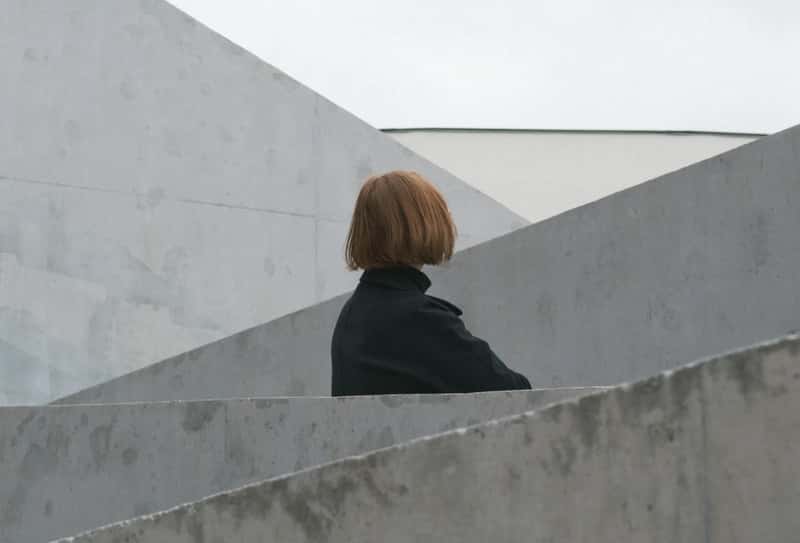
Brutalism was never about ugliness. It was about truth.
At its core, Brutalism isn’t about harshness for the sake of harshness – it’s about truth, structure, and the belief that architecture should openly express how it is made.
That is a radical act in a world built on veneer.
When you are drawn to a raw concrete facade, you are not aesthetically confused. You are responding to something your nervous system has been begging for – a surface that does not pretend. Brutalism was meant to be an honest and direct expression of structure and materials. It was meant to be “what it was” rather than a symbol or representation of anything else.
Consider what it means to live among surfaces that lie. Smooth finishes. Manicured lobbies. Walls that hide their bones.
The person who is drawn to the brutalist building is the person who is exhausted from hiding theirs.
They are not seeking coldness. They are seeking clarity. And those two things, in a world drenched in performance, are almost the same.
2. The Fortress Self
There is a type of person who photographs brutalist buildings obsessively.
They frame the shadow. They track the geometry. They stand in the wind beneath a concrete overhang and feel, briefly, sheltered.
Deep-set windows, narrow slits, or irregular openings reduce visual permeability. Low transparency makes interiors feel fortress-like and undermines perceived safety or sociability. And yet – for some – that fortress quality is precisely the draw.
Because the Fortress Self is not a failure of warmth. It is a survival strategy.
It is the self that learned early that being too open cost too much. That people would walk through you like a lobby if you let them. Rough-cast concrete produces coarse, uneven surfaces with stark light-and-shadow contrasts – a harshness that can feel cold, abrasive, or hostile compared with warm, ornamented facades.
But hostile to whom?
To the person who wants in without asking. To the person who expects your warmth as a given. The brutalist building asks you to announce your intentions at the door. Some people find that cold. Others find it the first honest architecture they’ve ever stood inside.
3. The Weight We Carry
Concrete is heavy. That’s the point.
Exposed, monolithic concrete, large geometric masses, and heavy cantilevers create a sense of visual gravity. And something in the human body responds to that gravity with a kind of recognition.
You have been carrying weight for years.
The weight of other people’s emotions. The weight of unspoken things. The weight of a self that keeps reshaping itself to fit whatever room it’s in.
When you stand beneath a brutalist structure – something that makes no pretense about how heavy it is – there is a strange, wordless solidarity. The building is not asking you to pretend it is light. It does not float. It does not dissolve into glass and sky. It sits. It presses down. It says: I am heavy and I have built myself around that fact.
That is not depression. That is integrity.
A hypothesis explaining positive reactions may be found in how the Brutalist palette uses tectonics to make “opaque” the otherwise invisible existential atmosphere of our lives. This architecture is constantly pulsating a transcendence that only awaits to be noticed in, with and through its brutal physical presence.
4. The Anti-Ornament
Every ornament is a negotiation.
A cornice says: please like me. A gilded lobby says: I need you to be impressed. A brutalist facade says absolutely nothing of the sort.
Instead of hiding functions behind decorative columns or ornate facades, Brutalist architects allowed the building’s “bones” to become the design. Stairwells, ventilation towers, beams, and circulation paths became visual elements. Mass and geometry replaced ornamentation. The building was meant to look like what it is.
Now apply this to personality.
The person who cannot stop over-explaining themselves. Who dresses every opinion in qualifiers. Who ornaments every boundary with an apology before the boundary even lands.
They are standing in front of a brutalist building and feeling the vertigo of recognition. What would it be like to say what you mean with no decoration? To need no one’s approval to hold your shape?
The building does not apologize for its angles. Neither should you.
5. The Personal Concrete
I’ll tell you where I first understood this.
It was a parking structure in a city I was only passing through. Three levels of raw poured concrete, ribbed from the formwork, stained grey-brown at the water lines. It should have meant nothing. I wasn’t a photographer or an architect. I was just a person in transit, dragging a carry-on through a city that didn’t know my name.
I stood there for eleven minutes. I counted because the absurdity of it made me keep track.
What I felt – and I’ve turned this over many times since – was not beauty. It was permission. The structure was unapologetically what it was. As one architect put it, “Architecture physically represents imperfection – both in terms of buildings and cities and, more importantly, acknowledges that we humans are not perfect.” That parking structure was imperfect and did not ask to be forgiven for it.
I was imperfect and had been asking to be forgiven for it my entire life.
That is the personal concrete. The moment you recognize your own psychology in a building’s bones.
6. The Boundary Made Visible
Here is the core of it. Here is what the research is slowly circling.
The people who are most drawn to brutalist structures are often the people who struggle the most with interpersonal limits. Not because they are weak. But because they are porous. Because they absorb. Because every room they walk into, they rearrange themselves to fit.
Analysing Brutalist objects through a corporeal perspective helped to further our understanding of the experience of living within them in a way that abstract thought could never have done. Reflections emphasise the tension between the physical and the psychological, whereby corporeal struggle intertwines with an abstract, aesthetic admiration of the Brutalist objects.
A brutalist building holds its shape.
It does not yield to weather. It does not soften for the crowd. It does not become charming because charming would be easier. It is what it decided to be, and it remains that thing regardless of who is watching.
The person standing outside it – jaw slightly loose, eyes tracing the shuttermark impressions in the concrete – is not appreciating architecture. They are grieving the version of themselves that could hold their own shape like that.
7. The Uncanny Familiar
There is a psychological term: the uncanny. The thing that is almost familiar but slightly wrong. It produces a low, electric unease.
Research aimed to illuminate the emotional qualities of Brutalist constructions through a neo-phenomenological perspective enriched by historical analysis and Gestalt theory. The concept of atmosphere was implemented to highlight the emotional qualities of Brutalist constructions and prove their affectivity to be one of the possible solutions to the problem of the lost resonance in contemporary society.
Lost resonance. That phrase deserves to sit alone on the page.
We live in a world vibrating at the frequency of approval. Every interface is frictionless. Every edge is softened. Every experience is personalized until it stops being an experience and becomes a mirror.
The brutalist building is not a mirror. Brutalist architecture often elicits strong reactions – discomfort, awe, indifference, or affection – because its formal language and social history activate sensory, cognitive, and cultural responses.
And some people need to be activated. Not soothed. Not reassured. Activated.
Because the uncanny feeling they get standing in front of poured concrete? That is their own unmet interiority, knocking from the outside.
8. The Exit Architecture
Every brutalist building has a specific quality of exit.
The doors are heavy. The thresholds are deliberate. You do not drift out of a brutalist building – you leave it. There is a commitment to departure that the building demands of you. It marks the transition.
Perhaps Brutalism succeeds because its materiality allows us to experientially retrieve something impossibly deep in our collective human memory, something that goes beyond styles and fashion.
There is something primordial about a boundary you can feel in your body.
The person who has never been able to exit a conversation cleanly, who lingers at the door of every relationship long past the point of sense – they understand this at a cellular level. They want an architecture that makes exit legible. That says: here is where outside begins. Here is where you end and the world starts again.
The hypothesis that architectural design significantly impacts human neurological and psychological processes is explored through the interdisciplinary field of neuroarchitecture. Elements of the built environment, including spatial layout, natural light, and color schemes, directly affect cognitive functioning, emotional well-being, and spatial navigation.
The brutalist building teaches a kind of navigation the self never learned in childhood. How to leave cleanly. How to know where you end.
9. The Permanence Hunger
The modern world is pathologically temporary.
Feeds. Notifications. Relationships with the half-life of a news cycle. Cities that rebuild themselves every decade. A self that must be perpetually updated to remain relevant. Everything is optimized for impermanence, and nobody talks about how much that costs.
The earthy and resilient nature of brutalist materials, usually concrete, rooted heaviness, and untreated surfaces make Brutalist edifices age at a different rate than other constructions, and therefore be felt as belonging to another time, if not timeless.
Timeless. The hungry want that word like water.
The brutalist building will not be updated. It will not pivot. It will not A/B test its own facade. It committed to its form in a specific moment of history and it has been that thing ever since, aging on its own terms, staining, cracking, still standing.
While often misinterpreted as referring to “brutal” aesthetics, the term actually derives from the French “béton brut” meaning raw concrete – a linguistic origin that immediately indicates the style’s central concern with material truth rather than aggressive appearance.
Material truth. The permanence-hungry person is not nostalgic. They are starving for something that doesn’t renegotiate its identity every morning.
10. The Thing That Holds
Here is the heaviest truth about the person who keeps returning to concrete walls.
They are not looking for beauty in the conventional sense. What we have learned after half a century of living with these buildings is that their architectural attributes elicit strong emotional responses from people. When unsuccessful, Brutalist buildings are experienced as inhuman, existentially depressing. At their best, they induce transcending experiences not by pointing at or representing some spiritual “other” but by becoming themselves the locus of profound phenomenologies.
The locus of profound phenomenologies.
In plain language: the place where something real happens inside you.
The person seeking brutalist spaces is looking for the thing that holds. The structure that does not flinch when they press their full weight against it. Because they have been, their whole life, surrounded by things that bent – people who folded under emotional pressure, institutions that changed their terms, relationships that turned out to be made of drywall.
Buildings, like people, can be unpolished and still powerful, stark and yet full of meaning. In rough concrete surfaces lies a strange form of elegance: one that emerges not from perfection, but from identity, presence, and conviction.
Identity. Presence. Conviction.
These are not architectural terms. These are the three things every person who has ever lost themselves in the service of someone else’s comfort is quietly trying to find their way back to.
The concrete does not comfort you the way soft things do. It does not wrap around you. It does not adjust its temperature to yours. It stands at its own temperature, indifferent to whether you find it welcoming, and somehow – inexplicably – that indifference is the most comforting thing you have felt in years.
Because what you have needed, all along, is not more warmth from the world. You have been drowning in other people’s warmth, absorbing it, metabolizing it, reshaping yourself around it. What you have needed is the cold, still, geometric proof that a thing can exist on its own terms and remain intact. That holding your shape does not make you cruel. That a wall is not a wound inflicted – it is simply a structure that knows what it is.
Stand in front of the building for as long as you need. Let the shadow of the overhang fall across your face. Feel the scale of it – how it makes you small without making you less. And when you are ready, walk away carrying the quiet knowledge that the boundary you have been unable to speak out loud has been standing in concrete for decades, waiting for you to recognize it as yours.