Skellig Michael is, quite literally, a rock in the middle of the Atlantic. Nothing but ocean around, seabirds cutting through the wind, and the very real sensation of being off the map. Standing there, I genuinely felt like I had reached the edge of the known world. I was in Ireland, yes—but I could just as easily have been somewhere else entirely.
It’s no coincidence that Star Wars ended up here. Skellig Michael doesn’t look like a film set. It looks like a glitch in reality, as if a fragment of another planet fell into the sea off the coast of County Kerry. When it appeared in Star Wars: The Force Awakens and later in The Last Jedi, it didn’t need special effects. The place was already doing all the work.
A Place Where the Weather Is Part of the Story
Skellig Michael is remote, and that remoteness is very much part of the experience. Simply reaching the departure harbor already means crossing a large part of Ireland—but if the weather cooperates, trust me, the journey is more than worth it.
I visited in mid-August and I was incredibly lucky. Clear skies, sharp light, and a sea calm enough to land. The day before? Heavy rain. The day after? Same story. On Skellig Michael, weather is not a side note—it’s a main character, and you have to factor uncertainty into your plans. Here, everything is provisional until the very last moment. Boats don’t sail if conditions aren’t right. Landings are canceled without drama or negotiation. And honestly, that’s part of what makes the experience feel so raw and earned. When the stars align—literally and metaphorically—the reward is unforgettable.
Two Islands, But Only One Humans Could Conquer
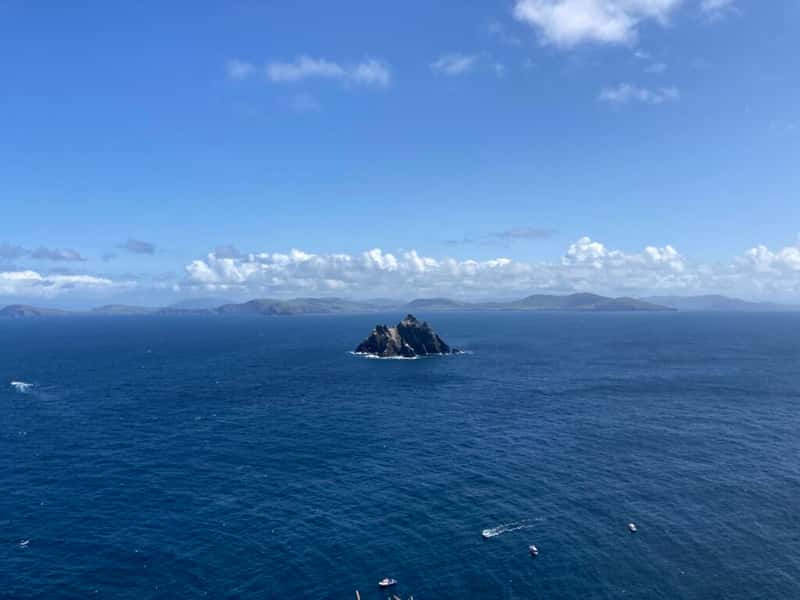
The Skellig Islands are actually two: Skellig Michael and Little Skellig. Seen from the boat, they rise abruptly from the sea, steep and defiant.
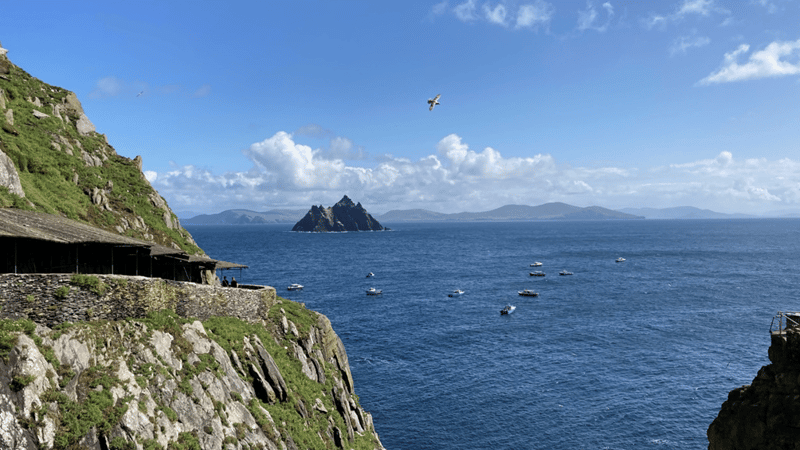
Little Skellig, in particular, is dark, jagged, like broken shards of a star emerging from the Atlantic. It is completely inaccessible, home to one of the largest seabird colonies in Europe. Humans never settled there—and looking at it, you understand why. As I approached it, perspective started to slip. This didn’t feel like Ireland anymore. Or Europe. It felt like changing planets.
Skellig Michael, by contrast, is the larger and marginally more forgiving of the two—and it’s the only one where boats are allowed to land. This is where human life once took hold, improbably, and where visitors step ashore today to begin the steep climb into a past that feels from a galaxy far, far away.
Climbing Into Another Time
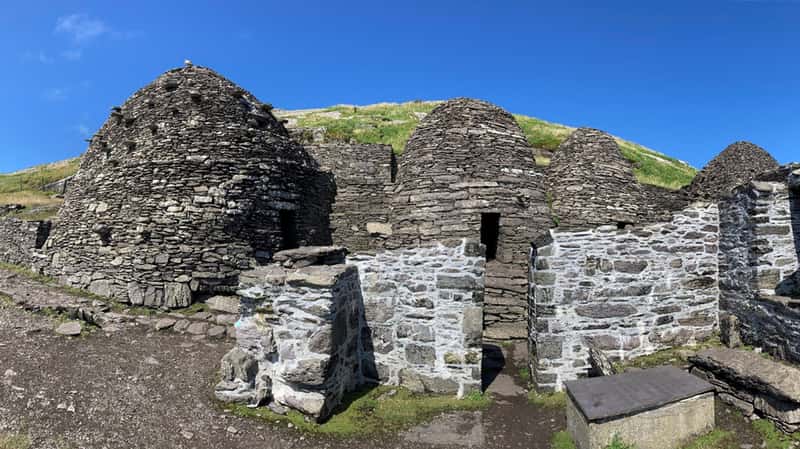
At the top of Skellig Michael sits one of the most extraordinary monastic settlements in Europe. Between the 6th and 12th centuries, a small community of monks chose to live here—on this rock, battered by wind and waves, believing they were at the very edge of the world. The settlement was abandoned when the monks moved to the mainland—likely because life up here had become simply too extreme.
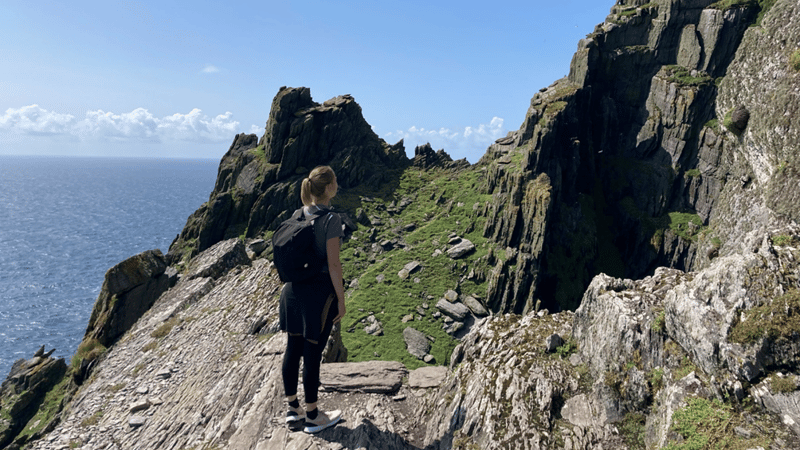
You reach the settlement by climbing around 600 steep, uneven stone steps, carved directly into the rock, with a vertical gain of roughly 500 feet. There are no railings, no barriers. Just concentration, balance, and trust in your footing. At the top, the settlement unfolds: about six beehive-shaped stone huts, small oratories, terraces, and stone walls, all built entirely without mortar. The monks stacked local stone with extraordinary precision, shaping the structures.
Star Wars, but Make It Existential
This is Mainistir Fhionáin—which means Monastery of Saint Fionán—and yes, this is where Luke Skywalker’s exile was filmed. And yes, standing there, you immediately understand why.
The landscape felt symbolic without trying: solitude, endurance, withdrawal, clarity—it’s all embedded in the place. What surprised me is how quickly the Star Wars narrative fades into the background once you’re actually there. The real history is so powerful that the cinematic layer quickly becomes secondary. I found myself far more absorbed by the real-life choices of the monks—the determination it took to come here, and the resolve required to survive in such an extreme place—than by any imaginary storyline layered on top of it.
Views That Silence You
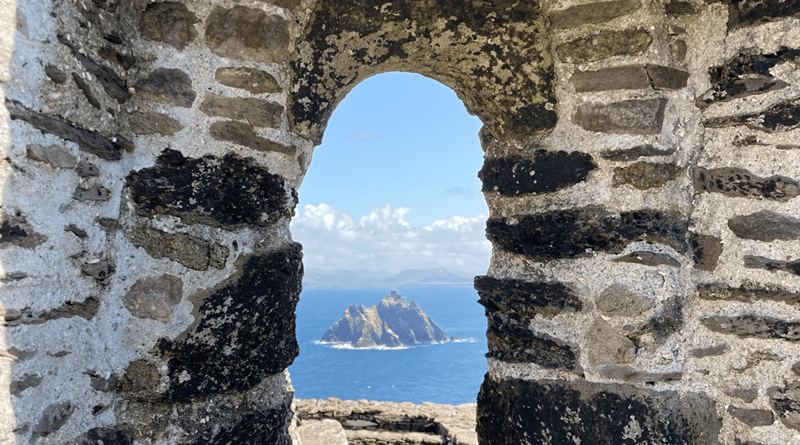
From the top, the views are staggering. The Atlantic stretches endlessly in every direction. Little Skellig looms nearby, darker and completely alive with birds. The wind is constant, the light shifts by the minute, and the sense of exposure is total.
It’s beautiful in a way that doesn’t invite conversation. You don’t talk much up there. You just look. Breathe. And quietly recalibrate your sense of scale.
August, Birds, and a Lot of Respect
In August, the island is also full of life. Seabirds—especially puffins, razorbills, and gannets—nest all over the island. You’ll see nesting boxes tucked into the rock, with puffin mothers inside guarding their eggs.
They are beautiful. And delicate. You’re not allowed to touch anything, of course (beware: the teamptation will be strong), and the respect visitors show is part of what makes the experience feel balanced. Humans are guests here—temporary ones.
Practical Information
Where it is: Skellig Michael lies off the coast of County Kerry and is reached by boat from ports like Portmagee.
Boat ride: Boats are small and open, but the crossing is relatively short—about 45 minutes each way. Even if you’re prone to motion sickness (like me), it’s usually manageable in calm conditions.
Season: Landings are typically possible from May to September, weather permitting.
Weather: Expect unpredictability. Bring layers and waterproofs—even in summer.
Physical difficulty: Moderate to demanding. The climb is steep and exposed; not suitable for severe vertigo or mobility issues.
Time required: Several hours total, including the boat ride and time on the island.
Booking: Tours must be booked well in advance. Landings are strictly limited.
Why It’s Worth the Uncertainty
Skellig Michael is not an easy destination. It asks for flexibility, physical effort, and a willingness to accept that things might not work out. But if they do—if the sea calms, the light opens up, and you make it to the top—it becomes one of those rare travel moments that quietly resets your internal compass. At the edge of the world, yes. But also, somehow, very close to the core of things.