There is something almost radical about choosing quiet. In a country where busyness is worn like a badge of honor and noise just blends into the background of daily life, finding a city that genuinely respects your peace feels like a rare gift. Most people simply assume they have to trade calm for opportunity, silence for culture, and serenity for decent healthcare. Turns out, that trade-off is entirely optional.
Two of the top factors that determine whether a place feels peaceful are the absence of noise and access to plentiful green spaces. A Center for Disease Control study reported lack of sleep and reduced productivity as adverse health conditions resulting from noisy environments, while access to nature provides psychological restoration and better cardiovascular health. The seven cities below prove you do not have to escape to a remote mountaintop to find that combination. Let’s dive in.
1. Ann Arbor, Michigan – The Quiet Overachiever

If you had to bet on a single city that quietly does everything right, Ann Arbor would be a very strong candidate. This Michigan city has fewer than 130,000 residents and is home to the University of Michigan. Ann Arbor ranks 23rd for access to quality healthcare and 15th out of the 150 most populous metro areas for college readiness, ninth for well-being, and 16th for its 24-minute commute, making it the number one best place to live for quality of life in 2024-2025.
According to U.S. News and World Report, citing the Trust for Public Land, more than nine in ten Ann Arbor residents live less than a ten-minute walk from a public park, giving them access to hiking, kayaking, and cross-country skiing. The city’s downtown is also a thriving hub for shops, restaurants, craft breweries, and distilleries. Honestly, it is the kind of place that surprises you. You expect a sleepy college town and instead find a place that is vibrant, walkable, and calmer than you ever imagined a city of its caliber could be.
Ann Arbor’s balance of collegiate culture and quiet neighborhoods makes it one of the best tranquil cities in America suitable for diverse peaceful living needs. For families, young professionals, or anyone just tired of being assaulted by traffic and sirens, this one belongs at the top of the list.
2. Des Moines, Iowa – The Underdog With Real Numbers

Let’s be real, nobody grows up dreaming of moving to Des Moines. Yet the numbers tell a story that is hard to argue with. Des Moines offers low-cost housing, short commute times, and a diverse population. The city is the main cultural center of Iowa, with many museums, arts organizations, and performance venues. Thanks to Gray’s Lake Park, Des Moines can also offer a wide array of outdoor activities, and it is considered one of the five quietest cities in the U.S.
According to U.S. News and World Report, Des Moines ranks number seven among the safest places to live in the U.S. for 2024-2025. This ranking is based on factors such as low violent crime rates, strong community engagement, and overall quality of life. Des Moines benefits from a lower crime rate compared to many other mid-sized U.S. cities.
The December 2024 cost of living index in Des Moines stands at 89.9, below the U.S. average of 100. That matters more than people realize. A city where your paycheck simply goes further, combined with genuine quiet and safety, is a combination that most coastal metros can only dream about offering.
3. Virginia Beach, Virginia – Peaceful Waterfront Without the Price Tag

Virginia Beach ranked number one on a comprehensive peace-and-quiet scale with a score of 43.13 out of 50, built on comparisons of residential construction, light and noise pollution, and traffic accidents. Its overall light and noise pollution and number of traffic accidents are lower than those in many other major U.S. cities. That is a striking result for a city of its size, and it does not come at the cost of having things to do.
Virginia Beach boasts 38 miles of coastline, offering plenty of activities such as swimming, fishing, kayaking, and waterskiing. For those who are not outdoorsy, there are plenty of opportunities for shopping, museums, and taking in the local cuisine. Think of it like this: you get ocean-town energy with small-city noise levels. That is a rare pairing anywhere in America.
Virginia Beach also ranks number eight among the 25 best places to live for quality of life in 2024-2025 according to U.S. News and World Report. Virginia cities like Alexandria and Virginia Beach post some of the highest student proficiency rates in the country. Strong schools, a coastline, and genuine quiet. It is hard to ask for much more than that.
4. Asheville, North Carolina – Mountain Calm With a Creative Pulse
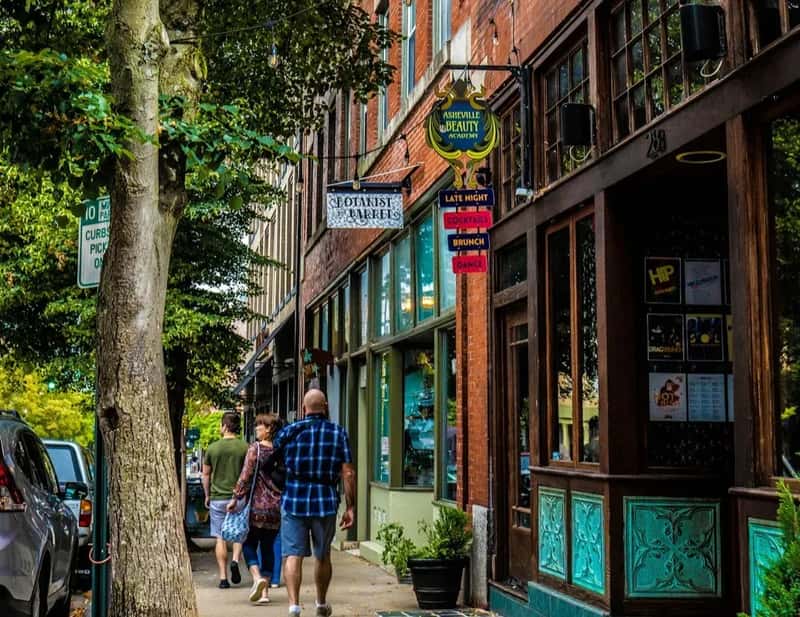
Located in Buncombe County in the Blue Ridge Mountains at the confluence of the French Broad River, Asheville is well-known as a regional art hub, and several reputable authorities have named it one of the greatest cities to live in. It sits in a valley surrounded by mountains, which naturally shields it from much of the acoustic chaos that plagues other cities of similar size.
The small western Carolina city ranks 16th for college readiness, eighth for air quality, and first for commute time with an average of just 22 minutes. Its food scene and outdoor opportunities are a big draw to residents. A 22-minute commute average is genuinely remarkable. Compare that to a city like Los Angeles or Atlanta where daily commutes can devour nearly two hours of your life, and the quality-of-life difference becomes almost mathematical.
Asheville, nestled in the Blue Ridge Mountains, is known for its craft beer culture and local artisans, offering a laid-back lifestyle with opportunities in hospitality and creative sectors. It is the kind of place where the slower pace feels intentional, not like something is missing. I think that distinction matters enormously when choosing where to actually build a life.
5. Lancaster, Pennsylvania – Quietly Living the Good Life

Lancaster is famous for its rolling farmland, Amish heritage, and welcoming rural communities providing a relaxed, quiet lifestyle. The city has a population of roughly 59,000 and a median home price of around $250,000, with median rent sitting near $1,200 per month. Those are numbers that feel almost quaint compared to what you find in most desirable American cities right now.
Lancaster is located in Lancaster County in the south-central part of Pennsylvania, near the Conestoga River, and Pennsylvania Dutch Country encompasses the city. Agriculture, numerous cottage industries, and tourism are all important to the local Amish community. There is something grounding about living near a community that has deliberately chosen simplicity for generations. It sets a different cultural tone for the entire region.
Lancaster’s economy is supported by healthcare, tourism, and manufacturing, with local colleges and strong community schools serving residents well. It is considered ideal for retirees and families wanting peaceful suburban and rural living. Lancaster’s pastoral charm and affordability rank it among the quiet towns to retire in the U.S., perfect for tranquility and a relaxed lifestyle.
6. Madison, Wisconsin – The Quiet City That Gets It Right

Madison, Wisconsin, ranks number five among the best places to live for quality of life in 2024-2025 according to U.S. News and World Report. That ranking is no accident. Madison sits on an isthmus between two lakes, which gives it a natural, almost built-in sense of separation from urban noise. The water literally buffers it.
A hub for young professionals, Madison combines a burgeoning tech scene with iconic dining and an outdoor lifestyle. It also benefits from being a university city, which brings with it a certain intellectual energy and cultural scene that punches well above the city’s actual size. Here’s the thing about college towns that people overlook: they tend to invest heavily in public spaces, walkability, and community events, which keeps noise more managed and daily life more human-scaled.
LawnStarter examined 50 metrics covering health, safety, education, affordability, and environmental factors across 13 categories to identify leading cities for quality of life. Madison consistently performs across all of those categories, not just one or two. That balance is exactly what separates cities that are merely pleasant from those that are genuinely livable for the long term.
7. Hartford, Connecticut – History, Calm, and Surprising Culture

Hartford is a varied city that combines history, culture, architecture, business, education, and economic development to create a very pleasant environment. It is ranked in the top six percent of North American cities for arts and culture, and more than 200 cultural, arts, and history groups can be found in the city. For a city of its size, that cultural density is genuinely impressive and contributes to a lifestyle that feels enriching rather than overwhelming.
As home to America’s oldest public park and art museum, Hartford combines its historical depth with fine dining and outdoor recreation. Hartford has many places to enjoy the outdoors, such as vineyards, parks, and historical attractions. The historic home and grounds of famous author Samuel Clemens, known as Mark Twain, is a great place to get a sense of Hartford’s history.
Hartford, Connecticut, also ranks among the 25 best places to live for quality of life in 2024-2025. It is a city that rewards the curious resident, the kind of person who wants weekend walks through history, access to art without the price tag of New York, and neighborhoods quiet enough to actually hear themselves think. It is easy to underestimate Hartford, which is perhaps the most compelling reason to take a closer look.
Why Quiet Cities Are Having Their Moment

Described as “an underestimated threat” by the World Health Organization, noise pollution is “a leading environmental nuisance.” Because we subconsciously interpret abrupt noises as signs of danger, they trigger involuntary fight-or-flight responses and strain the autonomic nervous and endocrine systems. As a result, noise pollution can impair sleep, work and school performance, and hearing itself.
The shift toward remote work has genuinely changed the equation for millions of Americans. When you are no longer tied to a specific city for your career, the calculation shifts entirely toward livability. Eight U.S. towns and cities stand out for their low noise levels and abundance of green spaces for relaxation. Access to outdoor spaces in the most peaceful cities in the U.S. offers a variety of activities to enjoy and promote well-being among residents.
Prolonged exposure to high noise levels can lead to numerous health issues including hearing loss, cardiovascular issues, sleep disturbances, and stress. For many city dwellers, the effects of noise pollution are serious, with relentless noise diminishing overall quality of life, impacting mental health, and reducing productivity. That is not a small thing. Choosing where to live is, in a very real sense, choosing how you want your body and mind to feel every single day.
The seven cities above are proof that quiet and quality are not opposites. They are, in the best cases, the same thing. What would you have guessed? Drop your thoughts in the comments below.