You’ve packed carefully, weighed the bag twice, and confirmed it matches the dimensions listed on the airline’s website. Then you get to the gate and something changes. Maybe it’s a different agent’s judgment call, a smaller regional jet, or a fare class restriction buried three clicks deep in your booking that never showed up on the confirmation email.
The frustrating part is that none of this is technically hidden. It’s just scattered across policies, fare rules, and enforcement practices that shift depending on the airline, the airport, and even the specific flight. Understanding how these pieces fit together is the only real way to avoid a surprise fee right before boarding.
The size limit hasn’t changed, but how it’s enforced has
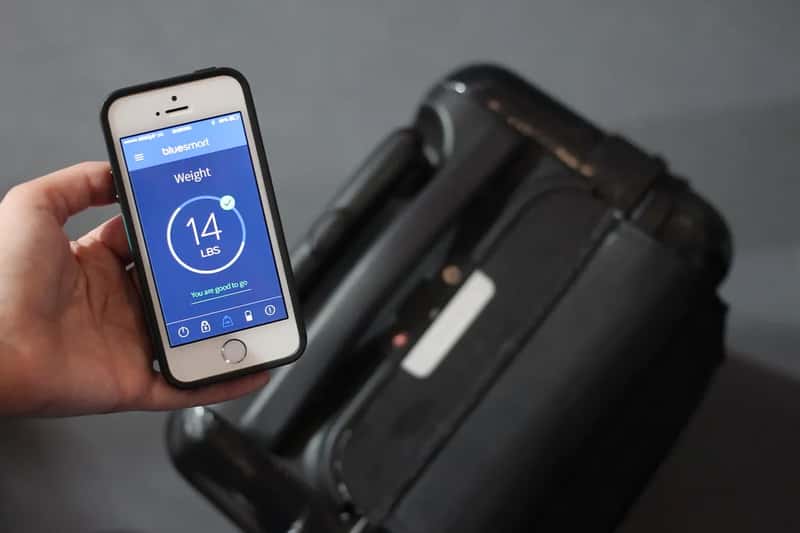
Despite a steady stream of headlines suggesting otherwise, the core carry-on dimensions at major U.S. carriers have stayed put. The long-standing 22 x 14 x 9-inch standard still applies at Delta, United, American, Alaska, and JetBlue.[1] Southwest remains the outlier with a bit more room, allowing bags up to 24 × 16 × 10 inches, one of the more generous major-airline limits.[2]
What has shifted is the moment your bag actually gets measured. For years, that happened at the boarding door with a metal frame everyone dreaded. Airlines haven’t loosened the rule itself, they’ve just moved where and how it gets checked, which is exactly why so many travelers feel blindsided even when they technically packed within the limits.
Why the metal sizer cage is disappearing from the gate
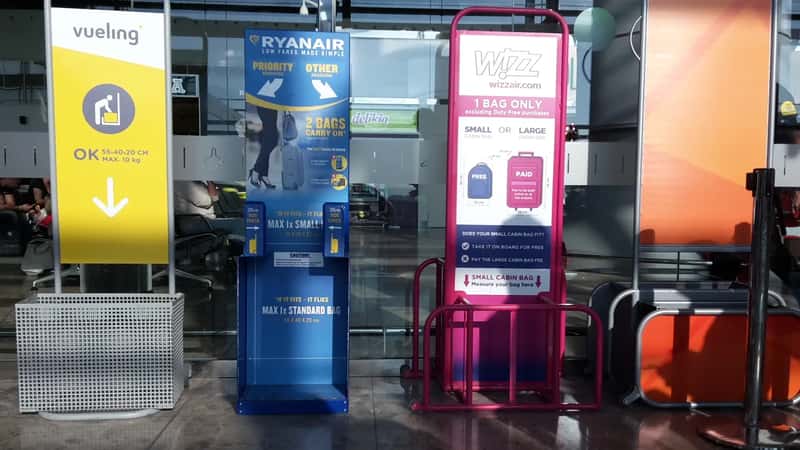
American Airlines made the most visible change. Since October 6, 2025, gate agents have relied on judgment instead of metal bag sizers to assess carry-ons.[3] This wasn’t unprecedented, either. American followed United Airlines, which pulled gate sizers from its gates back in 2020 and directed agents to assess carry-on bags by sight.[4]
The frames didn’t vanish entirely, though. They simply relocated. Lobby bag sizers remain in place, and agents are encouraged to proactively scan the area, identify oversized bags, and guide customers to use the sizer and check bags when necessary.[5] In other words, the test moved earlier in your journey, but skipping it doesn’t mean you’ve escaped it.
Why gate agents are checking your bag less than you think
Here’s the part that rarely makes it into the panicked headlines. Most gate-checked bags result not from size violations but from lack of space, either because the overhead bins on smaller aircraft can’t accommodate standard-sized carry-ons, or because flights are too full and the bins are already occupied.[3]
This means a perfectly legal bag can still end up tagged at the jet bridge, not because it broke any rule, but because the plane simply ran out of room. It’s a distinction airlines rarely spell out clearly, yet it explains why boarding order and aircraft type matter just as much as your bag’s dimensions.
Automated sizers are already testing at some airports
Enforcement is also moving toward technology in certain corners of the network. United Airlines deployed automated bag sizers at 35 airports in late 2025, with plans to expand to 80+ locations by end of 2026, with scanners that measure bags before boarding and flag oversized carry-ons for gate checking.[6]
Still, this isn’t a universal reality yet. As of mid-2026, carry-on enforcement relies more on bin forecasting and lobby checks than on automated scanners measuring each bag at the gate, with United testing automated bag scanning at only a small number of gates, a measure that remains a test rather than a network standard.[4] If you’re flying through one of the airports currently testing this system, expect a more objective, less negotiable check than you might be used to.
Fare class can quietly strip away your carry-on rights
The bag rule that trips up the most people isn’t about inches at all. It’s about the fare code on your ticket. Budget carriers have built entire pricing structures around this distinction, and it’s easy to miss when you’re booking based on price alone.
Budget carriers like Frontier and Spirit restrict free items to personal-item size, approximately 18 x 14 x 8 inches, for their lowest fares.[6] Anything larger than that requires an added fee, even if the bag would otherwise qualify as a standard carry-on elsewhere. Worth noting too, Spirit is no longer part of this equation at all, since the airline ceased operations in May 2026 and is no longer flying.[7]
Budget airlines play by a stricter, more literal rulebook
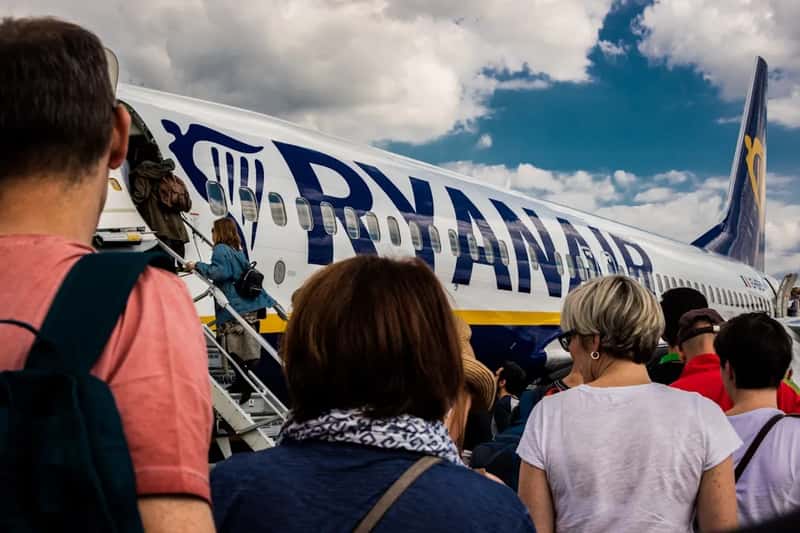
If American style leniency has made you complacent, low-cost carriers will correct that quickly. European low-cost carriers enforce mandatory weight limits of 10 to 15 kilograms and use sizer frames at the gate on effectively every flight, stricter than any U.S. carrier.[8]
The size allowances themselves are also noticeably tighter. Ryanair restricts carry-ons to 21.6 × 15.7 × 7.8 inches while EasyJet allows 22 × 17.7 × 9.8 inches, a roughly two inch variance in depth that causes many gate rejections.[8] That depth difference sounds minor until you’re the one repacking at the counter because a bag that flew fine on a domestic U.S. route suddenly doesn’t clear a European low-cost carrier’s frame.
Gate-check fees aren’t as uniform as travelers assume
Getting flagged for an oversized bag doesn’t always cost the same amount, and the difference can be significant depending on when and where it happens. Gate-check fees in 2026 generally range from about sixty to one hundred dollars.[6]
Timing matters more than most people realize, too. Air Canada, for example, charges passengers sixty five dollars to gate-check an oversized bag versus thirty five dollars if it’s checked before security.[9] Budget carriers push this further still, with charges that can climb toward the higher end of that range for bags that miss the mark by even a small margin.
Personal items have their own hidden limits

Carry-on rules get most of the attention, but the personal item sitting under your seat has its own set of restrictions that often go unnoticed until boarding. Twelve of eighteen major airlines now enforce strict personal item dimensions separately, meaning your bag must fit both limits to board without paying extra.[8]
American Airlines spells this out plainly, requiring that the personal item fit underneath the seat in addition to meeting the standard carry-on dimensions.[10] Frontier’s rules are similarly specific, listing a personal item allowance of roughly 14 inches high by 18 wide by 8 deep, separate from its 24 by 16 by 10 inch carry-on.[11] If your tote or backpack has grown a bit over the years, it’s worth measuring again before your next trip.
International carriers measure things differently
Flying internationally adds another layer of complexity, since several major global carriers don’t use the same inch or centimeter framework as U.S. airlines. Singapore Airlines is a good example. Its limit is based on a linear dimension of roughly 115 centimeters, meaning the sum of length, width, and height, rather than three fixed sides.[2]
Other carriers stick to fixed dimensions, but they’re not identical to the American standard. Qatar Airways caps carry-ons at 50 × 37 × 25 centimeters, or about 20 × 15 × 10 inches.[2] Emirates allows 55 × 38 × 22 centimeters,[2] while British Airways permits a slightly larger 56 × 45 × 25 centimeter cabin bag, including wheels and handles.[2] A bag that’s perfectly sized for a domestic U.S. flight can easily run afoul of these variations on the return leg of an international trip.
How to actually keep your bag out of the gate-check line

The most reliable habit is also the simplest one: measure your bag the way the airline does, not the way the manufacturer advertises it. Airline limits typically include wheels and handles as part of the total measurement,[2] which is where many otherwise compliant bags quietly go over.
If you’re unsure whether your bag will pass, use the resources airlines still provide before you reach the gate. If you’re unsure whether a bag is allowed, measure it at one of the lobby sizers before heading to security.[12] Combine that with an awareness of your fare class restrictions and the aircraft type on your route, and most of the surprises this article covers become avoidable rather than inevitable.