In Florence, the most revealing details rarely rise above eye level. They sit at shoulder height, near your knees, or just beyond your reach—iron rings embedded in stone, lion-headed door knockers, torch brackets curling outward like frozen flames. Walk quickly and you’ll miss them. Slow down and the city begins to read like a manual of urban life before electricity, engines, and asphalt.
Living in Italy has defined the way I scan a façade. I don’t only see rusticated blocks or elegant cornices. I look for what interrupts the flat plane of the wall. What protrudes is often what functioned. These small elements—hardware in the most literal sense—form a parallel narrative to Florence’s monumental architecture. They reveal how the city once moved, illuminated itself, defended its corners, and negotiated status at the threshold of a door.
Iron Rings and the Pre-Automobile Street

At roughly three to four feet above the sidewalk, iron rings still punctuate many historic façades. Known as anelli da cavallo, they were once used to tie horses outside palazzi and shops. Before parking garages and curbside meters, mobility required stone and iron infrastructure at hand level.
These rings map a different Florence—one calibrated to hooves rather than engines. Streets were narrower, traffic slower, movement more susceptible to theft. A rider would dismount, secure the reins, and step through a doorway framed by carved stone. Today the rings remain as quiet witnesses to that choreography. They remind us that transportation shapes architecture, and that urban hardware evolves with each technological shift.
Torch Brackets and the Architecture of Fire
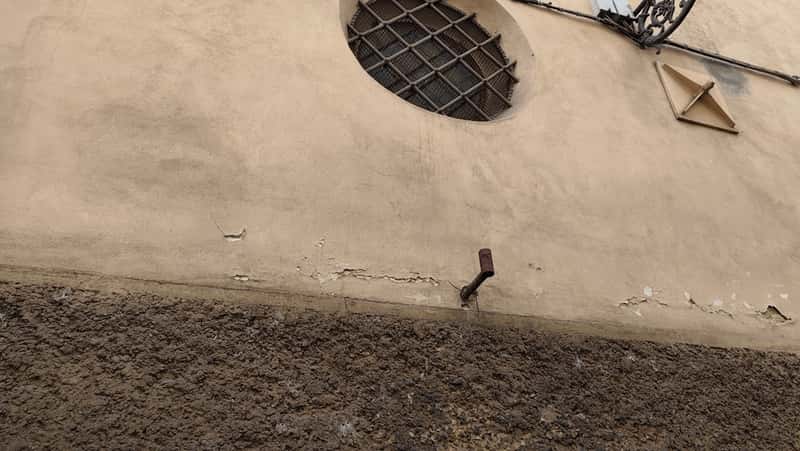
Look higher—above head level—and you may spot curved iron brackets extending from façades. These porta-torcia once held flaming torches before the advent of gas and electric street lighting. Nighttime Florence depended on firelight mounted directly onto buildings. They were often paired with the iron rings to make night riders’ life easier.
The brackets transform the wall into an active participant in illumination. Stone became anchors. Iron became arms. Flame became public service. Imagine the flicker against uneven plaster, shadows stretching across narrow lanes. The city’s visual drama, now enhanced by carefully calibrated lighting, once relied on combustion and manual upkeep. These brackets preserve the memory of a darker, more intimate nocturnal landscape.
Door Knockers and the Theater of Arrival

At eye level, the door knocker performs a different function: communication infused with symbolism. Lion heads, mythological figures, heavy bronze rings—each announces a threshold. To grasp one is to participate in a ritual that predates electric doorbells.
Knockers were never neutral. They signaled wealth, family identity, and aesthetic allegiance. The weight of bronze in your hand, the resonance of metal striking wood, the pause before a servant answered—arrival was deliberate. Even today, in a city wired with intercoms, historic doors retain their knockers. They are artifacts of social choreography, reminders that entry once required sound, strength, and patience.
Corner Guards and Defensive Geometry

At street corners, you may notice angled stone reinforcements or protruding blocks designed to absorb impact. These paraspigoli protected buildings from the wheels of carriages navigating tight medieval turns. The city anticipated collision and designed for it.
Here, hardware merges with geometry. The corner is no longer a sharp, vulnerable edge but a calculated buffer. Renaissance urbanism accounted for friction—between wheel and wall, speed and stone. In an era before traffic laws and standardized lanes, architecture absorbed the shock.
Sacred Niches at the Intersection

Not all protrusions were strictly utilitarian. Small tabernacoli—religious niches embedded into façades—extend slightly from the wall or recess within framed stone surrounds. Often housing a Madonna or a painted saint, they inserted devotion directly into the street.
These shrines blurred the line between private building and public ritual. A passerby might pause, cross themselves, or leave flowers. Faith occupied physical space in the urban fabric. Even today, candles occasionally flicker inside these niches, suggesting continuity and faith in heavenly protection.
Reading the City in Relief
What emerges from these elements is a Florence designed not only in elevation and plan, but in relief. The wall was never flat. It hosted transportation, light, communication, defense, and devotion. Iron and stone protruded because life required it. For outside visitors accustomed to smooth façades and standardized infrastructure, this layered hardware can feel almost accidental. It is anything but. Each ring, bracket, knocker, and niche reflects a solution to a specific urban need. Together, they form a tactile archive of how the city functioned before modern systems were centralized and concealed.
To read Florence solely through its cathedrals and galleries is to miss this dimension. What protrudes from the city walls reveals what once mattered most: everyday life and survival.