You check into your hotel after a long day of travel, kick off your shoes, and finally exhale. The last thing you expect is for your room phone to ring with someone trying to rob you blind. Yet that is exactly what is happening to travelers across the United States and beyond. The hotel room phone scam, also known as the “front desk scam,” is a coordinated fraud operation that exploits exhausted guests in one of the most disarming moments of their day, and it is growing far more sophisticated than most people realize.
How the Scam Actually Works

The caller is not the front desk attendant. The caller is a fraudster who calls hotels and asks to be transferred to random room numbers, then deploys the scam hoping the guest will fall prey. The scammer calls your hotel room pretending to be from the front desk and says there is a problem with your credit card, so they need you to verify your information. The excuse is usually that the card you gave at check-in was not accepted, often blamed on a glitch in the computer system.
They will be incredibly apologetic and reassuring, telling you that you do not need to come down to the lobby. Instead, they offer the “convenience” of handling everything over the phone. Once you hand over that information, your problems have truly begun. Scammers may claim the card was declined, that they need to re-verify payment information, or that they lost all the financial information and need to run an audit by a certain time. Every version of the story is designed to create just enough urgency to bypass your better judgment.
Why Tired Travelers Are Easy Targets

Often, guests arrive at the hotel tired and fatigued from a busy day, and the fraudsters know this pattern well. They count on exhaustion to cloud your judgment. When you are disoriented and half asleep, you are far less likely to question the legitimacy of the call or remember that hotels already have your payment information securely stored in their system. Scammers commonly call hotel rooms late at night, when guests are most vulnerable and least alert.
Perhaps the most dangerous thing about this type of scam is that, when the victim answers a call, there is little that anyone else can do to intervene. A phone conversation does not offer the opportunities for unhurried scrutiny that an email might. Scammers use this fact to their advantage, ratcheting up the sense of urgency and bombarding the victim with requests and information. The victim has no room to stop and think about whether it all adds up. Fatigue and social pressure form a perfect storm for deception.
The Jaw-Dropping Scale of Phone Fraud Losses
Americans reported more than $12.5 billion in fraud in 2024, the majority of which came from telephone fraud. Americans lost $2.6 million between April 2024 and April 2025 from travel-related scams, based on reported cases analyzed from Better Business Bureau tracking data alone. The actual financial damage is likely far higher, considering many victims never come forward.
There were 442% more voice phishing attacks in the second half of 2024 compared to the first half of the year. In January 2024, CrowdStrike recorded just two vishing attacks, while in December, they recorded 93. The median loss per vishing victim is $1,400. That figure can multiply quickly when a scammer gets hold of full credit card details, and hotel guests are uniquely exposed precisely because they have already surrendered their payment information to check in.
Hotel Data Breaches Feed the Scam Machine
In 2024, Otelier, a cloud-based hotel management platform used by over 10,000 hotels including Marriott, Hilton, and Hyatt, suffered a massive data breach. Hackers exploited an employee’s stolen credentials to access Otelier’s Amazon S3 cloud storage, exfiltrating 7.8 terabytes of data. This included millions of guest records: names, addresses, phone numbers, email addresses, booking details, and partial credit card information.
A recent industry report revealed that roughly 82% of North American hotels experienced a successful cyberattack during the summer of 2024, with many hit multiple times. Attacks in the industry are near-universally financially motivated, with the majority aiming to steal information that can either be sold or used to make a profit. Credit card information is a primary target, but cybercriminals also aim to steal sensitive guest information to commit fraud. This stolen data gives scammers the guest details they need to make their fake front desk calls sound legitimate, because they may already know your name, room number, and booking details.
AI and Caller ID Spoofing Are Making It Worse
Scammers trick people by making the hotel’s real phone number show up on caller ID screens. Major hotel chains are the main targets, as their high number of transactions makes it nearly impossible to spot fake charges. AI voice cloning technology can mimic anyone’s voice with high accuracy, making scams more convincing. By using cloned voices, scammers can impersonate trusted individuals. Caller ID spoofing involves altering the caller ID to display a different number or name, and this technique is often used in voice phishing to gain victims’ trust.
Deepfake-enabled vishing surged by over 1,600% in Q1 2025 compared to Q4 2024. Perhaps most concerning is the integration of artificial intelligence into vishing operations, enabling scammers to automate large-scale attacks while maintaining convincing human-like interactions. AI-powered vishing utilizes sophisticated algorithms to analyze and mimic speech patterns. Voice deepfake technology allows scammers to create highly convincing voice replicas of real individuals, including bank officials, making verification of caller identity increasingly challenging for potential victims. When a call sounds exactly like the hotel front desk and displays the hotel’s real number, the natural instinct to trust it is entirely understandable.
What You Should Do Instead
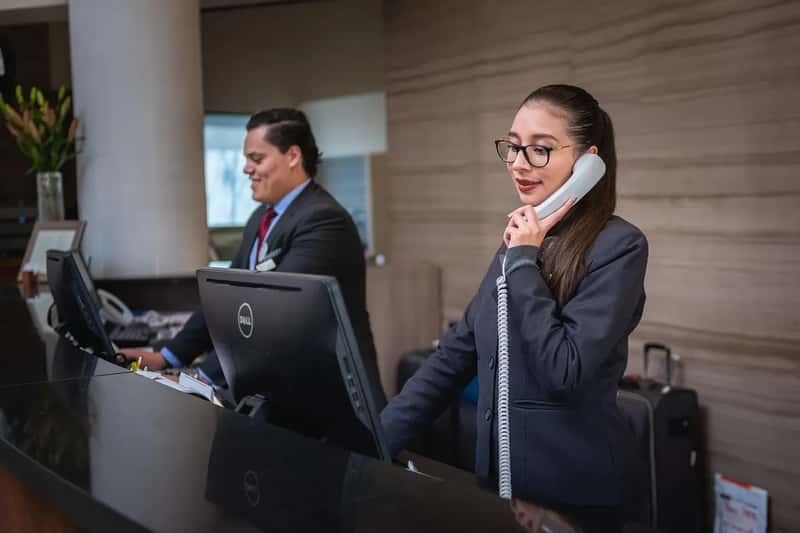
A real hotel staff member will never ask for your credit card information over the phone at odd hours of the night. They will always ask to settle up any charges at the front desk. If you receive this type of call, hang up immediately. Contact the front desk yourself to verify there is an actual problem with your card, and if so, proceed to the front desk in person to take care of it.
The chances are overwhelming that the real staff will have no idea what you are talking about, confirming the call was fraudulent. Always pay hotel charges by credit card, not a debit card. Using a debit card is essentially the same as using cash, offering far less fraud protection. If you encounter a scam, report it to the BBB Scam Tracker at BBB.org/scamtracker and file a report with the Federal Trade Commission at ReportFraud.FTC.gov. The rule is simple: if your room phone rings asking for payment information, put it down and walk to the lobby.