You’re laughing too loud at the joke.
You ordered something you didn’t want because everyone else was ordering it.
You’ve been performing for three days straight and you haven’t noticed yet.
The gap is always there. It lives between the self who books the trip and the self who shows up at dinner. One of them has opinions, needs, silences, desires for a cobblestone alley with no destination. The other one has a role to fill – the fun one, the flexible one, the one who’s just happy to be here.
That gap has a name. Psychologists call it the distance between your authentic self and your enacted social role – the version of you that exists specifically because a group expects it to. The term “role” was borrowed from the theater, where actors perform their parts according to a script. The real person, trained as an actor, can behave quite differently depending on the role being performed. Travel doesn’t dissolve that theater. Sometimes, it builds a brand-new stage.
The Costume You Put On at Baggage Claim
It begins before the trip starts.
Before you’ve even stepped off the plane, your nervous system has already drafted a version of you calibrated for the group. The funny traveler. The low-maintenance one. The person who doesn’t make things weird by needing space.
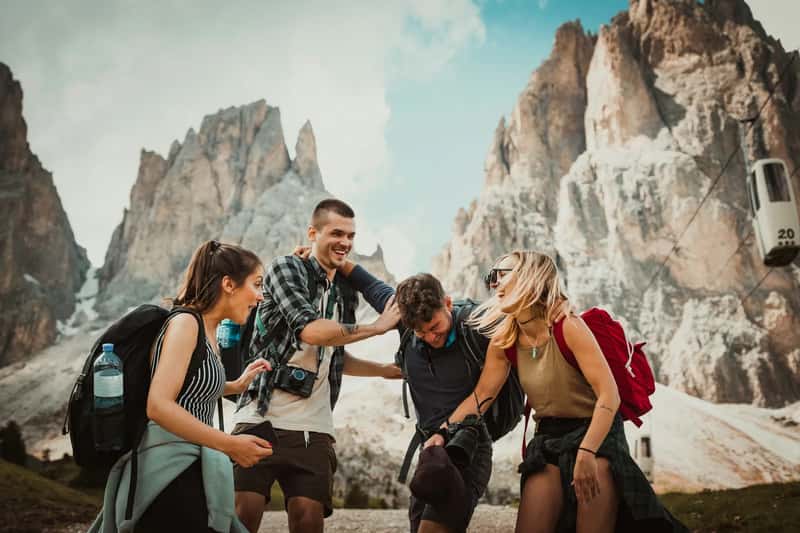
The presence of others sets up expectations. Each social situation entails a particular set of expectations about the “proper” way to behave. A group trip intensifies this. You are not just in a foreign city. You are in a foreign city performing a character for people who already have an opinion about who you are.
The costume is invisible. That’s the problem.
You can’t unpack it and hang it in the closet. It travels with you, worn directly against the skin, indistinguishable from the real thing until the weight of it becomes unbearable somewhere around day three, usually during a group dinner where everyone is talking at once and you are very, very quiet inside.
The first act of self-awareness is simply noticing that you’re dressed in something that isn’t yours.
The Group Mind Takes Over Faster Than You Think
Groups are efficient. They have rules.
Not the kind posted on hostel walls. The invisible kind. There is considerable pressure to conform to social roles. Social roles provide an example of social influence in general and conformity in particular. Most of us, most of the time, conform to the guidelines provided by the roles we perform.
On a group trip, those roles solidify fast.
Someone becomes the navigator. Someone becomes the historian who reads every placard. Someone becomes the one who says “we should probably eat soon.” And someone – maybe you – becomes the one who goes along with everything, keeping the peace, absorbing the friction, wearing the smile that is a degree or two brighter than anything actually felt inside.
We own a role when we adopt a specific behavior others have assigned us – a role we feel as our own, or one influenced by the situation. The quiet horror of a group trip is how quickly you can lose the plot of your own preferences inside the gravitational pull of collective choreography.
Noticing this is not betrayal. It is archaeology.
The Performance Starts With a Single Laugh
You can trace it, if you’re honest.
There is always a specific moment – a single, dateable second – when you shifted from being present to being on. The laugh that was slightly too committed. The enthusiasm at the suggestion you privately felt nothing about. The affirmation of a restaurant you knew, walking in, you wouldn’t enjoy.
Social roles are the parts people play as members of a social group. With each social role you adopt, your behavior changes to fit the expectations both you and others have of that role. The performance isn’t malicious. It’s almost tender – a kind of relational generosity that says: I will become whoever keeps this comfortable.
But comfort for the group is not the same as comfort for the self.
That first misplaced laugh is the canary. If you catch it in real time, you are operating at a rare level of self-awareness. Most people only notice it in retrospect – usually from the window of a moving vehicle, watching a city slide past, wondering why they feel vaguely depleted inside a trip that looked, from the outside, like joy.
Why the Body Knows Before the Mind Does
The body keeps the score, even on vacation.
You will feel the performance before you can name it. A low-grade flatness. A breath that doesn’t quite finish. The sensation of being slightly behind yourself, watching your own hands gesture and your own mouth form words that are correct but not quite true.
High-performing groups are able to avoid placing members under role stress. This occurs when individuals experience incompatible demands and expectations within or between the roles that they occupy, which often negatively impacts their ability to be successful in those roles. Your body files a complaint. It is rarely dramatic. It is mostly a heaviness in the chest around the fourth hour of a group itinerary you didn’t choose.
The physical cues are honest.
The jaw that tightens at another group consensus. The shoulder that rises when someone starts planning tomorrow without asking what you want. The small, particular exhaustion of performing enthusiasm in a location that, privately, doesn’t move you the way everyone else seems to be moved.
The body is always voting. The question is whether you’re counting the ballots.
The Internalization Point – Day Three, a Museum You Didn’t Choose
I know the exact museum.
Everyone agreed on it over breakfast. There was a consensus that had the force of law. I said yes with a speed that had nothing to do with wanting to go. Inside the first gallery, I watched myself read placards with performed interest, nodding at paintings I was not, in any meaningful sense, looking at.
Around the second floor, I noticed the gap. The distance between my feet on that marble floor and the version of me who had quietly wanted to find a café, sit outside, and watch the city do nothing in particular.
When we travel solo, we are free to decide how much time we spend in one place and do not need to worry about another person and their needs. It is possibly the only opportunity where we are released from obligations and expectations from others. That afternoon in the museum, I had accidentally borrowed a moment of that freedom – not by leaving, but by noticing that I could.
The noticing was the beginning of everything.
The Guilt Architecture of Wanting to Be Alone
Here is where it gets complicated.
The moment you register that you want to be alone on a group trip, a secondary performance begins. The performance of not wanting to be alone. Because wanting to separate carries an implicit accusation against the group – that they are not enough, that the trip is not working, that you are difficult.
None of this is true. But the guilt is very convincing.
What predicts comfort with solitude is a dispositional autonomy – a tendency to act in congruence with one’s own values rather than external pressure. Most people have been conditioned to read that autonomy as selfishness. The group trip amplifies this. Every divergence from the collective plan becomes a small referendum on your commitment to the shared experience.
But if you’ve ever felt guilty about disappointing someone, travel is boundary boot camp – it teaches you to prioritize your own needs without apology, and to communicate them clearly and calmly.
The guilt is not a signal to stay. It is a signal that you have been performing so long, even your nervous system has started to confuse obligation with desire.
The Permission No One Hands You
Nobody on the group trip is going to tap you on the shoulder.
Nobody is going to say: you look like you need a walk alone. You look like you’ve been performing since Tuesday. You look like a person who is genuinely moved by nothing right now because you are running on social fuel and it is almost gone.
The permission is internal. It always has been.
Travelling alone removes external influences and expectations. Every decision, big or small, comes from your own preferences. You don’t have to be traveling alone to access that truth. You just have to claim an hour of it inside the group trip – an hour that belongs entirely to your unaudited self.
The permission sounds like this: I’m going to take a walk. I’ll meet you back at the hotel.
That’s it. Eight words. No explanation. No apology architecture. No pre-emptive softening of the announcement with a joke to prove you’re still fun. Just a sentence that is honest, clean, and yours.
What Happens on the Walk
The first two minutes are strange.
There is a low-grade guilt hangover. A phantom awareness of the group, still moving through the world without you, possibly having opinions about your absence. This passes.
Then something opens.
Traveling alone allows you to access many more thoughts and sensations that may be blocked when distracted by a second person or group. It also allows you to focus your energy. The street presents itself differently when you’re alone in it. The specific light on a specific wall. The sound of a language you don’t speak, arriving as pure music because no one is waiting for you to have a reaction to it.
Being alone sharpens the senses, turning every journey into an exercise in mindfulness.
You slow down. You turn down an alley that has no purpose. You sit somewhere and order something small and watch the city be itself with no audience. The performance ends. And under it, still there, surprisingly intact – the actual you, a little tired but fundamentally present, relieved to have been found.
The Identity That Only Emerges in Negative Space
There is a version of yourself that can only surface in the absence of observation.
Time away from a familiar environment creates space to question culturally inherited ideas of identity. It explores how unfamiliar cultural contexts can create the psychological conditions for listening to an inner voice rather than external expectation.
This version is not dramatic. It doesn’t reveal hidden depths or secret passions. It mostly just knows what it wants for lunch without running it by anyone. It knows when it’s done with a museum and when it wants to stay in one room for forty minutes. It knows the difference between genuine delight and performed delight – a distinction that, after days of performing, feels like a rediscovered sense.
When you’re on your own, you have the time and space to reflect on your thoughts, feelings, and reactions. You become more aware of your strengths and weaknesses, your likes and dislikes, and your comfort zones. This heightened self-awareness often leads to personal growth.
The walk alone is not a rejection of the group. It is a recalibration. You go back to the hotel with something that was missing at breakfast – a genuine self to offer, instead of a performance of one.
The Most Radical Thing You Can Do Is Return Different
The walk changes the dinner.
Not dramatically. Not in a way anyone else would name. But you are less performed at the table. You order what you actually want. You laugh when something is actually funny. You are quiet when you have nothing to say and the quiet doesn’t cost you anything.
When travelling solo, travellers remove themselves from the continual negotiation that is often difficult with group dynamics. Travellers have control of the decisions and actions, deciding what to eat, what to do, and when to have a break. Having this control removes perceived obligation and makes preferences resurface that might have become obscured by social obligation.
One walk can do that. One hour of not performing can return you to yourself so completely that the people at the table – your people, the ones you chose to travel with – get something more real than anything you offered on day one.
The most radical act on a group trip is not the spontaneous detour or the unexpected adventure. It is the quiet, unremarkable morning where you said: I’ll catch up with you – and meant it without guilt, without explanation, without the performance of needing permission.
That is the whole thing. That is the entire practice of identity travel, compressed into a single sentence spoken to people who love you, in a city you’ll always remember, in the year you finally learned to notice the exact moment the act began.
The groups we travel with know us in fragments. The role we play for them is not a lie – it is a real piece of the self, just not the whole picture. What no itinerary accounts for is the part of the self that requires silence to exist at all. That part does not speak up at group dinners. It does not vote on the next landmark or weigh in on the route. It communicates only in the language of a quiet, unscheduled hour – through the particular quality of being alone in a foreign street, accountable to no one, watching afternoon light move across stone, remembering, with something close to relief, that you are a person and not a role.
The walk is always available. The permission was never withheld. It was only ever waiting for the moment you stopped performing long enough to hear it.
Some streets are only ever walked by the version of you that no one on the trip has met yet.