
Picture a warm August evening somewhere in middle America, circa 1986. The station wagon is finally unpacked, the suitcases are back in the closet, and the family dog has stopped sniffing everyone suspiciously. Then Dad disappears into the hall closet and reappears carrying the Kodak Carousel projector. The living room furniture gets rearranged, a bedsheet gets pinned to the wall, and for the next two hours the entire family — plus whatever neighbors could be corralled — relives every single moment of the trip through a parade of glowing 35mm slides. This was the post-vacation slide show. And if you grew up in an American home before 1990, you almost certainly sat through at least one.
Most people assume the tradition just faded naturally when cameras went digital. But the real story is more complicated — and more interesting — than a simple format swap. The slide show wasn’t just a way to display photos. It was a ritual, a social event, a family performance, and for many kids the thing that made a vacation feel finished and real. When it disappeared, it took something specific and irreplaceable with it. Here’s what actually happened — and why people are only now starting to feel the loss.
The Slide Show Was Never Really About the Photos
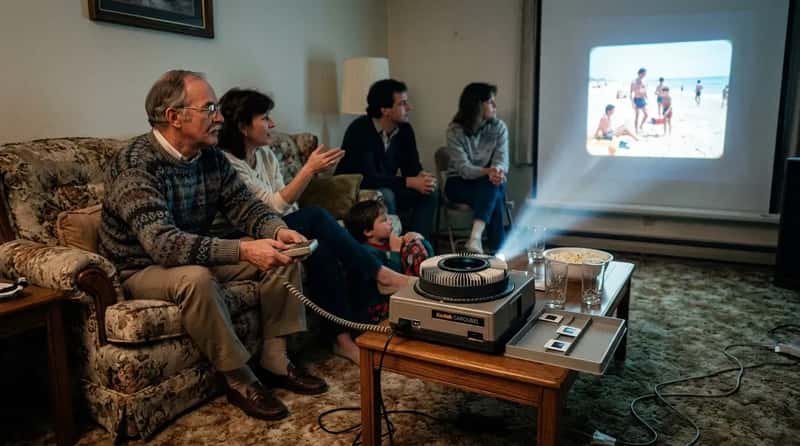
The projector transformed a living room into a theater. Dad was suddenly both director and narrator, fumbling with the clicker remote while Mom filled in the details he got wrong. Neighbors pulled up folding chairs. Kids were allowed to stay up past their bedtime because this counted as a social occasion. The whole setup was communal in a way that has no real modern equivalent — you couldn’t fast-forward, you couldn’t skip to your favorites, and you absolutely could not scroll past the boring ones.
For those who lived through it, the slide show brought either warm memories of family togetherness or vivid recollections of what felt like endless hours of low-grade suffering — sometimes both at once. Unlike a photo album that got handed around the table, the slide show required participation. Everyone looked at the same image at the same moment. Everyone laughed at the same unflattering shot of Grandma in her sun hat at the exact same time. That synchronized shared experience is precisely what made it stick decades later.
Fast Facts
- Kodak introduced the first Carousel projector — the Model 550 — in 1961. It held up to 80 slides in its signature circular tray.
- By the 1970s and ’80s, Carousel projectors were a standard fixture at family gatherings, holiday parties, and backyard barbecues across America.
- Kodak manufactured more than 19 million Carousel projectors over 40 years of production.
- The last Kodak Carousel projector rolled off the assembly line on October 22, 2004 — ending a run that outlasted most technologies of its era.
- Kodachrome film, the preferred choice for slides, was discontinued in 2009.
The Station Wagon Was the Stage That Made It All Possible

In the 1980s, one vehicle defined the American family road trip: the wood-paneled station wagon. With faux-wood siding and rear-facing back seats, these cars were equal parts practical and iconic. The kids wedged into that backward-facing seat weren’t just passengers — they had a front-row view of everything the trip left behind, watching the world unspool away from them mile by mile. That perspective bred a specific kind of boredom that somehow produced better memories than comfort ever would.
Families piled in with paper maps, cassette tapes, and no GPS to second-guess every turn. All those hours on the road — the license-plate games, the arguments over who crossed the invisible line, the crinkled AAA maps spread across someone’s lap — created the raw material that the slide show later organized into something resembling a story. Without the long drive, there was simply less to narrate. The car and the carousel were part of the same machine.
The Unplanned Stop Was Where the Best Slides Came From
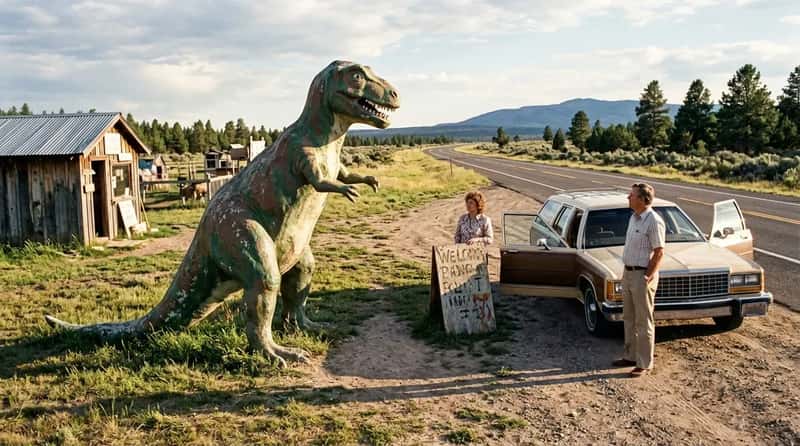
The American roadside in the 1980s was still alive with the kind of attractions that had no business existing: a giant fiberglass dinosaur visible from the highway, a mystery cave with a guide who was clearly inventing facts on the fly, a roadside petting zoo that turned out to be a farmer’s actual backyard. Nobody had vetted these places. Nobody had read a single review. You stopped because something caught your eye through the windshield, and half the time it turned out to be genuinely wonderful and half the time it was genuinely terrible, and either way it became a slide.
These spontaneous detours were never sanitized by pre-trip research. That chaos was the point. A slide tray full of planned, predictable shots of famous landmarks made for a dull show. But a slide of the entire family standing next to a concrete Brontosaurus in 95-degree heat, everyone sweating and slightly confused about why they stopped — that one got a laugh every time. The best slide shows were built on detours nobody planned.
The AAA TripTik Was the Slide Show’s Secret Collaborator
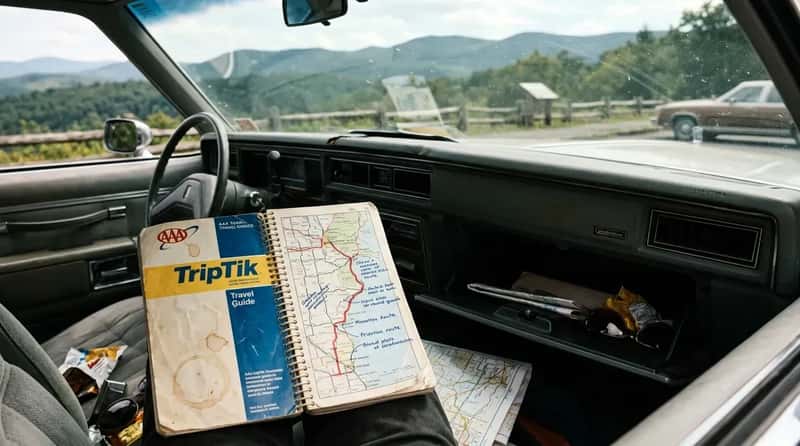
Before smartphones, the AAA TripTik was the closest thing families had to a personalized travel guide. These spiral-bound route planners were custom-made for each trip — detailed maps, highlighted paths, notes about rest stops, nearby attractions, and the occasional recommended diner. They lived in the glove box, slightly crumpled, with coffee-ring stains on the cover by day three. Flipping to the next section as you crossed a state line felt like turning a page in a story you were writing in real time.
The TripTik quietly shaped what got photographed. If it flagged a scenic overlook or a quirky landmark, that became a slide. The route decided the narrative before the projector ever clicked on. When digital navigation replaced it, something subtler disappeared too — the sense that the trip had a physical document, a paper artifact you could hold. The TripTik was the outline. The slides were the finished draft.
At a Glance: The AAA TripTik
- First issued in 1937; by the 1950s it was one of AAA’s most popular member services.
- Agents hand-highlighted each route in marker, often noting construction zones, rest stops, gas stations, and points of interest tailored to your specific trip.
- The spiral-bound format let you flip page by page as you crossed state lines — a physical sense of progress no GPS app has replicated.
- AAA still offers TripTiks today, though they are now digitally generated; printed copies are available only in select states.
- AAA paper TourBooks — the companion guides that listed attractions along each route — were fully discontinued at the end of 2021.
The Roadside Attractions That Filled Those Slide Trays Are Largely Gone

The Bottle Tree Ranch near Barstow, California — hundreds of glass bottles arranged on metal poles, catching the desert light and tinkling in the wind. The Winchester Mystery House in San Jose, drawing superstitious travelers with its staircases to nowhere. Bubblegum Alley in San Luis Obispo, which disgusted and fascinated visitors in equal measure. These weren’t just pit stops. They were destination-worthy oddities that families built detours around, and they filled slide trays with images that had actual personality.
The hunger for peak, shareable experiences has crowded out the serendipitous discovery of delightful roadside oddities — and that shift has a direct effect on what ends up in a photo collection. No quirky detours means no surprising images. No surprising images means no show worth watching. The random stop at the hand-painted sign on the highway was, it turns out, doing a lot of heavy lifting for the whole slide-show economy.
The Slide Projector Died Faster Than Anyone Expected
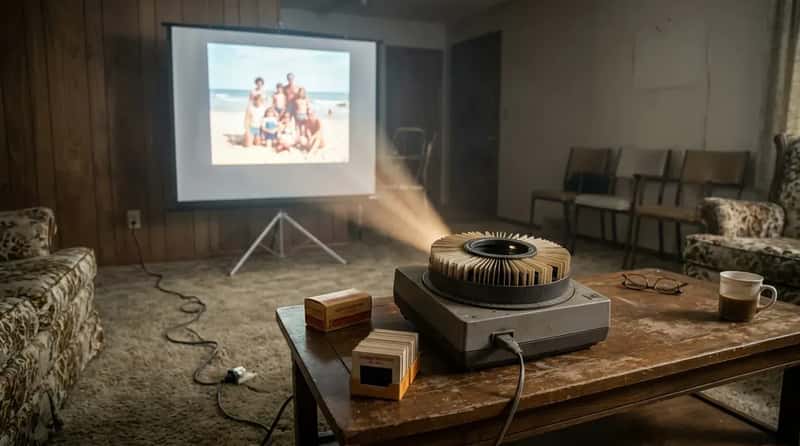
The decline began in the late 1980s and collapsed in the 1990s, driven by a technology that originally had nothing to do with family vacations. PowerPoint — first released on April 20, 1987, for the Macintosh, then acquired by Microsoft that same year for $14 million — gave offices a cleaner, faster system for showing images on a wall. Once the boardroom had moved on, the home carousel started to feel antiquated by comparison. Then digital cameras arrived, and the film slide simply had nowhere left to go. Both its business use and its personal use evaporated within roughly a decade.
What’s strange is how few families remember making a conscious decision to stop. One year there was a slide show after the summer trip. The next year there wasn’t. Nobody called a family meeting about it. The projector went back into the closet after Thanksgiving 1994 or so and just never came back out. The ritual didn’t end with a funeral. It ended with a quiet omission that nobody noticed until years later, when the kids grew up and started asking what happened to all those boxes of slides in the attic.
Quick Compare: Then vs. Now
- Then: Film dropped off at the drugstore; one-week wait for prints; photos revealed in a batch, like opening a time capsule.
- Now: Photo visible on your screen within one second of taking it; posted before dinner; liked and archived before you leave the parking lot.
- Then: 80-slide carousel tray; one communal viewing event; the room watched together in real time.
- Now: Thousands of photos on a phone; individual, asynchronous scrolling; no shared moment.
- Then: The wait created anticipation — and gave the slide show something to reveal.
- Now: The trip is already “over” on social media before the car pulls into the driveway.
What Digital Photos Could Never Replicate

Families spent entire vacations snapping photos with no idea how any of them would turn out. Film rolls got dropped off for development after the trip, sometimes at the drugstore, sometimes at a dedicated photo lab. Then came the wait — a week or more — before the prints came back. By then you had mentally let go of half of what you shot. Picking up that envelope and flipping through the photos was its own small event, a reunion with moments you had almost forgotten.
Today you see the photo a second after you take it. You edit it on the spot, post it before dinner, and it collects a dozen likes before you’re back in the car. By the time you get home, the trip is already over in a social media sense — there’s nothing left to project, no surprise left in the images. The delay wasn’t a flaw in the old system. It was the feature. It’s what gave the slide show something to reveal.
The Neighborhood Audience Is Gone Too
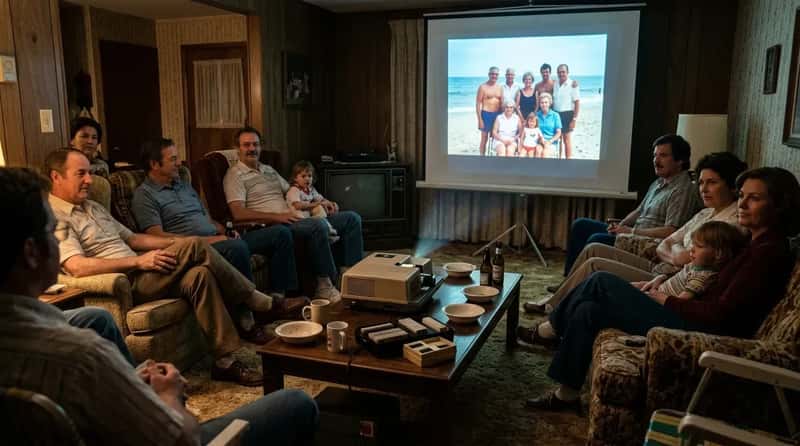
“Let’s have a slide night” was, by reputation, a phrase capable of causing aunts and uncles to suddenly discover pressing prior engagements. The groan was real. And yet — hardly a family was without a projector and folding screen, and people showed up anyway. The groaning was part of the ritual. It was the performance of reluctance that made the actual gathering feel like something you’d been talked into, which somehow made it more enjoyable than something you’d chosen freely.
The slide show was a neighborhood event in a way that Instagram is not. Someone brought beer. Kids stayed up late. The living room filled with people who had not taken the trip but were being welcomed into it anyway. That dynamic — showing your summer to a room full of people who didn’t experience it, and having them laugh and react in real time — turned out to be its own form of connection. Social media technically does the same thing, but asynchronously, privately, and without anyone sitting next to you on the couch.
The Generation That Grew Up Without It Has No Equivalent
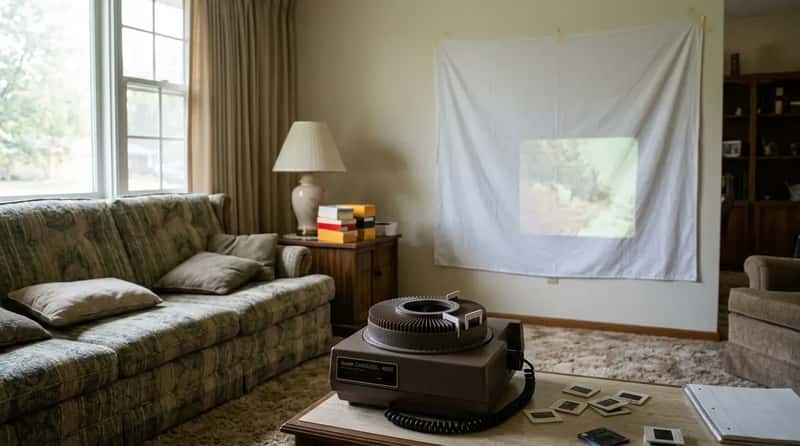
If you were born after roughly 1985, you have never experienced the full arc of a family slide show — the furniture rearranged, the sheet on the wall, the clicking Carousel, the 80 consecutive images of a Maryland crab shack while someone’s uncle narrated from the couch. That’s not a trivial gap. It means a large share of living Americans have never seen a vacation wrapped up as a communal performance. They’ve seen trip photos, obviously. But that’s not the same thing.
Some of those people are now parents themselves, packing kids into SUVs for summer trips with no ritual waiting at the other end. The vacation gets documented in real time and archived instantly, but there’s no event that closes the loop — no darkened room, no clicking carousel, no moment where the trip officially becomes a story the whole family agrees on. The absence is hard to name, which is probably why it took so long for anyone to name it.
Why Nostalgia for It Is Starting to Come Back Around
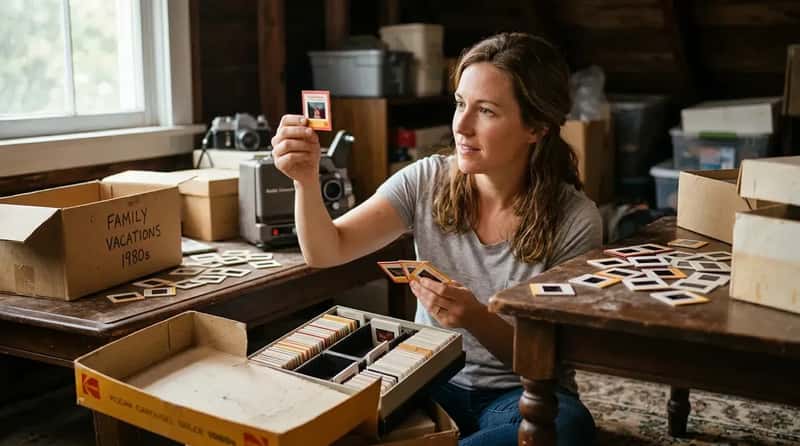
Boxes of old Kodachrome slides are turning up at estate sales and in attic cleanouts across the country, and the services that digitize them have grown steadily in the past decade. Grown children are discovering that their parents shot hundreds of slides through the 1970s and ’80s that nobody has looked at since Reagan was president. When those images get scanned and shared, families are often stunned — the photos are properly composed, warmly lit, full of a specific American moment that nobody thought to preserve intentionally.
The families who held those slide shows weren’t archivists. They were just narrating their own lives, one click at a time, in front of people they loved. What’s surprising, looking back, is how effective that was. The shared laughter in a darkened living room turned out to be a better preservation method than any format that came after. The instinct to show your trip to a room full of people who didn’t take it — to make them sit still and look — turns out to have been worth something that nobody fully appreciated until it stopped.
Worth Knowing: Rescuing Old Slides Today
- Today, millions of Kodachrome slides sit in family attics and estate collections, with many owners unaware the images inside are still vivid and recoverable.
- Kodachrome’s unique chemistry makes it exceptionally stable — slides stored in a cool, dark space can retain color and sharpness for 50 years or more.
- Professional digitization services typically scan at 3,000–4,000 DPI to capture the full detail of a 35mm slide; most consumer flatbed scanners fall well short of that.
- For collections under 200 slides, a DIY scanner is workable; for 500 or more, professional services (running roughly $0.40–$1.50 per slide) are generally the smarter call.
- Once digitized, those old vacation images can be shared with the whole family — which is, fittingly, exactly what the slide show was always meant to do.