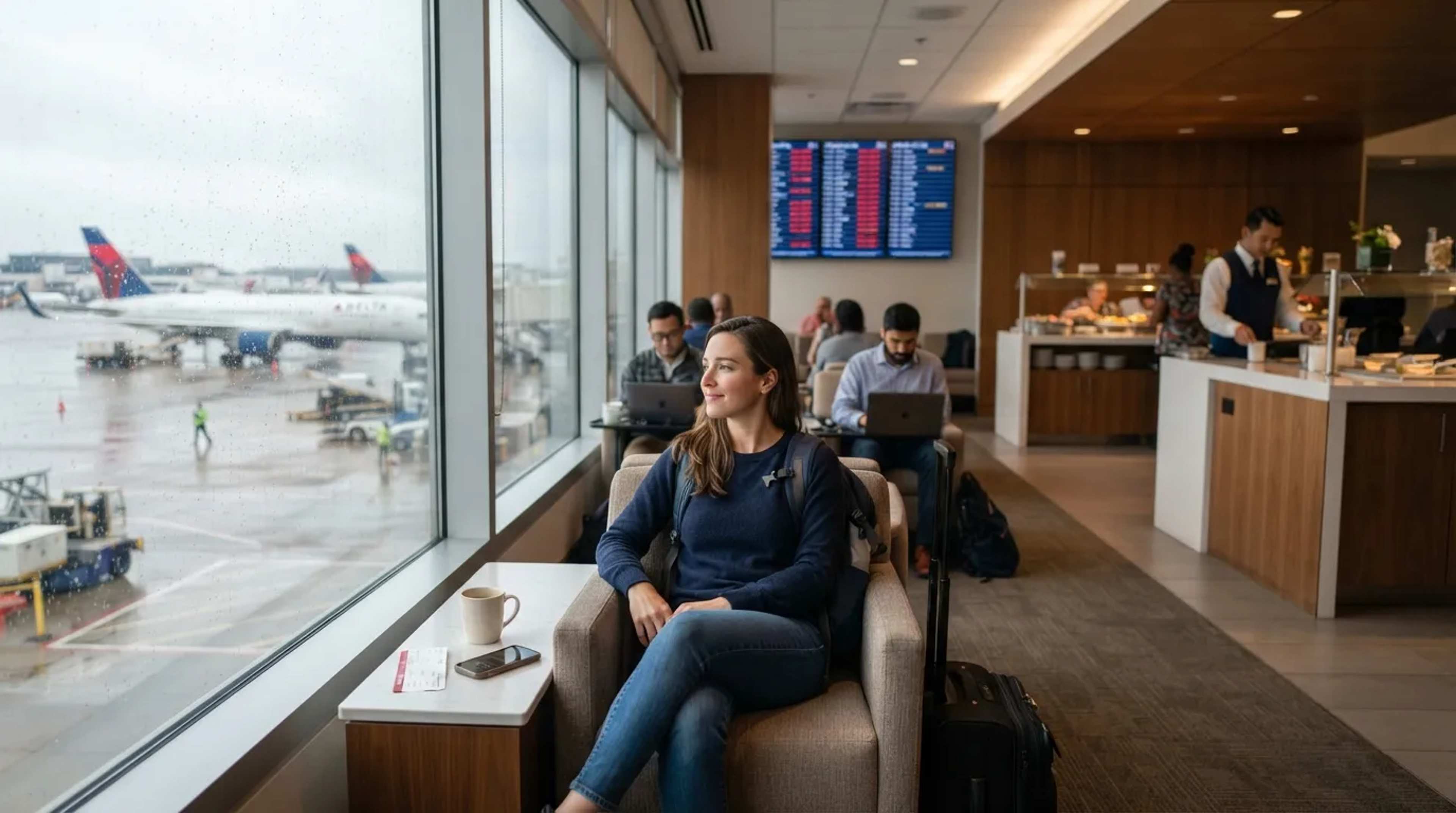
The granola bar is still there.
Crushed into the bottom corner of your bag.
The city outside has a hundred restaurants. A convenience store on every corner.
And still. The bar stays.
There is a version of you that has it all together. The curated carry-on. The oat milk in the hotel mini-fridge. The restaurant reservation made three weeks out.
And then there is the version of you that packed four snacks for a two-hour flight. That slipped a backup bar into a jacket pocket before a dinner you already had plans for. That felt a quiet, specific panic when you reached into your bag and found nothing.
This is the distance between the adult who performs competence beautifully and the child who learned, in some very specific and very indelible way, that the world cannot always be trusted to provide. These experiences can imprint the need for food at a young age, which can then “stick” in the mind and become a fixation. Most of us have never closed that gap. We’ve just built a very organized life around it.
1. The Forgotten Lunch Wound

It happened once.
Maybe twice.
A lunchbox left on the kitchen counter. A school cafeteria line you couldn’t afford. A parent who forgot, or a parent who was simply gone.
The event itself was small. The imprint was not.
One of the strongest predictors of food-related anxiety in adulthood is growing up in an unpredictable environment. A study of 662 adults found that childhood environmental unpredictability was significantly and positively correlated with hoarding behavior.
That forgotten lunch was not just a missed meal. It was a data point. Your nervous system filed it under: the world is not reliable.
Every snack you carry now is a counter-argument to that moment. A rebuttal. A small, portable declaration that this time, you are prepared. This time, no one is forgetting you.
The granola bar is not food. It is proof.
Proof that you, at least, remembered yourself.
2. The Controlled Plate
For some children, the dinner table was not a place of nourishment.
It was a place of negotiation. Of performance. Of earning.
Portions decided by someone else’s mood. Meals withheld as punishment or withheld as power. The specific cruelty of a full refrigerator you were not permitted to access freely.
“It could be where food is controlled or a child’s emotional needs are not met,” clinical experts note. Safety and security are not guaranteed in families with addiction, physical or emotional abuse, or neglect. “That can turn into holding comfort objects, whether it’s food or other sentimental objects, to try to take care of those needs.”
When the plate was managed by someone else’s power, you learned something dangerous: your hunger was not a legitimate need.
It was an inconvenience. An imposition.
So you learned to pre-empt it. Quietly. Before anyone could tell you no.
The emergency snack stash is autonomy in a wrapper. It is hunger answered on your own terms, finally, after years of asking permission.
3. The Poverty Math
There was a month. Maybe a year.
When the numbers didn’t work.
When food decisions were actually financial decisions wearing a different coat. When you learned that wanting something from a menu was not the same as being allowed to order it.
Children who couldn’t count on consistent meals, stable housing, or reliable caregivers often develop a relationship with possessions that serves as a buffer against the fear of going without. This pattern is common among people who grew up during wars, famines, or deep poverty. The logic is straightforward: if you once went hungry and had no control over when food appeared, accumulating it as an adult provides a feeling of safety that’s hard to let go of, even when your circumstances have changed.
The financial wound is a strange one to carry. Because from the outside, it’s invisible.
You look fine now. You have cards in your wallet. There are twenty restaurants within walking distance.
But the body keeps its own ledger. And somewhere in yours, there is still a line item marked not enough. The snack stash is how you balance it.
4. The Intergenerational Scarcity Transfer
You didn’t live through the Depression.
You didn’t survive the rationing, the empty shelves, the calculating of how far a single loaf could stretch across a week.
But someone you loved did.
Traumatic experiences, especially those occurring in childhood, can profoundly impact an individual’s sense of security and resource management. Childhood food insecurity, neglect, or even witnessing significant events like economic depressions or famines within the family narrative can create a lasting imprint. These early experiences can instill a deep-seated fear of future deprivation, leading to a hypervigilance around resource availability, including food.
Your grandmother stacked cans until they touched the ceiling. Your grandfather ate everything on the plate because waste was not a concept he could afford.
These were not quirks. They were survival architectures. And you inherited them without knowing.
The snack stash is your grandmother’s depression-era psychology, alive and operational inside your commuter bag decades later. You carry it for her. You carry it because no one told you that you were allowed to put it down.
5. The Sick Day Nobody Cared About
I remember the specific quality of that hunger.
Not physical. Something older than that.
I was eleven, maybe twelve, and I had stayed home from school. There was no one there to make anything. There was food in the house, theoretically. But accessing it required a kind of independence I hadn’t been given permission for yet – and yet had no choice but to take.
I made something terrible and ate it alone.
And I filed it away in a place I wouldn’t find again until I was an adult standing in a hotel room at 11 PM, relieved to discover a protein bar I’d forgotten I’d packed.
Children who were forced to take care of themselves before they were developmentally ready may carry around a “survival mode” mindset. And those who experienced abuse or other forms of physical or emotional trauma may lean on food hoarding behavior as an attempt to self-soothe, or create a sense of comfort.
The sick day nobody came for creates a particular brand of self-reliance that looks like strength but feels like loneliness with excellent organizational skills.
You carry the snacks because your body learned: when it is in distress, it cannot count on the world to fill the gap. So you fill it yourself. Every single time.
6. The Unpredictable Caregiver Schedule
The parent who came home late.
Or didn’t come home at all.
Or came home changed – different energy, different rules, different appetite for the night.
Mealtimes were not mealtimes. They were negotiations with unpredictability. You learned to read the room before you read the menu.
The connection between childhood unpredictability and adult hoarding behavior wasn’t just direct. It worked through two pathways: anxious attachment – difficulty trusting that your needs will be met by others – and a chronic sense of insecurity.
When you couldn’t predict when food was coming, you began to create your own certainty. Small caches. Hidden reserves. A backup plan that was always yours.
That pattern is still running. The desire for control is a significant driver. In a world that often feels unpredictable and chaotic, hoarding can provide a tangible sense of mastery. The act of accumulating resources can create an illusion of security, a feeling that one is prepared for any eventuality.
The snack stash is the illusion you built to survive unpredictability. And the terrifying thing? It still works.
7. The Transit Hunger That Was Never Just About Food
There is a specific hunger that arrives in airports.
It is not related to the last time you ate.
It arrives at gates and in terminals. In the middle of long delays. In rental cars on highways with no exits visible for miles.
Psychologists say this stems from catastrophic thinking: the belief that if you don’t bring something, disaster will strike.
The transit hunger is anxiety wearing hunger’s clothes. It is your nervous system scanning a new, uncontrolled environment and translating threat into appetite.
Anxiety and hunger speak the same language in the body. They both hollow you out. They both demand to be filled. The snack stash is a first-response kit for a body that has learned to confuse emotional distress with physical need.
You are not hungry in that airport. You are uncertain. Unmoored. Between the person you are at home and the person you become when the coordinates change.
The snack is not dinner. It is an anchor. A small, tactile proof that you are still yourself, even here, even now.
8. The Shame of Asking
At some point, you learned that needing things was dangerous.
That asking for food – more food, different food, food when you were actually hungry rather than when it was offered – came with consequences.
A sigh. An eye-roll. A comment about being difficult.
For many people who develop disordered eating behaviors, there is a sense that there “is never enough” – which, when looked at in a deeper way, aligns with a belief they hold that “I am never enough.”
The shame of asking calcifies over time into a refusal to ask at all. You stop requesting. You stop depending.
You just quietly, efficiently, provide for yourself before anyone notices you needed something.
Not having basic survival needs met as a child can perpetuate a premature self-reliance, and the child might begin to think that he or she needs to continually provide for themselves and be in “survival mode.”
The snack stash means never having to ask. Never having to expose that want. Never having to risk the sigh again.
It is armor shaped like a granola bar.
9. The Scarcity That Was Never About Food at All
This is the one that lives deepest.
The one that is hardest to name.
Because it was never about food. Not really. It was about love that was inconsistent. Attention that arrived in small, unpredictable portions. Emotional nourishment that came and went based on rules you couldn’t decode.
An adult might feel that there can never be enough food to fill the gaping hole in their heart. The “inner hunger,” which many people try to fill with food or alcohol or other band-aid substances, will never be filled by these material things; in fact, the hole will only get bigger because of the emotional damage that these behaviors inflict.
Food was the thing you could control when everything else was controlled for you.
Food was the thing that was always there, even when people weren’t.
Food became the proxy for everything you were not allowed to need out loud: safety, consistency, presence, love that didn’t come with strings attached.
Food hoarding isn’t just about the food itself; it’s a coping strategy shaped by a lifetime of learning that emotional needs get answered in the only currency that was reliably available.
And so you carry the bar. The crackers. The trail mix.
Not because you are hungry. But because some part of you is still waiting to be fed in a way that food was never actually equipped to deliver.
The bag is heavy. Not from the snacks. From everything the snacks are standing in for.
There is nothing wrong with carrying them. The emergency stash kept you sane on long layovers, through missed dinners, through the specific exhaustion of being in motion while simultaneously holding your entire life together with organizational skill and low-grade vigilance. It served you. It still serves you. The problem is not the behavior. The behavior goes beyond a mere desire to stockpile. Instead, it stems from deep-seated emotional and psychological issues. Understanding what those issues are – naming them, sitting with them, feeling their specific weight – is where the actual work begins.
You are not broken for carrying the stash. You are not irrational. You are not anxious in the way people say that word when they mean overreacting. You are a person who learned, at a very young age, that provisioning yourself was an act of survival. That lesson saved you. It got you here. And now you live in cities with food on every corner, in a body that still hasn’t received the memo that the scarcity ended.
Maybe today you don’t open the bar. Maybe today you let it sit there and notice what that feels like – not the hunger, but the almost hunger, the ghost of it, the anticipatory ache that was never really about food in the first place. Maybe that is where you find the gap. Not in the departure lounge or the hotel room or the bottom of the bag. But in the quiet, honest moment when you realize the thing you have been carrying all these years was never a snack at all.