The bus smells like old vinyl and someone else’s coffee.
It is 2:47 AM.
You are not tired.
The window is cold against your temple, and outside, the world is just headlights and dark fields dissolving into more dark fields. You should be miserable. You are not. You are, in some way you cannot fully articulate, at peace.
There is a gap between the person you perform in daylight – the one with the address, the job title, the curated personality – and the one who sits quietly in transit at 3 AM, watching the world go past. The daylight person has obligations. This one has none. The daylight person is accountable. This one is nobody in particular, moving between two somewheres, existing in a kind of blessed parenthesis.
Psychologists have a name for the places that make this happen. Liminal space refers to states where our usual identities, routines, or structures are suspended. The bus. The overnight train. The empty airport corridor at the hour when even the janitors have gone home. These are not destinations. They are thresholds. And for some of us – more of us than anyone admits – the threshold is where we breathe easiest.
The Suspended Clock
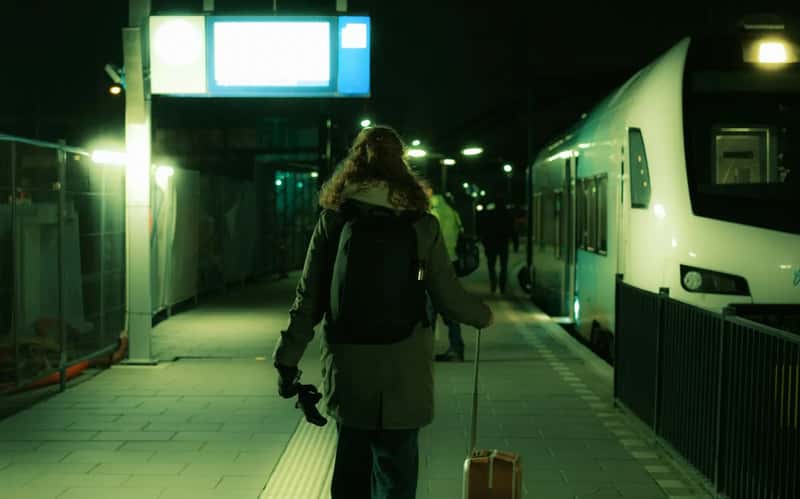
Something strange happens to time in transit.
It loosens.
It goes soft at the edges.
On a train or bus in motion, time seems endless, and there is no pressure to experience as much as possible. You are embedded in the experience. This is not laziness. This is not avoidance. This is a nervous system finally exhaling after a long, pressurized day of performing efficiency.
We live in a world that demands we account for every hour. Productivity is the secular religion, and idle time is its original sin. But the overnight bus asks nothing of you. There is no inbox here. There is no performance review. There is only the rhythm of the road, the hum of the engine, and the particular darkness of a highway at 3 AM.
The nervous system, which has been braced for impact since you woke up, slowly unclenches. The tight architecture of the day – the meetings, the small humiliations, the low-grade social vigilance – dissolves into motion. You are moving. You are also, paradoxically, still.
This is not a coincidence. It is the body finding its own geometry of rest – and it doesn’t look like a hotel bed. It looks like momentum without a deadline.
The Anonymous Body
Nobody knows you here.
That is the whole point.
If you are a human being living in a modern world, the majority of your anxiety comes from worrying about how you are perceived by others. Almost all of our anxiety can be traced back to other people in some way. When you remove teachers, bosses, peers from the equation, it can be comforting because it removes the element that often brings you so much anxiety.
The overnight transit carriage is its own kind of confession booth. Strangers who will never see each other again. A woman reading a paperback. An old man with his chin tucked into his coat. A teenager in headphones, eyes closed, somewhere else entirely. There is no social contract here beyond the basic one: don’t bother each other. Don’t perform. Just exist.
For the nervous system that has been in low-level social threat response all day – scanning rooms, modulating tone, calculating what’s safe to say and to whom – this anonymity is not loneliness. It is relief. It is the body finally standing down from a war it didn’t choose to fight.
You are nobody’s colleague here. Nobody’s disappointment. Nobody’s expectation. You are just a body in motion, which is ancient and sufficient and enough.
The Dissolved Obligation
The hotel room asks something of you the moment you step inside.
It asks you to settle. To arrive. To be somewhere.
And arriving, it turns out, is terrifying for a certain kind of nervous system. Liminal space is deeply uncomfortable for many – so much so that people often make choices or take action not because it feels aligned, but simply to escape the discomfort. Anything to get out of the vast unknown and move on, even if it’s not quite right. But the inverse is equally true: for those who have learned to fear the destination – the permanence, the exposure, the being-seen-in-one-place – the transit itself becomes the refuge.
In transit, you have a built-in excuse for everything. You haven’t replied because you’re on the move. You haven’t decided because you’re still getting there. The obligations that pile up in a fixed address simply cannot find purchase on a moving vehicle. They slide off like water.
The nervous system that learned early that stillness was dangerous – that staying in one place meant being caught, judged, held accountable – finds the bus, the train, the overnight coach to be a perfectly rational home. You cannot be cornered if you are always already leaving.
The Low-Stimulation Cocoon
The carriage is dim.
The sounds are consistent.
The motion is rhythmic.
Feeling at home is partly about how well a space’s sensory settings line up with your nervous system. For the nervous system that is easily overwhelmed – the one that finds hotel lobbies too bright, restaurants too loud, other people’s expectations too sharp – the overnight transit vehicle is a sensory miracle.
Low light. Constant white noise. The gentle percussion of wheels on rail or road. These are not the conditions of deprivation; they are the conditions of regulation. The same nervous system that cannot tolerate a busy hotel bar, that finds the overhead fluorescence of an airport terminal almost violent, discovers in the dim carriage at midnight something that functions like a weighted blanket wrapped around the entire body.
The motion matters too. Being in transit induces “think time,” to think through serious concepts. Some find that traveling on a long-distance transit is ideal for internal exploration, or daydreaming. Humans tend to find pleasure in being in motion, something that may be rooted in our DNA since the first hominids learned to stand and walk.
The body was made to move. It knows this. The nervous system, barreling through the dark at 60 miles an hour, finally agrees.
The Identity Suspension
I remember a particular overnight train from the south of France, years ago. Third-class seat. Bad coffee from a vending machine at the end of the car. I sat there for six hours and felt, with a clarity I still cannot fully explain, like a person I actually liked.
Not the anxious version. Not the one who second-guesses everything. The quiet one. The one without a résumé.
In transit, we exist in a kind of identity limbo. The person who you thought you were doesn’t fit anymore but the new you hasn’t solidified yet. And for those of us who have always found the solidified self to be a slightly uncomfortable costume – something that fits but pinches – this dissolution is not crisis. It is vacation from the self.
Anthropologist Arnold van Gennep first described liminal spaces in 1909 as the middle phase of rites of passage, that ambiguous period when we leave an old identity behind but haven’t yet stepped into a new one. We are, perpetually, in that middle phase. Not because we are lost. But because the middle is where we feel most real.
The hotel room demands you be someone. The overnight bus lets you be no one. And no one, it turns out, is the most restful person to be.
The Permission to Think
The dark window becomes a mirror.
And the mirror, for once, is not unkind.
There is a particular quality of thought that only arrives in motion. What we crave in transit is the potential of slowing down our lives, of allowing contemplation, and of spurring bonds both within ourselves and with others. The overnight transit vehicle is a machine for exactly this. The thoughts that cannot find you in a hotel room – the ones too slippery for a desk, too fragile for a deadline – arrive here, unsummoned, in the dark.
Grief surfaces on overnight buses. So does clarity. So do the things we have been meaning to say to people and haven’t, and the plans we have been too frightened to admit we want. The motion creates a container for all of it. You cannot act on anything while the vehicle is moving. You can only think. And thinking, uncoupled from the pressure to immediately produce something actionable, turns out to be a form of deep healing.
The nervous system that cannot sit still in a hotel room – that reaches for its phone, that turns on the television to fill the silence – finds in transit a different kind of quiet. Not the absence of noise, but the absence of demand. And in that particular quiet, the mind finally starts doing the work it’s been putting off for months.
The Temporary Urge to Belong Nowhere
There is a word for what you feel in transit.
Anthropologists call it liminality.
You call it home.
A liminal space is a transitional state – either physical, emotional, or psychological – where the usual structures are missing. You’re not where you used to be, but not yet where you’re going. For most people, this is terrifying. For the transit-comfortable nervous system, this is the only place the coordinates make sense.
Belonging nowhere sounds like a diagnosis. It isn’t. It is a temperament. It is the particular architecture of a person who was never entirely convinced by the idea of arrival – who suspected, from early on, that the destination was always slightly oversold.
Sometimes these “in-between” spaces aren’t just bridges from one chapter to another. They are the chapter. A long one has the potential to provide many valuable lessons to be learned and experienced if you can see it that way.
The hotel room has a number on the door. The transit vehicle has none. You exist, for the duration, in a numbered seat that belongs to everyone and no one. The nervous system, finally released from the tyranny of the fixed address, settles into the temporary like a body into warm water.
The Roleplay Reprieve
Every fixed destination requires performance.
The hotel lobby requires you to check in as someone. A name. A credit card. A confirmation number.
The overnight bus requires only a ticket and a body.
Commutes – and by extension, all transit – are a source of “liminal space,” a time free of both home and work roles that provides an opportunity to recover and mentally switch gears. This is not a minor psychological convenience. For the nervous system that has been shape-shifting all day – professional self at 9, social self at noon, family self at 6, exhausted-real-self at midnight – the transit carriage is the only place where no role is required at all.
You don’t have to be a good guest. You don’t have to be a good host. You don’t have to be impressive or reliable or easy to be around. The other passengers don’t need anything from you. The engine doesn’t care who you voted for or whether your career is going according to plan.
Without the ability to mentally shift gears, people experience role blurring, which can lead to stress. Without mentally disengaging from work, people can experience burnout. Transit solves this. Not through therapy or meditation or the correct podcast – but through the simple, animal fact of motion and anonymity combined. You are passing through. That is enough of an identity for the night.
The Noise That Quiets Everything Else
There is something about the sound of a moving vehicle in deep night.
It is not silence. It is better than silence.
Silence, for the hypervigilant nervous system, is not peaceful. It is suspicious. It is the quiet before something. The mind, left alone with nothing, generates its own threats. The 3 AM hotel room silence is the loudest thing some people have ever heard – every old anxiety given perfect acoustic conditions in which to perform.
But the overnight bus has its own sound. The engine. The road. The occasional creak of the chassis. The soft noise of someone else’s music leaking from headphones two rows back. These are not disruptions. They are a kind of white noise that occupies the surface of the nervous system just enough to prevent it from turning inward and beginning to devour itself.
The eerie silence and unusual emptiness of liminal spaces trigger a heightened awareness that makes us more sensitive to our surroundings. But that heightened awareness, pointed outward – at the road, the dark, the passing lights – is not anxiety. It is presence. Pure, uncomplicated, demanded-by-nothing presence. The kind that does not arrive in hotel rooms with their expectant silence and their soft, accusatory beds.
The bus will stop eventually. Every transit ends. The architecture of the world insists on destinations – on addresses, on rooms with numbers, on beds that face a wall. And you will step off the vehicle into the grey light of early morning, and the world will ask you, immediately, to be someone again.
But for those hours in the dark, something truer was happening. The nervous system, finally freed of its costume, was doing the quiet, unglamorous work of simply being. No arrival required. No performance pending. Just the body in motion, the mind unlocked, and the road holding all of it without asking for anything in return.
Maybe the question is not why you prefer the overnight bus to the comfortable hotel. Maybe the question is what the comfortable hotel was never actually offering you. And whether, in all the dark miles between here and there, you have already been building something that looks – if you let yourself see it – a lot like home.