The restaurant is loud.
You chose the bar.
Not because there were no tables. There were tables.
You chose the bar because a table requires you to be someone. It requires arrival. It requires performance. The bar just requires a stool and a willingness to disappear into the noise while remaining perfectly, privately whole.
There is a gap between the person who walks into a room and the person who actually lives inside your chest. One of them makes eye contact. One of them orders confidently. One of them laughs at the right moments. The other one watches all of this from a slight remove – curious, calm, and completely untethered from the social contract playing out six feet away at the four-top by the window.
The Threshold Personality
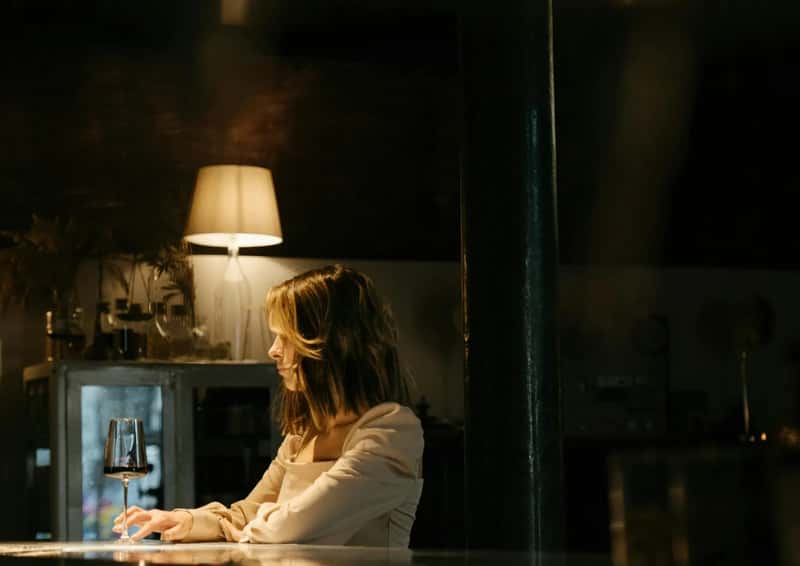
Not everyone who sits at the bar is avoiding something. Some of them are protecting something.
There is a particular kind of person who gravitates toward thresholds. Doorways. Edges. The last seat at the counter before the kitchen wall. The word “liminal” relates to the idea of the threshold – pertaining to the space on either side of it. Usually we think of what comes before a threshold is reached, and not so much about what comes immediately after, before the new form solidifies. The bar is that space. It is the architecturally-designated threshold between participant and observer. You are technically inside the restaurant. You are also, somehow, watching it from the outside.
This is not a small distinction. It is the entire psychological operating system of a certain kind of person.
The threshold personality does not want to be fully committed. Not out of fear. Out of a deep, almost biological awareness that full commitment to any social space means surrendering your vantage point. And the vantage point is everything.
The bar offers the view and the exit. Simultaneously. That is the entire value proposition.
The Controlled Exposure
A table is exposure. The bar is controlled exposure.
Diners want to feel part of the restaurant’s energy without being on display. Seating that provides some privacy while maintaining connection to the broader dining room creates the psychological comfort that encourages extended visits. The bar does this architecturally, almost by accident. Your back is to no one. Your face is to everyone, and yet everyone is looking past you, not at you.
You are technically in the most visible seat in the house. And yet you have never felt more invisible.
This is the paradox the bar-seater has quietly solved. Strategic placement of architectural elements can create psychological boundaries that provide comfort without physical barriers, allowing guests to feel simultaneously protected and connected to the broader environment. The bar is exactly this. It is protection wearing the costume of openness.
You are in the world. You have simply negotiated the terms.
The Identity Suspension
At a table, you are someone specific. You are a colleague, a date, a family member, a friend with a shared history. You are a role, and the role has lines.
At the bar, your identity is briefly, mercifully suspended.
In liminal space you are being directed into the nonphysical world to clear old patterns so you can receive your new set of instructions, your new imaginations, and more of your true self. You are being asked to occupy the present moment fully, to be still and transparent. Here you must be comfortable being timeless; you must become the pause.
The bar is that pause made physical.
No one at the bar knows your job title. No one at the bar has met your mother. No one at the bar carries a version of you built from accumulated shared memories. You are, for the duration of this glass and this meal, whoever you are right now, in this moment, stripped of history and obligation. Eating alone at a restaurant allows you to embrace independence and autonomy. Without the need for conversation, you can focus on your meal and your own thoughts. This is a time to be self-indulgent, order exactly what you crave, and linger as long as you like. It’s your time, your rules.
The Spotlight You Escaped
Here is something nobody tells you about sitting at the bar: you think everyone is watching you, and they are watching absolutely no one.
The self-consciousness of dining alone fades faster than you’d expect, partly because of a well-documented phenomenon. Researchers found that people consistently overestimate how much attention others are paying to them – a bias called the spotlight effect.
You walked in braced for judgment. You took the stool with the particular careful casualness of someone trying to look like they do this all the time. And then – nothing. The room continued being the room. The bartender nodded. The couple to your left kept talking.
The spotlight you feared was never on.
The observer effect in psychology describes how we alter our behavior when we’re observed. Inquiring into this phenomenon reveals that the voice in one’s head, the Ego, is always sitting in judgment of our thoughts and actions, and thus the Ego serves as the observer that alters our behavior. The bar teaches you this lesson faster than therapy does. The observer making you self-conscious is almost always internal.
The Watcher’s Advantage
I remember the first time I truly understood what the bar was for.
I was in a city that wasn’t mine, in a restaurant I’d walked past three times before going in. I sat at the bar because there was nowhere else, and within twenty minutes I had watched a first date go badly, a business deal go well, and a man eat an entire bowl of pasta with the focused reverence of someone who had been told he might never eat again. I felt, genuinely, like the luckiest person in the room. I had a front-row seat to the whole human performance, and no one had given me a speaking part.
This is the watcher’s advantage. Their preference for solitude provides introverted folks with the ideal vantage point to take in their environment without distraction. While others engage in lively conversation, they remain on the periphery, quietly drinking in the sights and sounds around them. It is this silent vigilance that allows them to glean insights that often elude the more vocal members of society.
The bar is the watcher’s designated seat.
The Positive Solitude Engine
Psychology has a name for what you feel when you eat alone by choice and it feels like relief rather than loneliness.
These folks have discovered what psychologists call “positive solitude” – the ability to be alone without feeling lonely. They’re not eating alone because they have to. They’re choosing it because they find value in that quiet space for reflection, planning, or simply savoring a good meal without distraction.
The bar is a delivery system for positive solitude with ambient heat.
Recent studies that have examined the role of conscious decision in alone time have found that the negative effects typically associated with being alone were reduced or entirely eliminated when participants purposefully set aside the time for a solo activity. Some even reported decreased stress and moodiness and improved sleeping habits. The key word is “purposefully.” You didn’t end up at the bar. You chose it. There is a profound difference between being left alone and choosing aloneness. One is a wound. The other is a door you opened yourself.
The Savoring Architecture
Something specific happens to your senses when you eat without the responsibility of conversation.
When you’re dining alone, something magical happens: you actually taste your food. You notice the way the light hits your wine glass. You catch snippets of interesting conversations around you. Without the distraction of conversation, solo diners often report more mindful, memorable meals. They’re practicing what psychologists call “savoring” – the ability to enhance and extend positive experiences through attention.
The bar makes this even more acute. There is warmth from the kitchen behind the pass. The glass feels specific in your hand. The bartender’s movements have their own rhythm, efficient and slightly theatrical. You are eating, yes. But you are also receiving the entire room through your nervous system with the volume turned up.
Eating solo can be a great mindfulness tool. Without conversation or external distractions, you’re more likely to notice the textures and flavors of your meal. You may also become more aware of your body’s hunger and fullness cues, which can support intuitive eating. The bar is, accidentally, a mindfulness chamber with a cocktail menu.
The Aesthetic Immersion Contract
There is a type of solo diner who does not eat at the bar for social reasons or anti-social reasons. They eat there for aesthetic ones.
Research extends previous portrayals of solo dining as a bundle of aloneness and togetherness by exploring such interplay in the context of the aestheticization of eating. Solo dining is depicted as a practice in which eating publicly alone is celebrated for the sake of enhanced aesthetic immersion.
This is the person who notices the tile work behind the bottles. Who watches the line cooks plate a dish with the attention of someone watching a short film. Who considers the acoustics of the room – the ratio of hard surfaces to soft, the way the laughter from the back booth arrives slightly delayed.
The field of environmental psychology reveals how physical surroundings directly influence mood, behavior, and social interaction. In restaurant design, these principles help create spaces that subtly guide guests toward desired experiences. Thoughtful design considers not just what spaces look like, but how they make people feel and behave. The bar-sitter feels all of this more acutely. They signed a different contract with the room than the table-sitter did.
The Exit Strategy That You Never Use
Part of why the bar feels safe is the illusion of exit.
A table involves geometry that traps you. You are inside it. Your coat is under you. Your bag is blocking someone. Departure requires logistics, apologies, a kind of social choreography. The bar, by contrast, promises frictionless egress. You can leave at any moment. The stool swivels toward the door.
And because you can leave at any moment – you stay.
For some, it’s a cherished moment of solitude in a world buzzing with constant interaction. This time allows for reflection, mindfulness, and the opportunity to recharge mentally. You might find yourself more in tune with your surroundings, enjoying your meal with a heightened sense of awareness. The exit strategy that never gets used is not a plan. It is permission. When you feel free to leave, you almost never want to.
The bar says: you are not stuck here. And that is precisely why you order another drink.
The Quiet Revolution of the One-Top
Something is shifting. The stigma is dissolving. The lone figure at the bar is being reread by culture, and the revision is long overdue.
Solo dining certainly isn’t new – OpenTable reports a whopping 64 percent rise in the practice since 2019, not accounting for walk-ins – but negative perceptions remain. That gap between the rising practice and the lingering perception is where the most interesting psychological work is happening. People are choosing aloneness faster than the culture can validate the choice.
Modern lifestyle changes – urbanization, remote work, single households, and the rise of solo leisure – normalize eating alone. Cultural reframing, media, influencers, and businesses promoting “solo-friendly” spaces are reducing stigma; many restaurants now design bar seating or communal counters specifically for solo diners.
While society often views solo dining as a sign of loneliness, psychological research reveals that people who prefer eating alone possess an enviable collection of strengths – from exceptional self-awareness to emotional independence. The person at the bar is not waiting to be joined. They are already complete. The world just hasn’t caught up to reading them correctly yet.
The quiet revolution of the one-top is this: it is not about being alone. It is about being sovereign. Sovereign over your attention. Sovereign over your time. Sovereign over how much of yourself you offer to the room, and how much you keep.
The table is a social contract signed in advance. The bar is something rarer. It is a temporary citizenship in the world, issued without obligation, renewable by the glass.
You are not opting out of connection. You are opting into a different quality of it – the kind you have with a room full of strangers, with the clink and the warmth and the low roar of everyone else’s evening playing out around you like a film score composed specifically for this meal.
And when you finally put on your coat and step back into the night, you carry the whole room with you – every overheard laugh, every plate carried past, every amber light reflected in the bottles behind the bar – tucked quietly inside you, belonging to no one else.