


You turn left.
Nobody argued.
Nobody sighed.
Nobody pulled out their phone to check whether left was actually the right call.
You just turned. And the city absorbed you, quietly, the way cities only do when you arrive on your own terms.
When you’re responsible for navigating new environments and solving problems on your own, you quickly learn to trust yourself and your instincts. Not the instincts shaped by committee. Not the instincts softened by years of deference. The raw, unmediated ones that know, without a map, which direction feels right.
The Autonomous Architect
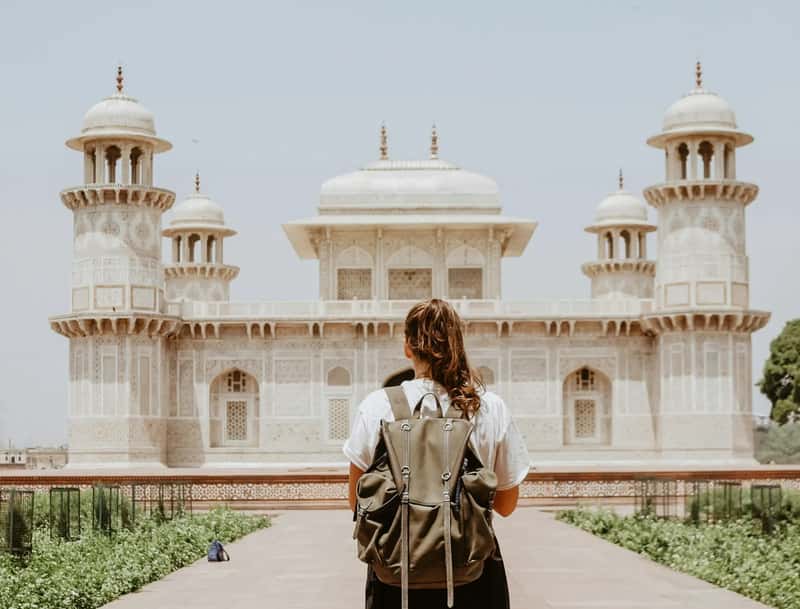
For people who genuinely prefer solo travel, the ability to control the texture of their experience isn’t a preference – it is a psychological requirement woven into the architecture of who they are.
This is not a personality flaw dressed up as wanderlust.
This is architecture. Structural. Load-bearing.
Solo travel grants complete autonomy over decision-making processes, from macro-level itinerary planning to micro-level daily choices – a departure from typical life circumstances where decisions often involve negotiation, compromise, or external constraints.
The solo walking tour is the purest expression of this need. No guide with a flag. No group consensus on pace. Just the cobblestones, the fog, and the clean, uncluttered fact that every turn is yours.
What predicts comfort with solitary movement isn’t introversion – it is something deeper: a dispositional autonomy, a tendency to act in congruence with one’s own values rather than external pressure.
You don’t walk alone because you dislike people. You walk alone because you dislike the dilution.
The Identity Gap
There is a version of you that exists only in motion.
It surfaces somewhere between the third and fourth block of a new city, when the jet lag has burned off and nobody knows your name yet.
Solo travel strips away the daily roles you play at home – employee, partner, parent – allowing your core identity space to breathe and be re-examined.
The walking tour is where this stripping happens in real time.
One foot. Then the other. The body moving while the constructed self slowly falls away.
Traveling alone removes external influences and expectations. Every decision, big or small, comes from your own preferences. This clarity helps surface who you are when you are not performing a role or responding to others’ expectations.
The identity gap closes, briefly, at the corner of a street you’ll never find again.
That’s the whole point. That’s what you came for.
The Locus of Control
Psychology has a clinical name for what you feel when you take that left turn alone.
It is called internal locus of control.
The psychology of choice suggests that exercising genuine autonomy over consequential decisions strengthens internal locus of control – the belief that outcomes result from one’s own actions rather than external forces.
On a solo walking tour, every outcome is yours. The detour that revealed the market. The shortcut that turned into a dead end. The cathedral stumbled upon because you refused to follow a prescribed route.
Solo travelers make hundreds of autonomous decisions daily, each reinforcing their sense of agency and capability.
Multiply that across three hours of wandering a city alone.
That is not just a walking tour. That is an extended, embodied therapy session in which you prove, block by block, that you are competent in a world that frequently makes you feel otherwise.
The Exit Strategy
Let’s be honest about something uncomfortable.
Part of the appeal is the exit.
On a solo walk, you can leave. Any time. In any direction. The alley to the right. The bridge ahead. The café that smells like cardamom and old paper. Nobody is waiting. Nobody is tracking progress against an itinerary.
Solo travel strips away the safety net of having someone else to rely on – you become the sole architect of your experience, making all the choices, whether big or small, that shape your journey.
The exit strategy isn’t about running away.
It is about the profound psychological comfort of knowing you could.
Contemporary solo travelers are further shaped by a pursuit of quietness as an antidote to hyper-connected everyday life. The solo walk delivers this in its most elemental form: movement as the antidote to noise, direction as the antidote to obligation.
You are not escaping. You are calibrating.
The Temporary Identity
I remember the morning I understood this fully.
Lisbon. Early. The kind of early where the city hasn’t decided yet what it wants to be. I had a printed map I never opened. I walked uphill, then down, then through a square where a man was feeding pigeons with the solemn dedication of someone performing a ritual. Nobody knew I was there. Nobody knew my job title, my relationship status, my unread email count.
I was, for approximately four hours, a person with no context.
It felt like relief.
Solo travel allows you to try out new behaviors uncharacteristic of your usual self. Everyone you meet is a stranger, and social mistakes in one-time meetings carry fewer consequences. No one encountered along the way knows your anxieties or self-perceived limitations. You can be anyone you please, which gives permission to try on new ways of being.
The temporary identity is not a lie. It is the truest audition your real self ever gets.
The Negotiation Tax
Group travel levies a tax.
It is invisible on the receipt but you feel it in your body by day two.
When traveling solo, travelers remove themselves from the continual negotiation that is often difficult with group dynamics. They have control of the decisions and actions – what to eat, what to do, and when to have a break.
The negotiation tax is cognitive. Emotional. Cumulative.
Someone always wants to stay longer at the museum. Someone always wants to eat earlier. Someone always has a preferred route that subtly overrides yours, not through malice, but through the simple gravitational pull of collective decision-making.
Studies suggest that solo travel may produce even greater stress reduction due to increased autonomy and reduced social obligation stress.
On the solo walk, the tax disappears. You move at the speed of your own thoughts. Slow when something catches the eye. Fast when the rain comes in from the west and the next street looks drier and more interesting.
No consultation required.
The Self-Efficacy Loop
Every decision on a solo walking tour creates data.
The data feeds back into a loop.
The confidence gained from solo exploration is cumulative and self-reinforcing. Each small decision – from choosing a restaurant to asking for directions – results in a measurable outcome for which you are solely responsible. This clear cause-and-effect loop is incredibly empowering. Your brain registers these successes, building a reservoir of resilience.
The cobblestone street you navigated without a map. The conversation you initiated in broken Italian. The wrong turn that became the best hour of the trip.
Each one is filed. Each one compounds.
That quiet internal shift – the subtle recognition of “I can handle this” – is what psychologist Albert Bandura describes as self-efficacy: the inner belief one has in their ability to overcome challenges and succeed.
Solo walkers are not running from fear. They are methodically dismantling it, one city block at a time.
The Self-Authorship Threshold
There is a threshold. Most people never consciously cross it.
It is the moment you stop navigating according to what the guidebook says is worth seeing and start navigating according to what your body and curiosity actually want.
For the first time, you allow yourself to act on your inner compass rather than external expectations. This reflects the beginning of self-authorship – the shift from relying on external expectations to inner voice.
The solo walking tour is the laboratory where self-authorship gets practiced in small, low-stakes repetitions.
You decide the pace. You decide the duration. You decide what constitutes a worthwhile detour and what constitutes a dead end.
In Self-Determination Theory, autonomy refers to making self-directed and authentic decisions even when it differs from consensus. The solo walk is this theory made physical. Made geographic. Made sweat and breath and the particular silence of a city side street at ten in the morning.
Cross the threshold enough times and you start crossing it at home, too.
The Resilience Economy
There is a specific kind of person who, when given a choice between a well-marked guided route and an uncertain unmarked path, gravitates toward the uncertainty.
Not out of recklessness.
Out of an unconscious understanding that resilience requires raw material.
The resilience-oriented traveler doesn’t travel despite disruption – they unconsciously travel toward it. Not out of masochism, but because some people feel most lucid when they are the only variable they can control.
By facing and overcoming obstacles on your own, you develop mental toughness and the ability to cope with adversity. Whether it’s dealing with a missed flight, navigating a language barrier, or simply managing solitude, these difficulties teach valuable lessons in patience, problem-solving, and emotional regulation. Solo travelers often report a heightened sense of accomplishment after tackling such challenges, which fosters greater confidence in their ability to handle stress and setbacks in other areas of life.
The solo walking tour is a controlled experiment in productive uncertainty. You set the parameters. You absorb the results. The economy of it is elegant: small disruptions in, compounded resilience out.
The Quiet Proof
Here is the heaviest truth of all.
The reason you prefer solo walking tours is not really about the walking, and it is not really about the tour.
It is about proof.
A strong sense of satisfaction and accomplishment comes after successfully solving problems and overcoming difficulties – “I led this, and I accomplished it on my own.”
“Solo travel is not just about seeing the world; it’s about discovering who you are when no one else is shaping your choices.”
The solo walking tour is the purest version of a question you have been asking your whole life: What would I choose, if I were the only one choosing?
Some solo travelers may continue to travel solo indefinitely, seeing it as a form of self-liberation – something that is achieved rather than given.
The city is still there, an hour after you’ve stopped walking. You find a chair outside a small café. The light has changed. Your legs carry the pleasant weight of distance earned without permission from anyone.
You think about the turns you took. The ones that worked. The ones that delivered you somewhere unexpected and better. You do not think about the turns you did not take, because on a solo walk, there is no such thing as a wrong turn – only a different story, slightly longer, slightly stranger, unfolding at exactly the pace you decided.
And somewhere beneath the caffeine and the quiet satisfaction of a city successfully walked, a deeper knowing settles in: you were never looking for the destination. You were looking for the version of yourself who was confident enough, curious enough, sovereign enough to go find it alone. You have been searching for them in every unfamiliar street. You find them each time you turn left without asking.



