The lounge is quiet at 6 AM.
Your sofa at home is not.
Your sofa knows too much.
It knows how long you’ve been sitting. It knows you haven’t moved. It knows you were supposed to call someone back three weeks ago.
The lounge asks nothing. It offers cool air, soft ambient light, and a glass of something cold. It offers the one thing your living room cannot: the built-in permission to leave.
This is the distance between the self you perform in a permanent address – the responsible one, the present one, the one who shows up and stays – and the self that only breathes freely when the departure board is overhead. One version of you is anchored. The other is always already in transit.
1. The Permission Slip You Never Had to Sign
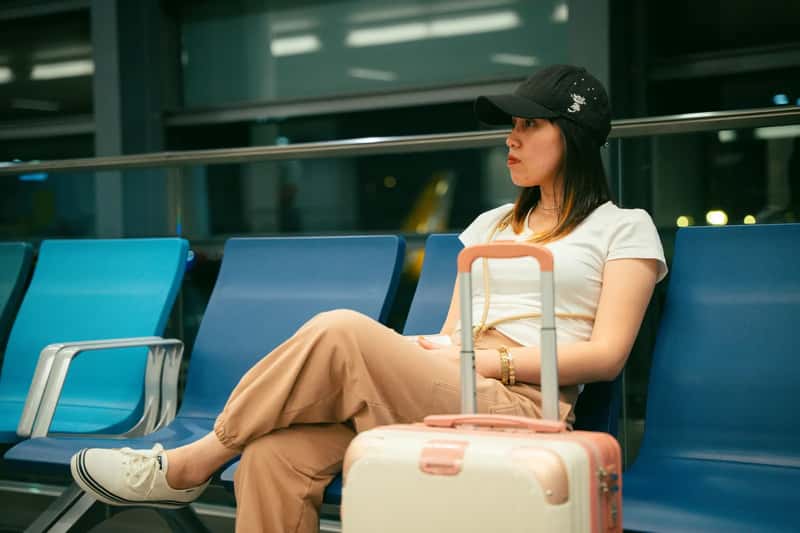
Transitional spaces are designed to be moved through – places that exist between destinations. That is the lounge’s unspoken contract. No one drafted it. No one handed it to you at the door. But you felt it the moment the heavy door swung shut behind you.
You are not required to stay.
This is not a minor psychological footnote. It is the whole story.
When a space carries no expectation of permanence, it carries no weight of accountability. Your living room silently demands that you water the plants, answer the mail, maintain the fiction of a life being well-managed. The lounge demands nothing except that you eventually catch your flight.
Commitment phobia rarely announces itself. It doesn’t knock. It simply finds a way to make every permanent space feel slightly too loud, too demanding, too visible. The lounge is its architectural answer. A room that was never going to hold you.
And in that, you feel – impossibly, quietly – free.
2. The Temporary Identity
Perhaps one of the most profound psychological effects of airports is how they temporarily strip away our usual identity markers. In the international transit zone, national boundaries become fluid, and our usual social roles temporarily suspend.
This is what the lounge sells, more than the free food or the charging ports.
It sells erasure. Comfortable, tasteful, leather-upholstered erasure.
In the lounge, you are no one’s child, no one’s partner, no one’s overdue project. You are only a traveler. Markers of your identity serve only to prove your instrumental identity – not your social identity. Your boarding pass is checked, your access confirmed. These markers affirm only an instrumental identity, one required to keep you moving.
That is a startling relief for people who have spent years being defined by their emotional geography.
In the lounge, you are what you do here, not what you left behind there.
3. The Non-Place and the Unburdened Self
French anthropologist Marc Augé described airports as “non-places,” arguing that airports function as sites in which “a person entering the space of non-place is relieved of his usual determinants.” In his analysis, airports are places where personal characteristics and histories are, at least temporarily, negated by the experience of “solitude, and similitude.”
Augé meant this as a critique. As a loss.
But for a certain kind of person, it reads like a gift.
Non-places are characterized as modern spaces of mobility, consumption, and exchange with which people rarely identify, develop few attachments, or undertake face-to-face interactions. Rare attachments. Few obligations. No accumulated history pressing against the walls.
For the commitment-averse traveler, this isn’t alienation. It’s oxygen.
The living room is heavy with attachment. The lounge is weightless by design. And the self that enters the lounge – unburdened, unnamed, unanchored – is often the self that feels most honestly like you.
4. The Exit Strategy Architecture
The lounge was engineered with the exit already visible.
Non-places enforce continual movement and directionality. In non-places, one is only allowed to follow certain paths; one’s movement, gestures and bodily acts are being guided.
Consider what this does to the anxious mind.
For someone whose primary psychological terror is being trapped – in a relationship, in a role, in a version of themselves that no longer fits – a space that architecturally insists on eventual departure is a space that feels safe. You cannot overstay. You cannot be held. The building itself is on your side.
Your living room has no gate number. No departure time.
It just sits there, asking you to be present. Asking you to stay. And when staying feels like suffocation, even the most beautiful home becomes a place you circle from a distance, like an airplane that hasn’t been cleared to land.
The lounge is not where you hide. It is where you breathe before the next departure.
5. A Moment From Gate 34
I remember sitting in a lounge in Frankfurt. It was midwinter. Outside the floor-to-ceiling glass, a grey sky pressed flat against the tarmac. I had a connecting flight in four hours. I had nowhere to be and no one expecting me at either end in any urgent way.
I felt – and this is the strange truth of it – completely at peace.
Not because the chair was comfortable. Not because the coffee was good. But because in that particular chair, in that particular window of non-time, nobody needed me to be anything specific. I wasn’t behind on anything. I wasn’t failing at anything. I was simply a person in a room that expected me to leave.
I’ve thought about that feeling many times since. I’ve wondered what it says that I’ve chased it.
For frequent flyers, airports are utilized as mobile office space or “free time,” indicative of contemporary travelers’ need for slow life and quality alone-time. But I suspect for many of us, it goes deeper than that. It isn’t leisure we’re seeking. It’s absolution from the permanent.
6. The Timeless Room
As airport lounges lack uniqueness, passengers may easily forget where they are and experience a sense of timelessness and placelessness. In this time-free and place-free zone, they are exempt from certain obligations.
Time is the axis of commitment.
Every promise made in a living room is a promise made through time. I will be here tomorrow. I will be here next year. I will be here when you need me. Commitment is time made personal.
One of the most disorienting aspects of airports is their relationship with time. In these spaces, traditional temporal markers become meaningless.
Without time, there is no debt. Without temporal markers, the lounge becomes a zone of perpetual present tense. You cannot owe anyone anything in a present tense that has no yesterday. You cannot break a promise in a room where time doesn’t quite apply.
The lounge offers the only thing the commitment-averse deeply crave: a world where the future hasn’t started yet.
7. The Shallow Belonging
There is a particular kind of connection the lounge permits. Warm. Brief. Undemanding.
The shared experience of travel, combined with the liminal nature of the space, often leads to unusual levels of openness between strangers. People who would normally maintain careful personal boundaries might find themselves sharing intimate life details with their seatmates at the gate.
This is intimacy without stakes. Community without consequence.
You can be fully present with a stranger at Gate 34 precisely because you will never see them again. The depth of that conversation is made possible by its guaranteed ending. This is the paradox at the heart of transit sociality: the lounge permits closeness because it promises separation.
For those who fear genuine attachment, this is not a compromise. It is the ideal social contract.
Airports are a space where strangers, for one shining hour, are on equal footing, comrades in their shared desire to depart. Nobody wants anyone to stay. Everyone understands leaving. That shared understanding is the closest thing to genuine community that a certain kind of wandering person ever finds.
8. The Living Room as Mirror
Here is the uncomfortable reversal.
The discomfort you feel in your own living room is not about the room. The couch is fine. The lighting is fine. The problem is what the room reflects back at you: a life that is asking to be inhabited.
A sense of identity is important to psychological health but can become constricting. Like actors stuck playing the same character week after week, we enjoy the security of our roles but long to test and stretch ourselves with new challenges. To step outside our normal routines and environments feels invigorating.
The living room is the stage set for the character you’ve agreed to play. The commitment-phobic traveler walks on set and feels the costume tighten immediately. The lines feel wrong. The scene feels too long. There is no flight number on the wall, no impending departure to lean against.
The lounge, by contrast, is a space with no character assigned to you at all. You get to improvise. You get to simply sit, briefly, and then go.
That is not freedom from your life. It is freedom from the version of your life that has started to feel like a role you never quite auditioned for.
9. The Ritual of the Habitual Transient
There is a curious irony in frequent travelers: the more they move, the more ritualized the movement becomes.
Consumption rituals are characteristic of frequent passengers in familiar airports. Same lounge. Same seat by the window. Same double espresso. Same moment of exhale as the door closes on the world outside.
The ritual is the disguised commitment. The commitment-averse person builds micro-homes in transit spaces. They know which lounge at Heathrow has the best light. They know which terminal in Singapore is quietest at 4 AM. The familiar at-homeness of frequently used passages, the dwelling-in-motion within virtual infrastructures of habit – this is what the habitual transient builds instead of a fixed home.
It is commitment dressed in a boarding pass.
The tragedy is not that they can’t commit. It is that they commit endlessly – to the pattern of not committing. To the ritual of leaving. They are perhaps the most loyal people in the world, faithfully returning to the same act of departure, time after time, gate after gate.
10. The Space Between the Life You Have and the Life You Keep
Psychological liminal spaces include the period after a job loss, the months following a significant life change, and the time between deciding to make a transition and arriving at the new chapter. What connects them is the quality of being in between – no longer in the previous state and not yet in the next.
But some people never leave the in-between.
Not because they can’t find the next chapter. But because the in-between has become the chapter. The lounge is the living arrangement. The transit is the destination.
Augé posits that these “non-places” – both overbearingly familiar and claustrophobically alien – suspend us in a state of never being home, if home is where we come to rest.
Never coming to rest. There it is. The cleanest diagnosis.
The lounge offers the perfect suspension: a space that is warm enough to relax in and temporary enough to never demand that you rest for good. You can sink into the chair. You can close your eyes. And when the gate opens, you can leave, and no part of the room will try to hold you. No ghost of a conversation will linger in the upholstery. No accumulation of shared history will press against the exit.
Victor Turner saw liminality as a condition with its own character: a space where social structure loosened, where normal rules were temporarily suspended, and where something new could emerge. He described liminality as a state of ambiguity and openness, a place where transformation becomes possible precisely because the usual structures are absent. Turner thought this was a threshold. A place you moved through on the way to becoming.
But the airport lounge has a way of becoming the whole journey for those of us who have made a quiet art form of the almost-arrival. We hover at the threshold so long it starts to feel like home. We mistake the space between for the destination itself. We confuse the freedom of leaving for the joy of living.
The lounge will always be there. Cool, clean, temporally suspended, and nonjudgmental. It will hold you loosely for exactly as long as your boarding pass allows. And then it will let you go – because that was always the deal, and some part of you signed it before you even knew you were afraid.
One day, maybe, you’ll sit in your own living room and feel that same loosening in the chest. Not because the room has changed. But because you finally stopped waiting for a departure that was never scheduled.