
Phnom Penh is often introduced through its cafés, riverfront, and colonial architecture, but two sites just beneath the surface define much of Cambodia’s recent history.
Tuol Sleng Genocide Museum and the Choeung Ek Killing Fields document the systematic violence carried out by the Khmer Rouge between 1975 and 1979.
Visiting both places provides a clear, chronological understanding of how the regime operated, from detention and interrogation to execution, and why these sites remain central to Cambodia’s national memory.
About the Khmer Rouge
While most people are familiar with Auschwitz and the atrocities commited to the Jews and more at the hands of the Nazi party, not many people outside of South East Asia are familiar with the brutal legacy of the Khmer Rouge.
Between 1975 and 1979, Pol Pot’s regime turned a high school into the Tuol Sleng (S-21) interrogation centre, where thousands were tortured before being sent to the Choeung Ek Killing Fields for execution.
I myself only became familiar with the Khmer Rouge in my twenties when I stumbled across a video titled “Families reunited after 40 years apart in Cambodia,” by Unreported World.
The video tells the story of how a Cambodian television show ‘It’s not a dream’ reunites families that had torn apart during Pol Pot and the Khmer Rouge’s reign of terror.
Inspired by the show and having plans to head to Vietnam for a 3-month vacation, I decided to alter my trip to include Cambodia, purely to learn more about the Khmer Rouge and Cambodia’s dark history.
Tuol Sleng: From School to Prison
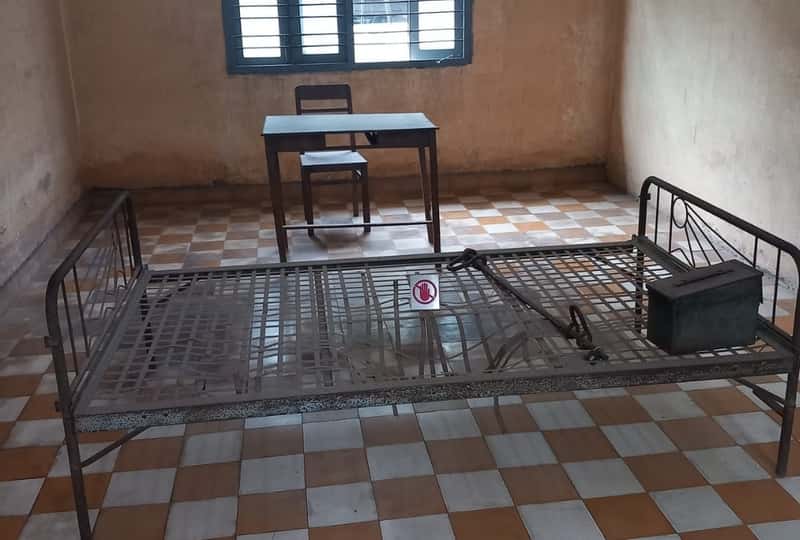
Tuol Sleng, also known as S-21, was originally a secondary school where classrooms, corridors, and courtyards were repurposed into a high-security detention centre where an estimated 14,000–17,000 people were imprisoned and murdered.
Classrooms were divided into small brick cells, and windows were covered with barbed wire to prevent suicides. Iron bed frames where prisoners were tortured and killed remain in place in several rooms, positioned exactly as they were found when the prison was liberated in 1979.
The Tuol Sleng museum never attempts to dramatise the space, with largely empty rooms making its function clear rather than more abstract.
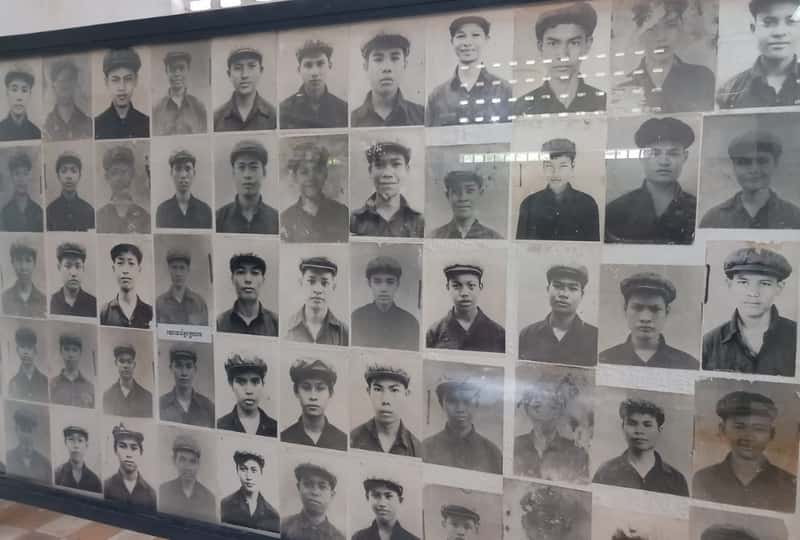
Photographs taken by prison staff document incoming prisoners, many of whom were photographed shortly before interrogation line the walls in large numbers, presented without commentary beyond names and identification numbers where known.
Similar to when visiting Auschwitz (link to article), the images of the deceased transform the numbers into living beings with faces and names, hitting you like a punch to the gut and showing the scale of the operation and how routine it became.
Tuol Sleng also explains the internal logic of the Khmer Rouge system. Prisoners included former government officials, intellectuals, ethnic minorities, monks, and even Khmer Rouge members accused of disloyalty.
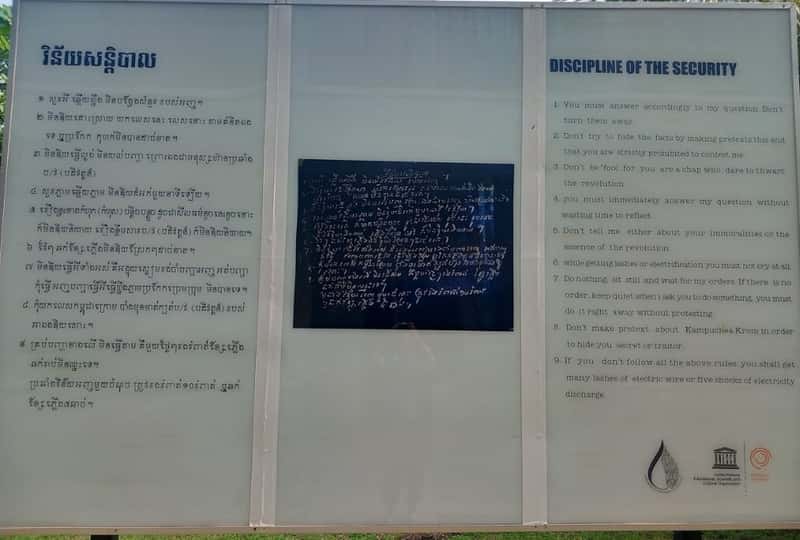
Confessions were extracted under torture and used to justify further arrests, creating a closed loop of suspicion. Displays include original documents, interrogation records, and rules posted for prisoners and guards. These materials show how bureaucracy and violence were tightly linked.
There is an audio guide available and strongly recommended, as it provides survivor testimony and historical context without emotional framing. It allows visitors to move through the site at their own pace while understanding how each building was used.
Choeung Ek: The Execution Site
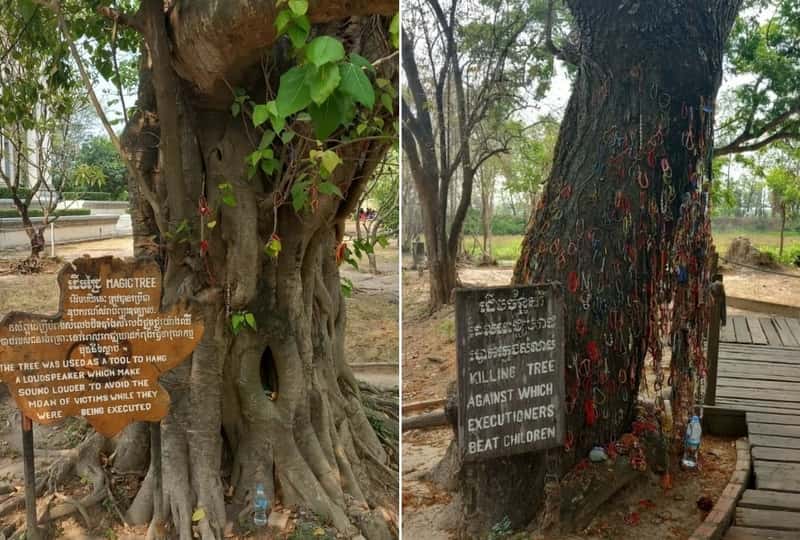
About 15 kilometres south of Phnom Penh lies Choeung Ek, one of the most well-known killing fields in Cambodia. Prisoners from Tuol Sleng and other detention centres were transported here, usually at night, to be executed.
Today, the area is quiet and open, with grass paths and trees that give little indication of what took place there unless you know what to look for.
At the centre of the site stands a memorial stupa containing thousands of human skulls, arranged by age and sex. This is the most visually striking element of Choeung Ek, but it is not the most informative on its own.
The surrounding grounds contain mass graves, some marked and some left undisturbed. In several places, fragments of clothing and bone still surface after heavy rain, a reminder that excavation has been limited out of respect for the dead.

Explanatory signs and audio guides describe how executions were carried out, often using farming tools rather than bullets to save resources. Loud music was played to mask sounds. Children were not exempt. The information is presented factually, without graphic imagery, focusing on process rather than shock.
It is better to visit Choeung Ek after Tuol Sleng, as it can feel abstract on its own. In connection with S-21, it becomes the final stage of a system already seen in detail.
The Khmer Rouge
The Khmer Rouge came to power after years of civil war and U.S. bombing campaigns in Cambodia. Once in control, the regime attempted to create a self-sufficient agrarian society by forcibly evacuating cities, abolishing money, and dismantling social institutions.
Education, religion, and family structures were targeted, with people categorised as “old people” (rural peasants) or “new people” (urban populations), with the latter facing harsher treatment.
The genocide was not driven by a single factor but by a combination of ideology, paranoia, and internal purges. Tuol Sleng demonstrates how the regime turned inward, while Choeung Ek shows the physical outcome of that system. Together, they clarify how mass violence can be perpetrated through bureaucratic processes rather than through spontaneous brutality.
Considerations for Visitors
Both sites are accessible from Phnom Penh, either independently or as part of a guided tour. Many visitors choose to visit Tuol Sleng in the morning and Choeung Ek afterwards, allowing enough time at each without rushing.
Dress modestly and behave respectfully, as these are memorial sites, not conventional attractions.
Photography is permitted, but discretion is expected. At Tuol Sleng, some rooms request no photos, and at Choeung Ek, photographing the memorial stupa is common, but selfies or posed images are generally discouraged by signage and local guidance.
There is no requirement to feel a particular way; they are not designed to elicit a specific emotional response, but to present evidence and help visitors understand what occurred. Many people find the experience heavy simply because the information is direct and unembellished.
Why These Sites Matter
Tuol Sleng and Choeung Ek are not preserved to attract visitors in the conventional sense. They exist because forgetting is considered a greater risk than discomfort.
For Cambodia, these sites serve as documentation, education, and warning, while for visitors, they offer a grounded way to learn about the Khmer Rouge period without relying on secondary interpretation.
Leaving Phnom Penh without visiting either site can result in an incomplete understanding of the country’s modern history.
Visiting both, in sequence, provides a clear picture of how ideology translated into daily operations and, ultimately, mass death. The absence of performative storytelling allows the facts to stand on their own, which is often more effective than emotional framing.