After several days immersed in the geothermal intensity of São Miguel, I headed west on my Azores journey. Faial and Pico, separated by just five miles of ocean, form a complementary pair—and could hardly be more different. The first is a lush, flower-filled green island; the second is an epic challenge shaped by dark colors, wind, and exposed rock. Together, they offer further proof that each Azorean island tells its own distinct story.
You arrive on Faial by flying into Horta, a port town that has served as a reference point for Atlantic navigation for centuries. After exploring the island, it’s natural to move on to Pico via ferry, which crosses the narrow channel between the two islands in under half an hour. Traveling between Faial and Pico feels seamless, but the experience on each island is radically different. That contrast is part of the appeal, and logistics are simple enough to let the landscape—not transportation—set the pace of the journey.
Faial: Wind, Hydrangeas, and Walking the Caldeira
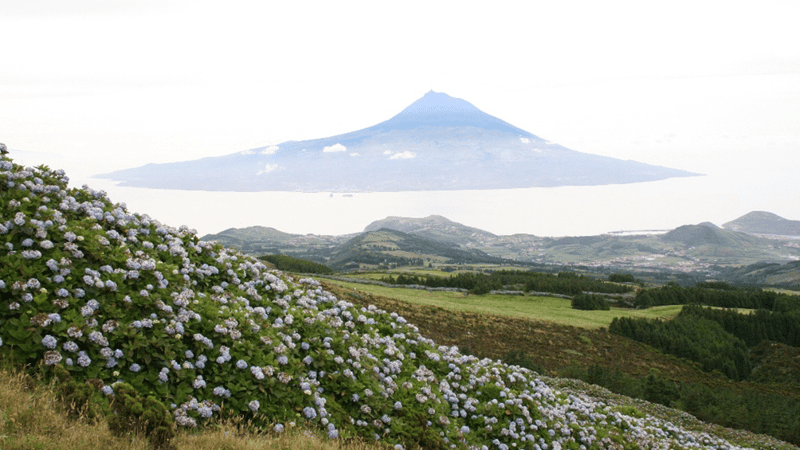
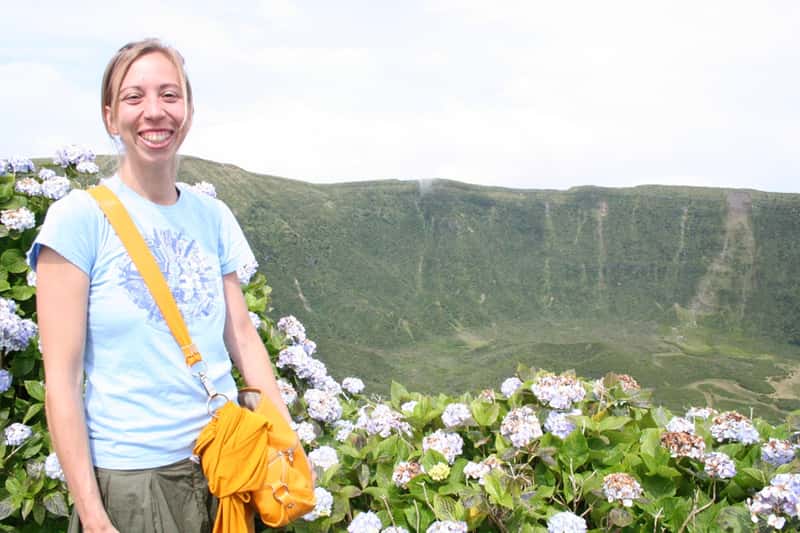
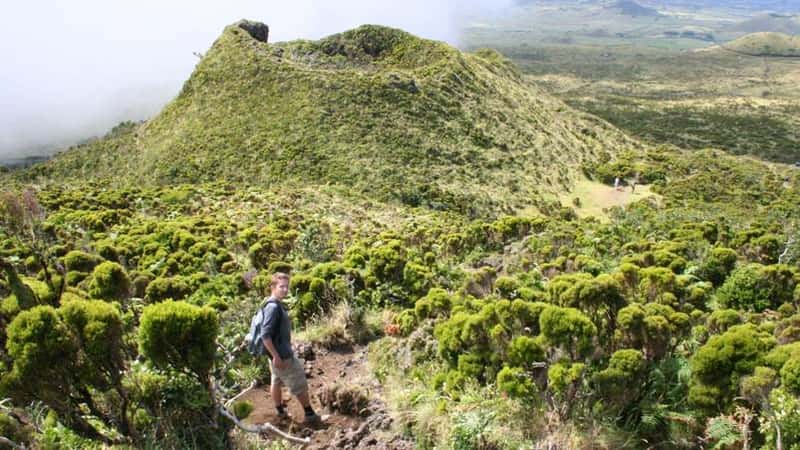
The first impression of Faial is one of openness and order: wide roads, low buildings, and a light that shifts constantly with the wind. Faial is often called “the blue island,” thanks to the hydrangeas that line roadsides and agricultural boundaries, thriving in the mild, spring-like climate that defines the Azores year-round. Those hydrangeas climb all the way up to the geographic heart of the island, the Caldeira do Faial, a vast extinct volcanic crater opening at the center of the island like a perfectly drawn circle. The trail that runs all the way around the rim of the Caldeira is one of the most rewarding and accessible walks in the Azores. It’s flat, clearly marked, and long without being tiring, often experienced in near solitude.
Inside the crater, the ground is dry and subdued; along the rim, everything is intensely green. Mosses soften the terrain, giving parts of the landscape an almost otherworldly quality. Hydrangeas trace the path like a natural border, sharing the space with cows that seem largely indifferent to passing visitors. As you walk the loop, the view frequently opens westward, where a familiar silhouette dominates the horizon: the unmistakable cone of the neighboring island. Pico is always there, visible and imposing, and the Caldeira becomes a natural observation platform. It’s hard not to feel the urge to cross the channel and see what’s waiting on the other side.
Crossing the Channel: Toward Pico
The ferry ride from Faial to Pico is short, but the transition is unmistakable. Within minutes, you’re facing an island organized around a single idea: verticality. Everything here gravitates toward the volcano, which defines the landscape from every possible angle.
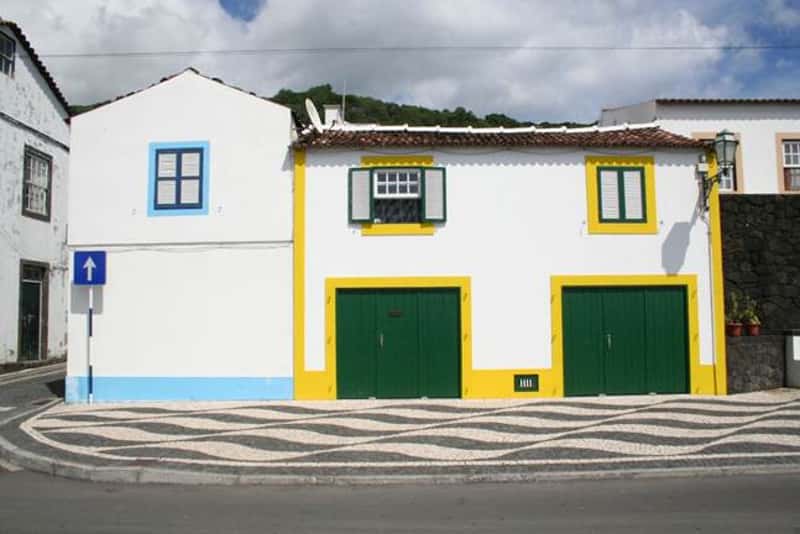
The first impression, however, isn’t only geological. Pico also surprises with its coastal villages, where low houses—often white with brightly colored trim—line the shore in neat, luminous sequences. These colorful houses, frequently facing the ocean, give the island a domestic, lived-in quality that balances the monumentality of the mountain. The architecture is simple but carefully maintained, constantly in dialogue with the black volcanic stone.
Climbing Mount Pico: the Island’s Defining Experience
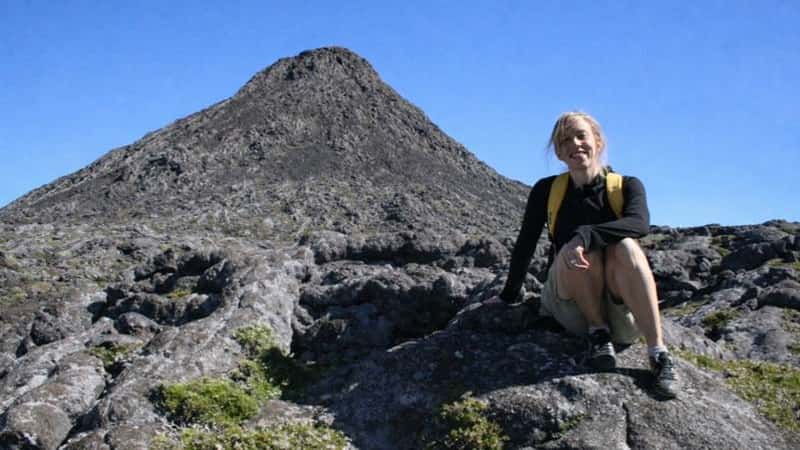
I found the ascent of Mount Pico unlike any hike I had done before. The trail begins on volcanic ground, but as you gain elevation, the landscape progressively strips itself bare. Green fades away, the soil turns brown, then gray, and eventually becomes nothing but lava rock. The climb requires preparation and attention. Bringing enough water and food is essential, as there are no services along the route. The elevation gain is substantial—over 3,000 feet—and the hike takes most of the day, but the effort is fully repaid.
The ascent is physically demanding but never technical. It’s steady and immersive, forcing you into your own rhythm. At a certain point, the perspective shifts dramatically: looking back, I saw the clouds settling below, while the horizon opened onto a patchwork of islands and open ocean. From the upper slopes and summit area, the ground is dotted with small crater-like depressions, irregular pockets covered in mosses and vivid green growth that contrast sharply with the surrounding dark rock. It’s a landscape that impresses not through sheer grandeur, but through its strangeness. It feels primordial, alive. Not hostile—just intensely focused. Walking there, you sense how geologically young Pico still is, and how much the island continues to redefine itself.
Pico’s Vineyards: When Lava Becomes Agriculture
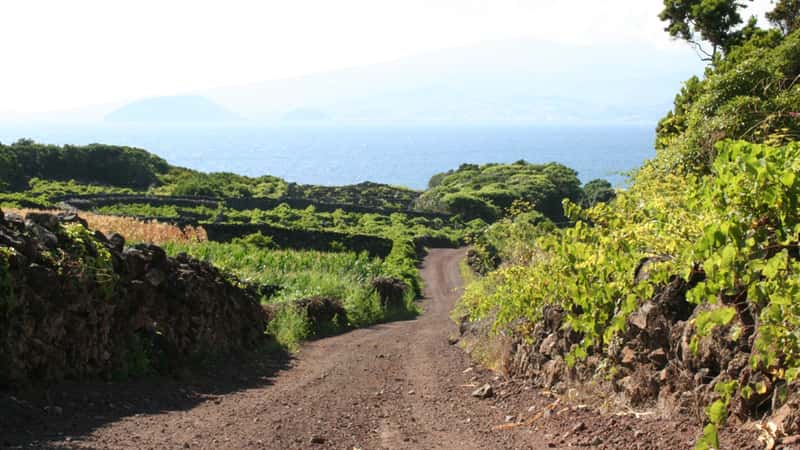
Descending from the volcano, Pico reveals another unexpected side: its vineyards. Here, vines grow directly on lava fields, protected by low walls of black stone that form dense geometric grids visible even from a distance. This agricultural system, developed to shield the vines from wind and salt spray, has become one of the island’s defining cultural landscapes.
Pico’s wines are direct and mineral, deeply tied to the ground they come from. Tasting them on the island makes the relationship between landscape and production immediately clear: nothing is decorative, everything is functional. Once again, lava isn’t an obstacle—it’s a resource.
Getting There and Around
Faial and Pico belong to the central group of the Azores and are well connected. Faial is served by Horta Airport, with frequent flights from São Miguel and seasonal connections to mainland Portugal. From Horta, ferries run regularly across the channel to Pico, with a crossing time of about 30 minutes. The short distance makes it easy to include both islands in the same leg of an Azores itinerary.
Once on Faial, getting around is straightforward. Distances are short, roads are in good condition, and visitors can either rent a car or rely on taxis, which also offer guided island tours lasting several hours. Horta itself is compact and walkable, especially around the marina and town center, but the island’s interior is best explored independently. On Pico, renting a car is strongly recommended. The island stretches lengthwise, and key sites—coastal villages, vineyards, and trailheads for the volcano ascent—are spread out. Roads are quiet and well maintained, and driving allows for spontaneous stops along the coast and through lava fields. For climbing Mount Pico, registration at the Casa da Montanha is mandatory, and checking weather conditions is essential: visibility and wind can change quickly, and the mountain sets its own rules.
Two Islands, Two Languages
Faial and Pico work best as a pair because they express two very different ways of being a volcanic island. Faial is horizontal, green, and contemplative. Pico is vertical, dark, and concentrated. One invites walking; the other demands ascent. After the geothermal intensity of São Miguel, this transition makes it clear how the Azores function as an archipelago of distinct identities, connected only by the ocean and a shared deep origin.