The city hums at midnight. You are perfectly still inside it.
Your inbox is full. Your calendar is packed. Your performance reviews are flawless.
And yet.
There is a version of you that nobody at the office has ever met. A version that doesn’t optimize, doesn’t network, doesn’t perform. A version that exists somewhere between the man you were told to become and the man you actually are when the lights go down and the noise stops.
That gap – the chasm between the curated self and the raw self – is where modern men are quietly disappearing. The idea that a man’s value is tied to his emotional detachment, his cool independence, his refusal to show weakness – what we might call hyper-masculinity – is at the heart of the male loneliness epidemic. The performance never stops. The audience never leaves. And the man behind the mask gets thinner by the year.
Maybe the bravest thing a man can do, in an era of relentless high-performance living, is buy a ticket somewhere quiet – and finally, deliberately, sit still with the one person he has been running from all along.
1. The Silent Epidemic Nobody Is Talking About Loudly Enough
We keep calling it a crisis. We keep publishing the statistics. And yet the quiet persists.
Men overall are more likely to report specific feelings of disconnection, such as not belonging to any group or community or feeling their place in the world is not relevant. Not dramatic, visible collapse. Just a slow erosion. A gradual dimming.
Economic change, shifting gender norms and the erosion of community have left many men struggling to define themselves and to connect with others. The framework they were handed – work hard, stay stoic, provide and perform – doesn’t come with an emotional instruction manual.
Imagine sitting in a crowded room, maybe at a ballgame, a busy office or even a family gathering. You’re surrounded by people, yet you feel completely alone. This feeling, a deep sense of isolation even though you have people near you, is the heart of the male loneliness epidemic that has become a serious public health worry.
Solo travel doesn’t fix this. But it creates the first honest conversation a man can have with himself in years. And for many, that conversation is long overdue.
2. The Stoicism Tax
There is a cost to wearing armour every day. Most men don’t discover how heavy it is until someone asks them to take it off.
Men are often encouraged to be stoic instead of vulnerable, which makes it hard for them to express themselves emotionally and interact in meaningful ways with other people, including intimate partners. This isn’t weakness. It’s conditioning. Decades of it, layered into identity like geological sediment.
Many successful leaders, once trust has been built, feel able to admit to an existential loneliness even as they remain the figurehead of their teams and organisations.
The road doesn’t ask you to be anyone. A train platform in a foreign city has no memory of your title, your salary, or your composure. In transit, the armour gets heavy in a new way. And slowly – if you let it – it starts to come off.
That shedding is not a crisis. It is the beginning of something.
3. The Temporary Identity
Here is the strange gift of being a stranger somewhere: nobody knows the character you usually play.
The “Anonymity Advantage” allows you to experiment with your identity. You realize that much of your behavior at home is just a habit performed for others. Without those witnesses, you can find out who you are at your core.
In a new city, you are not your job. Not your relationship status. Not the friend who always has it together or the son who never complains. You are just a man at a table, eating alone, watching the world move.
This form of independent travel strips away the daily roles you play at home – employee, partner, parent – allowing your core identity space to breathe and be re-examined.
The temporary identity is not an escape from the real one. It is the real one. The one that was there before the world told you who to be.
4. The Solitude Distinction
Men are told that being alone is shameful. That needing space is a defect. That a full calendar equals a full life.
The psychology says otherwise.
Critical to understanding solo travel’s mental health implications is distinguishing between solitude and loneliness. Loneliness represents an undesirable subjective state of social disconnection associated with negative health outcomes. Solitude, conversely, describes chosen time alone that can promote creativity, self-reflection, and emotional regulation.
Research demonstrates that voluntary solitude, when balanced with social connection, contributes positively to well-being.
Most men have never chosen solitude. It has either been imposed on them – by circumstance, by divorce, by the quiet drift of friendships – or it has been avoided entirely, masked by noise, screens, and busyness.
Solo travel is the first time many men choose to be alone. On purpose. With nowhere to hide. That choice is the entire point.
5. The Exit Strategy
I remember sitting in a bar in Lisbon, three years ago, the kind of low-lit place where the locals don’t check their phones. I’d been traveling alone for nine days. I hadn’t explained myself to anyone in nine days. No performance reviews. No group chat. No version of me that needed to be maintained.
And I felt – for the first time in what felt like years – like I could breathe all the way down.
When you’re free from the expectations and distractions of familiar environments and social circles, you have the space to reflect on your true desires, values, and goals. Solo travel offers time for introspection, helping you gain clarity about who you are and what you want from life.
The exit strategy isn’t about running from your life. It’s about gaining enough distance from it to actually see it clearly. Most men never get that distance. Most men don’t know they need it until the silence of a foreign city hands it to them, unsolicited, like a gift they didn’t know was missing.
6. The Anxiety Furnace
The road is uncomfortable. That discomfort is doing something important.
Solo travel helps you to tackle and overcome anxiety, because you have no choice but to deal with situations that arise. There is not another person with you to lean on for support and therefore you learn to trust your own judgement, which in the long-run reduces anxiety in uncertain situations.
Without companions to immediately share frustrations with, you learn to sit with discomfort, process setbacks like missed trains calmly, and find your own emotional equilibrium – a skill that reduces anxiety in other life areas.
For men who have spent years outsourcing their emotional regulation – to relationships, to routines, to substances – this is revelatory. The foreign city becomes a controlled burn. The anxiety is still there. But now you learn that you can walk through it and come out the other side, intact.
Not because the fear disappeared. Because you learned that it wasn’t fatal.
7. The Self-Efficacy Loop
There is a particular kind of confidence that cannot be given to you. It can only be earned from yourself.
Every time you solve a problem by yourself, your brain records a “win.” You are building “self-efficacy” – the deep knowledge that you are capable and resourceful. You move from a mindset of “I hope I’ll be okay” to “I know I can handle it.”
When challenges arise – lost luggage, language barriers, bad weather – you have no choice but to cope. Overcoming these hurdles alone proves your resilience to yourself in a way that group support cannot. This proven resilience becomes a psychological asset you carry forward, making future life stressors feel more manageable.
Most men in high-performance roles are deeply competent in the external world and deeply uncertain in the internal one. The solo journey rebalances that ledger. One missed connection at a time. One solved problem at a time. One small, private victory at a time.
8. The Stranger Paradox
Here is the counterintuitive truth: you will connect more deeply with humans on a solo trip than you do in most of your ordinary social life.
Paradoxically, traveling alone often leads to richer, more authentic social interactions. Without the comfort of a travel buddy, you are more open to approaching locals or other travelers.
Knowing that you’ll never encounter this person again may give you the courage to interact even more candidly. Nothing to lose. You can try out new behaviors uncharacteristic of you and you won’t be judged by those you meet.
There is a confession that happens over a shared meal in a place where no one knows your name. A rawness that ordinary social life, with its reputations and roles intact, never permits. Men who haven’t had a real conversation in years find themselves talking for hours to a stranger in a hostel kitchen. That stranger asks no performance of them. That stranger only knows the version of them that showed up tonight.
That version is often the truest one.
9. The Narrative Reconstruction
A man’s identity is a story he tells himself. After enough years of high-performance living, that story can become a cage.
The process of narrative construction during solo travel can help travelers make sense of challenging experiences, celebrate personal growth, and articulate new aspects of their identity that have emerged through their journey.
Solo travel is often framed as an opportunity for liberation and self-discovery; however, less has been written about the psychological depth of this experience and how solitude can challenge long-held beliefs about identity.
Some psychologists view new experiences in the context of self-determination theory, which is the idea that fulfilling basic psychological needs is essential to personal growth. Solo travel can be particularly conducive to novelty’s effects on personal growth because we have more time to pay attention to immediate experiences and reflect on them.
The road rewrites you. Not because it changes who you are. But because it lets you author the next chapter yourself, without editorial input from the world that built the previous ones.
10. The Return
This is the heaviest point. Because the return is where everything becomes real.
You come back. The city is the same. The apartment is the same. The inbox, the expectations, the careful architecture of the life you built – all of it is exactly where you left it.
But you are not.
The psychological shift isn’t about becoming a different person, but about integrating new, stronger parts of yourself forged through autonomous experience.
The psychological benefits of solo travel can continue when you return home. You have already started to build confidence, self-reliance and trust in yourself, which can apply to your day to day life too. The problem-solving, decision making and social skills you have strengthened can be transferable to situations at work or in your relationships.
Ultimately, solo travel’s psychological value lies not in escaping life but in engaging more fully with it – confronting challenges, embracing uncertainty, connecting across differences, and discovering one’s capabilities and values.
The return is not an ending. It is the test of everything the road taught you. It is where you find out whether the man who left and the man who came back can finally occupy the same body.
The world will keep accelerating. The performance expectations will keep rising. The metrics of a well-lived male life – the salary, the stoicism, the carefully managed emotional temperature – will keep demanding compliance.
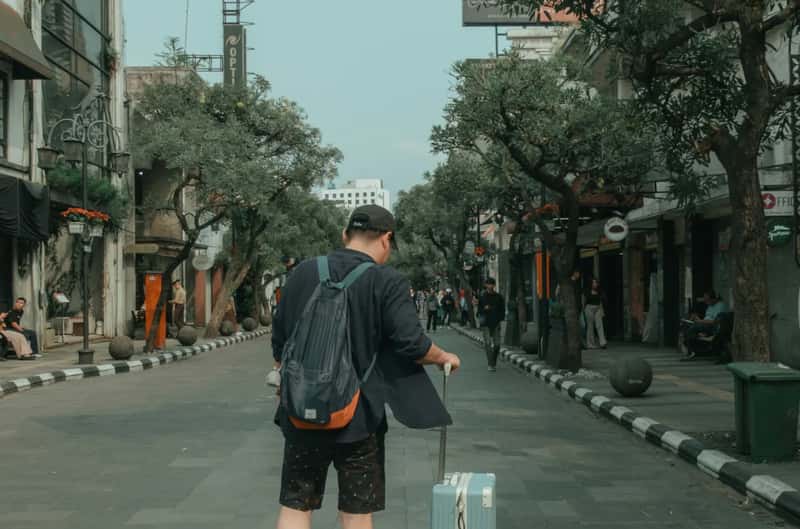
And somewhere in all that forward motion, a man will stand in an unfamiliar airport, bags at his feet, city he doesn’t know sprawling out ahead of him, and he will feel – just for a moment – like himself again.
He will honour his inner voice, listen to the desires he had long muted, and discover that home is not a fixed physical place. Home is the moment he returns to himself – the groundedness he can carry within, even in the most foreign place.