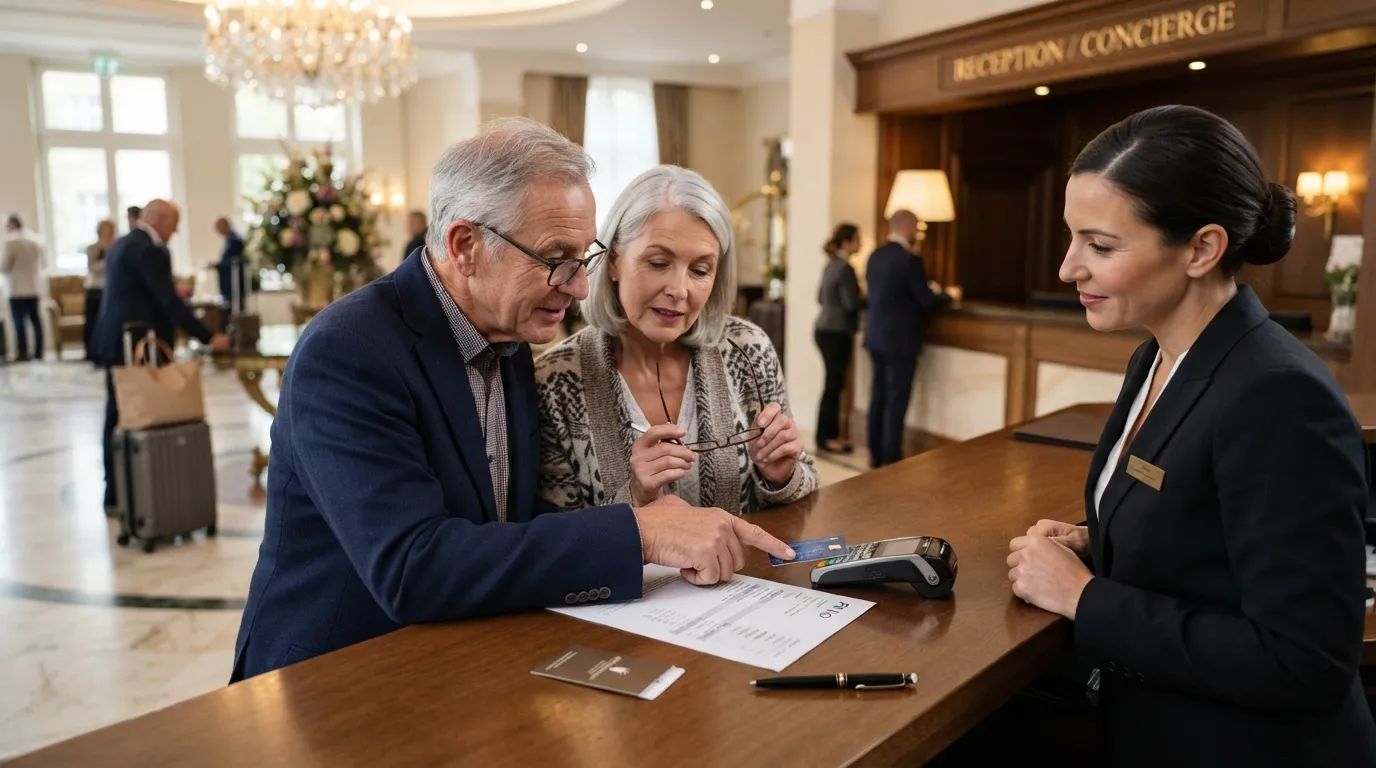
Most travelers over 60 quietly accept whatever lands on their hotel bill – and hotels are counting on exactly that. But it turns out a surprising number of those charges are negotiable, waivable, or flat-out wrong, and guests who simply ask are walking away paying less.
Front desk staff have more discretion than they ever let on, and older guests who stay calm and informed tend to get the most removed. Here’s what insiders and experienced travelers say actually disappears the moment you question it.
#13 – The Resort Fee Nobody Warned You About

Resort fees are the industry’s worst-kept secret – and the one charge most guests assume is completely non-negotiable.
Hotels like Hyatt, Hilton, Marriott, and Omni tell customers these fees are mandatory. But federal regulators have said it’s unfair to “coerce consumers into purchasing unwanted goods or services,” and hotels may have discretion to remove them upon request.
That word “mandatory” is doing a lot of heavy lifting. Simply asking an employee to waive the fee often does the trick, especially if you ask politely and give a clear reason.
You can make an even stronger case if you genuinely couldn’t use the resort amenities. Say you checked in late after the gym and pool had already closed, and checked out before they opened again.
Guests over 60 travelling light, who rarely touch the poolside bar or gym equipment, are in a strong position to make exactly that argument. Most don’t bother – which is exactly why it works so well for those who do.
Fast Facts
- (cite index=”1-1″>A recent NerdWallet study of 160 hotels found that some resort fees average about $33 per night, with charges climbing well beyond that at premium properties.
- (cite index=”7-3,7-4″>In 2010, the average hotel resort fee was charged at approximately 2% of properties, but by 2025 resort and destination fees are charged at an estimated 28% of all U.S. hotels.
- (cite index=”1-11″>As of May 2025, a new rule from the Federal Trade Commission requires hotels and short-term rental platforms to display the full price upfront, including mandatory fees.
- Disclosure rules don’t ban the fee itself – staff can still choose to waive it when a guest asks with a good reason.
But the resort fee is just the start. What comes next surprises even seasoned travelers…
#12 – The Parking Fee You May Never Have Needed

Parking charges are one of the most commonly auto-added fees on a hotel bill – even for guests who never touched the car park.
Parking fees can show up automatically if your reservation included a spot, whether you actually parked there or not. That’s not an accident – it’s a billing default that quietly profits the hotel if nobody checks.
Bring it up during your initial rate negotiation, not after you’ve already confirmed the booking. Once the hotel has your commitment, your leverage drops sharply.
But going in, a guest staying several nights can often get parking folded into the room rate or waived outright. If you arrived by taxi, train, or drop-off, you have an open-and-shut case.
Simply point it out at checkout: “I didn’t have a vehicle.” Many wrongful charges are simple errors that staff can reverse on the spot once you point out the discrepancy.
The charge disappears faster than it appeared – but the next one on this list is trickier to spot…
#11 – The Wi-Fi Fee Billed Twice (Or Per Device)

Most hotels now advertise free Wi-Fi, but the fine print tells a very different story.
Wi-Fi fees may apply per device rather than per room, meaning your phone and laptop each generate a separate line item. A couple travelling together with two phones, a tablet, and a laptop could unknowingly rack up four or five charges for what they assumed was one free connection.
Basic Wi-Fi is generally free for loyalty club members, but premium Wi-Fi often costs extra. Review the hotel’s terms before booking so you know exactly what’s included, and whether it’s billed per room or per device.
If you find multiple device charges and only used basic browsing, question every line. Front desk staff can usually remove duplicate charges immediately.
Next up is a fee so sneaky, it can be triggered without you ever consuming a single thing…
#10 – The Minibar Charge for Items You Never Touched

This one has blindsided careful travelers for years – and it’s completely fixable if you know what to say.
The minibar can be a trap if you’re unfamiliar with how it works. Some sensors register an item the moment it’s moved, meaning picking up a drink to read the label and putting it back could still trigger a charge.
These systems aren’t always accurate, and hotels sometimes charge for moving items even if you consumed nothing. If you notice this at checkout and genuinely didn’t touch anything, say so clearly and ask for itemised proof.
At a Glance
- Sensor shelves can log a charge the instant an item is lifted – even if it’s placed right back.
- (cite index=”7-11″>A bottle of water in a hotel minibar in 2025 costs $6–$9 at most full-service properties, so a single sensor error isn’t pocket change.
- (cite index=”7-8″>Many properties have eliminated the machine entirely or replaced it with a Nespresso capsule system where the initial capsules are complimentary and refills cost $5–$8 each.
- Ask for an itemised list of exactly what was recorded as used before you accept the charge.
Go over your bill at the front desk before you leave – it’s far easier to dispute charges in person. The hotel should have a record of exactly which items were taken, so you can check it line by line.
Guests over 60 tend to be taken seriously when they push back on these quietly. But #9 involves a charge that appears as a “courtesy” and still ends up on your bill…
#9 – The Early Check-In Fee You Were Never Warned About

Arriving a few hours before official check-in feels harmless – until you see the bill.
Early check-in fees can appear even if you arrived at the normal time, or if the front desk originally offered early access as a courtesy. That verbal “of course, no problem” doesn’t always mean the fee was waived in the system.
Ask about the hotel’s policy ahead of time – hotels may waive the fee if the room is available or if you’re a loyalty member. Guests over 60 who simply mention they’ve been travelling since early morning and needed to rest often find this fee disappears with one polite sentence.
The rule is simple: if nobody told you there would be a charge, don’t assume there was one. Ask for it to be removed and explain the circumstances.
What comes next is one most guests never even look for on their bill…
#8 – The Late Checkout Fee Added Without Consent

Flip the early check-in situation and you get the equally common late checkout charge – often added without a single warning.
Hotels justify it as flexibility that compensates them for slower room turnover. But the reality is this fee frequently appears even when the room isn’t needed until much later in the day.
If you need more time, ask the front desk before checkout day rather than on the morning itself. Depending on the hotel and your loyalty status, they may grant it at no charge.
Asking 24 hours in advance is far more effective than asking on the day. Guests over 60 travelling alone, who represent low-hassle stays, are well positioned to make this request.
A stunning amount of value sits right there on the counter – almost nothing about a hotel stay is truly fixed. But what about a charge added to every single guest’s bill, regardless of what they actually received?
#7 – The Housekeeping Gratuity Added Automatically

Many guests assume the service charge on their bill covers the staff. It often doesn’t – and an additional gratuity has quietly been added on top.
Some hotels add a daily housekeeping gratuity as a standard line item, separate from any general service fee. It’s often small enough to go unnoticed, until you total it across a multi-night stay.
If you declined daily housekeeping – which many guests over 60 prefer, for privacy and comfort – and the charge still appears, you have a clear basis to question it. Point out that housekeeping never entered your room on certain days and ask for a pro-rated adjustment.
Write down the names, dates, and times of every conversation you have with staff. It becomes important if you need to escalate, because you’ll need to show you tried to resolve things directly first.
One calm, documented conversation at checkout is usually all it takes. The next one is a charge that sounds official – but is often far more negotiable than the name implies…
#6 – The “Destination Fee” Disguised as a Local Tax

Destination fees have quietly become the resort fee’s younger sibling – and many guests mistake them for unavoidable government taxes.
They are not taxes. These mandatory-sounding charges supposedly cover amenities like Wi-Fi, gym access, and local calls whether you use them or not.
Worth Knowing
- Destination fees are separate charges the hotel keeps – they are not government taxes, no matter how official they sound on the receipt.
- They typically bundle amenities like Wi-Fi, gym access, and local calls, whether or not you ever used them.
- (cite index=”2-5,2-7″>Since May 12, 2025, the FTC’s Junk Fees Rule means you’ll see the real total price from the start when booking, so check your original confirmation against the final bill.
- If a bundled amenity was closed or unavailable during your stay, that’s a legitimate reason to ask for an adjustment.
They’re generally legal if disclosed at booking, but you may have grounds for a refund if the amenities were unavailable or not properly disclosed. The critical question to ask is: “Were these amenities actually available to me during my stay?”
If the fitness centre was closed for renovation, the concierge lounge was under refurbishment, or the shuttle wasn’t running, those are legitimate grounds to challenge the fee. Present this calmly at the front desk.
Most managers would rather remove a $25 fee than risk a one-star review from a polite, well-spoken guest. Keep reading – #5 is one that trips up even the most experienced travelers at checkout…
#5 – The In-Room Safe Rental Nobody Activated

Check your bill carefully: there’s often a small daily charge for the in-room safe – even if you never opened it.
At just a few dollars per night, it looks minor. But across a week-long stay it adds up, and the vast majority of guests never notice it at all.
If you didn’t use the safe, that’s your entire case. Simply say: “I never opened the safe during my stay – can you remove that charge?”
Front desk staff deal with this question regularly and know it’s legitimate. Many wrongful charges are simple errors that staff can reverse on the spot once you point out the discrepancy.
Guests who review their bill line by line – rather than just glancing at the total – catch this every time. What follows is a charge that technically involves a service you may have already paid for elsewhere…
#4 – The Telephone and In-Room Call Surcharge

Local calls from your hotel room – including calls to the front desk – can appear as itemised charges in properties still running legacy phone billing systems.
In an era when nearly every traveller uses a mobile phone, these charges often exist purely because nobody bothered to update the billing system, or to turn them off. If you made no external calls and the charges appear, question them immediately.
If you did make calls but weren’t told about a per-minute surcharge, that non-disclosure is your leverage. Ask that the fee be removed, since it wasn’t made clear to you at the time of booking.
Older guests who use in-room phones more often than younger travellers are particularly vulnerable here. Awareness alone – and the willingness to speak up – makes this a consistently removable charge.
Next is a fee that sounds entirely reasonable until you realise you had no say in it…
#3 – The Breakfast Charge That Appeared Automatically

Breakfast charges are one of the most commonly disputed line items at checkout – and one of the easiest to get removed.
Some hotels bundle breakfast into the rate by default, particularly on third-party booking platforms. Many guests never notice, assume it’s included, then get charged separately anyway.
Others find a daily breakfast fee added even though they ate elsewhere every morning. Complimentary breakfast is far more available than most guests imagine, especially for seniors – Best Western offers guests 55 and older discounts that at some locations include free breakfast.
If you’re over 60 and didn’t realise breakfast was supposed to be included, ask at checkout. You may be entitled to it free regardless.
Breakfast disputes are resolved at the front desk more often than almost any other charge. Now for #2 – a fee that seems small but tells you everything about how hotels view older guests…
#2 – The Loyalty Discount That Was Never Applied

This one isn’t a fee added in error – it’s a discount that was simply never applied, and nobody flagged it.
The Marriott Senior Discount Program is available to guests 62 and up, and while the reservation must be booked in the senior’s name, everyone else in the room doesn’t need to qualify. Guests who booked through a third-party site, or forgot to select the senior rate, frequently arrive without the discount attached.
If you’re an AARP member or at least 60 years old, you can save up to 10% at Choice Hotels with advance reservations. That percentage, missed across a multi-night stay, is real money.
At checkout – or even at check-in – it’s entirely appropriate to ask whether a senior rate was applied and request an adjustment if it wasn’t. If you’re a loyalty member or frequent guest, make clear that your continued patronage depends on being treated fairly.
Loyalty and seniority are two of the most powerful cards a hotel guest can hold. The final charge – #1 – is the one almost no one thinks to question, and it’s the most surprising of all…
#1 – The Full Room Rate Itself (When a Senior Rate Exists and You Didn’t Know)
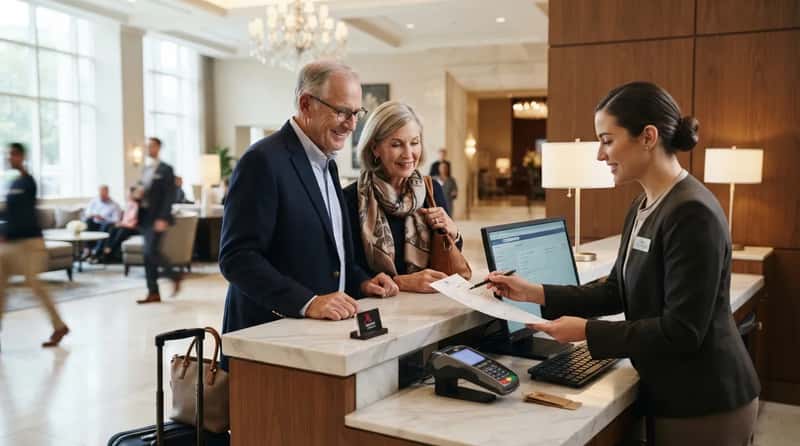
The single most impactful charge guests over 60 fail to query isn’t a fee – it’s the base room rate they accepted without ever asking if a better one existed.
Guests 60 and older can enjoy special savings on the standard rate at participating Wyndham Hotels & Resorts locations. Search from the senior rate page or call and request it directly – most guests never do either.
At Marriott, guests 62 or older are eligible for a Senior Discount of 15% or more. At La Quinta, guests 55 and older can receive up to 30% off standard rates.
Quick Compare
| Chain | Minimum Age | Typical Senior Savings |
|---|---|---|
| Marriott | 62+ | (cite index=”12-1″>15% off at participating hotels worldwide |
| Choice Hotels (AARP) | 60+ | Up to 10% off with advance booking |
| La Quinta | 55+ | Up to 30% off standard rates |
| Best Western | 55+ | Discount, sometimes with free breakfast |
These are not tiny courtesy discounts – 15 to 30% off a room rate across several nights is a substantial sum. Yet the vast majority of eligible guests pay full price simply because they didn’t know to ask.
For guests over 60, the leverage is even stronger: senior rates, extended-stay discounts, and a reputation as low-hassle, reliable guests that hotel managers genuinely value. If you checked in at full price and later discovered a senior rate existed, it’s reasonable to ask at checkout whether an adjustment can be made.
Some properties will. Many will surprise you.
The room rate is the one line on your bill that nobody thinks to challenge. It turns out, it’s the one that matters most.
The Bottom Line

Hotels quietly count on guests – especially older ones – accepting their bill without a word. But resort fees, parking charges, minibar sensor errors, safe rental fees, auto-added gratuities, and missed senior discounts are all regularly removed or adjusted for guests who simply ask.
These savings aren’t locked behind platinum status or secret handshakes. Many are available to any guest who asks in the right way at the right moment.
The pattern is consistent: calm, polite, specific questions get results. Always review your bill line by line before checkout, never in a rush.
Did any of these charges show up on your last hotel bill? Drop it in the comments – we’d love to know which one surprised you most.
Bonus: The One Line That Gets Almost Any Fee Waived

Every charge above can be challenged one at a time – but there’s a single approach that works across nearly all of them, and it has nothing to do with which fee you’re disputing.
- Never dispute at the counter with a line forming behind you. Ask the front desk for a printed, itemized folio the night before checkout, then review it in your room with zero pressure and no audience.
- Ask by title, not by luck. Say “May I speak with the manager on duty about an adjustment to my folio?” – on-duty managers typically have waiver authority that a front-desk agent does not.
- Time it early. Approach the desk in the first hour of a shift change, before the morning checkout rush, when staff have more time and patience to actually read your bill line by line.
- Close with intent, not anger. End with: “I’d like to stay loyal to this brand, so I just want the bill to reflect what I actually used.” This signals you’re a repeat-guest risk worth keeping happy, not a one-time complaint to dismiss.
If the on-duty manager still declines, ask for their name and the general manager’s email, then follow up in writing the same day referencing the specific date, room number, and charge. Written requests create a paper trail that’s far harder to ignore than a verbal one at the counter.