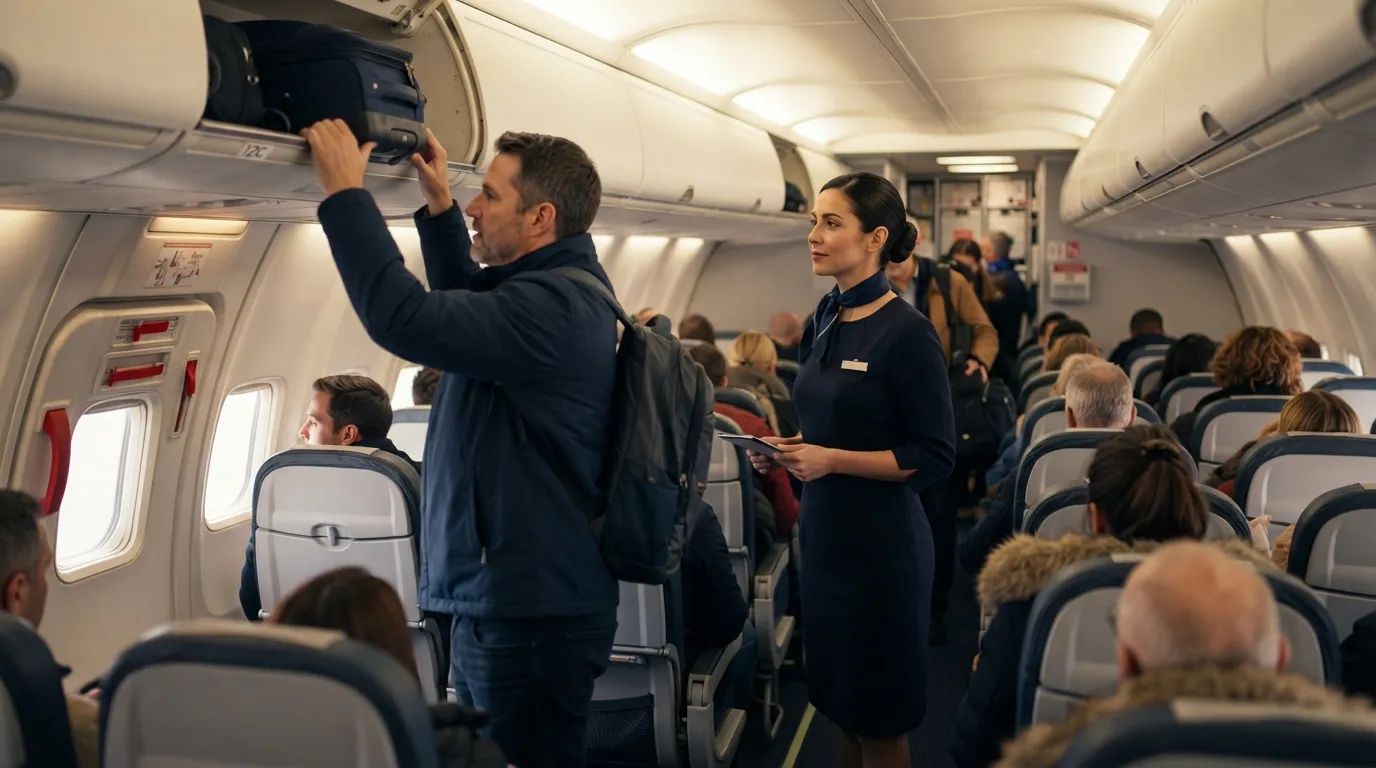
Most people think flight attendants spend boarding smiling and pointing at overhead bins. That’s the cover story. While you hunt for 24C, the crew is running a quiet scan: who’s in the exit row, whose bag won’t fit, who looks unsteady, and who isn’t listening. Some of it is federal rule. Some of it is instinct built over thousands of flights.
The things that set off alarm bells are rarely the ones passengers expect. A few are about safety, a few are about sanity, and one on this list is something you’ll never see a crew member actually do. Start at the bottom of the countdown, because the first two entries already change how boarding looks.
#14 – The Exit Row “Yes” That Can Cost You Your Seat
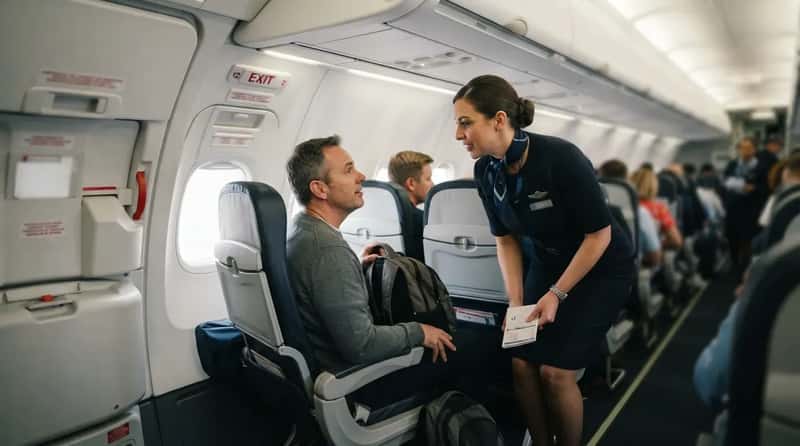
That extra legroom comes with a hidden job interview. U.S. airlines have to verify that anyone sitting in an exit seat is willing and able to help in an emergency evacuation. Crews want a clear spoken answer, not a sleepy nod. If a flight attendant decides you can’t handle the job, you’re required to give up the seat. The decision is theirs, and it can change from one crew to the next.
The checklist is longer than most people think. Exit-row passengers must generally be at least 15, physically able to operate the exit, able to understand the crew’s instructions, and free of infant-care duties or mobility aids. So the family with a toddler who booked the “bonus legroom” row is often the first group a crew quietly reseats. The upgrade they paid for vanishes before the doors close.
But the next thing crews look for has nothing to do with seat assignments at all…
#13 – The Passenger Who Boarded a Little Too Relaxed
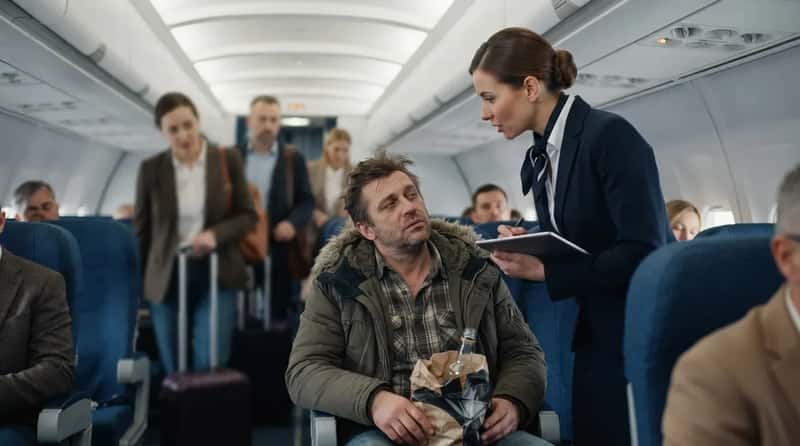
Crews start reading faces at the aircraft door. Slurred speech, a stumble on the jet bridge, or a strong smell of alcohol gets noticed fast. Federal rules bar airlines from letting a person who appears intoxicated board the plane. That puts the crew in an awkward spot, because they’re often the last human check before the door closes.
The reason is simple. Everything is harder to manage at 35,000 feet, and a passenger who’s already impaired is more likely to ignore instructions later. Crews would much rather have a tense conversation at the gate than a diversion over the Midwest.
- Unsteady walking or trouble finding the seat
- Loud, slurred or repetitive talk
- Bottles from the airport bar still in hand, which crews can’t let you drink on board
And that’s only the people. Next up is something that causes far more daily friction: the luggage.
#12 – The Bag That Was Never Going to Fit
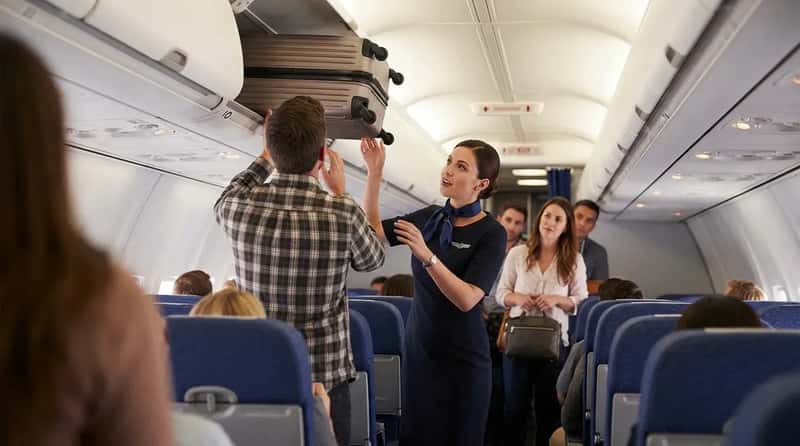
Watch a flight attendant’s eyes during boarding and you’ll see them judging bags before they reach row 10. They know which roller bags are oversize and which are about to cause a bin standoff. A single jammed bag can freeze an entire aisle of passengers. That’s why crews step in early with a cheerful “Let’s check that one at the door.”
Here’s the opinion that sparks arguments. Many crew members say the real bin hog isn’t the big suitcase. It’s the passenger who wedges a second bag into the bin and leaves the space under the seat empty. Some travelers call that fair play. Plenty of crew call it the reason the last 15 people have nowhere to put their stuff.
But a stuffed bin is nothing compared to what happens when a single person stops in the middle of the aisle…
#11 – The Aisle Stopper Who Creates a 30-Person Traffic Jam
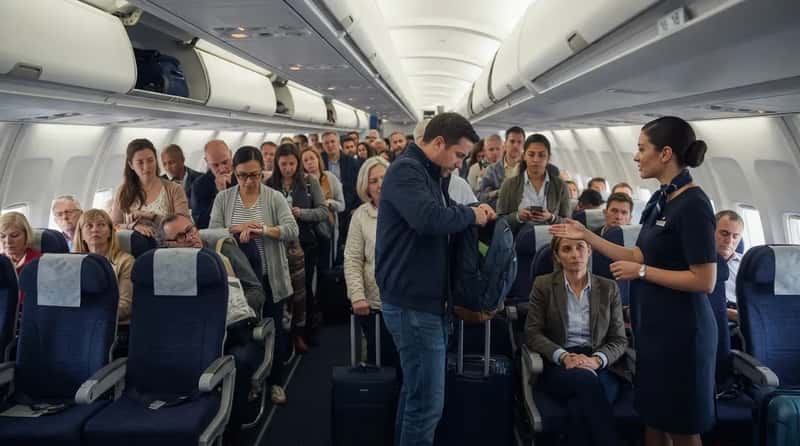
You know the move. Someone reaches row 18, stops, and starts rearranging a backpack while the whole plane stands behind them. Crews see this as the moment boarding goes sideways. One person standing still can undo minutes of smooth boarding. The crew’s job is to keep the line moving without making anyone feel scolded.
Flight attendants will often step in with a friendly “Step in here and finish that.” It sounds polite, and it is. It’s also a safety move, because a blocked aisle slows the crew’s own access to the cabin. And a delayed departure can ripple through an airline’s whole day.
Worth Knowing
- The aisle is the crew’s only route through the cabin, so a blockage affects them too
- Stepping into your row to sort your things is the standard fix
- Pulling out what you need before you reach your seat saves everyone behind you
- A short delay at the door can carry over to later flights that day
Behind every on-time departure is a lot of invisible traffic control. And speaking of things people carry on board, the next one has four legs…
#10 – The Pet Carrier That Isn’t Quite Under the Seat
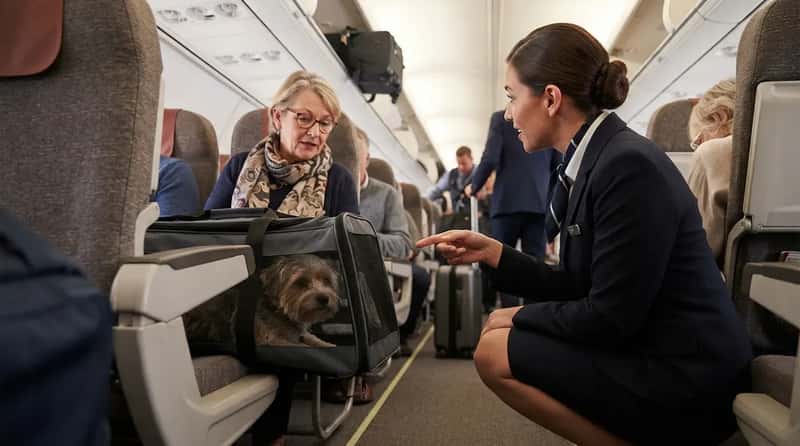
Crews watch pet owners closely at boarding. The carrier has to fit under the seat in front of you and stay there for takeoff and landing. Flight attendants check the zipper, the size, and whether the animal is fully inside. A pet in the cabin generally means you can’t sit in an exit row, even if you meet every other requirement. Airlines such as American spell this out in their exit-row policies.
That rule catches people off guard. A traveler pays extra for the exit row, then gets moved the moment the crew spots the carrier. The logic is blunt: in an evacuation, your hands need to be free for the door, not for your dog.
Then there’s the person who decides the seat they were given isn’t the one they want…
#9 – The Quiet Seat Swap Nobody Announced
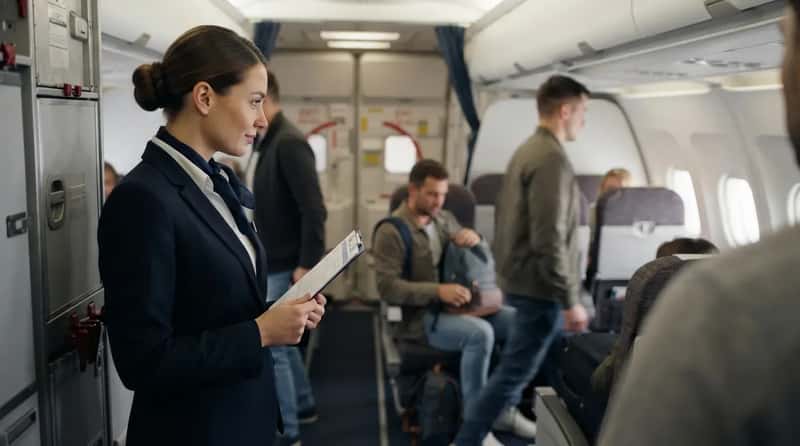
Seat swapping looks harmless. Crews see it differently. Someone slides into an empty exit row or an empty section, and suddenly the manifest no longer matches the people on the plane. On smaller aircraft, where weight distribution matters more, crews can ask you to go back to your assigned spot. On big jets, the bigger issue is usually exit rows and who’s legally allowed to sit in them.
Here’s the opinion that splits crews. Some say the “move to an empty row” crowd should ask first. Others shrug and say it only matters if the seat comes with duties. Either way, the person who quietly moved up to row 12 is exactly who the crew keeps an eye on.
Quick Compare
- Smaller aircraft: Where people sit affects weight distribution, so moves get noticed
- Big jets: The real flashpoint is the exit row and who qualifies to sit there
- Either way: Asking a flight attendant first is the safest play
If you’ve ever been asked to go back to your seat, now you know why. But the next group on the crew’s radar is far more sympathetic…
#8 – Parents, Kids and the Quiet Hunt for Who Needs Help
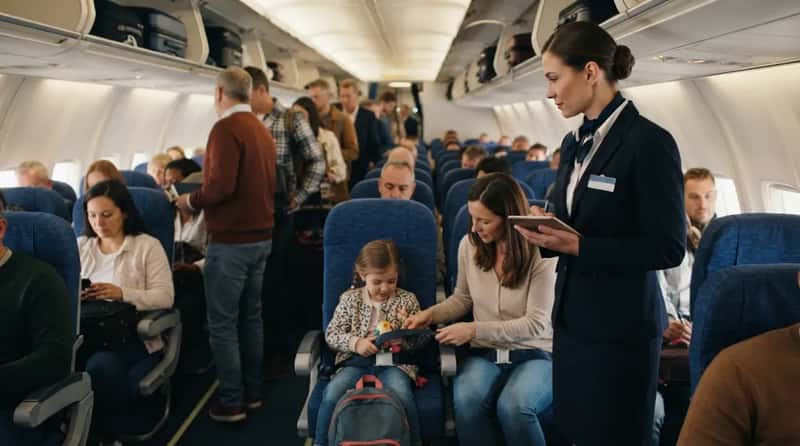
Crews scan boarding for anyone who may need extra attention. That includes families with young kids, passengers who need help with mobility, and children flying alone. Some of the most important safety work on a flight happens before the first announcement. The crew isn’t just noting who is seated. They’re noting who would need a hand in an emergency.
It also explains why crews sometimes shift families together. A parent split from a child is stressed, and a stressed parent is a harder passenger to brief. A calm, seated family makes for a safer cabin.
The next group is the one that makes crews roll their eyes the most…
#7 – The Headphones Crowd That Tunes Out the Safety Demo
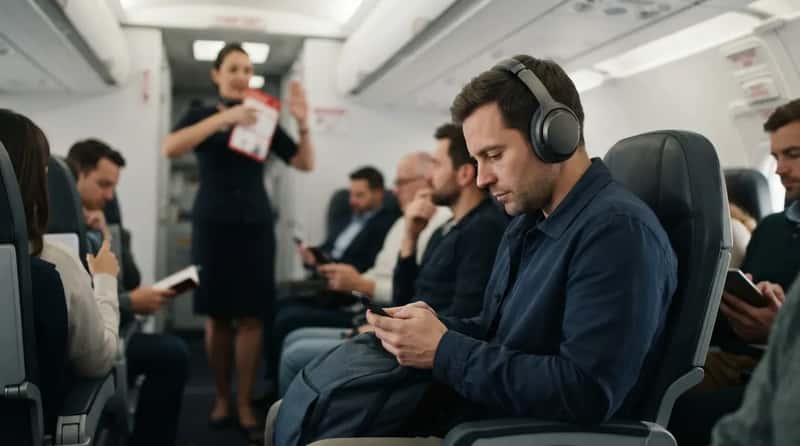
Every flight attendant has seen it. The safety demo starts, and half the cabin disappears into a screen or a pair of headphones. Crews notice exactly who isn’t looking up, and many say frequent flyers are the worst offenders. They’ve heard it a hundred times, so they stop hearing it at all.
Here’s the take that starts comment wars. Some crew argue the “I know it by heart” traveler is the riskiest person on board. Procedures and aircraft types differ, and the exit might not work the way you remember. Frequent flyers push back and say the card is basically the same on every plane. Both sides have a point.
If tuning out the demo bothers crews, the next one worries them for a very different reason…
#6 – The Passenger Who Looks Pale, Sweaty or Close to Panic
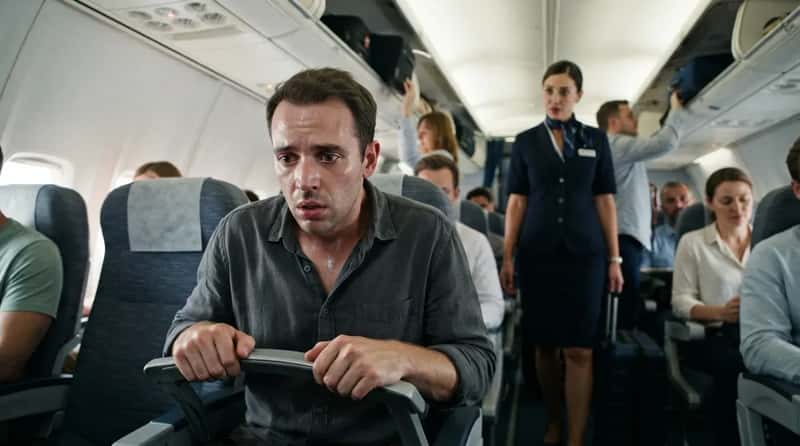
Crews watch more than behavior. They watch how people look. A traveler who’s sweating, gripping the armrest, or breathing quickly gets a second glance. It’s easier to help someone before takeoff than at cruising altitude, when the plane can’t simply pull over. A quick “Are you doing okay?” at the door can head off a much bigger problem.
The same goes for anyone who seems confused or unwell. Crews have medical training, and they know a plane’s remote setting changes the stakes. If someone can’t safely fly, the gate is the best place to find out.
Next, a quiet conflict that starts with just a few inches of space…
#5 – The Armrest and Recline War That Gets Expensive
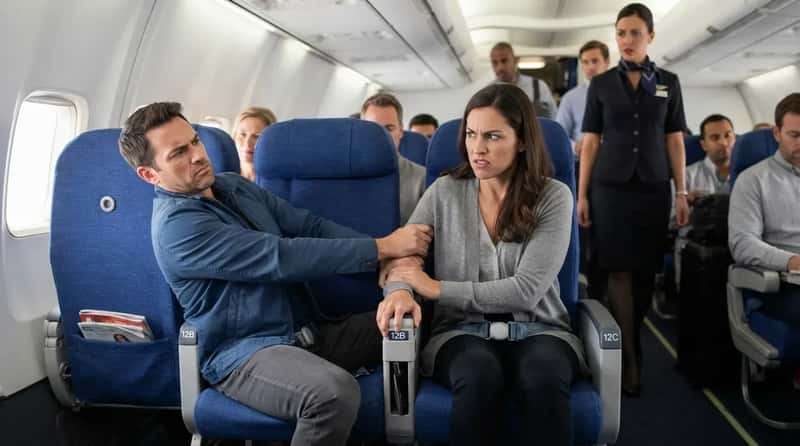
It starts small. Someone leans back, the person behind objects, and the tension builds. Recent coverage warns that a seat or armrest dispute can escalate into a diverted flight and a five-figure fine. Crews watch for the early signs: the sigh, the glare, the tap on the seat back.
The money side is real. One report puts the maximum civil penalty at $43,658 per violation. The FAA focuses on interference with crew, not rudeness between neighbors. But once a passenger refuses to follow crew instructions, it’s a different story.
And that brings us to the most common problem crews actually report…
#4 – The Person Who Ignores the First Instruction
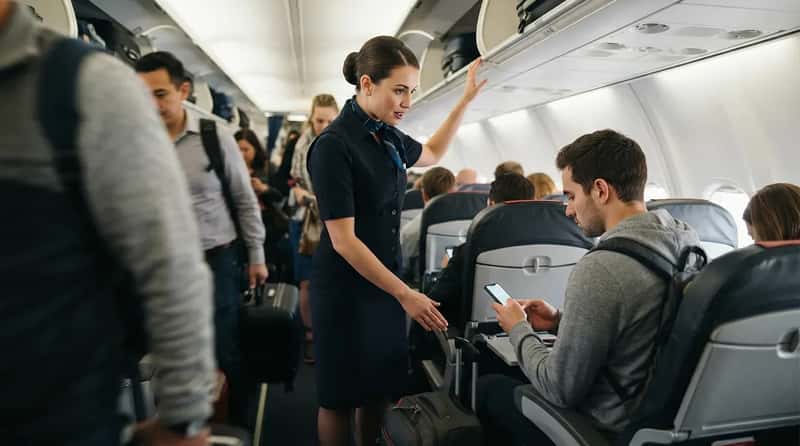
Here’s the quiet pattern behind many cabin problems. Non-compliance with crew instructions is the most frequently reported type of unruly behavior. It’s rarely dramatic. It’s the passenger who keeps standing, keeps using a device, or keeps arguing after being asked once.
The trend is moving in the right direction, according to IATA’s data. That still means roughly one incident on every 355 flights, worldwide. Crews treat that first ignored instruction as a warning light.
At a Glance
- 2024: one reported unruly incident every 307 flights, per IATA
- 2025: one every 355 flights, a clear improvement
- Most common type: ignoring crew instructions
- Typical triggers: staying standing, keeping a device on, arguing after the first request
The FAA is blunt about it too. It has a zero-tolerance policy on unruly passenger behavior. But the next item has nothing to do with attitude and everything to do with what’s in your bag…
#3 – The Power Bank Crews Now Treat Like a Hazard
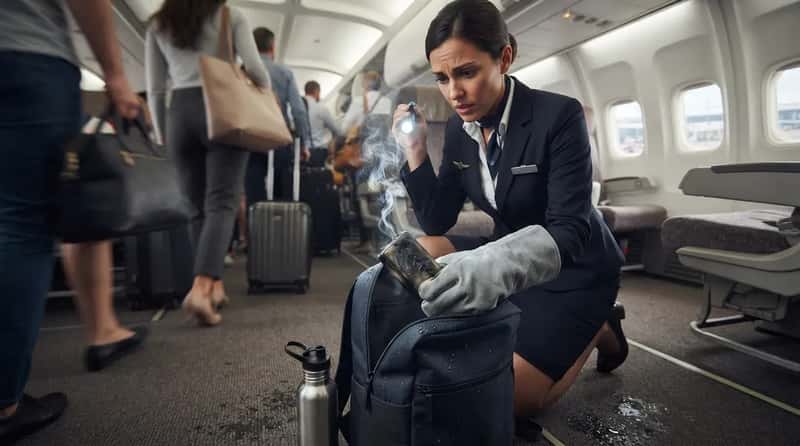
That phone charger in your bag is on the crew’s mind. The FAA verified 93 lithium battery incidents involving smoke, fire or extreme heat on U.S. aircraft in 2025, up from 89 the year before. Both years are the highest the agency has recorded. Crews now watch where chargers are plugged in and whether anything is stuffed into a bin next to a hot battery.
Airlines are reacting. Southwest moved to restrict charging a device from a power bank while it sits inside a carry-on bag. When things go wrong, crews act fast. On a United flight in April 2025, a flight attendant poured water on a backpack with an overheating battery, then placed the battery in a thermal containment bag.
But there’s one more cabin check that happens right before the engines spool up…
#2 – The Final Walk Down the Aisle Before the Door Closes
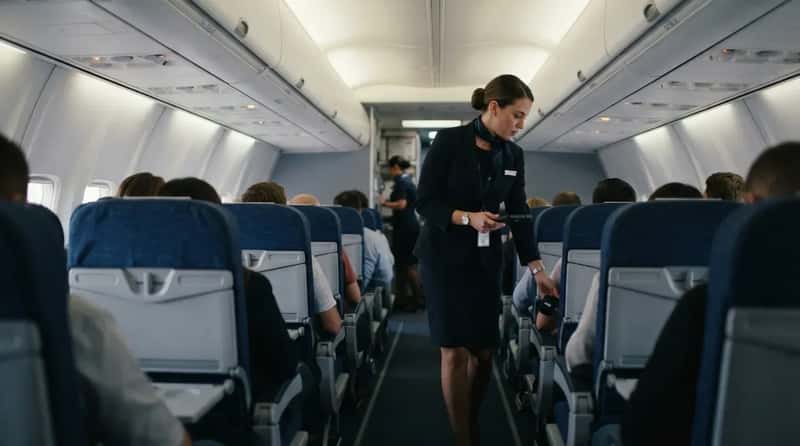
Once you’re seated, the real inspection begins. Crews walk the aisle checking seat belts, tray tables, seat backs and stowed bags. Every item is checked by a human, even on the newest planes. It looks routine because it is, and that routine is the point.
Crews are hunting tiny details. A belt that isn’t buckled. A laptop left on a tray table. A bag half out of a bin. These small misses are the ones that matter in turbulence or an aborted takeoff.
But the most important thing crews do during boarding is one you’ll never see them do…
#1 – The Silent Question: Who Would Help If Something Went Wrong?
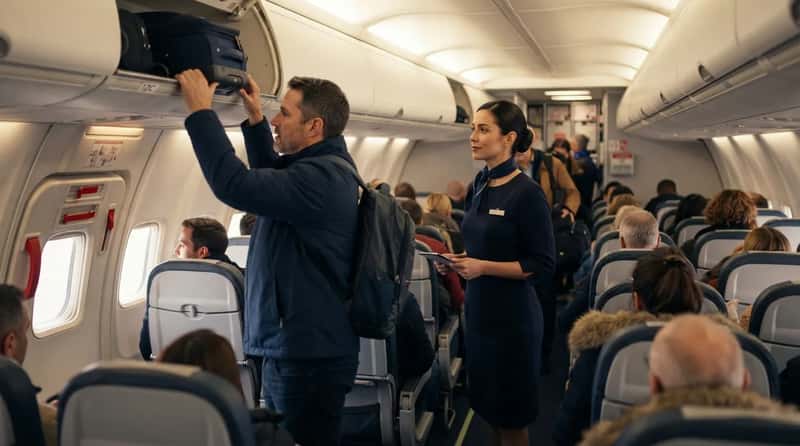
While you’re stowing your bag, many crew members are quietly sizing up the cabin. Not out of suspicion, but out of preparation. They think about which passengers could assist near an exit, who might need help getting out, and where the weak points are. The plan for the worst day is being made while everyone else is just looking for the window seat.
This is why the exit-row check exists. Those seats sit beside exits that a passenger may be asked to open in an emergency, so boarding is when crews decide who they’d turn to first. You’d never know it from the smile at the door. That’s the real job: not the coffee or the safety card, but a calm, constant readiness that starts the second you step on the plane.
So boarding looks chaotic, but the crew is working through a quiet checklist. They’re confirming who’s fit for the exit row, catching impaired passengers, wrangling bags, and watching for anything that might go wrong. The surprising part is how much of it is judgment, not paperwork.
Next time you shuffle down the aisle, glance at the flight attendant by the door. That friendly nod may be the quickest safety check of your day.