
Airline fees look carved in stone on a checkout screen. On the phone, a surprising number of them quietly disappear.
Age alone won’t wipe a fee, but the things that often come with it will: loyalty status, a family loss, a website that locks up, a mobility need. The 15 waivers below are the ones worth knowing, and the one at #1 is backed by federal law, not airline goodwill.
#15 – The $25 JetBlue Phone Fee After a Website Error

JetBlue charges $25 per person to change, cancel, or book a trip by phone. That stings before you’ve even touched your itinerary.
The airline says it will waive that fee if you tried to change your flight online and ran into technical trouble. If the website froze, timed out, or threw an error, say so specifically when you call.
Naming the exact failure is often the detail an agent is listening for before applying the waiver.
JetBlue’s same-day change fee has its own waiver path, and it has nothing to do with website glitches.
#14 – JetBlue’s $75 Same-Day Change Fee for Mosaic Members
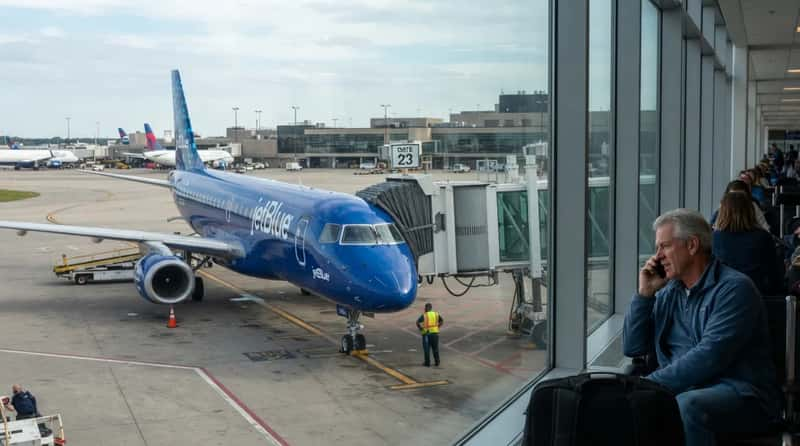
Blue Basic is one of the most restrictive fares JetBlue sells. Yet the same-day change fee is waived for Mosaic members on every fare, Blue Basic included.
If you fly JetBlue often, check your Mosaic status before you hand over $75.
Loyalty waivers show up at other carriers too, but the details change from airline to airline. United is next, and it hides two separate fee waivers behind one phone call.
#13 – United’s $25 Phone Fee and Same-Day Change Fee for Premier Members

United lists its phone fee at $25 per ticket, with exemptions for Premier elite members and for technical website errors. On a booking for two or three travellers, that adds up before you’ve changed a single seat.
If you hold any Premier tier, state it at the start of the call rather than after the agent has quoted you a total.
MileagePlus elite status can also waive same-day change fees. Premier Silver, Gold, Platinum, and 1K members frequently get that waiver as a standard perk, but it isn’t always applied through the app or the online change tool.
If United changed your connecting flight, you also have grounds to request a waiver. An agent can apply it manually in minutes, while the online system would simply charge you and move on.
American Airlines has a same-day fee of its own, and one of its waivers doesn’t depend on status at all.
#12 – American Airlines’ Same-Day $75 Fee Waived for AAdvantage Elites

Same-day confirmed changes at American carry a $75 fee, waived for Gold and above. Elite members should never pay it, yet the waiver isn’t always applied automatically.
A phone agent can apply the elite benefit and make sure the fee disappears, which the self-service tool doesn’t always do.
There’s a second route, too. When irregular operations entitle you to a same-day change, such as a delayed inbound flight or a connection the airline cut short, the change can be free regardless of status. Raise the disruption specifically.
Alaska’s same-day fee works on a similar logic, but its waiver list is wider than most travellers know.
#11 – Alaska’s Same-Day Change Fee for Status Holders and Cardholders

Alaska waives its same-day change fee for first class or coach passengers who hold Atmos Rewards Gold or Titanium status, or certain American AAdvantage elite tiers. Companions on the same reservation get the waiver too.1
That last point is easy to miss. Travelling with a spouse or adult child on the same booking? Their fee disappears along with yours once you identify your status at the start of the call.
Phone agents check these boxes manually, something the automated online tool doesn’t do.
Quick Compare: Same-Day Change Waivers
- JetBlue: $75 fee waived for Mosaic members on every fare, Blue Basic included.
- American: $75 fee waived for AAdvantage Gold and above.
- Alaska: Waived for Gold or Titanium status holders, and companions on the booking.
- Delta: $75 fee waived for Gold, Platinum, and Diamond Medallion members.
#10 – Delta’s $75 Same-Day Fee Waived for Medallion Members

Delta charges general ticket holders $75 for a same-day change. Gold, Platinum, and Diamond Medallion members pay nothing.
Silver Medallion holders are in a different position, so ask the agent to confirm whether your tier qualifies before the change is processed.
Severe weather waivers also eliminate the $75 fee, and you don’t need Medallion status for those. When there’s an active weather advisory, a call to ask whether a waiver covers your route costs nothing and can save $75 per person.
Delta’s bereavement program runs through the same phone line, and it covers a very different kind of cost.
#9 – Delta’s Bereavement Fee Waiver Available Only by Phone

Delta’s bereavement policy gives you flexibility on the best published fare for your trip. Tickets are still subject to availability and no extra discount is offered, but service fees are waived on both the outbound and return bereavement flights.2
The booking has to go through a phone agent. The person booking must be a current SkyMiles member, or sign up before calling.
Fast Facts
- Bookings go through a Delta phone agent, not the website.
- The person booking must hold a SkyMiles number.
- Service fees are waived on both outbound and return flights.
- No extra discount, and tickets are subject to availability.
With a SkyMiles number and a qualifying family loss, the call takes a few minutes longer than a standard change. It removes the fee on both legs.
#8 – Alaska and Hawaiian’s 10% Bereavement Fare, Phone-Only

Alaska Airlines and Hawaiian Airlines have been part of the same group since the September 2024 merger, and their bereavement policies are closely matched. Both offer 10% off the lowest available fare for bereavement travel.
The airline’s definition of immediate family is broader than most people expect. It covers a spouse or domestic partner, a child or stepchild, a parent, siblings, grandparents, grandchildren, an aunt or uncle, a niece or nephew, and direct in-laws.
That matters when you need to reach an aging parent or a sibling fast.
Some airlines have dropped formal bereavement programs altogether. Their agents can still help, if you know how to reach the discretion they have left.
#7 – Compassionate Change Fee Waivers at Airlines With No Formal Program

American and United no longer run bereavement programs, but they may waive change fees case by case. United agents may still grant compassionate exceptions, such as waived change fees or refund reviews, when you explain the situation and provide a death certificate.
Ask for a supervisor and request a “compassionate exception.” Front-line agents have limited discretion, but supervisors can often waive change fees or arrange standby placement.
It doesn’t always work. It costs nothing to ask, though, and it works often enough that skipping the call is the more expensive gamble.
#6 – The 24-Hour Cancellation Rule That Agents Apply More Cleanly

The Department of Transportation requires airlines to let you cancel or change a ticket at no cost within 24 hours of purchase, as long as you booked at least seven days before departure.3 Online tools apply the rule, but they don’t always make it obvious which button triggers it without a processing charge.
Call-center changes often carry a nonrefundable $25 service fee, but that fee is routinely waived inside the 24-hour window. Tell the agent upfront that you’re within it, before any fee is quoted.
The 24-hour window is one of the few protections that runs on federal mandate. The next one does too, but far fewer travellers know to bring it up.
#5 – The Air Carrier Access Act Waiver for Accessibility Needs

If an airline’s website isn’t fully accessible to screen readers, or a physical, sensory, or cognitive disability keeps you from booking online, the airline must waive its telephone reservation fee. That isn’t airline policy. It’s federal law under the Air Carrier Access Act.4 5
JetBlue’s published guidelines, for example, waive the $25 phone fee for travellers who can’t reasonably complete transactions online because of visual, auditory, cognitive, or physical limitations.5 The same principle applies at other U.S. carriers.
If reduced vision, hearing difficulty, or a physical limitation makes online booking genuinely hard, you’re entitled to make that call without paying for the privilege.
At a Glance
- Legal basis: The Air Carrier Access Act.
- Applies when: A disability or inaccessible website blocks online booking.
- Example: JetBlue waives its $25 phone fee in these cases.
- If refused: The DOT disability hotline is 1-800-778-4838.
#4 – Air Canada’s Bereavement Fare, Phone-Only and Proof-Required

Air Canada does offer a bereavement (compassionate travel) fare, but the rules are nuanced. Travel must begin within 10 days of booking, and the fare must be booked through a representative, not online.2
You also have to provide documentation within a week of returning. Miss that window and you may owe the difference to the regular fare.6
The deadline is tight, but the process is straightforward if you keep basic paperwork after a loss. Flying into or out of Canada? Call Air Canada first.
Southwest takes a completely different approach, one that makes some phone calls unnecessary.
#3 – Southwest’s No-Change-Fee Policy, the One That’s Structural
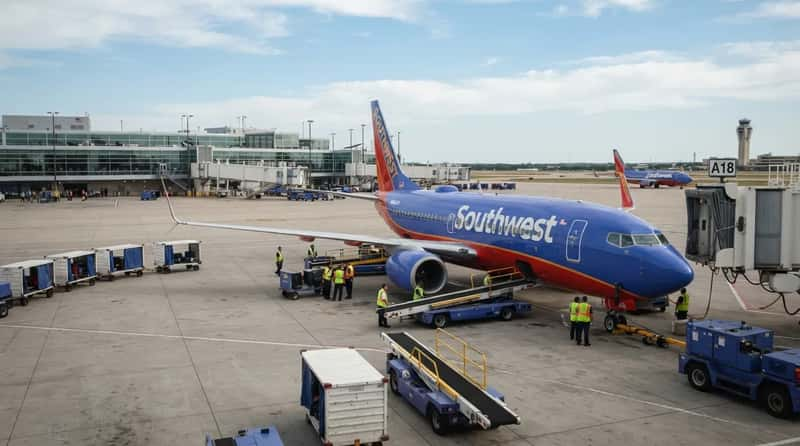
Southwest built its reputation on not charging change fees, and that structure is why it earns a spot on this list. This is the rare case where booking with the right carrier beats calling the wrong one.
There are no senior fares here and no loyalty-based exceptions to track. Just know that Southwest changed its checked-bag and fare-type rules in 2025, so confirm what your specific fare includes before you book.
The last two items are the ones most callers over 60 never think to raise, and they hold the biggest savings.
#2 – The Award Ticket Phone Fee That Status Silently Covers

Alaska can add a phone fee to award bookings that many travellers don’t notice until the receipt arrives. Alaska MVP Gold and Gold 75K holders see that fee disappear.
Award tickets are where loyal, long-time flyers pile up the most value. They’re also where phone calls are most necessary, because award space is hard to manage online.
If you hold that status and you’re booking or changing an award ticket by phone, the fee shouldn’t appear on your bill. If it does, name your status before the call ends and ask for it to be removed.
Every fee above depends on you asking the right question. The final item is the one where the law asks it for you.
#1 – The DOT Wheelchair and Accessibility Fee Mandate No Agent Can Override
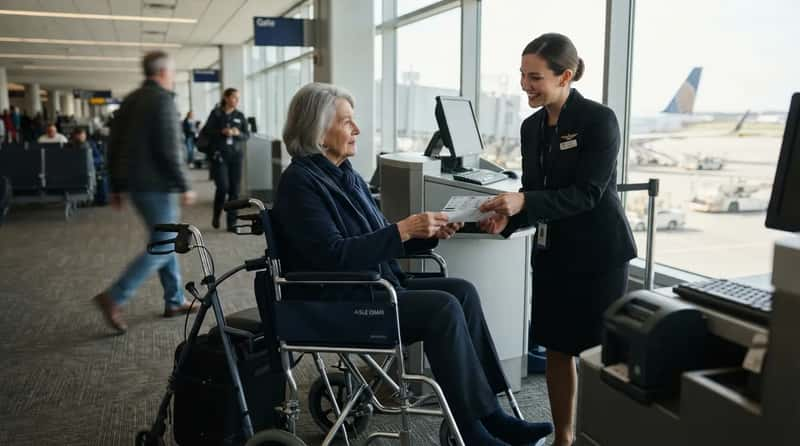
Accommodation rules can force an airline to absorb fare differences in specific circumstances, such as when a passenger’s wheelchair won’t fit on the booked aircraft. This is the strongest protection on the list because it doesn’t depend on status, timing, or agent goodwill.
Federal enforcement stands behind it. Carriers that fail to waive fees for disabled passengers who need telephone assistance risk civil penalties from the DOT.5
If you use a wheelchair, a walker, or any mobility aid, and a rebooking creates a fare difference or change fee tied to your equipment, that charge is challengeable under the Air Carrier Access Act. If the airline refuses, you can call the DOT’s disability hotline at 1-800-778-4838 during business hours or file a complaint with the DOT.
It won’t come up every trip. When it does, most travellers simply accept a charge they were never required to pay.
That’s the thread running through all 15. A checkout screen applies the same rules to everyone, and it can’t know about your status, your website error, your loss, or the law that exempts you.
A phone agent can see all of it and act on it, but only if you lead with your situation before they start quoting fees. The fee was never the hard part. The question was.
Bonus #16 – The Schedule-Change Phrase That Turns a Fee Into a Full Refund

When an airline changes your flight time, most agents open with a rebooking or a travel credit. You may be owed something much better: your money back.
Under the DOT’s refund rule, a domestic flight that departs at least 3 hours earlier or arrives at least 3 hours later than scheduled counts as a significant change. For international trips, the threshold is 6 hours. Other triggers include a different airport, an added connection, or a downgrade to a lower class of service.
If your trip qualifies, here is exactly how to play the call:
- Screenshot the schedule-change email or app notice before you call, and note the old and new times.
- Say this early: “This is a significant change under the DOT refund rule. I’m declining the new itinerary and requesting a refund to my original form of payment.”
- Decline any voucher, credit, or rebooking offer until the refund is confirmed. Accepting an alternative can end your refund right.
- Ask for a confirmation number and the agent’s name, then watch your card statement. Credit card refunds should post within about 7 business days.
This works even on non-refundable fares, because the airline changed the deal, not you.
One limit to know: a delay you still fly through does not earn a ticket refund, and a change smaller than the thresholds does not qualify. If an agent refuses a change that clearly meets them, ask for a supervisor and file a complaint with the DOT.
- Alaska Atmos Rewards Guide: https://thepointsparty.com/articles/alaska-atmos-rewards-guide
- U.S. News Bereavement Fares: https://travel.usnews.com/features/bereavement-flights
- DOT 24-Hour Rule Explained: https://www.mightytravels.com/knowledge/what_are_the_airline_cancellation_policy_rules_for_refunds.php
- ACAA Part 382 Regulation: https://cms.volaris.com/globalassets/pdfs/eng/part382.air.carrieraccessact.pdf
- Phone-Booking Fees Scrutiny: https://www.nomadlawyer.org/us-airlines-phone-booking-fees-scrutiny-american-united-jetblue-2026
- AFAR Bereavement Fares Guide: https://www.afar.com/magazine/how-bereavement-fares-work-and-when-to-use-them