Let’s be straight about the title: no Marriott rule deletes fees just because you’re over 60. What does exist is better to know: a few questions at check-in that can shrink, waive or dodge charges, plus one real senior rate for guests 62 and older.
And the costliest charge on this list can turn a “free” points night into a bill of $100 or more. It’s waiting at #1, but first, a fee that depends on the clock.
#15 – Early Check-In Charge at the Front Desk

Showing up before the posted check-in time can put a line on your bill. Many hotels charge extra for early check-in or late check-out.
Loyalty members, whose programs are generally free, may get that fee waived or an expedited check-in line. Ask whether your room is ready before you agree to pay for early access.
An early-arrival fee is a poor deal until the desk confirms a clean room is actually waiting. If it isn’t, ask the bell desk to hold your bags and call you when it is.
The same clock runs on departure day, and the desk’s answer depends heavily on when you raise it.
#14 – Late Check-Out Request Made Too Late

By 10 a.m. on departure morning, the front desk already knows how many rooms it needs by afternoon. That’s why timing matters, and why Kayak lists late check-out among the extra costs travelers meet.
Ask about late check-out when you check in, not on the morning you leave. Arrival day is when the desk can see tomorrow’s departures and arrivals, so a request then has a better shot at a yes, and possibly a free one.
If your flight leaves in the evening, compare any late-check-out fee with simply storing your bags at the bell desk. One costs money and the other often doesn’t.
Leaving a day sooner than planned triggers a different charge, and the warning sits in the paperwork you sign on arrival.
#13 – Early Departure Fee Buried in Registration

Cut your stay short and some hotels bill you for it. Event materials for the Gaithersburg Marriott Washingtonian Center tell guests to confirm their departure date at check-in, and say an early departure fee is charged to anyone who leaves sooner.
Fee amounts are set property by property, so the registration card matters more than it looks. Confirm your departure date at check-in and ask whether leaving early carries a fee.
A family call or a health scare can change a trip overnight. If your plans are shaky, say so at the desk, where it can be noted, rather than at checkout, where it’s already a charge.
Changing plans before you arrive falls under a different clause, with a deadline counted in hours.
#12 – Cancellation Deadline and the No-Show Night

Cancel too late and a hotel can keep a night’s room and tax. At the Gaithersburg Marriott, reservations can be canceled without penalty up to 72 hours before check-in, and later cancellations may incur a one-night room and tax charge.1
Marriott’s broader rule for hotels in the Americas, announced in 2017, required cancelling by midnight 48 hours before arrival, with some hotels requiring 72. Check the cancellation deadline on your confirmation, because it can be 48 or 72 hours before arrival.
Quick Compare
- Gaithersburg Marriott: free cancellation up to 72 hours before check-in
- Marriott’s 2017 Americas rule: cancel by midnight, 48 hours before arrival
- Some hotels: a longer 72-hour window
- Too late or no-show: a one-night room and tax charge at that hotel
A no-show is worse because the room is also released for the remaining dates.
If you’ll be a day late, call before the first night.
Once that window closes, the next question is who’s actually sleeping in the room, because your rate may assume fewer guests than you’re bringing.
#11 – Extra Guest Charge for Visiting Grandchildren

The rate you booked is built around a certain number of guests, and bringing more can change the bill. Kayak lists additional guest fees among the extra costs travelers meet at check-in.
If a grandchild or travel companion is joining you, ask what occupancy your rate covers. Also ask whether children count and whether a rollaway bed or crib carries its own fee.
Those answers are easy to get at the desk and hard to dispute once the folio is printed. Ask what occupancy your rate covers before anyone else moves into the room.
That one question also tells you whether a second room would cost less than the extra-person charge.
#10 – Parking Charge Outside the City Center

Free parking used to be the default outside big cities, and that’s changing. Some resorts, suburban hotels and hotels near airports have started charging for unattended, non-valet parking.
It may also sit outside the price you saw when booking. Under the FTC’s total-price rule, truly optional charges such as valet parking stay outside the requirement.
Ask the nightly parking rate before you hand over the keys. Then check whether it’s billed per night or per 24 hours, since a late arrival can make that difference add up.
Then there’s a parking charge billed to guests who never parked at all.
#9 – City Fee That Isn’t a Tax
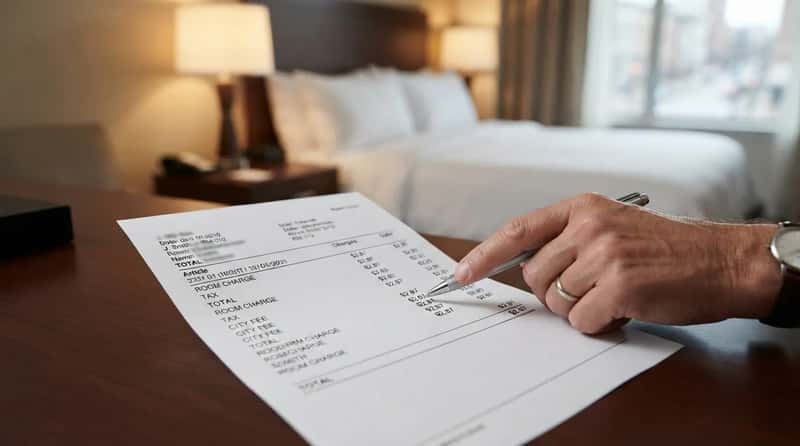
A charge of $2.87 a night looks too small to question. One Mile at a Time reported that a Fairfield by Marriott charged that amount nightly for parking whether or not guests parked, shown on the folio as a “City Fee.”2
Parking had been free when that hotel opened. It’s the same parking charge as the section above, moved to a line where you wouldn’t think to look.
That’s one hotel, but it shows how a small line can slip through on a four-night stay. A fee labeled “city fee” deserves one question at the desk.
Many hotels slide a folio under the door or print one on request the evening before you leave. That leaves time to ask about anything you can’t identify.
The older extras are easier to miss because they’re named after services: restocking, delivery, a safe.
#8 – Folio Extras With Service-Sounding Names

Bjorn Hanson of New York University’s Tisch Center for Hospitality listed the most prevalent hotel extras, and the list reaches well beyond resort fees. A few that matter on an ordinary stay:
- Minibar restocking fees and charges for in-room safes
- Telephone-call surcharges and business-center fees
- Room-service delivery surcharges and mandatory tips added to the bill
Not every Marriott applies every one, and the list dates from years back, but it tells you what to look for. At check-in, ask whether the safe, room service or hotel phone carries a separate charge.
The phone one is the easiest to dodge, because your own cell phone costs the hotel nothing to ignore.
Since 2025, a federal rule has governed which charges must appear on the booking screen, and that gives you something to hold the desk to.
#7 – The Total Price Your Booking Must Show

A federal rule now sets the baseline for what your booking page has to show. Here’s the short version.
Fast Facts
- Effective date: May 12, 2025, for the FTC’s Rule on Unfair or Deceptive Fees3
- What it requires: the true total price, including all mandatory fees3
- How it’s shown: more prominently than other pricing information
- What it doesn’t do: prohibit any fees or cap what a company can charge4
- Local angle: some states already have stronger laws
That gives you a benchmark. Save the total price from your booking page and compare it with the folio.
If a mandatory fee appears at the desk that your quoted total didn’t include, ask the manager to explain it. You can also report it to the FTC at ReportFraud.ftc.gov.
The fee most likely to show up in that total is the resort fee, and one traveler got it waived by pointing at a closed pool.
#6 – Resort Fee When the Pool Is Closed

A resort fee is a mandatory daily surcharge, typically ranging from $20 to more than $100 per night. At hotels in non-resort locations, it’s often renamed a destination, amenity or facility fee.
A Points Guy staffer at a Hawaii resort got the fee waived when the pool was closed during the stay, and the site’s conclusion is that asking never hurts. That’s the logic to borrow.5
If an amenity the fee covers is closed, ask for an adjustment that day. Waiting until checkout hands the hotel an easy reason to say no.
Some resort fees also list Wi-Fi, which becomes a problem when your loyalty status already includes it.
#5 – Wi-Fi You May Be Paying For Twice

Resort fees are meant to cover amenities such as the pool, the gym and Wi-Fi. If a perk you already hold covers one of them, you could be paying twice.
Elite members at Platinum and above may sometimes get replacement benefits when a resort fee covers something they already receive free, such as internet, but they still pay the fee itself. Marriott Bonvoy membership is free, so joining before you book costs nothing.
Ask for a replacement benefit when the resort fee duplicates your perks. Do it at check-in, with your member number in hand.
Another membership gets pitched to travelers over 60 all the time, and Marriott’s senior rate doesn’t require it.
#4 – AARP Card Not Needed for the Senior Rate
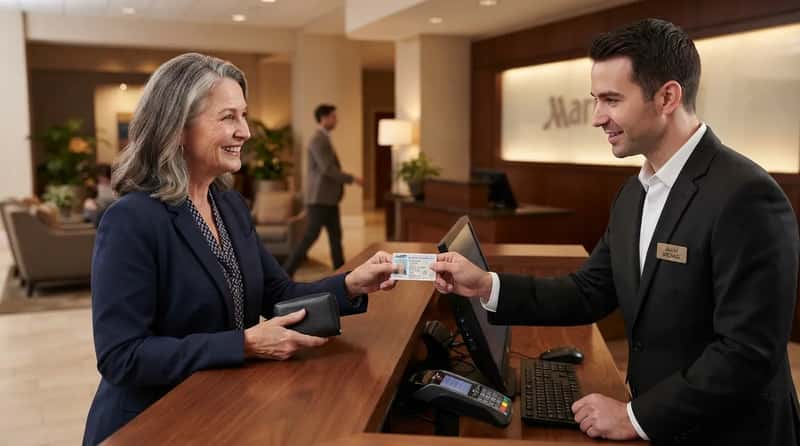
You don’t need an AARP card to get Marriott’s senior rate. Eligibility is purely age-based, and the guest must show a government-issued ID proving age at check-in.6
If Marriott is your only reason for paying AARP dues, skip it. Whether the group’s other travel discounts earn back the dues depends on how often you’d use them, and that’s a separate decision.
Marriott’s senior rate needs proof of age, not an AARP card. A driver’s license or passport works, and without it the hotel may adjust your room rate to the current daily price.
So what does that age-based rate actually save you?
#3 – Senior Rate for Guests 62 and Older

The senior rate takes 15% or more off the standard room rate for travelers 62 and older at participating properties across Marriott’s brands.6 It’s the one item on this list that turns on your age, and it can outweigh several fees above.
At a Glance
- Who qualifies: guests 62 and older
- Typical savings: 15% or more off the standard room rate
- Proof needed: government-issued ID at check-in
- Room limit: up to two rooms per night, with the reservation in your name6
- Fine print: subject to availability and may not combine with other promotions
On marriott.com, open Special Rates in the booking widget and select Senior Discount.6 It won’t surface by itself, so you have to look for it.
Marriott Bonvoy member rates occasionally price lower, so price the senior rate against your Bonvoy member rate for the same dates.
Age earns that discount, but at one group of Las Vegas hotels it’s loyalty status that erases the resort fee, even on a points stay.
#2 – The MGM Collection Resort Fee Exception

Marriott’s own FAQ for MGM Collection with Marriott Bonvoy lists a waived resort fee among its benefits. The catch is who qualifies.
Ambassador-level guests get resort fees waived on up to two rooms, including their own, whether redemption or paid. At MGM Collection hotels, Ambassador status waives resort fees on up to two rooms.
Marriott has room to do more. TheStreet reported that the franchise agreement lets Marriott waive resort fees for Bonvoy elite members.
My read: the age on your ID won’t get a resort fee waived, but status can, and so can a polite question about what’s closed or duplicated.
For everyone below that tier, the largest charge on a Marriott bill is one points can’t touch.
#1 – Resort Fee on a Points Night

A Marriott “free night” isn’t free at any hotel that charges a resort fee. Hilton Honors and World of Hyatt waive resort fees on award stays booked entirely with points, and Marriott Bonvoy does not.5 7
Guests can pay around $30 to $50 or more per night even on a redemption, and that can top $100 a night at some resort properties.5 7 At $50 a night, three nights is $150 in cash on top of your points.
Worth Knowing
- Bonvoy points cover only the room and tax
- Resort and destination fees are charged separately
- Marriott leaves it up to each hotel whether to add the fee
- Hilton Honors and World of Hyatt waive the fee on award stays booked entirely with points
Marriott points cover the room and taxes, but not the resort fee. That makes a points night at a resort-fee property a weaker deal than it looks, and the senior rate from earlier may come out ahead, so price both.
Fifteen charges, one pattern: the first number you see is rarely the last. Check-in is the one moment you’re standing at the desk with the confirmation in hand and the folio still empty.
Treat it as the final step of buying the room, not the start of the vacation. Two minutes of questions there cost far less than a dispute at checkout.
Which charge has turned up on one of your own hotel bills that you hadn’t expected, and what did the desk do when you asked about it?
- Cvent Gaithersburg Marriott Venue: https://www.cvent.com/venues/gaithersburg/hotel/gaithersburg-marriott-washingtonian-center/venue-9c4795ff-0a18-46a7-90d3-313974f22386
- One Mile at a Time City Fee: https://onemileatatime.com/news/marriott-hotel-forces-guests-pay-parking-passes-off-tax/
- Hotel Dive FTC Fees Rule: https://www.hoteldive.com/news/ftc-junk-fees-rule-takes-effect-hotels/747738/
- PIRG Junk Fees Rule: https://pirg.org/edfund/articles/junk-fees-finally-new-protections-against-surprise-charges-for-event-tickets-hotels/
- The Points Guy Resort Fee: https://thepointsguy.com/glossary/what-is-a-resort-fee
- Marriott Senior Discount Guide: https://retirehub.org/senior-discounts/marriott/
- Points Guy Avoid Resort Fees: https://thepointsguy.com/travel/avoid-resort-fees/