

Most travelers over 60 assume asking for anything extra makes them a burden, so they quietly settle for whatever room, table, or schedule they’re handed. But dozens of hotel and resort employees say the opposite is true: the guests who ask for a handful of specific things almost always end up happier, safer, and more likely to get the good stuff nobody advertises.
The strange part is that these requests aren’t demanding or expensive. They’re small, specific, and often the exact thing staff are waiting to hear so they can quietly go to work behind the scenes. Here’s what resort insiders actually say they wish more guests over 60 would just come out and ask for.
15. A Quiet Floor, Named Out Loud

Staff can steer you away from noise before you ever check in, but only if you ask early. Where a room sits in the building matters enormously for sleep quality, and experienced staff know the floor plan better than anyone, including which floors sit near ice machines, elevator banks, and stairwells. Left alone, they’ll sometimes make the switch quietly anyway. But naming it outright speeds everything up.
The catch is that most guests never realize their room assignment was switched on their behalf – they just notice they slept well. That means plenty of guests who never asked got lucky, while others sat above a rowdy group all week. Saying “a quiet room away from the elevator” out loud removes the guesswork entirely.
14. A Fridge for Medication, Not Just Champagne

Front desks hear this request less than you’d expect, and it’s an easy yes almost everywhere. Guests are encouraged to confirm whether their hotel offers in-room refrigerators, especially if they need to store medications. Staff would honestly rather set this up before arrival than scramble on day one.
Travelers often assume a fridge is a luxury amenity reserved for suites, so they never mention it. In reality, most properties keep a stock of mini-fridges specifically for medical needs. Keeping medications close by, ideally in a carry-on and near the guest at all times, is one of the most repeated pieces of senior travel advice around. A quick call ahead turns that advice into an actual room feature.
13. Real Talk About Mobility, Not Hints
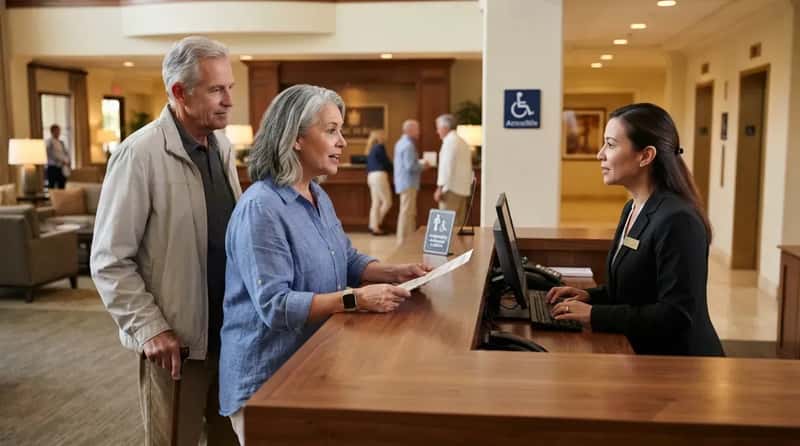
Vague comments about “not moving as fast as I used to” don’t trigger action. Direct requests do. Guests are encouraged to request a first-floor room or an elevator-accessible floor, and to ask directly if the room has grab bars, walk-in showers, or handicap-accessible bathrooms. That specificity is exactly what staff need to actually solve the problem.
This matters more than most people realize. More than 1 in 10 travelers 50 and older need accommodations for a disability, with mobility being the top concern at 78%. Staff aren’t guessing whether that applies to you – they’d rather you just tell them plainly so nothing gets missed at check-in.
12. “Do You Have Any Senior Rates I’m Not Seeing?”
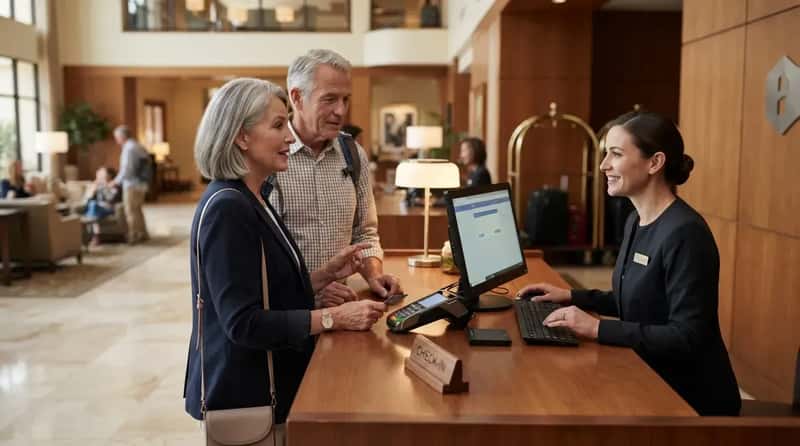
This single question can quietly shave real money off a stay, yet almost nobody asks it out loud. Senior rate programs, like AARP member hotel discounts, are often in the system but not displayed on public booking pages. Staff aren’t hiding it out of malice – it simply isn’t part of the standard script unless prompted.
The savings can be significant. AARP offers discounts of up to 35% on car rentals, reduced rates at hotel chains such as Hyatt and Omni, and cruise credits for its members. An experienced front desk agent who’s asked directly will usually check without hesitation – but a guest who never mentions it may pay full rate for years without knowing better.
At a Glance
- AARP hotel discounts are often hidden from public booking pages
- Car rental discounts up to 35% for AARP members
- Reduced rates at chains like Hyatt and Omni
- Cruise credits also available through AARP membership
11. “Can You Combine My Old Loyalty Stays?”

Loyalty numbers from a decade of scattered trips often go unclaimed simply because guests forget they exist. Even at smaller independent hotels, repeat guests get quiet treatment that first-timers don’t – extra towels pre-stocked, a note about a quiet-floor preference, a late checkout already penciled in. None of that happens automatically if the account sits buried and unmentioned.
Some properties can even piece together forgotten history. Loyalty points from stays made years apart can sometimes be combined for a free night or dining credit. Staff genuinely wish more longtime guests over 60 would ask, “Can you look up my old account?” instead of assuming those points vanished into thin air.
10. An Earlier, Slower Dinner Seating

A rushed dinner ruins more resort stays than staff ever hear about directly. It’s one of the most common disappointments older travelers never actually voice – they just don’t go back, and they don’t return to the hotel that sent them there. The frustration stays silent, and so does the guest, permanently.
Fixing it is almost embarrassingly simple. A quick request for an earlier seating or a slower-paced table gives staff room to actually deliver a relaxed meal. A concierge who prevents that disappointment with a quiet phone call earns the hotel a loyal guest for years, even though it never shows up in a review. Staff would rather hear the ask than lose the guest quietly.
9. Wheelchair Assistance Requested in Advance, Not Improvised

Waiting until arrival to mention mobility needs puts everyone in a tougher spot than necessary. Slow walkers are encouraged to request a wheelchair or an electric cart when booking so they can easily make any connecting flights or transfers. The same logic applies at check-in – advance notice beats an on-the-spot scramble every time.
Airports back this up with real accommodations, and resorts follow the same pattern. Travelers 75 or older usually qualify for expedited security lines, skipping shoe removal and separating laptops or liquids. Staff would rather build a smooth arrival around a known need than react to a surprised, exhausted guest at the door.
8. “Please Just Show Me the TV Remote”
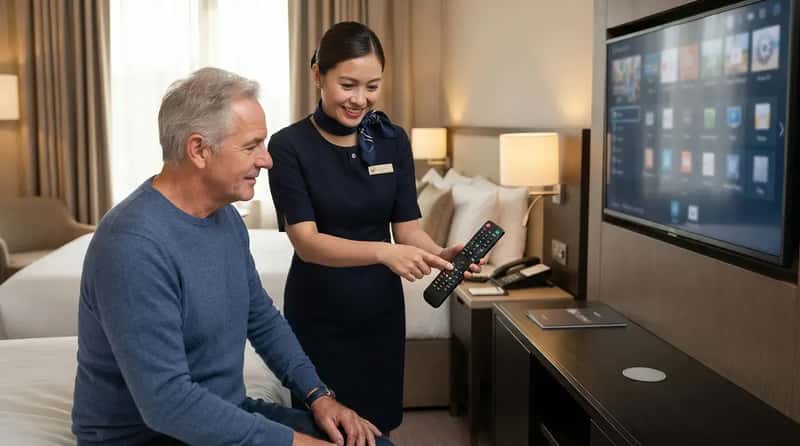
Nobody wants to admit they’re stuck on a smart-TV menu, so guests suffer through blank screens in silence. Staff notice this constantly and genuinely don’t mind explaining. Most hotel employees will readily admit that operating certain in-room TV systems basically requires an advanced degree in information technology. You are never the only one confused.
Complicated tech isn’t limited to televisions. Age-unfriendly technology like smart-TVs with vague instructions, “smart” lighting, and confusing air conditioning controls can leave older guests feeling cut off and frustrated. A simple “can you walk me through this?” at check-in saves an entire evening of fumbling later.
Worth Knowing
- Smart-TV menus trip up even tech-savvy guests
- “Smart” lighting controls can be just as confusing
- Air conditioning panels are a common source of frustration
- A quick ask at check-in usually solves it in seconds
7. A Familiar Face Each Morning

Solo travelers over 60 rarely ask for this outright, yet it’s one of the easiest things staff can arrange. One quiet move a concierge makes for a solo older traveler is ensuring at least one staff member, usually at breakfast or the front desk, knows the guest by name and greets them personally each morning. It’s a small thing that changes the entire tone of a stay.
The impact is bigger than it sounds. For a traveler far from home, perhaps traveling alone for the first time in years, that daily greeting can become one of the most meaningful parts of the entire trip. Staff genuinely wish more guests would simply say, “I’d love a familiar face each morning” instead of assuming it’s an odd thing to ask.
6. Flagging Special Needs Before Arrival, Not At the Desk

A phone call days before check-in accomplishes more than any request made in a busy lobby line. The moment a reservation is confirmed, a good concierge isn’t sitting back waiting for check-in day – they start working the guest’s profile immediately. That head start only happens when the guest actually calls ahead.
Booking channel matters here too. Resort fees are more likely to appear as a surprise at check-in when booked through a third-party site, and the guest experience gap strongly favors booking direct. Calling the property directly lets staff attach notes, preferences, and accommodations to the reservation long before a guest ever walks through the door.
5. Naming the Actual Mattress or Pillow Preference

Guests assume a hard mattress and stiff pillow are just what they’re stuck with. Most resorts have a fix sitting in a storage closet. Many hotels offer pillow menus that aren’t always advertised in the rooms, along with extras like hair straighteners and coffee machines. None of it appears unless someone actually asks for it.
Comfort requests extend beyond pillows, too. Guests who prefer a larger bed or a specific mattress type shouldn’t be afraid to ask before booking. Staff would much rather field that question in advance than hear about a sleepless night after the fact, when there’s little left to do about it.
Quick Compare
- Stiff pillow you never mention vs. pillow menu you never knew existed
- Standard mattress by default vs. specific firmness requested ahead of time
- Silent discomfort all week vs. one quick call before booking
4. Speaking Up the Moment Something’s Off

Older guests are far more likely to quietly tolerate a problem than complain about it, and staff say that habit backfires constantly. Travelers often fear speaking up if they have an issue, but one hotel staffer put it bluntly:
If you are unhappy with something, tell us as soon as possible.
Hotel front desk staffer
The fix costs nothing but a little discomfort in the moment. If neighboring guests are loud, staff can send security to quiet them down or simply move the room – but only if someone calls. Waiting until checkout to mention a problem guarantees it never gets solved, no matter how legitimate the complaint was.
3. Asking For the Manager to Give a Compliment

Most guests only request a manager when something has gone wrong, which trains staff to brace for bad news the moment those words leave someone’s mouth. Flip that script, and something interesting happens. Glowing reviews of specific staff members reflect well on employees to both future guests and managers, and at some hotels can even earn bonuses or incentive rewards.
A guest over 60 who asks to see a manager just to praise a housekeeper or server by name creates a genuinely rare, memorable moment for that employee. It costs nothing, takes thirty seconds, and often gets remembered for the rest of the stay – sometimes even the next one.
2. A Straightforward, Specific Ask – Not a Vague Hint

Staff consistently say the biggest gap between older guests isn’t age, it’s confidence in how they ask. There’s a clear, observable difference between a guest over 60 with decades of genuine travel experience and one who simply hasn’t traveled that widely – the seasoned traveler doesn’t demand, but asks once, clearly, at the right moment, without lingering or needing hand-holding.
Vague requests get vague results. Specific ones get real action. Ranking preferences clearly – “a quiet room on a high floor away from the elevator” – is far more actionable than simply asking for “the best room you have,” because staff can work through a specific list in order. Clarity, not age, is what actually determines the outcome.
1. Simply Believing They’re Allowed to Ask At All

The single biggest thing resort staff wish guests over 60 would request is permission from themselves to just ask. Decades of being told not to be “a bother” leaves many older travelers silently absorbing bad rooms, cold food, and confusing technology rather than saying a word. Staff say this group is consistently their favorite to serve, yet the most reluctant to speak up.
The math backs up why hotels want to hear from this group specifically. Travel spend among adults 50 and older averages roughly $6,847 per year, making this group among the highest-value repeat guests a hotel can cultivate. And the goodwill runs both ways: experienced older guests are widely regarded by hotel staff as the best demographic to serve – polite, appreciative, loyal, and more likely to return and leave honest reviews than almost any other group. Staff aren’t waiting to be impressed. They’re waiting to be asked.
Fast Facts
- Average annual travel spend for adults 50+: about $6,847
- This age group ranks among the highest-value repeat hotel guests
- Staff widely describe older guests as polite, loyal, and appreciative
- More likely than most groups to return and leave honest reviews
None of these fifteen requests require confidence you don’t already have or money you’d rather not spend. They just require saying the quiet part out loud instead of hoping someone notices.
The resorts already have the fridges, the quiet floors, the senior rates, and the pillow menus sitting ready. They’ve had them the whole time. The only thing missing was someone willing to ask.