

Most people assume gate agents treat every passenger the same way, scanning boarding passes on autopilot until the plane is full. That assumption falls apart the moment someone over 60 walks up to the podium. Behind the counter, gate staff swap tips, shortcuts, and quiet accommodations for older travelers that never make it into any airline brochure.
Some of these are federal law. Others are just habits gate agents picked up because they actually work. Either way, most older flyers never hear about a single one of them unless they happen to ask the right question at the right moment. Here’s what airport insiders actually admit happens once you’re on their radar.
#15 – TSA Cares Isn’t a Club You Have to Prove You Deserve
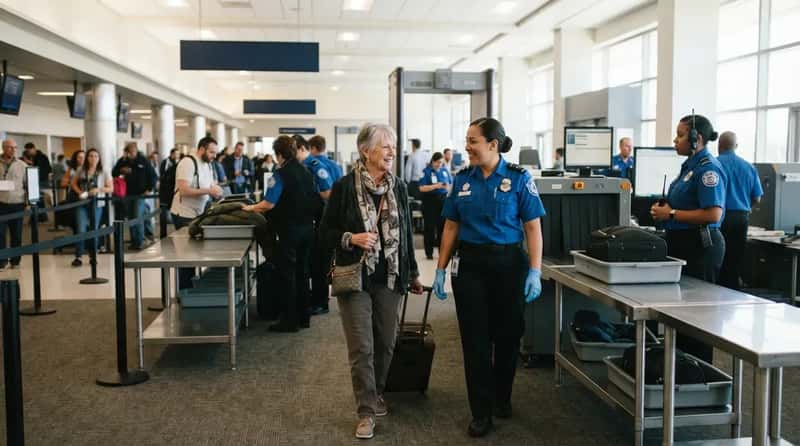
A lot of older travelers avoid asking for help because they assume they’ll need paperwork, a doctor’s note, or proof of a disability. That fear keeps thousands of people quietly struggling through security every single year for no real reason. TSA Cares is open to any traveler who needs help during screening, with no eligibility approval, no membership, and no documentation required.
Gate and security staff know this, but they rarely announce it out loud. It’s entirely free, with no sign-up and no long-term commitment – you simply ask when you need it. The single biggest mistake older travelers make is assuming they don’t “qualify” for a program built specifically for them.
#14 – Requesting a Wheelchair Can Move You Ahead of First Class
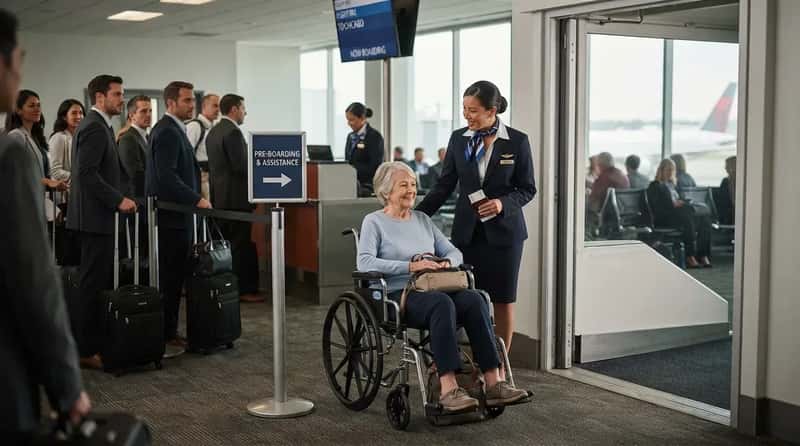
This is the one gate agents almost never volunteer, because it sounds too good to be true. You don’t need to be visibly disabled or use a wheelchair at home to request airport wheelchair service. The Air Carrier Access Act entitles seniors to free wheelchair or ambulatory assistance throughout the entire airport journey, and that’s federal law, not an airline favor.
Requesting a wheelchair automatically puts you at the very front of the boarding line, ahead of first class and ahead of elite status holders. Plenty of frequent flyers who’ve paid thousands for premium seats have no idea this even exists. That imbalance is exactly why it’s one of the more quietly debated perks whispered about behind the counter.
Why It Stands Out
- Wheelchair requests typically board before first class and before elite status groups are called.
- No proof of disability is required – a verbal request at check-in or the gate is enough.
- The assistance follows you through every leg of a connecting itinerary, not just the first flight.
- It’s protected under the Air Carrier Access Act, so airlines can’t casually deny a reasonable request.
#13 – A Family Member Can Walk You Straight to the Gate
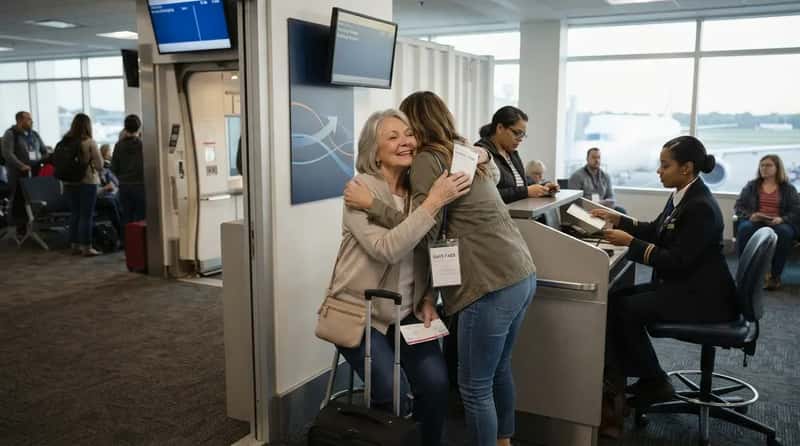
Older travelers flying alone often dread that final goodbye at security more than anything else about the trip. Staff know it too. Airlines can issue a companion security pass that lets a non-traveling guest walk through security, reach the gate, and stay until boarding is complete – one of the most quietly generous policies in commercial aviation.
Major U.S. airlines, including Alaska, American, Delta, JetBlue, Southwest, Spirit, and United, offer these passes to non-passengers assisting seniors. The pass is obtained at the ticket counter, and the helper only needs a valid ID. Gate agents rarely bring it up first – you have to ask before you clear security, not after.
#12 – Your Walker or Scooter Rides Free, No Questions Asked
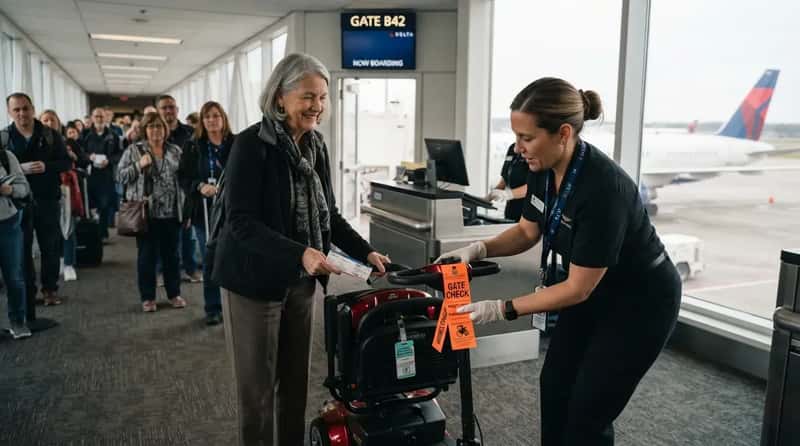
Older travelers using mobility aids often brace themselves for a fight over baggage fees or damaged equipment. That fight almost never has to happen. Under the Air Carrier Access Act, all U.S. airlines must let passengers check wheelchairs, scooters, walkers, or other medical devices at the gate for free, and it doesn’t count as one of your checked bags.
Collapsible wheelchairs and other assistive devices get priority for in-cabin storage space over other passengers’ items when the passenger pre-boards. Gate staff quietly prioritize this because a mobility device that arrives undamaged saves everyone a headache later, including them.
#11 – A New Federal Rule Just Made Airlines Take This More Seriously
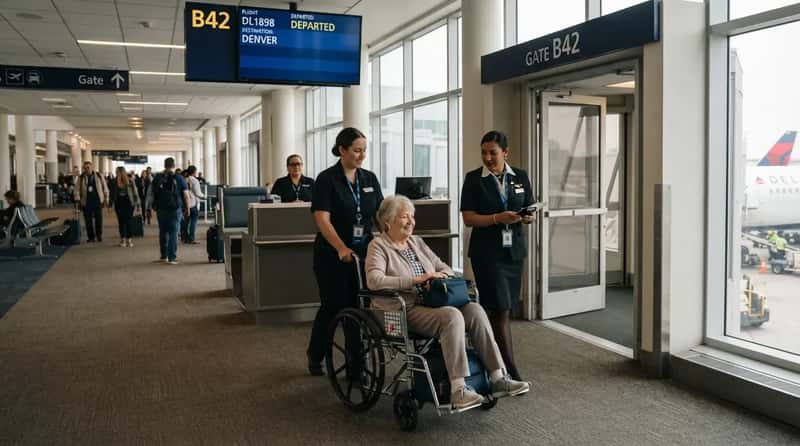
If wheelchair service has felt inconsistent in past years, that’s not your imagination. In December 2024, the DOT issued a landmark final rule significantly expanding airline obligations for wheelchair assistance. It took effect January 16, 2025, and active enforcement began August 1, 2025.
Airlines are now under stronger legal obligation than ever to deliver this assistance promptly and with dignity. Gate agents have noticed the shift too – supervisors are watching wheelchair turnaround times far more closely than they did even two years ago.
#10 – One Quiet Note Follows You Onto the Plane
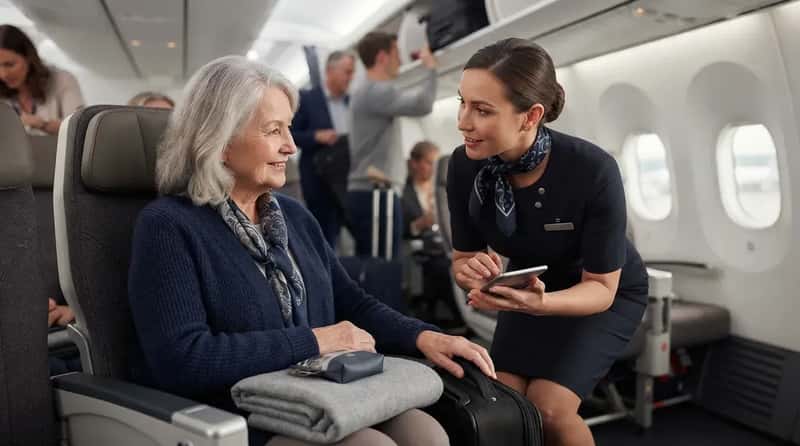
Here’s something almost nobody realizes until it happens to them. If you mention a comfort or medical need to a gate agent, that information doesn’t stay at the desk. The agent adds a note to your passenger record, and the flight crew is briefed before you ever board.
That means flight attendants already know to check on you, help with your bag, or bring what you need, without you flagging anyone down mid-flight. Most travelers over 60 never say a word to the gate agent, then wonder why nobody on the plane checked in on them – that one conversation is the difference.
Fast Facts
- Gate agents can flag medical or comfort needs directly in the passenger record before departure.
- Flight crews often review these notes during pre-flight briefings, before boarding even starts.
- The note can cover something as simple as needing help with an overhead bag or a seatbelt extension.
- It costs nothing and takes about as long as saying it out loud at the counter.
#9 – Some Airlines Board Wheelchair Passengers First, Full Stop
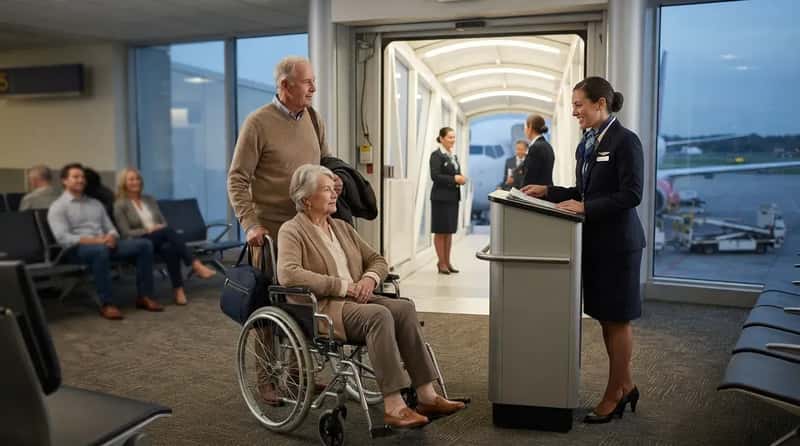
Boarding order feels like a mystery to most passengers, but for one group it’s remarkably simple. With Southwest Airlines, wheelchair-assisted passengers board first, regardless of their boarding position number.
Their traveling companion boards with them too. Gate agents who work Southwest gates say this is one of the least confusing parts of their job, precisely because there’s no negotiation involved – a wheelchair tag simply moves you to the very front of the line before anyone touches the jet bridge.
#8 – You Legally Cannot Be Left Alone for More Than 30 Minutes
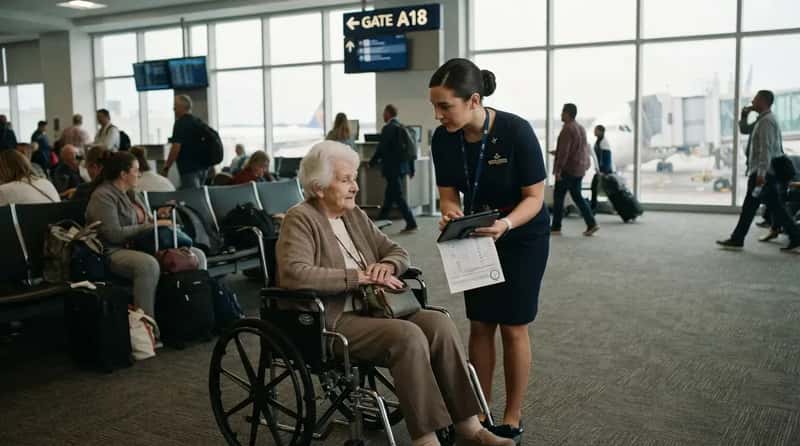
This is one of the more overlooked federal protections, and it exists for a reason. When an airline is providing assistance to a passenger who isn’t independently mobile because of a disability, the airline must not leave that passenger unattended for more than 30 minutes.
This applies even if another person is accompanying the passenger, unless the passenger explicitly says it’s okay to be left longer. Gate agents track this quietly on their assistance logs, and a long, unexplained gap can trigger real accountability from a supervisor.
#7 – Pre-Boarding Doesn’t Require a Doctor’s Note
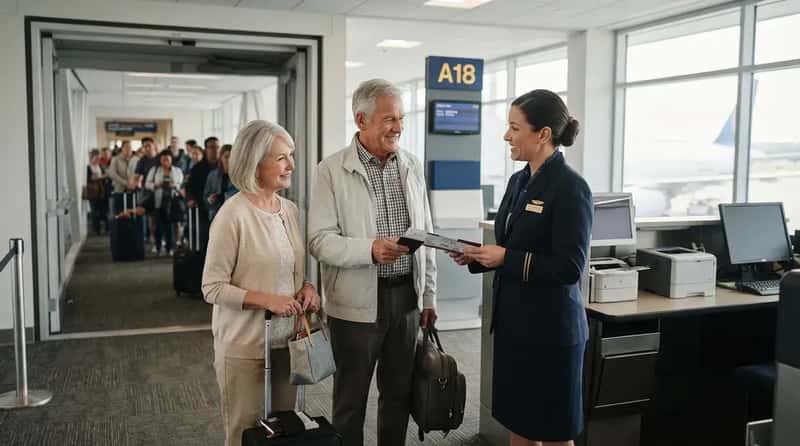
Older travelers frequently assume early boarding is reserved for people with an obvious disability or a form to prove it. That assumption costs them a calmer boarding experience every single trip. Pre-boarding is one of the most underused perks available to travelers over 60 – all it takes is self-identifying to a gate agent before boarding begins.
The key phrase isn’t “Can I board early?” It’s something closer to “I need a little extra time to get settled,” and that framing matters more than most people realize. Airlines actually encourage this because it keeps the aisles less congested for everyone else.
#6 – Turning 75 Quietly Changes Your Security Screening
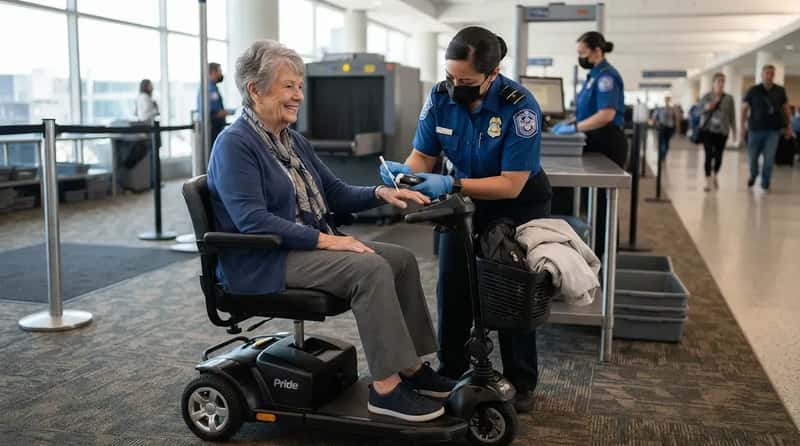
Most travelers never learn this because nobody advertises it at the checkpoint. Passengers 75 and older can receive expedited screening through risk-based, intelligence-driven security designed to let TSA focus resources on passengers who more likely pose a risk.
If you’re 75 or older and in a wheelchair or scooter, you may remain seated while a TSA officer tests your hands for trace explosives. Shoes and light jackets can stay on, and you can request to sit if you alarm. Officers rarely mention this out loud – you generally have to know to bring up your age yourself.
At a Glance
- The screening change applies automatically at 75 – no ID check or paperwork, just mentioning your age.
- Shoes and light jackets can often stay on during the checkpoint process.
- Wheelchair and scooter users may stay seated for the hand-swab explosive trace test.
- The policy falls under TSA’s broader risk-based approach to screening older travelers.
#5 – A Personal Escort Can Meet You Before You Even Reach Security
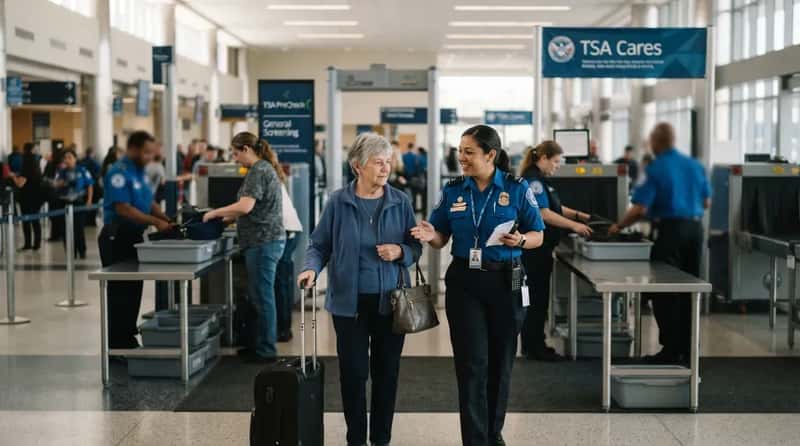
This is the program insiders describe as genuinely life-changing for anxious or overwhelmed travelers. TSA Cares is a free assistance program that connects you with a Passenger Support Specialist who meets you at the airport and walks you through security according to your actual needs, including modified screening and mobility help.
If nobody contacted you before your trip, you can still ask a TSA officer or supervisor at the airport for a Passenger Support Specialist on the spot. Most older travelers discover this program only after a stressful trip – not before one, which is exactly the wrong order.
#4 – Not Every Agent Trusts Every Wheelchair Request
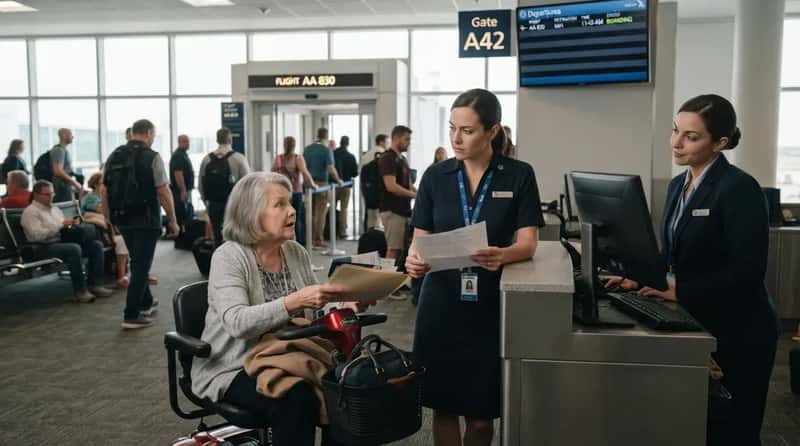
Here’s the friction gate staff won’t say to your face but will absolutely say to each other. Preboarding abuse has become common enough that some agents quietly scrutinize requests more than travelers expect, even though genuine wheelchair users are rarely challenged.
When disputes do happen, insiders describe them bluntly as “entitlement versus need,” because the passenger’s actual needs usually still get met even after an awkward back-and-forth. It’s an uncomfortable truth: real need almost always wins, but the interaction along the way isn’t always smooth.
#3 – Your Wheelchair Disappears at the Gate, and That’s Actually Normal
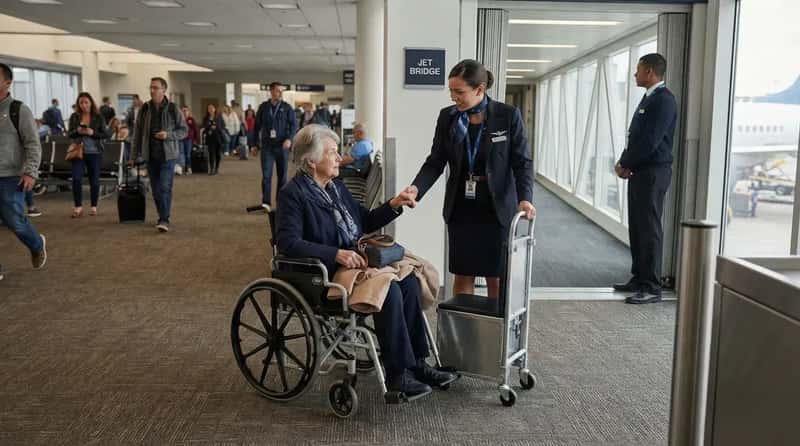
This catches first-time wheelchair travelers off guard almost every time. You’re entitled to stay in your own wheelchair right up until you reach the gate. Once you’re there, your wheelchair gets taken from you, which can feel alarming if nobody warned you first.
If you can’t walk, you’ll be transported to your aircraft seat in an aisle chair, and your own wheelchair will be returned to you at the gate once you land. Gate agents say the process itself isn’t the problem – it’s that nobody explains ahead of time that the chair is about to vanish into cargo.
Worth Knowing
- Your personal wheelchair stays with you all the way to the jet bridge, not just through security.
- An aisle chair – a narrow, foldable seat – moves you from the gate to your actual airplane seat.
- Your own wheelchair is stowed in the cargo hold and reappears at the gate on arrival, not at baggage claim.
- Asking the gate agent to walk you through the handoff beforehand removes most of the surprise.
#2 – Calm, Visible Passengers Get Quietly Rebooked First
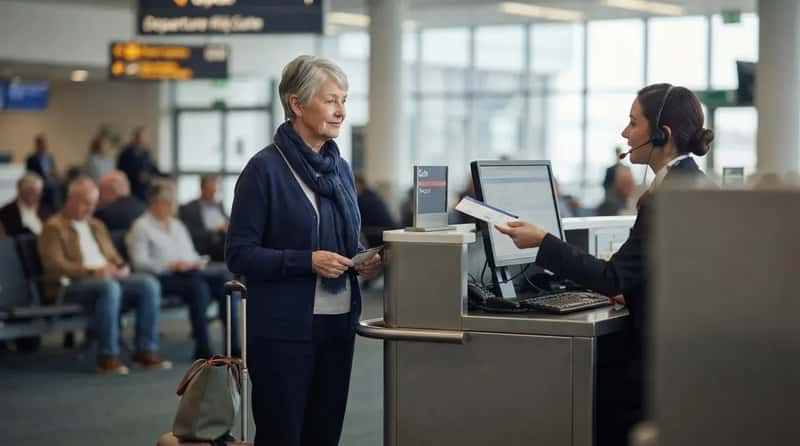
When flights get delayed or overbooked, gate agents don’t scramble randomly – they reach for the passengers already on their radar. In that scramble, they need to move people fast, and the ones they reach for first are already checked in early, flagged for a comfort need, and easy to work with.
Travelers who signal they’re easy to reroute, not complicated, not demanding, are the ones agents reach for first when they need to solve a seating puzzle under time pressure. You don’t need elite status for this – you just need to already be on the agent’s radar. Older travelers who arrive early and stay visible near the podium consistently get first crack at better seats.
#1 – Some Staff Remember Older Travelers Long After the Flight Leaves

This is the secret that gate and TSA staff talk about most among themselves, and it has nothing to do with policy at all.
We’ve had so many passengers literally go into tears because they are so happy with our team.
TSA Cares Specialist
That quote describes older adult travelers with dementia unable to navigate the airport alone, and staff who genuinely go out of their way for them. At larger airports, there’s even a dedicated space for this: a sensory room called the Compassion Corner, stocked with tables, chairs, puzzles, and twinkle lights, where staff sometimes send passengers to relax before heading to the gate. For people who see thousands of strangers a week, these are the encounters they actually remember.
None of these fifteen things are secret because airlines are hiding them out of malice. They’re buried because nobody trains front-line staff to lead with them, and nobody hands older travelers a manual when they book a ticket. The pattern across all fifteen is the same: the help exists, but it almost always requires you to ask first.
A thirty-second conversation at the right podium can change an entire trip, from boarding order to who’s waiting for you when you land. Which of these surprised you the most – and did a gate agent ever quietly help you or someone you love in a way you didn’t expect? Tell us your story in the comments.