The man refilling your water glass has smiled at a couple hundred strangers tonight, and he’ll do it again tomorrow. On a cruise ship, that smile isn’t a mood. It’s part of the uniform, and behind it sits a long list of sentences he is trained never to say at your table.
Some of those unspoken lines are funny. A few are surprisingly tender. And one, saved for the very end, is the sentence many crew members carry off the ship long after you’ve unpacked your suitcase.
#15 – “That’s Not My Table”: The Sentence Dining Room Teams Quietly Avoid

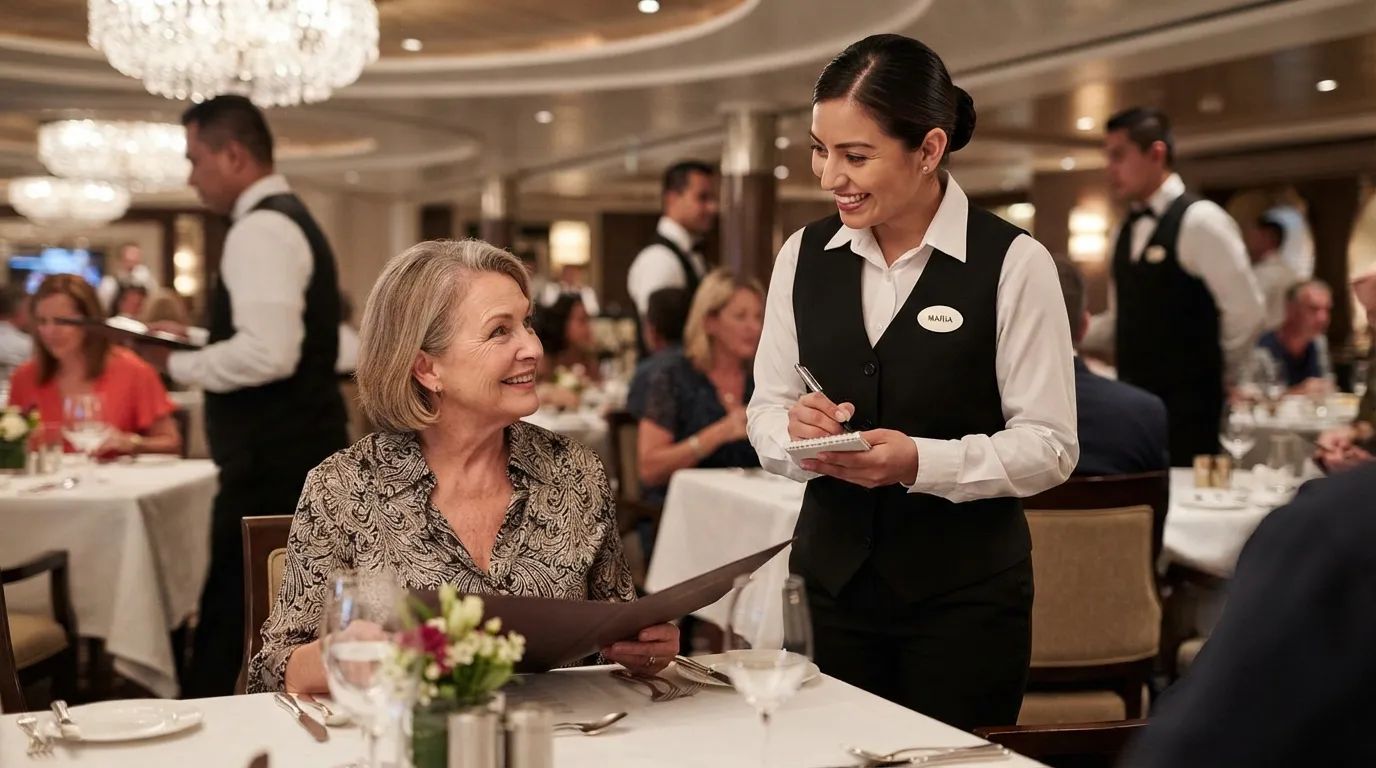
Ask a server who isn’t yours for a spare napkin and it will show up in seconds. Nobody says “not my section.” Main dining rooms typically run on teams, with a head waiter and an assistant sharing a station. You see one name tag, but several people are carrying your dinner.
It’s practical, since hundreds of guests sit down within minutes of each other and one stalled table ripples through the whole room. It’s also cultural. Crews are trained to treat every guest as everyone’s guest. The next slide shows what that cheerful teamwork costs the people doing it.
#14 – “I’m Exhausted”: The Shift Confession You Will Never Hear

The waiter pouring your coffee at 7 p.m. may have been on his feet since the breakfast rush. Dining crew often work long days with very little time off, for months at a stretch. Ship contracts are known for running far longer than most shore jobs. Yet the smile at your table never dips.
Part of that is pride, and part of it is pressure. Guest comment cards matter in this business, and every crew member knows it. Nobody wants to be the tired face mentioned in a review. So the yawn happens in the corridor, and the warm greeting happens at your table.
But the next one touches your wallet, and it gets awkward fast…
#13 – “You Don’t Have to Tip”: The Line That Would Get Awkward Fast

Here’s what many first-timers miss. Many cruise lines add a daily service charge to your onboard account automatically. That money is meant to be shared among service crew, including the people in the dining room. A waiter will never tell you to skip it, because he doesn’t set the policy and often counts on it.
Whether to add extra cash is your call, and on many lines you can adjust the charge through guest services. Plenty of passengers tip more for standout service. People on all sides debate whether the system is fair, and the server holding your dessert menu will stay politely silent on the subject. The next one involves your health, and silence is not an option.
#12 – “A Little Bit Won’t Hurt You”: The Allergy Phrase That’s Strictly Off Limits

Mention a food allergy and watch the whole table’s energy change. Cruise lines generally ask guests to report allergies before sailing, so the galley can plan ahead. A waiter will never wave off your worry or guess about ingredients. The standard move is to pause and bring in the maître d’ or a chef.
That caution is deliberate. A ship at sea can’t summon an ambulance in five minutes. Staff are trained to double-check sauces, garnishes, and cross-contact risks instead of improvising. It’s one of the rare moments when the automatic “yes, of course” gives way to “let me confirm.”
Wait until you hear what waiters think about the kitchen’s biggest logistical secret…
#11 – “That One Came Out of the Freezer”: The Provisioning Secret Nobody Mentions

Picture feeding thousands of people, three meals a day, with no grocery store for miles. Ships load enormous quantities of food in port, and some of it has to be frozen by necessity. You’ll never hear a waiter say so. The menu description is the only story he’s there to tell.
That doesn’t mean the food is bad. Frozen and fresh ingredients sit side by side in high-volume kitchens everywhere. What’s surprising is how rarely anyone admits the logistics. Many guests imagine a tiny farm-to-table kitchen below deck, and the staff gently let that picture stand.
At a Glance
- Big supply loads are taken on in port, then planned around the whole itinerary.
- Long-lasting items like frozen proteins and dry goods form the backbone of the stockroom.
- Fresh produce and dairy are topped up whenever the ship docks.
- Menus are designed around what can be served reliably to a full dining room.
#10 – “Please Finish Up, We Need the Table”: The Pressure Behind the Pace

Ever notice the dessert menu arrives a little sooner than you expected? On ships with set dinner seatings, the dining room may need to turn tables over for a second group. Waiters won’t rush you with words. They use quiet signals instead, like clearing plates promptly or offering coffee a touch early.
Flexible dining formats have softened this on many lines. Even so, the choreography is tight. If you’d like to linger, a relaxed pace is often possible, but nobody will announce the clock.
And the next one is about the one drink order every server is trained to cheer for…
#9 – “That Wine Package Probably Isn’t Worth It”: The Honest Opinion They’ll Keep to Themselves

Beverage packages are a major product for cruise lines. A waiter will almost never tell you whether the math works in your favor. That’s not dishonesty so much as job design. Staff are expected to present the offer, not audit it.
Plenty of frequent cruisers argue these packages only pay off for heavy drinkers, while others swear by the convenience of never checking a bill. Either way, the person at your table won’t weigh in. You’re left doing the arithmetic yourself, usually with a glass in hand.
Now for a line that proves how generous the main dining room can actually be…
#8 – “Sorry, That’s Too Much Food”: The Phrase That Barely Exists at Sea

Here’s a fact that stuns first-timers. In many main dining rooms, you can order more than one appetizer or entrée at no extra charge. Policies vary by line and by restaurant, but waiters rarely push back on a curious guest. Ordering two desserts is practically a tradition.
It changes the whole experience. You can sample dishes you’d never risk on land, and nobody blinks. That generosity is baked into the cruise promise, and staff deliver it without a single raised eyebrow.
Worth Knowing
- Rules differ by cruise line, so a quick question to your waiter settles it.
- Some premium dishes may carry a surcharge on certain lines, and the menu usually flags them.
- Half-portions and tasting-size plates are often available if you want to try several dishes.
- Asking early in the meal gives the kitchen time to pace your extra plates.
The next phrase, though, comes with a private eye-roll.
#7 – “I’ve Heard That Joke a Thousand Times”: The Eye-Roll They Never Let You See

“Is the lobster free?” “Don’t let the ship sink before dessert!” Waiters hear the same handful of jokes week after week. Their reaction is almost always a perfect, hearty laugh. That’s a skill, and it takes practice.
The best servers treat every joke like it’s the first one they’ve heard. It keeps the table relaxed and the mood warm. If you want to truly surprise a waiter, ask about his hometown instead. That tends to earn a smile that isn’t part of the script.
But the next one is the cruise world’s most polite sales pitch…
#6 – “The Specialty Restaurant Is Better”: The Upsell They’ll Never Admit Is an Upsell

Walk past the main dining room and you’ll spot menus for the extra-fee restaurants. Staff generally won’t tell you the included food is the weaker option. They’ll praise both, because both belong to the same company. And they know the main room is the backbone of the whole voyage.
Some seasoned cruisers say specialty dining is overrated for the price. Others call it the highlight of the trip. The truth likely depends on the ship, the menu, and your mood that night. Your waiter will smile and stay perfectly neutral.
Quick Compare
- Main dining room: Included in your fare, bigger menu variety, and a lively, social atmosphere.
- Specialty restaurant: Usually an added fee, a smaller menu, and a quieter, more special-occasion feel.
- The deciding factor: Reviews from recent sailings on your exact ship say more than any sales pitch.
#5 – “I’m Not Singing Happy Birthday”: The Request That Always Gets a Yes

Tell your waiter it’s someone’s birthday and see what happens. On many ships, the dining staff will gather, sing, and sometimes dance. It’s a ritual guests either adore or quietly dread. Either way, a refusal basically never happens.
Behind the cheer is real effort. Staff may carry the cake, coordinate with the galley, and still keep their other tables moving. Celebrations are also a big part of how cruise lines win loyal guests. For the crew, it’s a rare burst of fun in the middle of a long shift.
The next one is far less cheerful…
#4 – “I Miss My Family”: The Hardest Sentence to Say With a Smile

Many dining crew come from countries far from the ports where they work. They can spend months away from home, often keeping in touch through limited internet. You’ll rarely hear a word about it. The warmth at your table is partly how they get through the contract.
Ask, though, and many will tell you about their kids, their hometown, or the first meal they’ll eat when they land. Those short conversations often turn out to be the most memorable part of the trip. It’s one of the few moments when the uniform comes off, figuratively speaking.
And what happens when something goes wrong at the table? That’s next…
#3 – “That’s Your Fault”: The Blame Game Waiters Are Trained Never to Play

Cold soup? Wrong order? The standard response is to apologize first and investigate later. A waiter will never argue about who made the mistake. The goal is to fix it fast, even when the guest simply misread the menu.
If the problem isn’t solved, the maître d’ or guest services is usually the next stop. Calm, specific feedback tends to get quicker results than sarcasm. And complaints aren’t just brushed aside, since dining managers generally want to hear about trouble before it turns into a bad review.
Worth Knowing
- Your waiter is the fastest fix for a small problem like a wrong dish or a cold plate.
- The maître d’ can step in when something needs a bigger answer.
- Guest services handles issues that carry over from the dining room.
- Raising a concern during the meal gives the team a chance to fix it before dessert.
#2 – “I Forgot What You Like”: The Memory Trick That Feels Like Magic

On night four, your waiter remembers you take no ice and want extra bread. It feels like magic, but it’s a deliberate skill. Servers rely on notes, habits, and routine to keep dozens of preferences straight. Forgetting is almost never admitted out loud.
That small act of memory does a lot of heavy lifting. People feel known, and people who feel known tend to come back. It’s also why a change in seating can feel like a real loss to regulars. The next slide is the one waiters feel most deeply.
And now, the sentence that never gets said at all…
#1 – “This Is the Last Time I’ll Serve You”: The Goodbye They Quietly Carry Home

On the final night, the dining room feels different. Waiters know they may never see these guests again. After a week of shared dinners, the farewell is real, even if it comes as a handshake and a quick smile.
You’ll never hear them say it. Instead you’ll get a warm thank you, maybe one last joke, and a little extra attention. Then they’ll reset the table for the next voyage, often within hours. Of everything the job asks them to hide, this may be the hardest.
Cruise waiters aren’t hiding anything sinister. They work inside a system built on teamwork, consistency, and a lot of unspoken rules, and the most revealing part is what they leave unsaid, from exhaustion to homesickness to honest opinions about packages and upsells.
So next time you sit down for dinner, listen for the pauses. That’s where the real story of the dining room lives.