


You’ve probably pictured it already: a table for one, a ship full of couples, and a bill that charges for a second guest who never showed up. Some of that is real. But a solo cruise after 60 turns out to be stranger, smarter, and in a few spots pricier than the brochures admit. Here are 15 things that rarely make it into the brochure.
Some are small perks cruise lines have quietly built for travelers like you. Others are fine print that can cost you real money. And one has nothing to do with the ship at all. It’s the thing many solo cruisers say they remember long after they unpack.
#15 – The Price Tag That Punishes Solo Cruisers

That tidy per-person fare on the cruise website? It’s quietly built for two. The industry calls the extra charge a single supplement, and cruise lines have billed solo travelers between 75% and 200% of the per-person double-occupancy rate. The logic is simple, and it stings: the ship counted on a second fare that never boarded.
That means the same cabin can cost a solo sailor far more per day than each half of a couple pays. On some sailings, you end up paying for a bed nobody is sleeping in. The good news is that the supplement isn’t universal anymore. Some lines now sell cabins priced for one, and others cut or waive the charge on select voyages.
But that’s nothing compared to the catch with the so-called “solo cabins” in #14…
#14 – The Solo Cabins That Sell Out Before You Even Look

Here’s the twist: the cabins made for one person are often the hardest ones to get. Norwegian Cruise Line pioneered purpose-built Studio cabins, which are priced for a single traveler with no supplement. They’re a big reason the line has such a loyal solo following.
Virgin Voyages has dedicated solo categories too, but only a limited number of them. Travel experts describe the same pattern across the industry: the solo-friendly rooms exist, but the supply is thin. If a no-supplement cabin is your goal, book early, and check the specific ship rather than just the cruise line.
And the cabin you land in may not be the one you pictured, as #13 shows…
#13 – A Solo Cabin Can Be a Closet or a Suite With a Balcony

Not all cabins for one are created equal, and the gap is wider than most travelers expect. Some solo rooms are small interior cabins with no window at all. Others come close to real staterooms, like Celebrity’s 184-square-foot solo cabins on Celebrity Ascent and Celebrity Xcel, each with an Infinite Veranda.
American Cruise Lines offers single cabins with no supplement on every ship in its fleet, and most have a private balcony. Holland America’s new Solo Verandah category offers over 200 square feet, a workspace and a private balcony, and it’s debuting first on Oosterdam. Same label, wildly different experience.
But the biggest mismatch isn’t the room. It’s the crowd, as #12 reveals…
#12 – The “Best Solo Ship” May Be Full of People Half Your Age

Ask five travel sites for the best ship for solo cruisers and you’ll get different answers. Age is a big reason. Virgin Voyages is adults-only and runs daily Solo Sailor meetups, yet one travel site’s comparison lists its best fit as ages 25 to 45 and calls it nightlife-forward.
Viking is the opposite. Its passengers skew consistently older, which can feel like a mismatch for travelers in their 30s or 40s. At 60-plus, that “mismatch” may be exactly what you want. A great solo program means little if nobody on board shares your pace.
Some lines go even further than matching ages, as #11 shows…
#11 – The “Gentleman Host” Tradition Is Real, and Rarer Than You Think

Yes, ships still hire men to dance with solo women. It sounds like a relic from another era, but the tradition is alive on some lines. Cunard, Crystal, Regent Seven Seas, Holland America and Silversea have all offered gentleman-host programs, and the hosts are vetted before they sail.
They can join you for meals, dancing and some activities. But availability changes by ship and voyage. Crystal and Holland America, for example, have placed dance hosts on lengthier voyages, while Silversea has them only on some voyages. Confirm before you book.
But even the best programs have a weak spot, which we found in #10…
#10 – Some “Solo Meetups” Are Just One Awkward Hour

The brochure promises a community. The schedule may deliver a single gathering on day one. On Cruise Critic’s forums, one Holland America cruiser said a ship may offer just one hosted solo event, and it can land on embarkation day at a time that’s inconvenient for anyone on second-seating dinner.
Another poster said later gatherings were unhosted, meaning nobody was there to get the conversation going. That’s one traveler’s account, not a rule. Still, it shows the gap between a solo program that exists on paper and one that runs daily. Ask what the solo schedule actually includes, and look for meetups after day one, not just a welcome event.
Worth Knowing
- A “solo program” can mean one welcome event or a daily schedule.
- Embarkation-day meetups can clash with second-seating dinner.
- Hosted gatherings tend to be easier to join than unhosted ones.
- Virgin Voyages, for one, runs daily Solo Sailor meetups.
The real social test comes at dinner, as #9 explains…
#9 – Dinner Is Where Solo Cruises Are Won or Lost

The dining room can feel like the loneliest place on the ship, or the friendliest. The deciding factor is how the ship seats you. Cunard offers assigned dining tables specifically for singles who wish to dine together, and Holland America pairs solo travelers for dinner so you have a consistent group through the cruise.
A fixed table can give you the same dinner companions every night, without the nightly “where do I sit?” scramble. And if you’d rather keep dinner private, those lines still let you dine alone. The choice stays yours.
But you don’t have to wait until you board to meet people, as #8 shows…
#8 – You Can Make Friends Before the Ship Leaves Port

The secret weapon of seasoned solo cruisers is an online group, not a bar. Cruise Critic has a Roll Call feature for each sailing, where passengers introduce themselves weeks or months ahead. Experts there say meeting people gets easier through early first-night bar visits, shared dining, shore excursions, pre-cruise roll calls and theme cruises.
The site also runs Meet & Mingle parties on lines including Azamara, Celebrity, Holland America, Norwegian, Princess, Regent, Royal Caribbean, Silversea and Viking Ocean. You can have a few familiar names on board before you step through the gangway. Walking into a crowded ship is a lot easier when someone is already expecting you.
Fast Facts
- Roll Calls are set up for individual sailings, so you meet people on your exact cruise.
- You can join them weeks or months before departure.
- Meet & Mingle parties span nine cruise lines, from Azamara to Viking Ocean.
- Shared dining, shore excursions and theme cruises are other easy icebreakers.
Next, we get to the part of solo cruising that can actually save you money, in #7…
#7 – The Cheapest Time to Cruise Alone Is Not When You Think

The best solo deals tend to hide in the quiet months. One 2026 senior-cruise guide recommends off-peak sailings, pointing to September through November and January through March, when fares are lower. It also advises asking about single-supplement waivers and checking AARP and senior group discounts.
Waivers vary by line. Crystal has offered a 25% supplement on select cruises, and one guide notes that Viking’s typical supplement runs 50% to 100%, with occasional promotions on river sailings. A little flexibility with your dates can matter more than which ship you pick.
But saving money means little if you never leave the ship, as #6 explains…
#6 – Port Days Feel Different When You’re Alone

The ship feels safe and social. The pier can feel like a different story. For some solo travelers, wandering a foreign port alone is intimidating enough that they stay on board and miss the very places they paid to see.
That’s a common reason travelers book organized tours. Ship-run excursions are one way to see a port with a built-in group. They also come with a practical bonus: a ship-organized tour is expected back on time, and the ship will generally wait for it.
And the next surprise isn’t about ports. It’s about what happens if you get sick, in #5…
#5 – Your Health Insurance May Not Follow You to Sea

Here’s the mistake plenty of retirees make: they assume Medicare goes wherever they do. In general, Original Medicare does not cover care received outside the United States. That can include care on a ship in international waters or at a foreign port, and the ship’s medical center is a paid service.
That’s why travel insurance matters even more when you sail alone. There’s no travel companion to make calls or handle paperwork if something goes wrong. Check whether a policy covers medical evacuation and pre-existing conditions, and ask your own insurer what it covers abroad.
But there’s a quieter risk that few people mention until it’s too late, in #4…
#4 – Nobody Notices When You Skip a Day
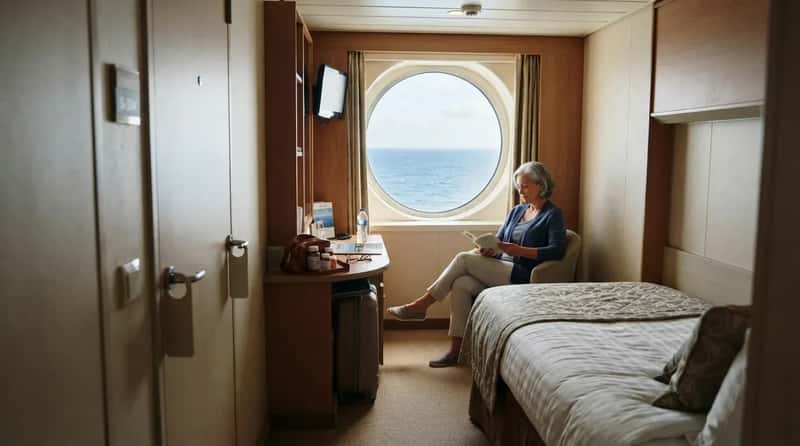
A solo cabin is private, and that cuts both ways. On a couple’s cruise, someone notices if you don’t come back. When you’re alone, that built-in safety net is gone, and you can go a whole day without anyone expecting to see you.
Senior-travel experts often suggest simple habits to fill the gap. Share your itinerary and cabin number with a trusted contact, and keep medications in a carry-on along with a current list. Let your cabin steward know about any health needs. It’s a small step, and stewards see your door every day.
At a Glance
- Send your itinerary and cabin number to someone at home.
- Pack medications and a current list in your carry-on.
- Tell your cabin steward about any health needs.
- Pick one regular spot, like a daily tea or trivia, where people expect you.
Then there’s the ship itself. Its size creates a challenge few people discuss, in #3…
#3 – The Walk to Dinner Can Be Longer Than You Expect

Big ships are small cities, and they test your stamina. One guide describes some megaships as carrying 5,000-plus passengers. That’s a lot of corridors, decks and buffet lines between your cabin and a seat at dinner.
Mobility needs matter more when there’s no one to carry your bag or hold your table. Smaller vessels can feel easier. American Cruise Lines says all of its ships offer accessible rooms and elevators, and most public spaces are wheelchair accessible. Ask about accessibility before you pick the ship, not after you’ve already unpacked.
The next truth turns the “I’ll be lonely” fear on its head, in #2…
#2 – You May Talk to More People Than You Ever Do at Home

Most people expect loneliness. Many solo cruisers describe the opposite. One solo-cruise guide calls loneliness a myth, and its author says they met more people traveling alone than they ever did with a partner, simply because they were open to conversation.
That’s one traveler’s view, but it echoes what cruise experts often describe. Without a partner to talk to, you tend to turn to the people around you. Trivia nights, lectures, afternoon tea and excursions all hand you a natural reason to start a conversation.
But the biggest surprise isn’t about other people. It’s about you, in #1…
#1 – The Freedom Is What Most Solo Cruisers Remember

The real payoff isn’t the cabin or the deal. It’s a schedule that belongs only to you. You eat when you’re hungry and skip the show if it bores you. You can stay on deck for the whole sunset, or take a nap, with no one to negotiate with.
For many travelers over 60, it’s the first trip in years planned entirely around their own preferences. The ship has built-in company if you want it. You also have a door to close if you don’t.
So cruising alone after 60 isn’t the lonely, overpriced trip many people expect. The single supplement is real, but no-supplement cabins and discounted sailings do exist if you book early and pick the right ship. The weak spots are real too: thin solo programs, insurance gaps and long walks to dinner.
Plan for those, and what’s left is a trip with no compromises. The sea, the sunsets and the table you choose are yours.


