Most people walk into a hotel banquet sales office, fall in love with the chandelier and the sample menu, and sign the contract within a week. Then six months later an invoice shows up for thousands of dollars nobody remembers agreeing to. The gap between what a hotel promises on the tour and what actually lands on the final bill is one of the best-kept secrets in the events industry.
Turns out the difference between a smooth banquet and a budget disaster almost never comes down to the food. It comes down to sixteen very specific questions that experienced planners ask before they ever pick up a pen – questions most first-time hosts never think to ask at all. Here’s what actually separates the good bookings from the expensive lessons.
#16 – Ask How Long the Banquet Team Has Actually Been There

This sounds like small talk, but it’s one of the most revealing questions on the whole list. That single answer tells you how stable the operation really is behind the pretty tour. High turnover in the banquet department almost always means the person who sold you the dream on tour day won’t be the person running your event.
A hotel with a banquet manager who’s been in place for years tends to run tighter service, fewer last-minute surprises, and more consistent food quality. A revolving door of coordinators is a quiet red flag that details get lost between handoffs. Ask directly, and pay attention if the salesperson hesitates before answering.
#15 – Ask to See the Floor Plan for Your Exact Guest Count
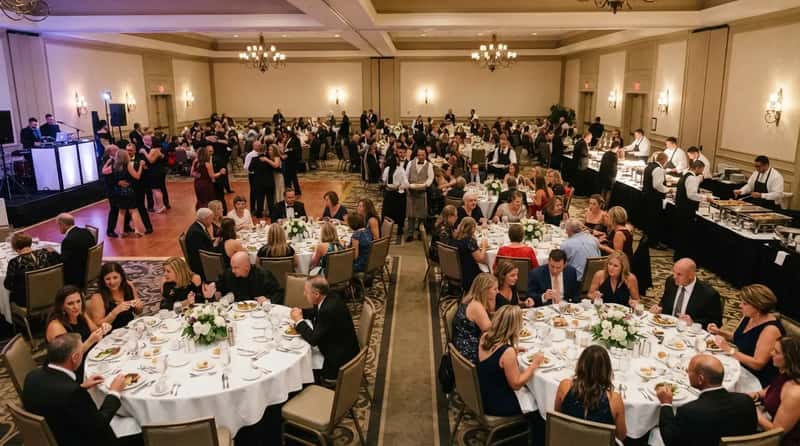
A generic capacity number on a glossy brochure means almost nothing once real tables, a dance floor, and a buffet line get squeezed into the room. Ask to see an actual floor plan built around your exact guest count and table configuration, and request a photo from a similar past event if the hotel has one.
Capacity varies dramatically based on setup. A seated dinner with a dance floor eats up the most space per guest, while a cocktail reception with limited seating can fit 30 to 40 percent more people in the same room. Skipping this question is how hosts end up with a space that looked spacious empty and felt like a subway car once people showed up.
#14 – Ask Exactly What Counts Toward the Food and Beverage Minimum

Every banquet contract has a magic number attached to it, but not every hotel defines that number the same way. Service charge, tax, and room rental fees sometimes count toward the minimum and sometimes don’t, and that one distinction can swing your final bill by thousands of dollars.
Some planners now negotiate specific language stating that if the group exercises an attrition adjustment, the food and beverage commitment gets reduced by an equivalent percentage. Without that protection in writing, you can end up locked into a spending floor even after you’ve already cut your guest count.
#13 – Ask What the Actual Staff-to-Guest Ratio Will Be
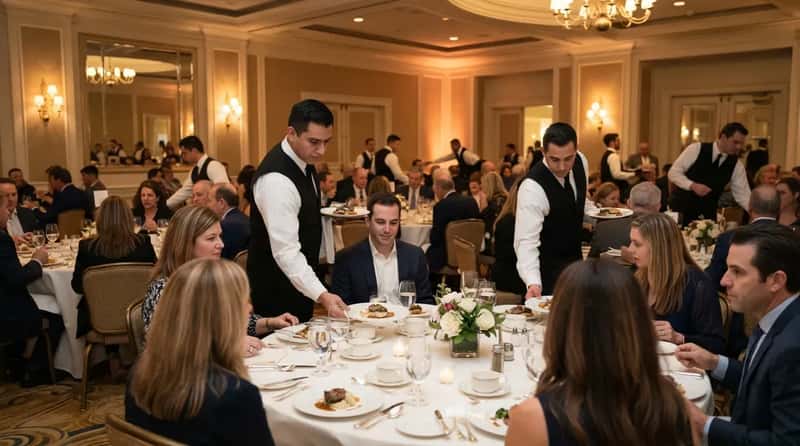
A gorgeous ballroom with too few servers turns into a slow, frustrating night no matter how good the menu tastes on paper. One waiter for every 20 guests is a common industry standard, and one busser for every 50 guests is common as well.
If a hotel is proposing thinner staffing than that for a plated dinner, expect cold food, long gaps between courses, and a floor team that’s visibly drowning. This is a number worth pinning down in writing before signing, not something to leave as a vague verbal reassurance from the sales tour.
Fast Facts
- Plated dinners: roughly 1 waiter for every 20 guests
- Buffet and family-style service: about 1 busser for every 50 guests
- Cocktail receptions: staffing shifts toward bar stations and passed trays instead of table service
- Thinner ratios than these usually mean slower courses and colder plates
#12 – Ask for the Full Cancellation Fee Schedule, Not Just the Headline Number

Most hosts ask “what if I cancel,” get a vague answer, and move on. That’s a mistake, because the real damage is buried in the timeline, not in the summary. Cancellation fees escalate the closer you get to the event date, so you need to see the full schedule and confirm whether your event insurance actually covers it.
A contract might look forgiving at the 90-day mark and brutal at the 30-day mark. Get every threshold and every dollar figure spelled out in writing before you sign, not paraphrased by a salesperson over coffee.
#11 – Ask What Force Majeure Actually Covers in 2026

This clause used to be boilerplate nobody bothered reading. Not anymore. Since 2020, force majeure has quietly become one of the most important clauses in the entire contract – ask specifically whether it covers government-ordered shutdowns, travel restrictions, and public health emergencies, not just hurricanes and blizzards.
Some hotels have quietly narrowed this language back down since the pandemic faded from headlines. Read the exact wording rather than assuming it still protects you the same way it did a few years ago.
#10 – Ask Who Your Point of Contact Is and What Happens If They Leave

Sales manager turnover in hotels is far more common than most first-time hosts assume, and it directly affects your event. Ask who your primary point of contact will be and what the backup plan is if that person leaves the property before your date.
If your original contact quits three months before your event, will the new person even know your requests existed? Get a commitment in writing that every agreed-upon detail transfers with the file, not one that simply lives in someone’s memory.
#9 – Ask If Menu Pricing Can Change Between Booking and Event Day
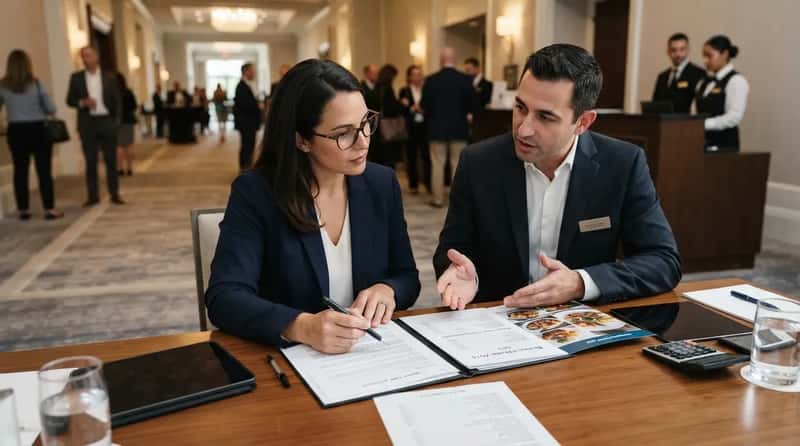
Food costs move, and hotels know it better than you do. Smart planners now lock this down before signing rather than getting surprised later. Negotiate a clause stating the facility must attach copies of its actual banquet menus to the contract, and if pricing changes before the event, the group won’t pay more than a 3 percent increase over that attached pricing.
Without that cap, a hotel can legally reprice your dinner months after you signed, and you’ll find out on the final invoice instead of during negotiations when you still had leverage.
Worth Knowing
- Ask the hotel to attach its actual banquet menu and pricing sheet to the signed contract
- Negotiate a price-increase cap – often around 3 percent – between booking and event day
- Confirm whether the printed price already includes tax and service charge, or if those get added later
#8 – Ask What Shipping and Receiving Actually Costs Per Box

This one catches almost everyone off guard. Décor, signage, gifts, and giveaways – every single box that arrives before your event tends to come with a fee attached, and hotels rarely lead with that detail on the tour.
For a small event this might be a rounding error. For a large conference shipping dozens of boxes ahead of time, it turns into a real line item that almost never shows up in the original proposal.
#7 – Ask If Setup and Strike Labor Is Included or Billed Separately
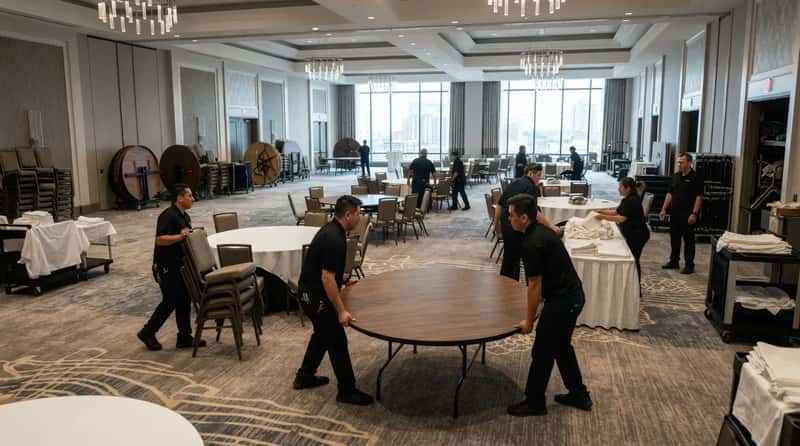
This is one of the sneakiest charges in the entire industry because it often only surfaces after the contract is already signed. Labor to set up and tear down your room is frequently treated as a separate line item, quoted late and priced high.
Combined with other add-ons, this is exactly how budgets quietly balloon. It’s how an $800,000 event becomes a $1.1 million event with zero changes to the actual scope. Get labor costs itemized in the original quote, not added later as a “standard fee.”
#6 – Ask If You’re Locked Into In-House AV, and What the Patch Fee Is
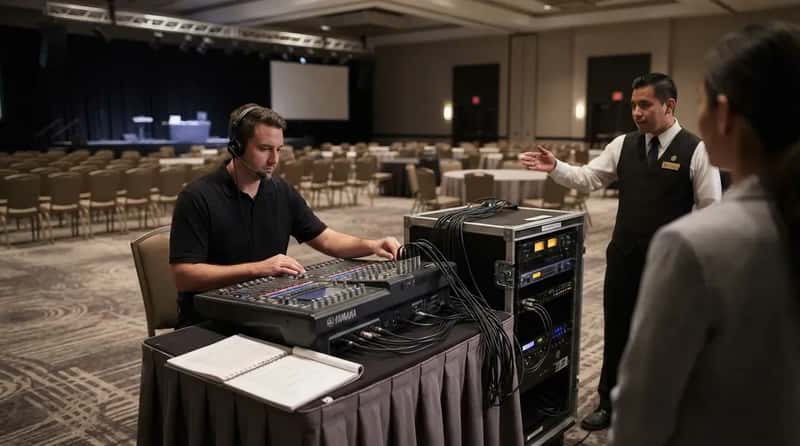
Many hosts assume they can bring their own sound and lighting team to save money. Many hotels quietly won’t let them. Plenty of contracts require in-house AV vendors, with rates that can run 40 to 60 percent higher than an independent company would charge.
Even when outside AV is technically allowed, it rarely comes free. Bring your own equipment and expect a “patch fee” or house engineer fee in the $500 to $2,000 range, just for the privilege of plugging into their power. Ask this before assuming an outside vendor will actually save you a dime.
Quick Compare
- In-house AV vendor: convenient, but rates can run 40 to 60 percent higher than an independent company
- Outside AV vendor: often cheaper on paper, but expect a patch fee or house engineer fee of $500 to $2,000
- Either way: get the exact fee structure in writing before assuming you’re saving money
#5 – Ask for the Exact Split Between Service Charge and Gratuity

This is where a lot of well-meaning hosts get it wrong, because the two terms sound identical but mean completely different things. The service charge – often 22 to 26 percent – typically goes to the hotel as revenue, not to the staff working your event.
Actual gratuity may be expected on top of that, so always ask for the split in writing and demand a guarantee that anything labeled a gratuity actually reaches the staff. Add tax on top and the real total climbs well above the printed menu price. A $200-per-person dinner isn’t really $200 – it’s closer to $258 to $267 once service charge and tax get folded in, using math that’s never spelled out in the marketing materials.
Ask questions until you understand every fee on the page. A hotel that’s proud of its contract will walk you through it line by line.
National Association for Catering and Events guidance to event planners
#4 – Ask If Your Room Block Rate Is Actually Better Than Third-Party Sites

This is the question planners consistently rank as the most overlooked, and it’s expensive to skip. Compare your group rate against the best public rate you can find online, check for blackout dates, and if your group rate turns out higher than what guests can find on a booking app, you will hear about it from every single attendee.
Worse, if guests defect to a cheaper third-party rate, it can still count against your room block commitment. That’s true even if you technically filled the rooms, just through the wrong channel – so ask the hotel to add a clause guaranteeing third-party sites will never undercut your negotiated group rate.
#3 – Ask Exactly How the Attrition Penalty Gets Calculated

This is the clause that quietly ends more banquet budgets than any other single line in the contract. An attrition fee requires you to fill a minimum number of room nights in your block, and if the group falls short, the hotel can charge you for every unused room.
The math is rarely forgiving. Contract for 500 room nights but only book 400, and the hotel may bill you for the 100-night shortfall at full rate. One real-world example shows how brutal this gets: a planner with a 200-room block for three nights only booked 160 rooms each night, and because her contract had a strict 85 percent attrition requirement, she was charged for 10 rooms per night at the full contracted rate – more than $12,000 in fees she never saw coming. Ask for the exact cushion in writing, and push for a sliding scale instead of a hard cliff.
At a Glance
- Room block: 200 rooms per night for three nights
- Rooms actually booked: 160 per night
- Contract requirement: 85 percent attrition threshold
- Result: charged for 10 rooms per night at full rate – more than $12,000 in unexpected fees
#2 – Ask Whether the Hotel Has to Try to Resell Your Rooms First

Most hosts never think to ask this, and it might be the single most consequential question on this entire list. Many hotels will charge attrition penalties even after reselling the rooms you didn’t use – if your contract doesn’t specifically require the hotel to attempt resale first, they can legally collect payment from you and a new guest for the exact same room.
This isn’t some rare edge case, either. The standard attrition clause charges a percentage of revenue tied to unbooked rooms at the contracted rate, regardless of whether the hotel resold those rooms at a higher price – meaning a hotel that resells every empty room and still collects an attrition fee has effectively been paid for it twice. Requiring proof of resale attempts before penalties apply is one of the cheapest protections you can negotiate into any contract.
#1 – Ask for Every Verbal Promise to Be Put in Writing, No Exceptions

Every question on this list ultimately funnels into this one, because a verbal promise from a smiling sales manager is worth nothing the moment that person transfers to a different property. Get everything in writing. Verbal promises don’t hold up when there’s a dispute six months later.
Regulators have started catching up to how misleading hotel pricing can be. An FTC rule requiring hotels to display full pricing, including mandatory fees, took effect in May 2025, which means hosts finally have more leverage to demand transparency than they did just a couple of years ago. A reputable venue will answer every question thoroughly and without flinching; a venue that turns evasive or pressures you to sign quickly is telling you something important. Every clause discussed on the tour, every discount promised in an email, every “don’t worry, we’ll take care of it” – get it typed into the contract before you sign anything.
None of these sixteen questions are about being difficult. They’re about closing the information gap that hotel banquet contracts have quietly relied on for decades. A little friction before you sign almost always beats a surprise invoice after the event is already over and the ballroom lights are off.
Which of these questions have you actually asked before booking a hotel event – and which one do you wish someone had told you about sooner? Drop your experience in the comments.