Most travellers assume missing is just bad luck – a storm, an air traffic jam, fate. They’re wrong.
Missed connections aren’t luck. They’re math – and the math has been quietly getting worse while airlines keep selling tighter itineraries.
U.S. DOT data shows international flight delays caused 127,000 missed domestic connections in just the first quarter of 2025 alone. Almost every one of those passengers made the same avoidable errors, before they even packed a bag.
Here’s what the insiders actually know, starting with the booking decision most people get wrong before they ever reach the airport.
#16 – Booking a Connection Through a High-Risk Hub
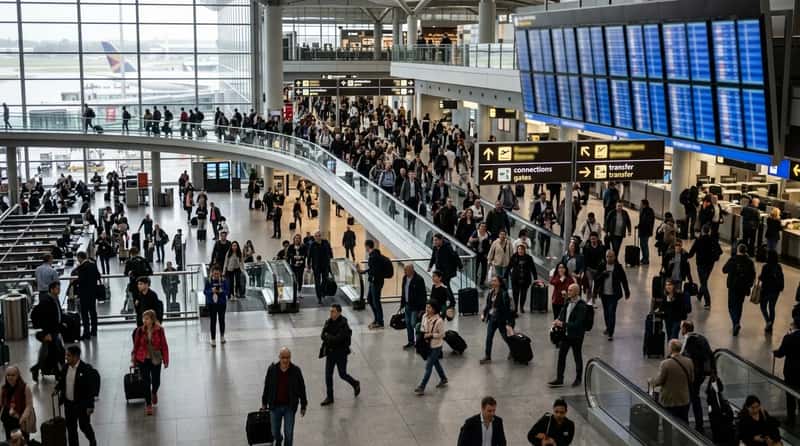
Not all connecting airports are equal, and most travellers have no idea which hubs are quietly dangerous.
Airports like Bergamo, Dallas/Fort Worth, Frankfurt, São Paulo Guarulhos, and Philadelphia all sit near the top of the missed-connection risk list. The sheer volume of traffic, combined with complex terminal layouts, raises the odds dramatically.
If your journey routes through any of these airports, build in more buffer time than the recommended minimum, especially on international routes. Simply picking a different routing through a more efficient hub can be the single most impactful booking decision you make.
Singapore Changi and Amsterdam Schiphol rank among the most reliable big hubs for tight connections, thanks to strong airside terminal connectivity. Know the difference before you click ‘book.’
Quick Compare
- High-risk: Bergamo, Dallas/Fort Worth, Frankfurt, São Paulo Guarulhos, Philadelphia
- Reliable: Singapore Changi, Amsterdam Schiphol
- Why: traffic volume plus complex layouts drive the risk gap
But hub choice is just the beginning. #15 reveals a booking habit millions of travellers repeat every day – one that quietly strips away all their legal protection the moment something goes wrong.
#15 – Booking Flights on Separate Tickets
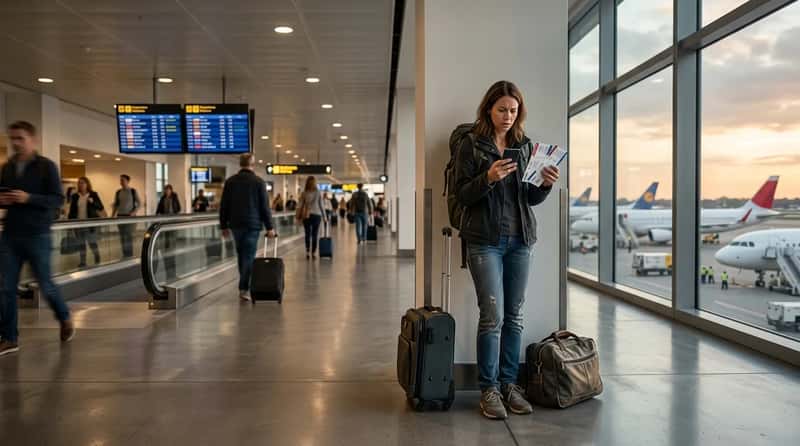
This is the mistake that turns a mild delay into a full financial disaster.
Separate tickets eliminate your safety net entirely. If your first flight is late and you miss the second, you’re on your own for rebooking fees, fare differences, and overnight costs, because the second airline has no obligation to help.
The Minimum Connection Time only protects single-ticket bookings. For separate tickets, allow at least 3 hours domestic-to-domestic, 4 hours international-to-anything, and 5+ hours if you must claim and re-check baggage.
The lure of a cheaper price on two separate tickets regularly costs travellers far more than they saved. Even a modest saving can evaporate the moment things go wrong.
Still think you’re covered because you always fly one airline? #14 exposes a trap that catches even frequent flyers.
#14 – Ignoring Gate Changes After Landing
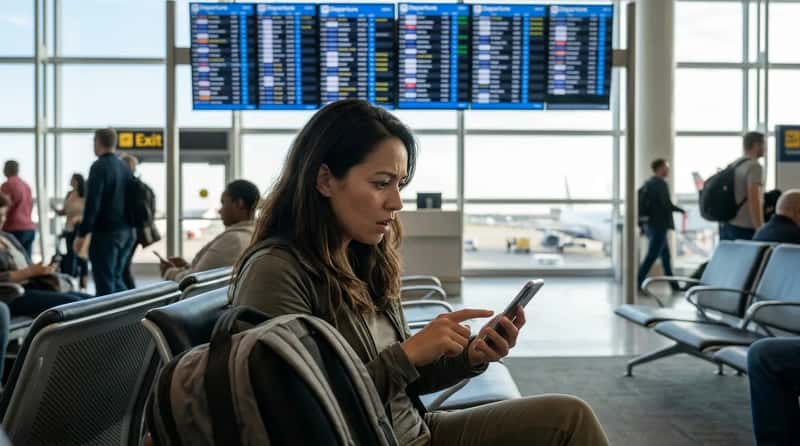
You checked the gate at home. You memorised it. That’s exactly the trap.
Gates change constantly due to aircraft swaps, earlier delays, and congestion – the gate on your boarding pass can be completely wrong by the time you land.
Your real gate assignment is usually visible on the airline app long before touchdown. Checking it while you still have in-flight Wi-Fi gives you a head start on the terminal.
Passengers who wait until the arrivals hall to check the departure board lose precious minutes just scanning screens. Turn on gate-change notifications before you fly – it’s free insurance.
The gate is only one screen you need to watch. #13 covers the screen most people ignore entirely, until it’s too late.
#13 – Not Tracking Your Inbound Flight’s Delay
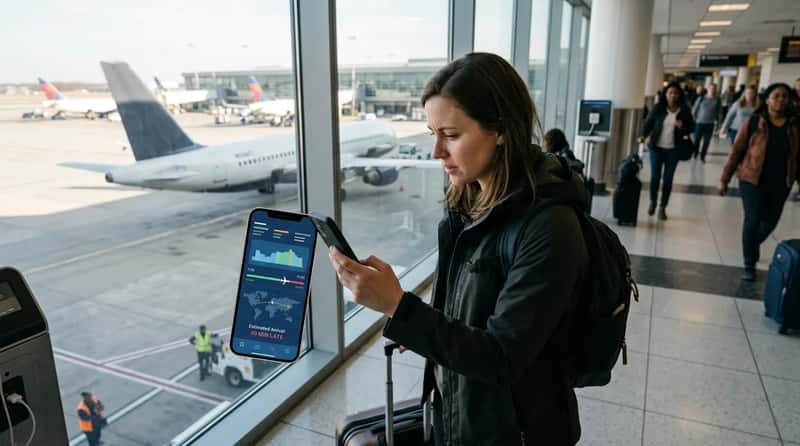
Your outbound flight is on time. Great – but is the aircraft flying you actually on time?
Early departures tend to run smoother because they’re first in an aircraft’s schedule that day. As the day goes on, disruptions build and late arrivals become far more likely.
One early-morning delay at one airport can echo through a dozen connections by evening. The plane sitting at your gate right now has probably already made someone else miss their flight today.
Track your inbound aircraft’s tail number with an app like FlightAware. If it’s running 40 minutes late on its previous leg, you already know what’s coming.
Knowing about a delay early buys you time – but only if you haven’t already made the seating mistake in #12.
#12 – Sitting at the Back of the Plane
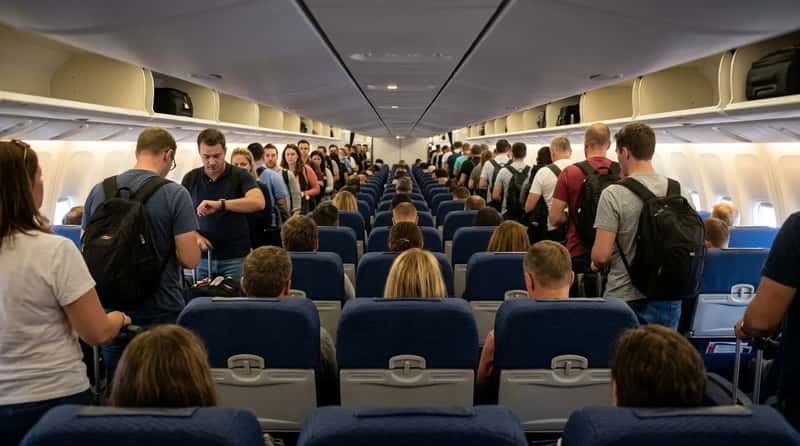
It looks like a minor booking detail. On a tight connection, it’s the difference between making it and watching a gate door close.
When a flight lands late, every second counts, and passengers in the back rows are always last off. Those extra five or ten minutes can be the entire margin you had.
On a full flight, back-row passengers can wait 15 to 20 minutes just to reach the aisle. Sitting in the front third of the cabin shaves real minutes off your deplaning time.
If the airline charges for seat selection, weigh that fee against the cost of missing your next flight. On a short connection, it’s usually worth every penny.
You’ve got a front-row exit now – don’t blow it at the security lane. #11 covers the checkpoint mistake TSA officers say they see constantly.
#11 – Setting Off Security Alarms With Forgotten Items
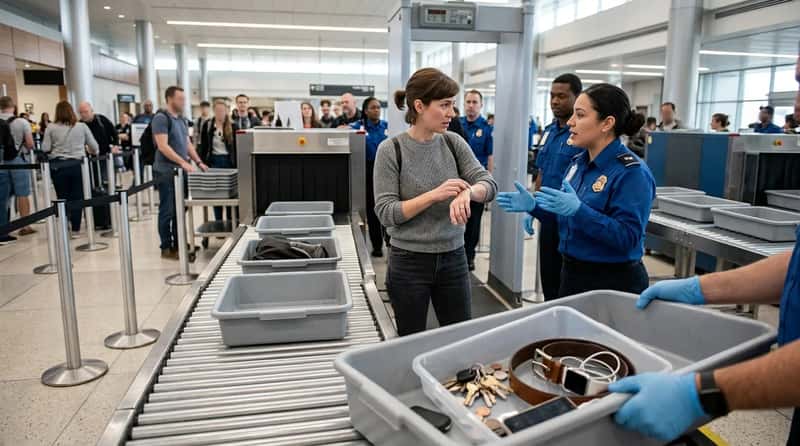
Security delays feel random. They almost never are – they follow a very predictable pattern.
A forgotten coin, a belt left on, a phone buried in a bag – each one triggers a rescan that can add five to fifteen minutes when the lane is busy. TSA officers say small, forgettable items cause the vast majority of these holdups.
Oversized liquids, metal belts, and buried electronics are the usual culprits. Put liquids in a clear bag, wear slip-on shoes, and keep laptops within easy reach.
Cameras, drones, power banks, and tablets often need separate screening. Most travellers bury them all in one bag and act shocked when the alarm sounds.
Separate your electronics before you queue, and empty your pockets at the lift, not at the scanner. If you travel often, #10 reveals a programme most people dismiss that changes the entire security equation.
#10 – Not Enrolling in Trusted Traveller Programmes
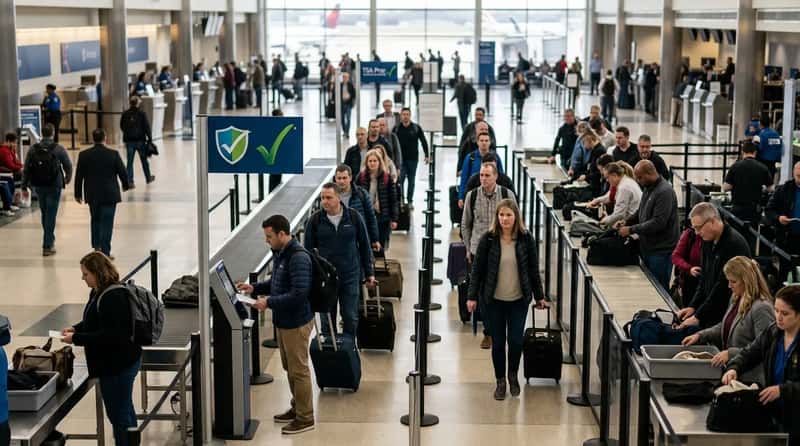
Frequent flyers who skip TSA PreCheck or Global Entry are gambling with their connection time every single trip.
PreCheck lanes are consistently shorter, and members don’t need to remove shoes, laptops, or liquids – eliminating the main causes of security slowdowns. For international connections, Global Entry gets you back through faster too.
The enrolment fee works out to under $20 per year on a five-year membership. That’s almost certainly less than the cost of one missed connection.
This isn’t just a perk for business-class flyers. Anyone regularly connecting through a major U.S. hub should have one – and #9 moves the story outside security entirely, to a mistake made long before you ever leave home.
#9 – Underestimating the Size of the Connecting Airport
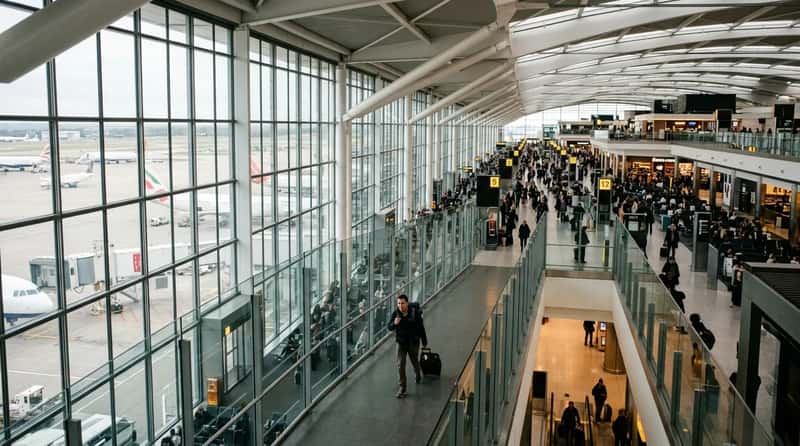
A 90-minute layover at a regional airport is comfortable. The same 90 minutes at Heathrow, O’Hare, or DFW is a sprint.
Before booking a layover, be honest about whether you can actually make it. What works at a small airport like Belfast International simply won’t work at London Heathrow.
Leaving at least an hour and a half between connecting flights meaningfully lowers your risk. Forty-five minutes might sound doable, but in a sprawling hub with distant gates, it often isn’t.
Many travellers look at the clock, not the map. Pull up a terminal map before you book and actually count the walking distance between arrival and departure gates.
The map only tells part of the story. #8 reveals what happens when your connection crosses an international border – and why most travellers have no idea what’s waiting for them.
#8 – Not Accounting for U.S. Customs Re-Entry
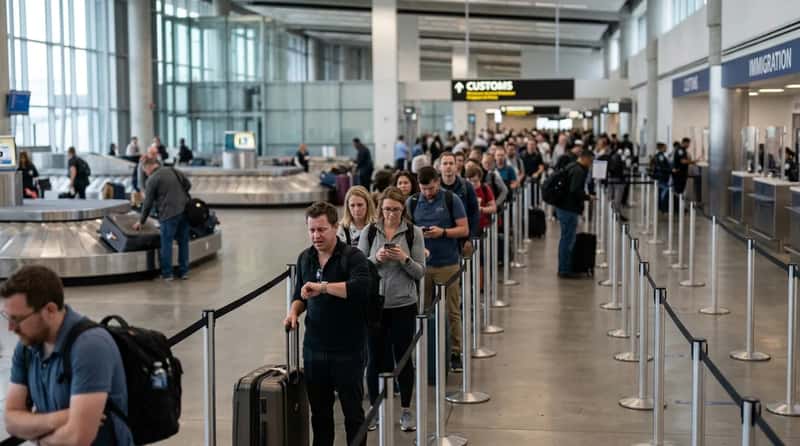
This one catches thousands of travellers off guard every year, and it’s entirely avoidable with ten minutes of research.
Arriving in the U.S. from abroad means clearing customs and immigration at your first port of entry, even with a domestic connecting flight. That means collecting bags, clearing customs, rechecking luggage, and going through security again – a process that easily eats 60 to 90 minutes.
This process is non-negotiable and cannot be fast-tracked by airline staff, gate agents, or good intentions. The customs queue moves at its own pace, no matter how tight your next flight is.
Build in a minimum of two hours for any U.S. re-entry connection, more during peak travel periods. #7 covers a similar hidden time cost that applies on international connections worldwide.
#7 – Misreading Minimum Connection Times as Personal Guarantees
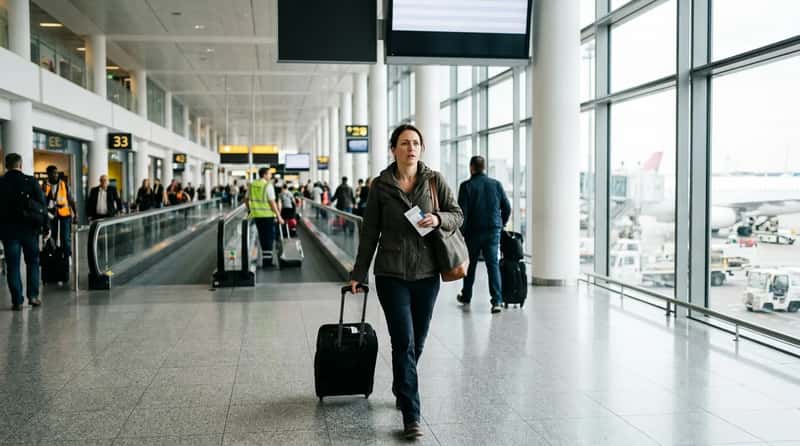
Airlines publish Minimum Connection Times. Most travellers assume these are comfortable guidelines – they are not.
MCTs are calculated for an average, healthy adult walking briskly with zero complications. They don’t account for a delayed first flight, a gate change, or a long immigration queue.
A same-terminal codeshare might carry an MCT of just 45 minutes. But that number only protects single-ticket bookings – on separate tickets, it means almost nothing.
Fast Facts
- Same-terminal codeshare MCT: as low as 45 minutes
- Calculated for a healthy adult walking briskly, no delays
- Separate tickets: MCT protection simply doesn’t apply
Treat the MCT as a floor, never a target. #6 shows how one common luggage decision quietly shrinks your available connection time even further.
#6 – Checking a Bag When the Connection Is Tight
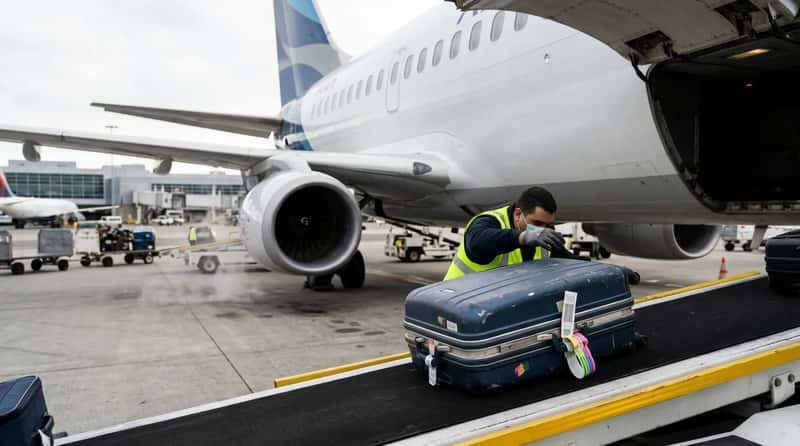
Carry-on travellers have a structural advantage at connecting airports that most people never think about, until it’s too late.
On a single ticket, your bag is supposed to transfer automatically – but on tight connections with delays, bags routinely miss the flight even when the passenger makes it. On separate tickets, the odds get worse.
A three-hour connection feels comfortable when you’re only changing gates. It feels very different when you’re waiting at baggage claim, walking terminals, and clearing security again.
Before you hand over your luggage, ask one very specific question: ‘Can this bag be checked all the way through, even though these are separate tickets?’ Never assume a shared alliance guarantees automatic through-checking.
Once you know your bag situation, #5 tackles a mistake that costs travellers time at the exact moment they can least afford it.
#5 – Not Telling the Crew You Have a Tight Connection
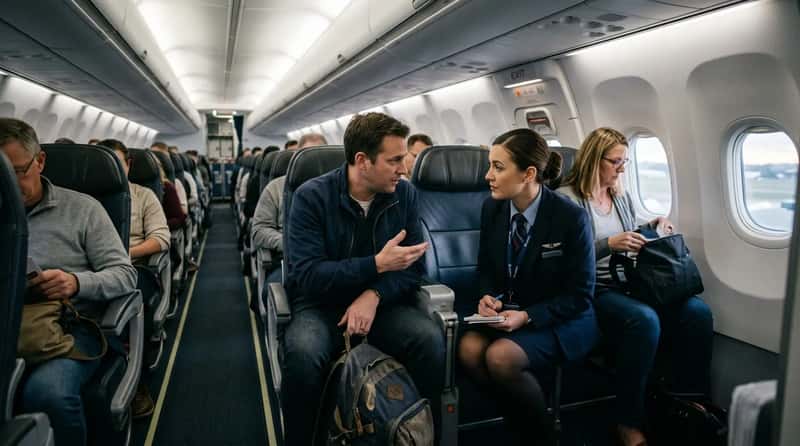
Flight attendants can help – but only if they actually know you need it.
Cabin crew see the same scramble on every flight: passengers barrelling down the aisle from the back rows the second the plane reaches the gate. Fellow travellers may let you through, but there’s no guarantee, and rushing forward can spark real arguments.
Tell the crew before landing that you have a tight connection. Often they’ll make a brief announcement asking seated passengers to let connecting travellers off first – it’s not guaranteed, but it works more often than people think.
Cabin crew deal with tight connections every single day. They know the airport, they know the fastest exit, and they know who to call ahead to the gate.
Crew can get you off the plane faster – but #4 reveals what you should have already done while you were still in the air.
#4 – Wasting Airborne Time You Could Spend Planning
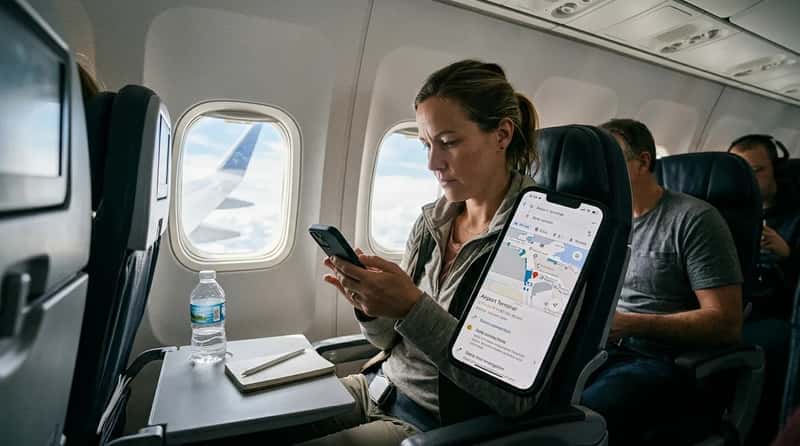
Most travellers spend their in-flight Wi-Fi on Netflix. The ones who make tight connections spend it on the airline app instead.
While you’re still airborne, you can usually see whether your onward gate has changed, whether a train or shuttle links the terminals, and how far you’ll need to walk. That’s information worth far more mid-air than it is standing confused at the arrivals board.
Passengers who land already knowing their route move faster, make fewer wrong turns, and stay calmer. Set up gate-change alerts before departure, not while you’re already running.
You’re informed, you’re moving – #3 reveals the legal-protection mistake that could cost you everything if things still go wrong.
#3 – Skipping Travel Insurance on Complex Itineraries
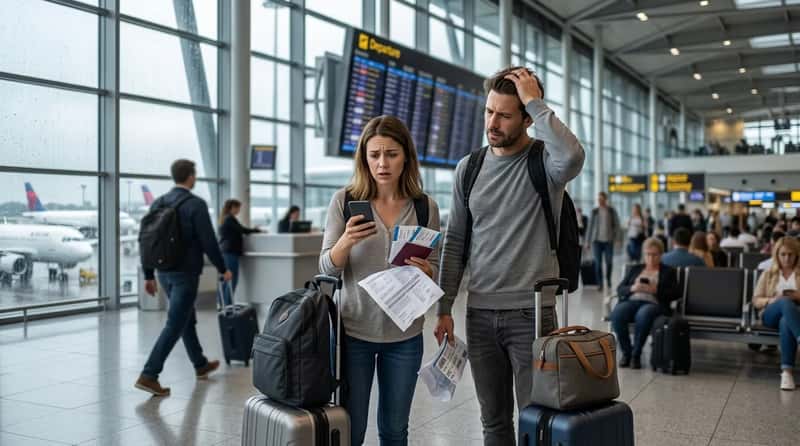
Most travellers think travel insurance is only for cancellations or lost bags. The coverage that actually matters at a connecting airport is trip interruption, and most people have never even heard of it.
Many policies include missed-departure or travel-delay coverage that can reimburse costs airlines won’t touch. If a missed connection forces you into a replacement ticket, hotel, or transport, the right policy can cover some of that.
Without insurance on a separate-ticket booking, you are entirely exposed. A replacement ticket on a busy route can cost three to five times the original fare.
Read the policy wording before you buy – ‘trip interruption’ and ‘missed connection’ are specific clauses, and your policy needs to name them. #2 covers a mistake almost nobody discusses, yet it consistently derails travellers who should know better.
#2 – Assuming the Airline Will Automatically Rebook You
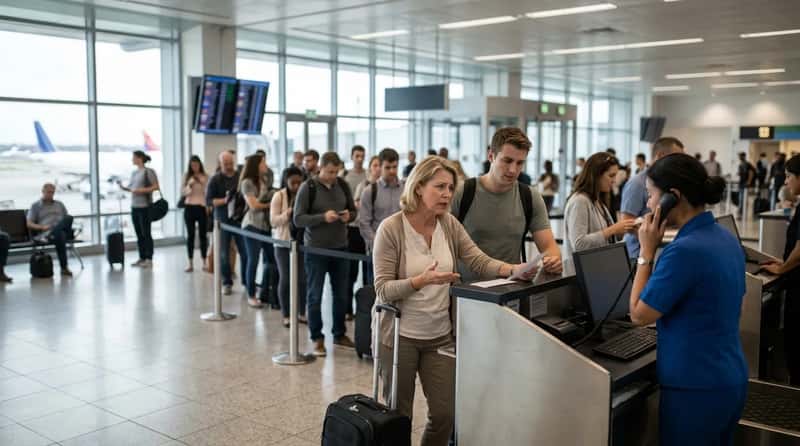
When a connection is missed, most travellers do exactly the wrong thing: they stand at the gate, confused, waiting for someone to help.
Gate agents handling departing passengers can’t also manage missed-connection cases efficiently. Head straight to the airline’s transfer desk or service desk instead – that’s what it’s there for.
If the airline caused the delay, they should put you on the next open flight, or cover a hotel and meals if that’s the next morning. But if you booked separately, none of that applies.
You won’t be charged for an airline-caused delay, but if the miss was your fault, you’ll likely lose the fare and pay for a new ticket yourself. Know which situation you’re in before you queue.
#1 is the mistake that starts everything – the one almost every stranded traveller wishes they’d fixed before they ever reached the airport.
#1 – Booking the Minimum Possible Connection Time
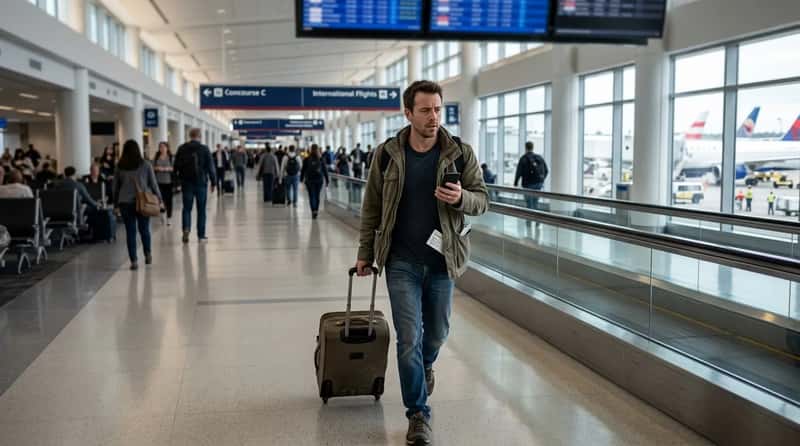
Every other mistake on this list becomes irrelevant if you simply gave yourself enough time. This is the root cause of most missed connections, and it’s entirely self-inflicted.
A short layover feels efficient – less waiting, faster trip. But airports are big, gates change, and flights get delayed more often than travellers want to admit.
The bare minimum is 45 minutes domestically and two hours internationally, and that’s under ideal conditions. Experts and frequent flyers consistently recommend going well beyond that minimum, especially through complex hubs or during peak seasons.
Season and airport matter enormously here. During the holidays, Newark showed 1-hour arrival delay rates of 13% – numbers that turn a ‘confident’ 45-minute layover into a genuine gamble.
At a Glance
- Domestic bare minimum: 45 minutes, ideal conditions only
- International bare minimum: 2 hours, ideal conditions only
- Holiday-season Newark: 13% of flights arrived at least 1 hour late
The fix costs nothing at the booking stage: add buffer time. It can save you hundreds of dollars, or an entire trip.
The Bottom Line
Missing a connection is one of the most stressful travel experiences there is. But the data is clear: almost all of it is preventable.
Book single tickets where you can, and sit near the front of the plane. Check your gate while you’re still in the air, and know your MCT, your hub, and your luggage rules before you fly.
The travellers who miss connections aren’t unlucky – they’re underprepared. The ones who make every flight aren’t lucky either; they just stopped making these 16 mistakes.
Have you been caught out by one of these? Which one nearly cost you a connection – drop it in the comments.