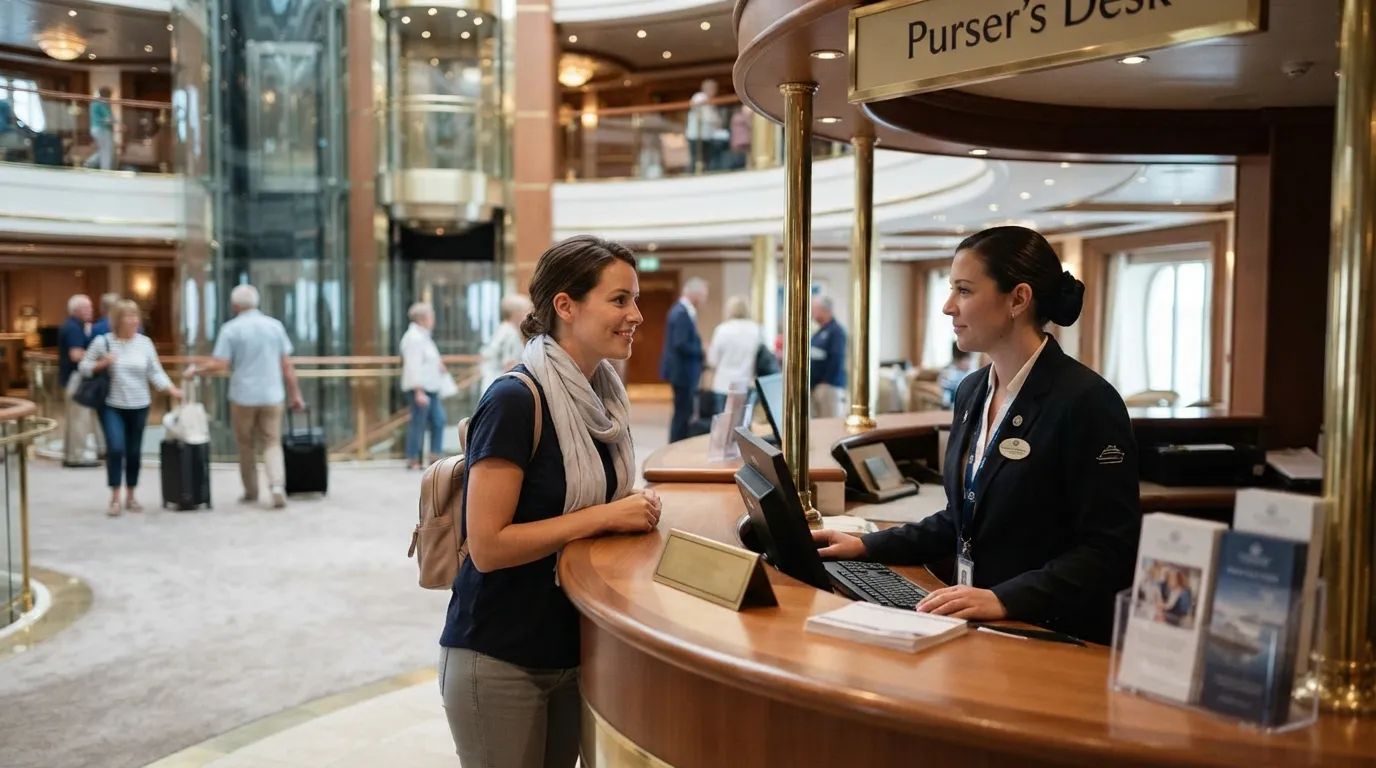
Most first-time cruisers walk past the purser’s desk without a second glance – and that’s exactly the mistake that costs them hundreds of dollars and dozens of missed perks every single sailing. The purser (also called the Guest Relations or Passenger Services desk) is the nerve centre of your entire onboard experience, handling everything from your cabin account to crew scheduling to complaint escalation.
Regulars who know how to approach this desk on day one consistently leave the ship with things other passengers didn’t even know existed. Here’s what insiders actually say.
#16 – Free Seasickness Medication Nobody Told You About
Most guests suffer in silence – or pay spa prices – when the answer was always free at the front desk.
If you’re feeling queasy, you can often get seasickness meds or ginger candies from the purser’s desk for free. Most people don’t realize this is an option because it’s never listed in the welcome booklet. The purser keeps a small supply precisely because guests ask – but only if you ask early enough in the voyage.
The real mistake is waiting until day three when you’re already miserable. Walk up on embarkation day and ask what seasickness remedies they stock. Even if the seas are glassy and calm, knowing your options costs you nothing.
- Ask specifically for ginger candies, wristbands, or over-the-counter meds.
- Some ships also stock green apples via room service – crew swear by them.
Once you know the purser has your back on basics, you’ll want to know what else they’re quietly holding back. But that’s nothing compared to what we found about #15.
#15 – You Can Adjust Your Gratuities Right Here
Gratuities feel like a fixed, non-negotiable line on your bill. Turns out, they are very much negotiable.
Nearly all cruise lines let passengers adjust or remove automatic tips at the front desk. On the major lines, roughly $17 to $20 per person, per day for a standard cabin, and more for suites. On a 10-night sailing with four passengers, that can still add up to $700 or more in auto-charges you may never have scrutinised.
Quick Compare
- Carnival: $17.00 per person, per day in standard cabins, $19.00 in suites
- Royal Caribbean: $18.50 per person, per day in standard staterooms, climbing to $21.00 in suites
- Norwegian: $20 per guest, per day standard, $25 per day in suites
- Princess: about $18 per person, per day in standard cabins
What most people don’t realize is that you can also adjust gratuities upward to reward standout crew members directly. If you adjust a gratuity charge downward, expect to be asked why – staff will want to know if you’ve had service issues.
- Do this before the final morning – modifications can’t be made once the sailing has ended.
- Want to tip specific crew personally? You can always do so in cash on top of the pooled amount.
But gratuity adjustment is just the beginning of what the purser’s desk controls. #14 is where things start to get really interesting.
#14 – The Upgrade Waitlist That Isn’t Advertised
Walk to the purser’s desk on boarding day and ask if any cabins in a higher category are going unsold. Most guests never do this – and most guests stay in their original cabin.
Different staff hold different levels of upgrade authority. Guest services handles immediate requests, while hotel directors oversee cabin assignments and can approve bigger moves based on operational needs.
The window is narrowest right at embarkation – that’s when unsold cabins are sitting empty and the purser has the most flexibility. Be polite, be specific about what you’re looking for, and ask early.
- Don’t demand. Ask. There’s a massive difference in how it’s received.
- Mention any special occasion – anniversary, honeymoon, birthday – calmly and once.
Think that’s forward? Wait until you see what loyalty status can unlock through the exact same desk. That’s #13.
#13 – Loyalty Perks Hidden Behind a Single Question
Cruise line loyalty programs have a dirty secret: many of their best perks are never applied automatically. You have to ask for them.
The purser’s desk is where those surprises actually materialise. Princess Elite members, for example, can bid for last-minute room upgrades – a perk most passengers never hear about, often going for 50% less than the standard upgrade fee.
Most loyalty members at mid-tier status leave the ship having collected zero of the perks they were actually entitled to. Higher-tier members may get upgraded cabins, complimentary services, or free excursions – but only if someone on the ship knows to apply them.
- Bring a printed copy of your loyalty tier and its listed benefits.
- Ask the purser to confirm every benefit is loaded to your cabin account.
The purser knows about your loyalty file. But there’s something else they know about your account that most guests never think to ask about. See #12.
#12 – Onboard Credit You Didn’t Know Was There
This one genuinely shocks people: onboard credit can come from multiple sources at once – your travel agent, a promo, your loyalty program – and it doesn’t always show up automatically.
Make sure you use it before disembarking, because it often expires at the end of the cruise. The purser’s desk can pull up your full account and show every credit applied.
Unused onboard credit that expires is money handed back to the cruise line for free. Ask at the purser’s desk on day one for a full account summary, then ask again on the second-to-last evening to make sure everything is allocated.
- Credits often can’t be converted to cash on departure – spend them or lose them.
- Some lines let you apply credits to shore excursions booked onboard if you ask.
There’s a related financial move even savvier guests make at this desk. And it’s the one almost nobody is doing. That’s #11.
#11 – Booking a Future Cruise Right Here Saves You Real Money
The purser’s desk – or a dedicated Future Cruise desk nearby – is one of the most overlooked savings tools on the ship.
Booking before disembarkation often unlocks special rates, cabin upgrades, or loyalty points, and the onboard rate is frequently lower than what you’d find at home. Most lines let you transfer the booking to a travel agent later.
Fast Facts
- Royal Caribbean’s NextCruise program lets you book with a nonrefundable deposit as low as $100 per person and earn up to $600 per cabin in onboard credit or a cash discount.
- Carnival’s Welcome Home program offers up to $50 per cabin – or up to $100 per suite – in onboard credit for booking while you’re still sailing.
- Norwegian’s CruiseNext deposits come in flat amounts of $250 or $500, applied toward a future sailing.
Insiders book a “placeholder” cruise on the last sea day, lock in the rate and bonus credit, then sort out the itinerary later. Not every line offers this, so ask specifically whether a “future cruise deposit” or “open booking” option exists.
- Onboard credit amounts vary widely by line and sailing length – always ask for the exact figure before you commit.
- Ask whether your deposit is refundable – policies vary by line and booking type.
Now we’re getting into territory most guests would never dream of asking about. #10 is where the purser’s real power starts to show.
#10 – Requesting Special Bedding and Cabin Configuration
Cruise cabin bedding is not fixed. Most guests just accept whatever the steward set up – but the purser’s desk can relay specific requests to housekeeping before you even board.
Some lines will supply egg crate mattress toppers, top sheets, and alternative pillows by special request. This is almost never advertised, so guests with back problems, allergies, or sleep preferences who ask early get accommodated – and everyone else gets the standard setup.
Couples who want a double bed instead of two twins should flag this before embarkation, not after arriving to find the room split. A quick call or email before sailing, or a stop at the purser’s desk the moment you board, gets it sorted before your first night.
- Ask for foam pillows, extra blankets, or a mattress topper specifically by name.
- Request a specific bed configuration – twin or double – at the same time.
That’s useful. But #9 is the one frequent cruisers consider a genuine game-changer.
#9 – The Purser Can Flag Your Account as a Celebration
Here’s something the brochure will never spell out: flagging your reason for sailing with the purser on embarkation day puts you in a different category for surprise gestures from the crew.
Word travels fast through a tight-knit ship community, and crew members often share notes about passengers who stand out positively – or communicate something meaningful early on.
Guests who mention a honeymoon, anniversary, or milestone birthday to the purser on day one frequently find small surprises in their cabin – wine, a dessert plate, a personalised note – without ever asking for anything specific. This isn’t guaranteed, and it isn’t a transaction. It’s simply how tight shipboard communities respond to guests who communicate.
- Be genuine, not transactional. Crew can tell the difference instantly.
- Mention it once, at check-in. Repeating it starts to feel like demanding.
But there’s an entirely different kind of ask that the purser handles – one most guests don’t even know is their right. That’s #8.
#8 – Formal Complaints That Actually Get Resolved
Most passengers who have a bad experience stew in silence, leave a negative review at the end, and never get resolution. That is exactly the wrong approach.
If something’s wrong, contact guest services immediately. The cruise line will likely investigate, and you may even be able to adjust the gratuity after a review of your situation.
The purser’s office has authority to issue onboard credit, reassign service staff, move guests to different cabins, and escalate to senior officers – none of which happens if you just complain to a friend at dinner. Removing or adjusting gratuities may be reasonable after subpar service, but speak with guest services first.
- Document the issue with dates, times, and cabin numbers when you visit.
- Ask specifically what resolution is available, rather than leaving it open-ended.
Most guests resolve complaints on the last day, when nothing can be fixed. The smart move is #7.
#7 – Early Resolution Means the Ship Still Has Time to Fix It
This is the single biggest mistake repeat cruisers see first-timers make: waiting until the last day to raise a problem.
Notify the purser’s office the minute you suspect trouble. A noisy cabin, a billing error, a malfunctioning air conditioner – all of these are far easier to solve on day two than on the morning of disembarkation.
Pursers work on a “passenger satisfaction” metric that feeds directly into their performance reviews – which means they’re incentivised to fix your problem, not ignore it. The earlier you bring it, the more tools and time they have to deploy them.
- Don’t apologise for visiting the desk. That’s what it’s there for.
- Ask for a follow-up time so the issue doesn’t fall through the cracks.
Now let’s talk about one of the most overlooked conversations at the purser’s desk – one that costs guests nothing to have. That’s #6.
#6 – Port and Destination Inside Knowledge
The purser’s team knows the ports you’re visiting better than any guidebook you brought aboard. They’ve been there dozens of times, and so has the rest of the crew.
Ask the purser’s desk for honest recommendations – not the shore excursion sales pitch from the tour desk, which has a financial interest in what it recommends.
The real value is in asking what crew members personally do when they get a free hour in that port. That answer is never in a guidebook: the local beach, the cheap lunch spot, the market that opens early, the taxi driver everyone trusts.
- Ask specifically: “Where do crew members go?” – not “What do you recommend?”
- Get any walking directions written down; phone signal in ports is unreliable.
Port knowledge is handy. But #5 is about something guests deal with every single day of their cruise without realising there’s a better option.
#5 – Billing Errors Are Far More Common Than the Cruise Line Admits
Cruise ship onboard accounts are complex, high-volume systems. Errors happen, and they happen regularly.
With dozens of daily transactions across bars, restaurants, spas, and shore excursions, a duplicated charge or misallocated fee isn’t rare. Most guests only look at the final bill slid under the door on the last night – right when the purser’s office is slammed with a queue.
Experienced cruisers check their onboard account every two or three days at the purser’s desk or on the cabin TV. Catching a $35 bar charge you didn’t make on day four is a five-minute fix. Catching it on departure morning is a nightmare that might follow you through customs.
- Ask for an itemised printout mid-cruise – most ships provide this for free.
- Query anything unfamiliar immediately, while the signed receipts are still fresh.
Speaking of what’s hiding in your account – #4 is something almost nobody thinks to ask, and it’s genuinely free.
#4 – Currency Exchange and Cash Advances at the Desk
Many guests don’t know the purser’s desk handles basic financial transactions beyond your onboard account – including cash advances against your credit card and, on some ships, currency exchange for your next port.
Asking for local currency before hitting a port, rather than scrambling for a dodgy ATM on the pier, saves both money and stress.
Cash advance fees and exchange rates vary by line, but they’re often comparable to – or better than – port ATMs that stack international withdrawal fees on top of currency conversion fees. Always ask what the fees are before committing, but don’t assume the desk can’t help.
- Ask on the evening before a port day – not the morning rush.
- Some ships only exchange currency on sea days, so plan ahead.
Now we’re into the secrets that regular guests almost never share publicly. #3 is one insiders guard carefully.
#3 – The “Do Not Disturb” Profile They Can Set on Your Account
This is a little-known power move: the purser’s desk can note preferences on your passenger profile that ripple through every department on the ship.
That account isn’t just billing – it’s a living profile that housekeeping, dining, and guest services all reference. Preferences like late cabin service, dietary needs, or communication style can be logged so you never repeat yourself to every crew member individually.
Guests who spend two minutes at the purser’s desk on day one flagging their preferences are served differently for the entire voyage – not because they demanded it, but because the note is on file. This is especially powerful for medical dietary needs, mobility considerations, or sleep schedules outside the standard service windows.
- Ask specifically: “Can this be noted on my cabin profile?”
- Follow up with your cabin steward directly so there’s no disconnect.
Only two more secrets to go – and they’re the ones that tend to generate the most debate among regular cruisers. #2 might actually surprise you.
#2 – The Quiet Hours and Noise Complaint Escalation Path
Cabins near elevators, entertainment venues, or galley corridors are notoriously noisy, and many guests just suffer through it for an entire week. The purser’s desk is the one place that can actually change.
A noise complaint logged formally – not just mentioned casually in passing – triggers a specific escalation path that can result in a cabin move, a compensatory credit, or crew intervention.
Most guests who complain about noise do it verbally and informally, which means nothing gets logged, nothing gets actioned, and nothing changes. A written complaint submitted at the purser’s desk creates a record, and that record has weight.
- Ask for a written acknowledgement of your complaint when you submit it.
- Request a specific resolution timeline – “by tomorrow morning” is reasonable.
And now, the one secret that almost no one acts on – even though it has the highest potential payoff of all. Here’s #1.
#1 – The First Morning Is the Most Powerful Moment of Your Entire Cruise
Every secret on this list has one thing in common: timing. The single highest-leverage moment of any voyage is the first hour after you board – before the ship is crowded, before the purser’s queue forms, and before all the flexible inventory gets locked in.
Complete online check-in the moment it opens. It signals engagement, secures earlier boarding, and gives you more time for a personal conversation before the desk gets swamped.
Guests who visit the purser’s desk in the first 60 minutes of boarding – politely, briefly, with a clear list of questions – consistently leave with more than they arrived with. Unsold cabin upgrades are still available. Account preferences haven’t been locked, loyalty perks haven’t been filed away, and the officers aren’t distracted yet.
That first conversation costs you nothing but five minutes. It can shape the entire sailing.
- Have a short, specific list of requests ready before you board.
- Be friendly, be brief, and thank them by name.
The Bottom Line
The Bottom Line (Image Credits: Gemini)The purser’s desk is the most underused resource on any cruise ship. From free seasickness medication and hidden onboard credit to formal complaint escalation and cabin profile preferences, nearly every advantage on this list starts with one early conversation.
At a Glance
- Visit the desk within your first hour onboard, before the line forms.
- Ask about seasickness remedies, unsold upgrades, and loyalty perks in the same visit.
- Check your onboard account every few days, not just on the last night.
- Report problems immediately – early complaints get fixed, late ones don’t.
Most passengers walk past that desk without a word. The ones who don’t walk away with better cabins, resolved issues, and perks that never appeared in any brochure.
The window is small, and it opens the moment you board. Did we miss a purser’s desk trick you’ve used? Drop it in the comments – we want to hear it.