Most travelers think baggage claim is just a boring waiting room. It’s actually a live scoreboard, broadcasting the staffing levels, operational shortcuts, and hidden decisions your airline made long before wheels-down.
Every bag that slides onto the carousel tells a story, and almost nobody knows how to read it. From what your wait time really means to why that one lonely spinning bag is probably stuck on the wrong continent, the truth has been hiding in plain sight this whole time.
#16 – Your Wait Time Is a Direct Report Card on the Airline
The clock starts the second your plane’s door opens. Baggage claim is where airlines get graded, whether they like it or not.
At most major U.S. airports, the first bags hit the carousel 12 to 20 minutes after landing. Wait 45 minutes or more, and that’s not bad luck – that’s a staffing shortage or a ramp crew running behind.
Fast Facts
- Typical first bag: 12-20 minutes after landing
- Red-flag wait: 45+ minutes signals a staffing or ramp problem
- Common delay causes: weather, gate-checked bags, slow ramp-to-belt transfers
- JFK is a repeat offender, thanks to long taxi times and heavy volume
The wait time is basically an operational fingerprint, and it varies wildly by airline and airport. But wait time is only the first clue – what actually arrives on that belt, and in what shape, tells a much darker story.
#15 – The Lone Spinning Bag Tells You Someone Got Rerouted
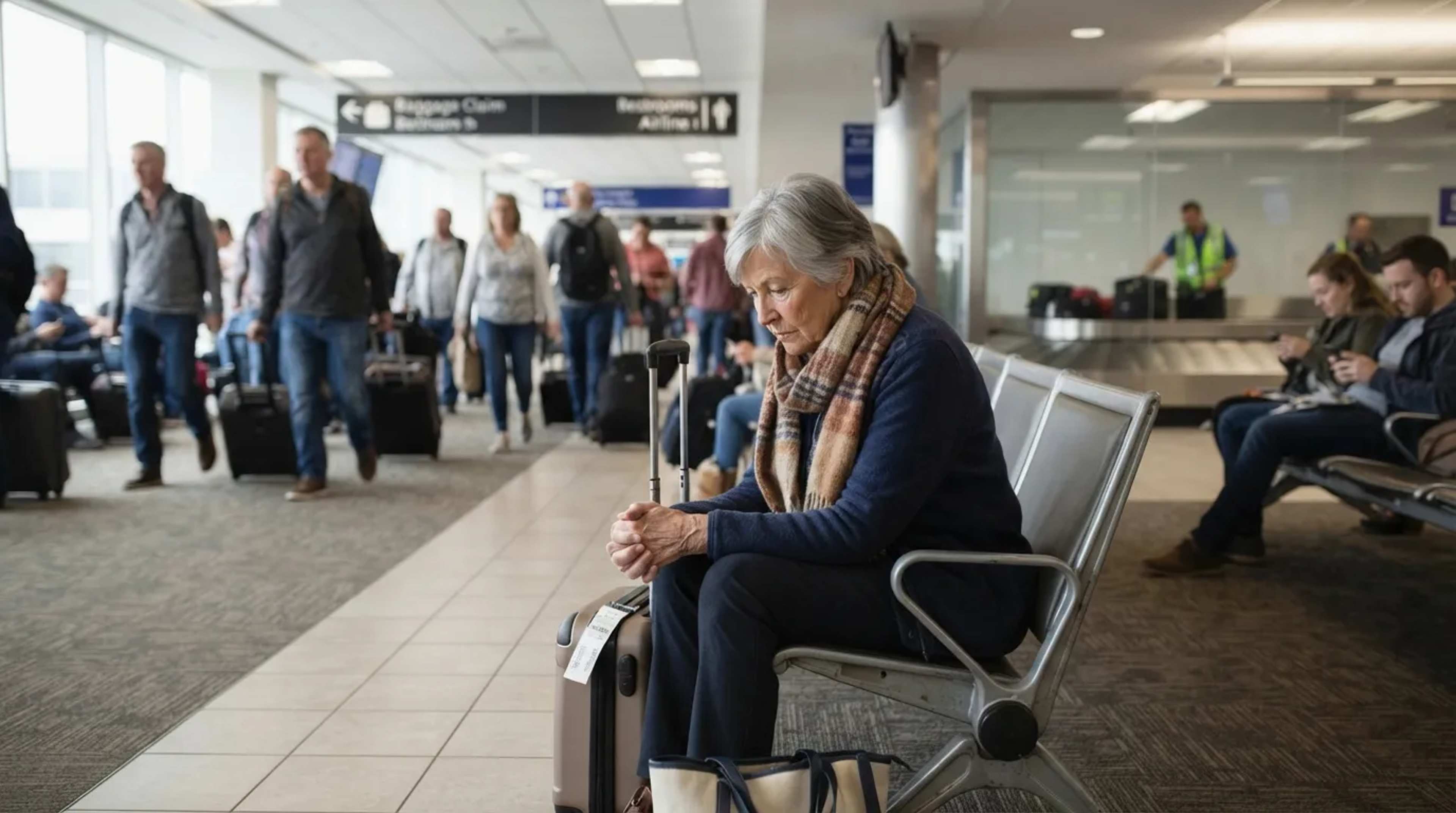
You’ve seen it – one lonely bag circling the carousel long after everyone else has grabbed theirs and left. Most people assume the owner just didn’t show up.
They’re usually wrong.
If a piece of luggage is just spinning on the carousel, it’s usually something that was diverted onto the wrong plane or has otherwise been lost.
Kate Sullivan, Secret Fares
That means an entire connecting-flight failure just played out inside a cargo hold, and the carousel is where the evidence finally surfaces. A lone bag on an empty belt is often physical proof of a missed connection.
The carousel doesn’t lie. It shows exactly where the system broke down, and that breakdown usually started much earlier than anyone at baggage claim realizes.
#14 – How Quickly Your Bag Arrives Reveals Loading Priority
Think bags come off the plane in random order? They don’t. The sequence is intentional, dictated by physics rather than fairness.
Bags loaded last often come off first. That reverse-unload logic means a last-minute check-in bag can beat yours to the belt by 20 minutes flat.
Handlers load by weight, size, and shape under strict instructions, fitting the cargo hold like a puzzle. Bags that don’t fit cleanly slow the whole process down, especially during tight turnarounds.
Your bag’s position in that puzzle decides when you actually get to leave the airport. Understanding it is the first step to outsmarting the wait.
#13 – Your Airline’s Baggage Rate Exposes Its True Performance
Airlines spend billions marketing their reliability. Baggage claim shows you what’s actually true.
Quick Compare: Mishandled Bags per 100 Passengers (H1 2026)
- American Airlines – 0.73 (highest in the industry)
- Envoy Air (American’s regional arm) – 0.72
- United Airlines – 0.66
- Allegiant Air – 0.12 (best in the country)
The airline with the cheapest fare isn’t always the one that loses your bag – the data flips that assumption completely. That’s exactly why some airlines invest in fixing it, and others simply don’t bother.
#12 – Bag Damage Reveals Whether the Ground Crew Was Rushed
A scuffed wheel is nothing. A cracked frame or a burst zipper tells a completely different story.
Not all damage is the passenger’s fault. Bags get run over by tugs and belt loaders whose drivers are moving too fast to notice.
Skip anything valuable or fragile in checked luggage – that’s rule number one. Crushed corners and broken handles are a direct window into how rushed, or how understaffed, the ramp crew was that day.
If your bag comes out looking like it lost a fight, the turnaround behind that flight was almost certainly too tight.
#11 – The “Fragile” Sticker Reveals an Industry-Wide Lie
Millions of travelers slap a fragile sticker on their bags every single year. Ground crews are quietly laughing at nearly all of them.
The sticker often does nothing. So many travelers slap it on non-fragile bags that handlers have learned to ignore the label entirely.
If you actually need careful handling, tell airline staff directly at drop-off. Otherwise, pack anything delicate with real internal protection – the sticker is theater, and the actual protection happens inside the bag.
That single truth leads directly into something even bigger: what travelers are getting wrong before they even reach the airport.
#10 – Overstuffed Bags Reveal What Passengers Are Getting Wrong
The carousel doesn’t just expose what the airline did. It exposes what passengers did, too.
An overstuffed bag is a ticking time bomb. Push a zipper past its limit and it becomes the weakest point in the entire system.
When it fails mid-transfer, everything spills across belts, carts, and sometimes the open tarmac. A simple TSA-approved lock keeps the zipper compressed and the bag from blowing open under pressure.
Baggage handlers consistently name overpacking as one of the top causes of in-transit damage. A burst bag at the carousel is almost always a packing failure, not a handling failure, even when both play a role.
The real surprise, though, is that what doesn’t show up on the carousel can reveal even more than what does.
#9 – A Missing Bag Reveals Whether Your Flight Had a Connection
Not all missing bags are equal. Where your flight came from changes everything about the odds.
At a Glance
- 46% of all mishandled bags vanish during a plane-to-plane transfer
- Direct flights face far lower odds of a lost bag
- A no-show bag on a direct flight usually means a mistake at the origin airport
If you had a connection, the math was already stacked against you. Choosing a direct flight is statistically one of the most effective ways to keep your bag from vanishing – not just faster, but safer.
And the scale of the global missing-bag problem is far bigger than most travelers ever realize.
#8 – Wait Time Varies Wildly by Airport – and Reveals Infrastructure Gaps
Not all airports are built the same, and baggage claim is where that inequality becomes obvious. LAX is the most inconsistent in the country, because every terminal runs almost like its own separate airport.
The international terminal there runs noticeably slower, weighed down by volume and the extra complexity of international baggage handling. On international arrivals generally, waits can stretch from 30 minutes to over an hour depending on customs and immigration.
An unusually long wait at an international terminal is often the airport admitting it hasn’t kept pace with its own passenger growth. Some airports, though, have almost entirely solved this – and the gap between them is staggering.
#7 – The Red Suitcase Myth Reveals What Viral Travel “Tips” Cost You
Millions of travelers still buy a red suitcase believing it gets loaded first. It’s completely false.
The rumor went viral anyway, and plenty of people still swear by it. Ground crews shut it down fast – a Delta communications manager who started his career as a ramp agent confirmed there’s zero truth to the claim.
Color has no impact whatsoever on loading priority. What actually decides loading order is weight distribution, bag size, and cargo hold configuration – none of which care what color your suitcase is.
The real priority system is driven by something passengers can actually control. Most of them just never bother.
#6 – Priority Tags Reveal Exactly How the Airline Values You
That little “priority” tag on a first-class or frequent-flyer bag isn’t just a status symbol. It directly determines when your bag hits the carousel.
Priority tags are tied to your booking class, and airport systems track them electronically the moment they’re scanned. Frequent flyers and business-class passengers get them automatically as part of the fare.
Fake or reused tags get caught almost every time, because ground crews scan and verify them all – and quietly enjoy catching the fakes. The system isn’t really about comfort so much as a mechanized queue that decides who gets their bag first, and economy travelers are consistently pushed to the back of the line.
This hierarchy reveals something bigger about how airlines think about operations as a whole.
#5 – Unclaimed Bags Reveal How Airlines Handle Their Own Failures
When a bag keeps spinning and nobody ever claims it, the airport’s next move reveals its entire lost-luggage protocol. Airports genuinely sell unclaimed baggage.
When an airline loses your luggage and it never gets returned, there’s a real chance it ends up auctioned off. It’s how airports clear the buildup of lost bags, turning a logistical headache into extra revenue or, sometimes, a charitable donation.
Airlines are actually required under DOT rules to compensate passengers for lost, delayed, or damaged bags. Most travelers never file that claim simply because they don’t know they’re entitled to one, and the unclaimed carousel is a monument to that gap.
#4 – The Scale of Mishandled Bags Reveals the True Cost of Flying Cheap
Here’s a number most travelers never see. The global scale of this problem is almost unbelievable.
SITA’s WorldTracer system, used by more than 500 airlines and ground handlers across roughly 2,800 airports, tracked nearly 24 million bags delayed, misrouted, damaged, or lost worldwide in 2025. That’s a rate of 4.9 bags for every 1,000 passengers who fly.
Airlines spent $5 billion on mishandled baggage in 2024 alone, and that figure doesn’t even count hidden costs like overtime and delayed departures. Somehow, the industry still charges passengers an average of $45 to check a single bag in 2026.
Most carriers have quietly pushed that fee higher across domestic and short-haul international routes. The price keeps climbing at the exact same time the mishandling rate refuses to drop.
#3 – Technology at Baggage Claim Reveals Which Airlines Are Actually Investing
Some airports have nearly eliminated the missing-bag problem entirely. Others haven’t changed in decades, and the difference is visible the moment bags start moving.
Baggage mishandling dropped by almost 60% between 2007 and 2022, largely thanks to better luggage-tracking technology. A big driver of that improvement is RFID tagging, now used at around 27% of airports worldwide, with far higher adoption at major hubs.
That means nearly three-quarters of airports on Earth are still tracking bags the old way. If your luggage keeps vanishing at a particular hub, you’ve just found one of them, and the airline flying there hasn’t pushed hard enough for an upgrade.
#2 – Most Delayed Bags Reveal That the Problem Is Almost Always Fixable
Here’s the part that should frustrate every traveler. The vast majority of “lost” bags aren’t actually lost at all.
Worth Knowing
- Delayed or misrouted: 75%+ of all mishandling cases
- Damaged in transit: about 21%
- Permanently lost: roughly 4%
- Reunited within 48 hours: about two-thirds of misplaced bags
The bag isn’t gone; the system just temporarily failed to route it correctly. Knowing that changes how you should react at the carousel.
File the report, track the bag, and let the airline’s legal obligations do the work instead of panicking. But the single most revealing thing baggage claim can tell you about your flight is still coming.
#1 – How Fast Your Bag Appears Reveals the Entire Operational Health of Your Airline
Every factor on this list – staffing, turnaround speed, ramp efficiency, tech investment, loading decisions – converges into one single moment. How fast your bag slides onto that carousel.
The New York Times analyzed baggage wait times at Houston’s George Bush Intercontinental and found the gold standard: eight minutes from plane to carousel. Most airlines never come close to hitting it.
Most passengers wait anywhere from 20 to 60 minutes instead, depending on carousel availability, oversized luggage, and the size of the aircraft. That range is where the real story lives.
A bag that appears in under 15 minutes tells you the airline runs a tight, well-staffed ramp operation. A bag that takes 55 minutes, or never shows up at all, tells you exactly what that airline’s budget meetings decided wasn’t worth funding.
Baggage claim was never a waiting room. It’s a live operational audit, and the data never lies.
The Bottom Line
Baggage claim is one of the most information-dense moments in all of travel, and almost nobody reads it correctly. The wait reveals staffing and infrastructure, while the order of arrival reveals loading priority and your ticket class.
A lone spinning bag reveals a broken connection somewhere upstream. Missing bags reveal which airports still haven’t upgraded their tracking tech.
The speed of that very first bag onto the belt reveals whether your airline actually invests in ground operations, or just spends its money on marketing. Airlines spent $5 billion on mishandled baggage in 2024, and passengers are still paying more to check a bag than ever before.
Next time you’re standing at that carousel, you’re not just waiting. You’re watching a report get filed in real time – did any of these surprise you?
Bonus: The One Baggage Claim Move That Guarantees You Get Paid
The single highest-value move at baggage claim has nothing to do with luggage color or packing tricks – it’s filing the right paperwork in the right order, on the spot, before you ever leave the terminal.
- Go straight to the airline’s baggage service desk and file a formal delayed/damaged/lost report before you leave the airport – this opens the WorldTracer file your airline actually uses to search for the bag.
- Photograph your bag tag and claim ticket, and get a copy of the report with a written file reference number in hand.
- Save every receipt for items you buy while waiting for a delayed bag – toiletries, clothes, chargers – because U.S. DOT rules require airlines to reimburse reasonable expenses caused by the delay.
- On international trips, a bag still missing after 21 days is officially classified as lost under the Montreal Convention, which unlocks your right to file for full compensation up to the treaty’s liability limit.
Most travelers skip the in-person report and just wait at home hoping the bag turns up – that single decision is why so many never see a dime in compensation.