You walk into a buffet thinking you’re just another face in a crowded room, free to fill your plate however you like. You’re not. The manager standing near the carving station has already sized you up, and by the time you reach the salad bar, they’ve made a dozen silent predictions about how your meal is going to go.
None of this is a guess. It’s a pattern built from watching thousands of guests move through the same line, and the tells are consistent enough that veteran managers can spot them from across the room. Here are the sixteen things they clock before you’ve even picked a table.
#16 – The Way You Walk In
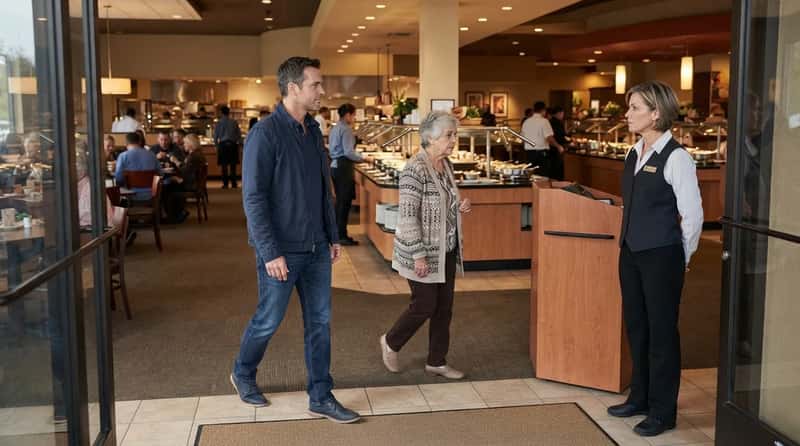
Before you say a word, your walk has already given you away. A confident stride toward a familiar station reads as “regular.” A slow shuffle near the door, eyes scanning everywhere, reads as someone about to bottleneck the line.
Staff clock this instantly and start repositioning before you’ve even touched a plate. Managers who’ve worked the floor for years describe it as an instinct they can’t switch off, even on their days off.
But the tell that comes right after matters even more than how you walked in. Wait until you see #15.
#15 – Whether You Scout the Whole Line First
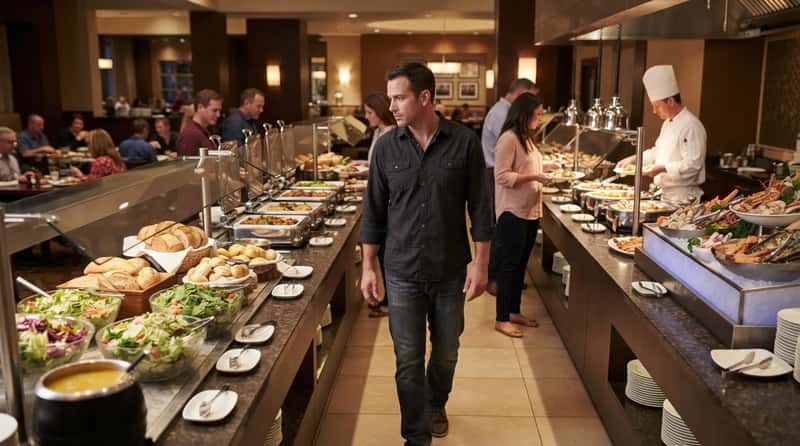
Some guests walk the entire buffet before serving themselves. Others grab whatever’s closest and start piling it on.
The layout isn’t random. Cheap, filling items like bread and salad sit near the start on purpose, so guests fill up before ever reaching the pricier dishes further down.
Guests who skip the scouting trip are, without knowing it, doing exactly what the layout wants. Managers can often guess what’s left on your plate before you’ve even sat down.
Worth Knowing
- Cheap, filling foods like bread, salad, and soup are almost always positioned closest to the entrance.
- Higher-cost items like carved meats, seafood, and made-to-order stations tend to sit farthest from the door.
- Dessert is usually placed in clear view from the start, even though it’s meant to be eaten last.
What happens with the serving spoons next is where things get stricter.
#14 – How You Handle the Serving Utensils
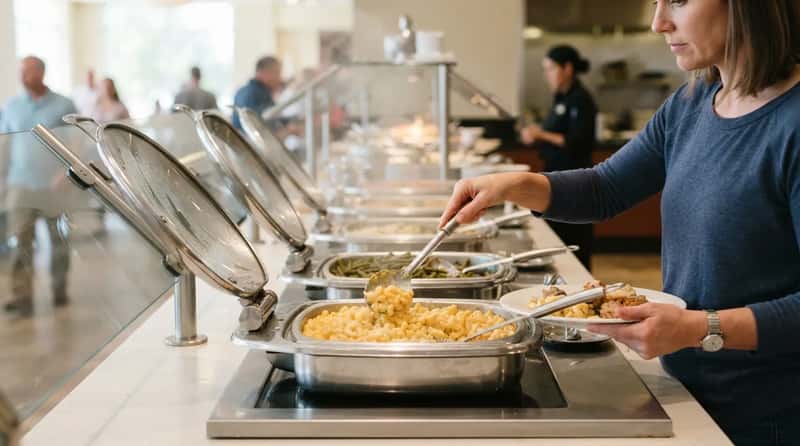
Utensil habits get noticed fast. One spoon per dish, no cross-contamination, marks you as a considerate guest.
Swap dishes without swapping utensils, and you’re noted too – just not kindly. It’s one of the most common food-safety complaints buffet workers quietly deal with.
A manager’s job is partly to catch what a health inspector would catch first. Misused utensils are one of the fastest ways to land on the internal watch list.
The very next thing they track happens the moment you load your plate.
#13 – The Size of Your First Plate Load
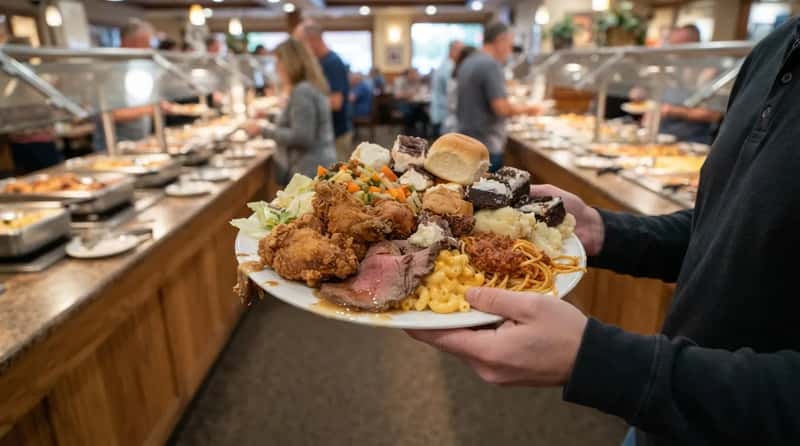
A towering first plate looks like enthusiasm. Managers read it as the opposite.
Buffet waste patterns consistently show the guest with the biggest plate eats the least of it. A 2024 University of Michigan study found all-you-can-eat buffets produce more waste than any other restaurant format, with over 70 percent of it food guests served themselves and never touched.
Managers can predict how much ends up in the trash just by watching your first trip through the line.
Plate size itself isn’t left to chance either – and #12 shows exactly how it’s engineered.
#12 – Which Plate Size You Chose
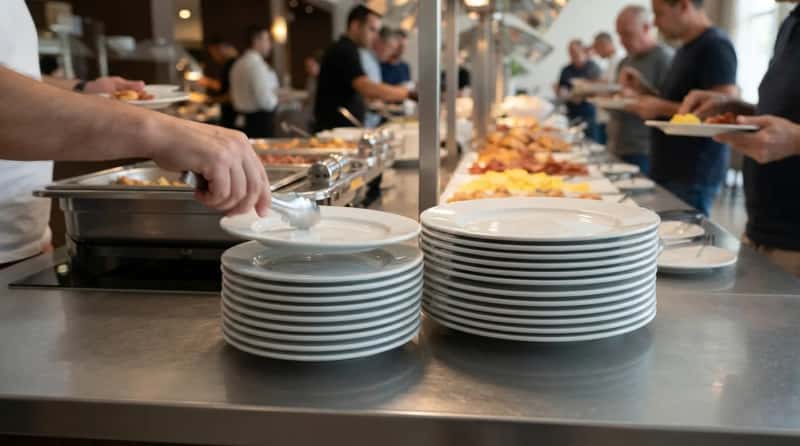
Most guests never think twice about the plates stacked at the start of the line. Managers think about them constantly.
Smaller plates create an illusion of abundance – a full plate feels like plenty, even though it holds less food. One hotel study found that shrinking breakfast plates by just 3 centimeters cut plate waste by 20 percent without hurting guest satisfaction.
Hunt for a bigger plate, and you’ve already been mentally flagged as an above-average waste risk.
#11 – How Long You Linger at Each Station
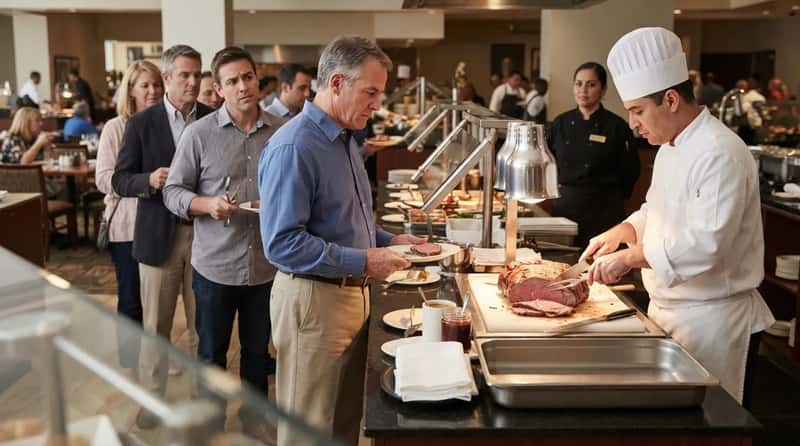
Managers track flow like traffic controllers. Someone who moves steadily through the line keeps everything moving.
Someone who parks at the carving station for five minutes while a queue builds behind them becomes a problem to manage. Reaching across other guests or crowding the person ahead breaks the rhythm fast, and staff often have to step in.
A good manager can tell from across the room when a line is about to stall – and redirect staff before it does. Most guests who cause the slowdown have no idea they’re doing it.
#10 – Whether You Greet the Staff or Ignore Them
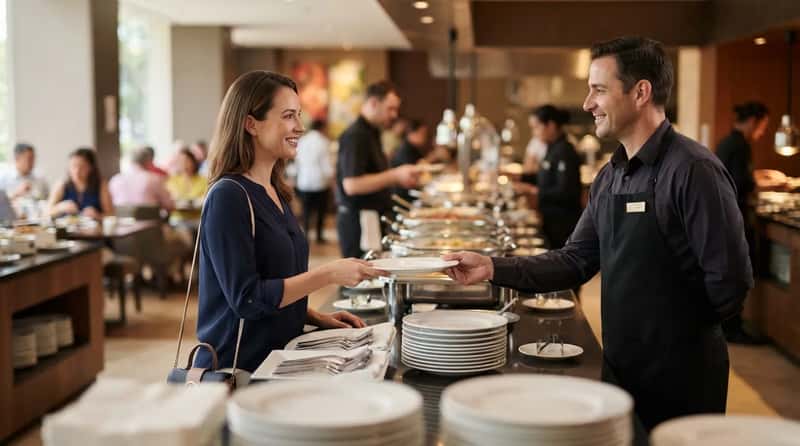
This one seems small. It isn’t.
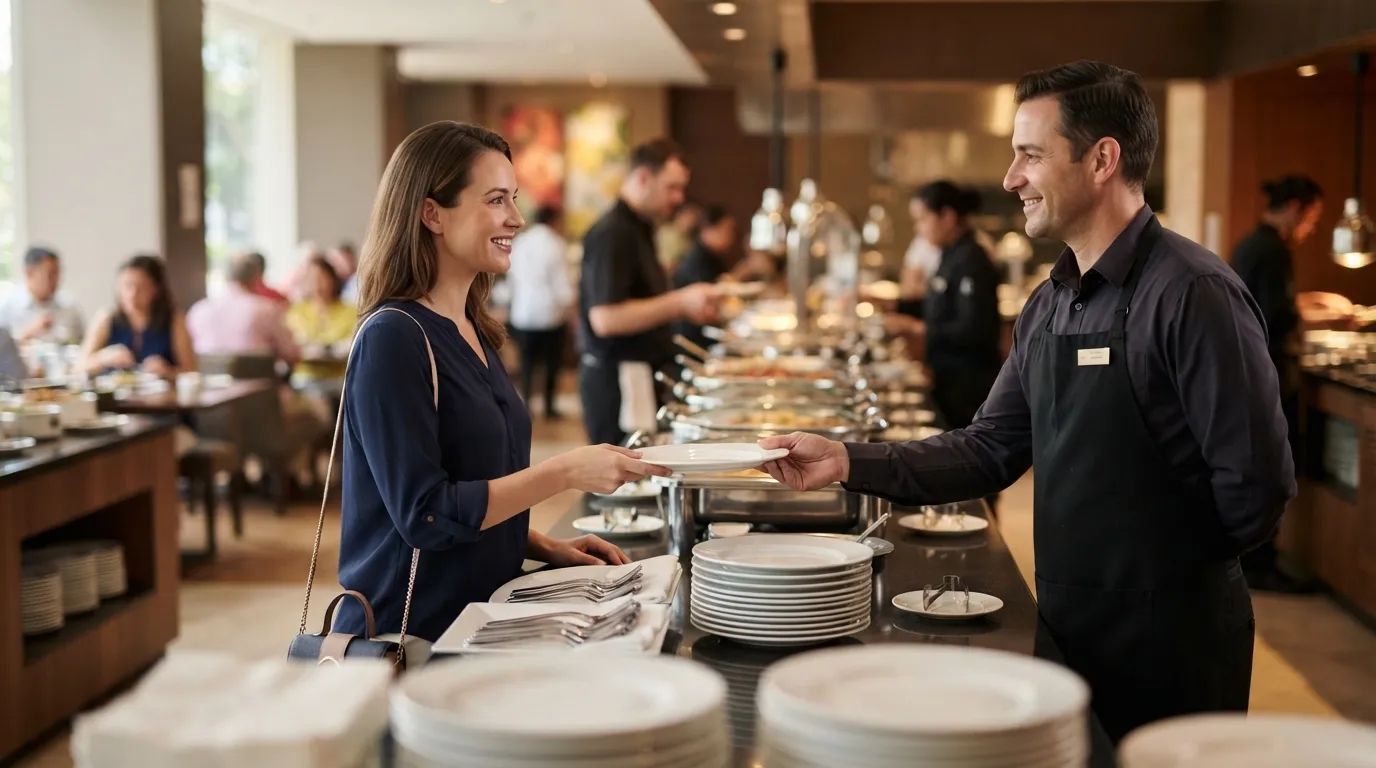
How you treat staff in that first exchange – eye contact, a simple thank you – tells managers a lot about how the rest of your visit will go. Regulars who build rapport with staff often get quietly rewarded with better service or a heads-up about what’s coming out next.
Guests who make that small effort at the first station tend to get treated differently for the rest of the meal. Most never realize the dynamic exists at all.
#9 – What Time You Arrived
Your arrival time alone tells a manager plenty. Buffets run on predictable rhythms, and guests who hit the edges of peak hours get shorter lines, fresher food, and calmer staff.
Data on breakfast buffets shows the latest serving slots produce more waste than the earliest ones, and pricier buffets tend to waste more than budget ones. Guests who show up in the final 15 minutes and load full plates are one of the most consistent, most tracked sources of waste a manager deals with.
It’s documented enough that it shapes how aggressively trays get restocked near closing.
Quick Compare
- Off-peak arrival: shorter lines, freshest trays, more attentive staff.
- Peak rush arrival: longer waits, crowded stations, thinner staff attention.
- Final 15 minutes before close: the highest waste levels of the day, since trays rarely get restocked.
#8 – Whether Your Group Is Coordinated or Chaotic
Solo diners are simple to read. Groups are their own event.
Managers notice instantly whether a party moves together or splinters – one person guarding a table while everyone else queues, half the group already at dessert before the mains arrive. There’s a well-known move where one person claims a table for six with a coffee cup, then vanishes to the buffet for fifteen minutes.
Guests who monopolize tables during a rush cost a buffet real revenue, and staff notice every time.
Common buffet management observation
The behavior of kids inside that group adds a whole other layer – which is exactly what #7 covers.
#7 – How Children in Your Group Are Behaving
Families are always welcome. Unsupervised kids at the serving line are a different story.
Research on buffet behavior shows children generate more plate waste than adults, mostly because they don’t yet understand portioning or have the self-control to stop. Staff notice the kids – but they watch the parents even more closely.
A parent who guides portions signals a low-friction table. A parent who waves a child toward dessert and looks away gets quietly flagged.
#6 – How You Approach the Dessert Station
Desserts are placed where you can’t miss them – near the entrance, front and center – specifically because sight and smell override how full you already feel.
Managers watch for guests who beeline to dessert before touching a savory dish. It’s a strong signal of impulsive choices and higher waste across the whole meal, since desserts are cheap to produce but create outsized perceived value.
Guests who skip it entirely, or circle back for a small portion at the very end, are quietly ranked among the lowest-maintenance diners in the room.
At a Glance
- Dessert is almost always positioned near the entrance, not the exit, so sight and smell work on guests early.
- Bright colors and glossy finishes are chosen specifically to trigger impulse choices.
- Desserts are among the cheapest items on the line to produce, yet they carry some of the highest perceived value.
#5 – How Much Is Left on Your Plate When You Stand Up
This is the moment that confirms everything a manager suspected from the start. A nearly clean plate signals a mindful guest; a mountain of leftovers signals the opposite.
One study at a five-star Malaysian hotel found guests left behind an average of 300 grams of food at breakfast and 400 grams at dinner – 92 percent of it avoidable. That’s not an abstract number to a manager; it’s daily cost, daily labor, and a direct hit to the sustainability targets they’re measured on.
Plate waste is the single number buffet managers watch closer than anything else you do.
#4 – Whether You’re Pocketing Food to Go
Buffets survive on thin margins built around a specific number of guests, not takeout stockpiles. Food that leaves in a napkin or to-go container is inventory the property never planned to lose.
Staff are trained to spot repeat offenders, and a guest who regularly walks out with wrapped food gets remembered, even if nothing is ever said. At hotels, this behavior has been known to get quietly noted against a room number.
It rarely turns into a confrontation. It does shape how proactively that guest gets served next time.
#3 – Whether You Tip the Clearing Staff
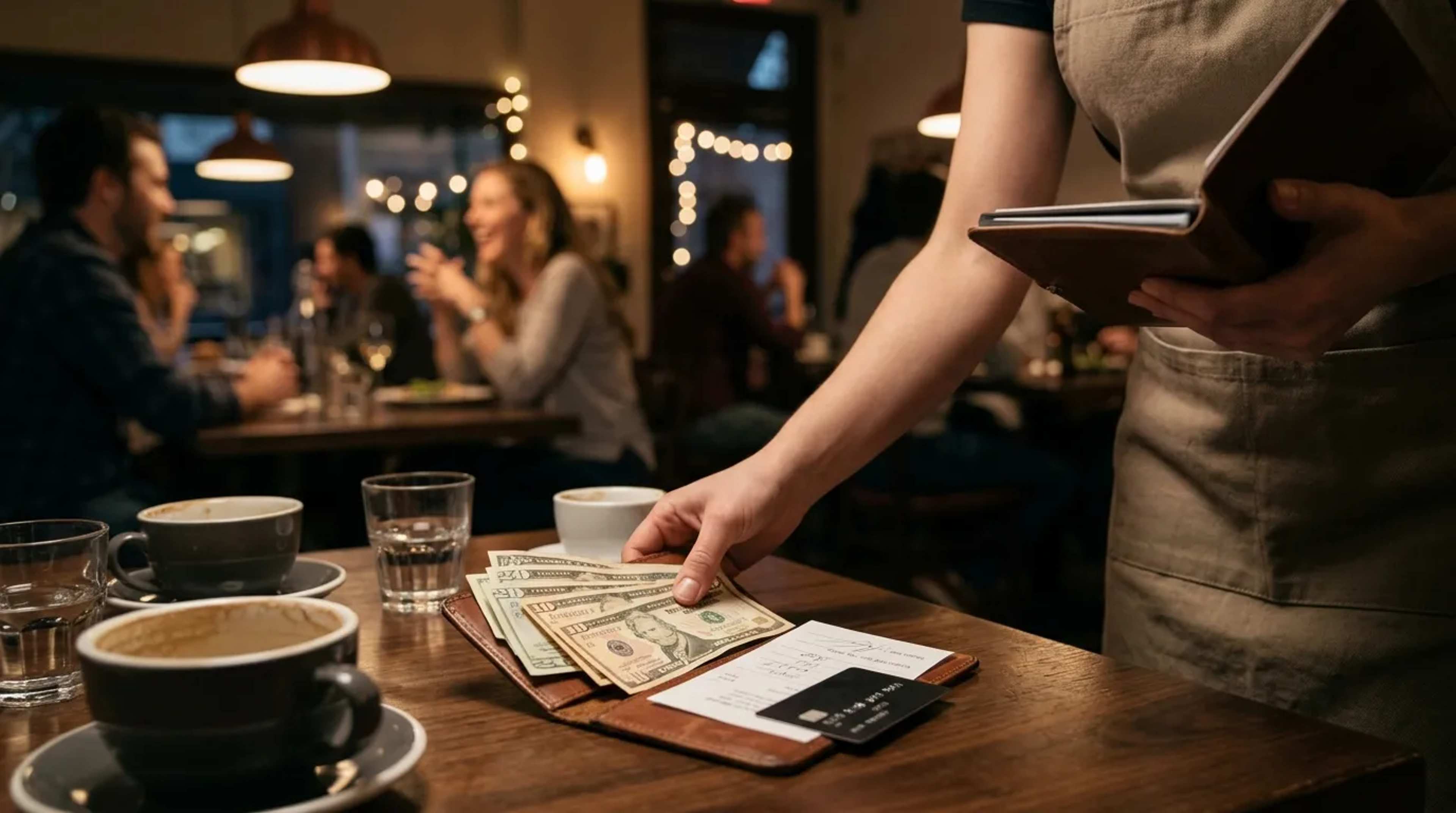
Here’s the one almost nobody thinks about: buffets still have floor staff clearing plates and refilling drinks nonstop. Whether you acknowledge that is something managers absolutely register.
A typical gratuity of 10-20 percent reflects that ongoing service, even though tipping at buffets is far less common than at table-service restaurants. Guests who do tip get noticed – not just by the server, but by the manager watching the whole floor.
Guests who snap at staff to clear faster, on the other hand, become one of the most talked-about problem behaviors of any given shift.
Fast Facts
- Buffet wait service is typically listed at 10 percent of the pre-tax bill, compared with 15-20 percent for full table service.
- Many etiquette guides recommend 10-15 percent, adjusting upward when staff deliver drinks or clear plates promptly.
- Upscale, all-inclusive, or specialty buffets often warrant a tip closer to the higher end of that range.
#2 – How You Treat the Line When It Gets Busy
Peak service is a stress test for everyone. Managers watch closely: do you wait patiently, or push and complain the second a tray runs low?
Buffets aren’t really selling unlimited food – they’re selling the feeling of abundance and the relief of not having to decide from a menu. Guests who stay calm when the line backs up get something back for it: extra attention and fresher trays sent their way first.
The guests who complain the loudest usually get served last, not first. The final observation on this list is the one nobody sees coming.
#1 – Whether You Come Back for More the Right Way
The most revealing moment in the entire meal isn’t the first trip – it’s the second. A guest who returns with a clean plate, takes a moderate portion, and waits for a natural gap in the line gets silently filed away as a near-perfect guest.
Research shows that two simple nudges – smaller plates and visible social cues – can cut hotel restaurant food waste by roughly 20 percent. Guests who moderate their own portions without being told are exactly the guests that research points to.
The buffet was never just about food. It’s a running behavioral read that experienced managers make in real time, on every guest, all shift long – and the ones who understand that, even without realizing it, always end up with the better experience.
The Bottom Line
Buffet managers are never really off duty. From your first step through the door to the moment you stand up for the last time, they’re reading plate loads, timing, utensil habits, tipping, group dynamics, and whether that second trip was reasonable or reckless.
They lean on psychology, layout tricks, plate sizing, and portion control to keep the room feeling abundant while keeping waste and cost under control. The guests who waste the least, treat staff decently, and read the room without needing to be told are the ones who get the warmest service, every single time, without ever asking for it.
Did we miss a tell you’ve noticed at the buffet line? Drop it in the comments.
Bonus: The One Move That Gets You Treated Like a Regular on Visit One
Every tell on this list is passive – things managers notice about you. This one flips the script: it’s something you actively do that changes how you’re treated for the rest of the meal.
Within your first five minutes in the room, make brief, friendly contact with whoever is running the floor – not a server refilling drinks, but the person checking trays and scanning the room. A short, specific question does more than any compliment.
- Ask, don’t small-talk: Say something like “What’s coming out fresh in the next little while?” instead of a generic greeting.
- Time your big plate to the answer: If they mention a hot item restocking soon, hold off your main plate until it lands.
- Say thanks by name if you catch it: A quick “thanks, appreciate it” using their name signals you’re paying attention, not just passing through.
- Repeat it on your second trip: Circle back to the same person instead of a random staffer – familiarity is what triggers the better treatment.
This single habit does what none of the sixteen tells above can: it moves you from “guest being watched” to “guest being taken care of.” Staff remember faces that ask real questions, and that memory is what gets you the freshest tray, the faster refill, and the benefit of the doubt on everything else.