Most people picture cruise ship crew living some kind of floating dream: hopping between exotic ports, eating for free, partying every night below deck. Ask an actual crew member, and that image falls apart fast.
They know things about your cabin, your ship, and your entire vacation that almost nobody ever thinks to ask about. Keep reading, because some of these answers explain a lot about that smile at the buffet line.
#16 – They Work Every Single Day, No Exceptions
Most passengers assume crew members get weekends off. They don’t.
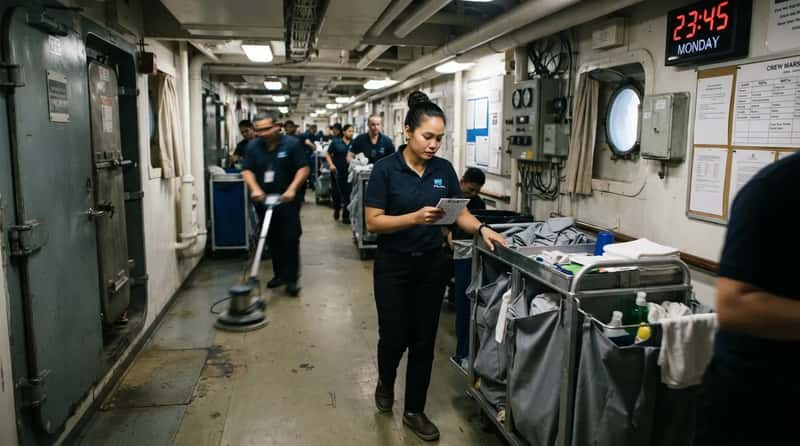
Every crew member, no matter the contract, works 10 to 12 hour shifts, seven days a week. No Saturday lie-in, no Sunday off, no holidays.
One former Norwegian Cruise Line employee said they pulled 70-hour weeks for just $1,600 a month. That’s a few dollars an hour, less than many fast-food jobs, without ever going home.
Fast Facts
- Standard shift length: 10 to 12 hours a day, every day
- Scheduled days off during a contract: typically zero
- Contract length for most crew: 6 to 9 months straight
- One reported entry-level wage: about $1,600 a month for 70-hour weeks
A few stolen hours might go to laundry, a quick meal, or a call home. That’s the whole day, most days.
Nobody relaxing near the pool deck is actually off duty. The next fact shows just how long they keep this up before they see home again.
#15 – Their Contracts Run Up to Nine Months Without a Break
Most people assume crew rotate between ships often. They don’t.
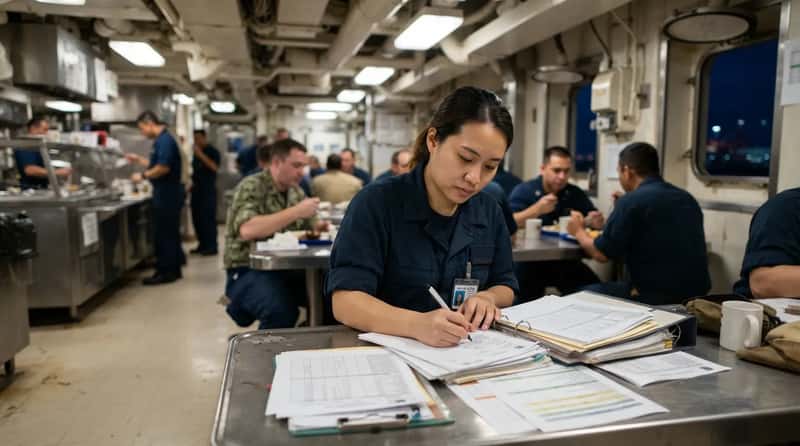
Senior crew like captains and cruise directors sign 3 to 4 month contracts. Everyone else, chefs, waiters, cabin stewards, signs on for 6 to 9 months straight.
Some contracts are 9 or 10 months but you work every day of it. EVERY DAY!
A cruise ship crew member
Nine months. No weekends. No day off, so your vacation runs on schedule.
Contracts run anywhere from 2 to 11 months, and crew usually get a couple of months off between them. That break sounds like a vacation, but there’s a catch almost nobody asks about.
#14 – Crew From Different Countries Are Paid Different Rates for the Same Job

Here’s one that should raise eyebrows on every ship.
Two crew members doing the identical job at the identical level aren’t guaranteed the same pay. An American crew member and a Filipino crew member clearing the same tables can earn very different wages.
This isn’t a glitch. It’s standard practice across the entire industry.
Many crew from developing countries also pay recruitment agencies a fee just to get hired, sometimes worth three months’ salary. They arrive already in debt, sending most of what they earn home to family.
Passengers tip the steward and move on without a second thought. The economics underneath that smile are heavier than they look.
#13 – There’s a Hidden Highway Running Through Your Ship
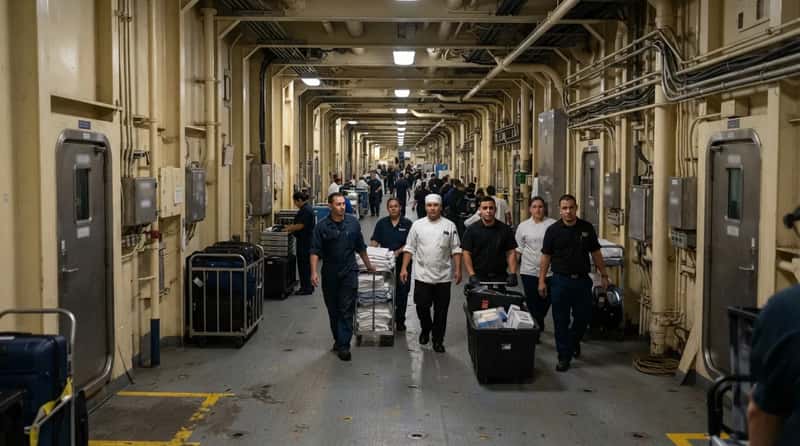
Passengers navigate the ship by grand staircases and glass elevators. Crew use something else entirely.
It’s called the “I-95,” a long interior corridor running the length of the ship, buried low in the hull. Crew move through it to reach their work areas without ever crossing into guest spaces.
While you’re ordering a poolside cocktail, dozens of crew are moving through a narrow, windowless tunnel directly beneath your feet.
At a Glance: The I-95 Corridor
- Runs bow to stern, connecting crew cabins, mess halls, laundry, and the engine room
- Named by crew themselves, after the famous East Coast highway
- Handles all luggage sorting during embarkation and disembarkation day
- Off-limits to passengers, except on a handful of paid behind-the-scenes tours some lines now sell
Most crew live in this hidden “ship within a ship” and rarely leave it. Very few even get access to passenger decks or guest facilities.
The ship you think you know is only half of it. What’s below deck gets even smaller from here.
#12 – Crew Cabins Can House Up to Four People in One Room
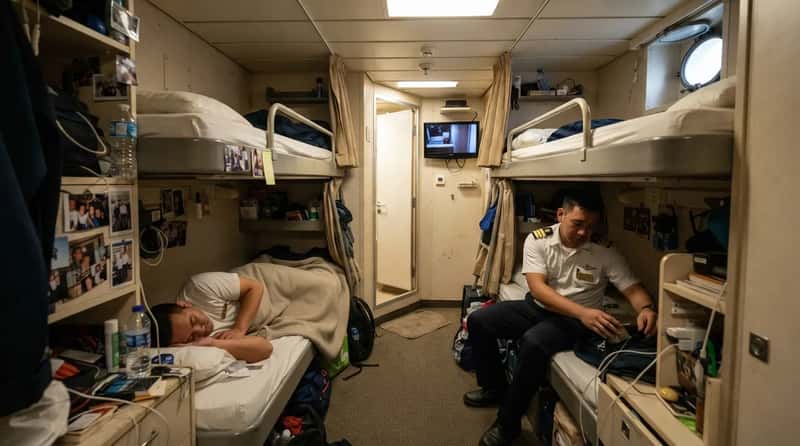
Your cruise cabin might feel snug. Crew quarters make it look enormous.
Two to four crew members often share one small room, with a shared bathroom and TV. No balcony, no ocean view, barely any personal space, for nine months straight.
The room a crew member sleeps in is often smaller than the bathroom in a mid-range passenger cabin.
Days off are rare, so crew get “rest hours” instead, short windows to nap before the next shift starts. Fatigue builds fast, and staying permanently tired becomes part of the job.
It’s not glamorous down there. What crew actually eat is its own surprise.
#11 – The Crew Doesn’t Eat Your Food, But Their Food Isn’t Great Either
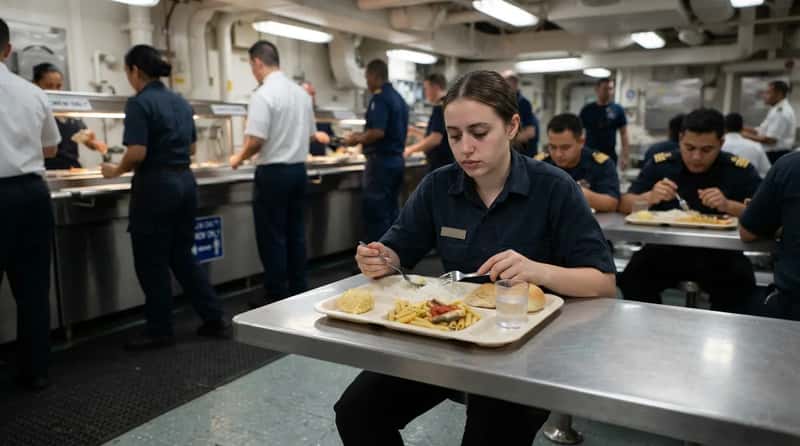
There’s a persistent myth that crew feast on leftover buffet food. Reality is messier than that.
Crew get three free meals a day, but the menu leans heavily on white rice, odd desserts, and the occasional tin of sardines with limp pasta. It’s not something to look forward to.
A passenger might be enjoying lobster one deck above a crew member eating canned fish for dinner.
Only senior staff typically get access to passenger dining. For everyone else, meals are fast and functional, eaten in a crew-only mess passengers never see.
What crew do with their scraps of downtime, though, is the part cruise lines really don’t advertise.
#10 – The Crew Bar Is Real, And It’s Very, Very Cheap
Below the waterline, after the last shift ends, there’s a bar. It works exactly the way you’d imagine.
Beer runs about $1. A bottle of wine is around $3, and after months of seven-day weeks in a shared cabin, that bar becomes the social heart of the whole ship.
The scene down there is something most passengers would never guess exists on their “family-friendly” cruise.
Spirits are technically banned, but crew reportedly sneak vodka aboard in mouthwash bottles, tinted with blue food coloring. Hangovers get blamed on seasickness.
It’s a pressure valve, and nine months of nonstop shifts demands one. But what happens when things get serious is the part nobody thinks to ask about.
#9 – Every Ship Has a Jail and a Morgue
Nobody at the embarkation desk is going to mention this one.
Every large cruise ship has both a small, windowless jail cell and a morgue stocked with dry ice. These aren’t rumors, they’re standard equipment on any vessel carrying thousands of people for weeks at sea.
Medical emergencies happen more often than the industry likes to publicize. A ship holding thousands of passengers for weeks is statistically going to face them, and not every outcome is a good one.
One crew member said their first month onboard included three helicopter medical evacuations and one passenger who died in their sleep.
Crew train for this constantly. The way they talk about it without alarming you is more clever than most guests ever realize.
#8 – The Announcements You Hear Are Coded, Deliberately
That calm voice on the loudspeaker might be telling crew something very different from what you just heard.
Crew have shorthand codes for nearly everything. Code Alpha means a medical emergency, Code Oscar means someone’s gone overboard, Code Adam means a missing child.
Passengers hear a neutral phrase and keep sipping their drink. Crew hear the same words and are already moving.
It’s deliberate design, panic on a ship at sea is its own serious risk. Security also uses quiet hand signals to respond without ever alarming the room.
The whole system runs silently in the background of every voyage. But there’s a bigger legal structure behind the ship itself that explains a lot more.
#7 – Your Ship Is Registered in a Foreign Country to Avoid Labor Laws
This is the one most passengers never think to ask, and it explains a lot.
Most cruise lines register ships under “flags of convenience,” countries like Panama, the Bahamas, or Liberia with famously loose labor laws.
Quick Compare: Where Cruise Ships Are Registered
- Bahamas: roughly 35% of cruise ships, the world’s largest cruise registry
- Panama: roughly 17%, long favored by lines like Carnival
- Bermuda: roughly 14%
- Italy and Malta: roughly 11% each, used by lines such as Costa
The result is crew have limited legal protection, and contracts are written to favor the company. An injury or pay dispute often means arbitration in a foreign country instead of a straightforward court case back home.
This isn’t a conspiracy theory. It’s a well-documented, entirely legal industry practice that crew know about before they ever sign.
Most passengers never think about it at all. There’s one more layer of that system hiding in how crew actually get hired.
#6 – Crew Are Tested for Drugs and Alcohol, Randomly, Every Month
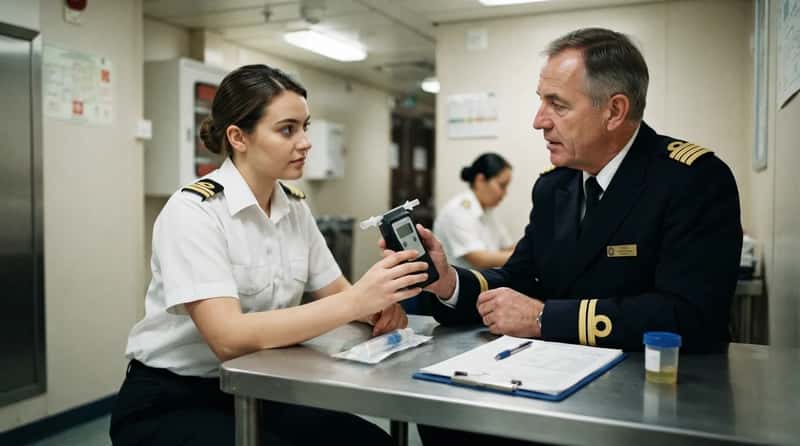
Fail the test, and you’re off the ship at the very next port.
Crew undergo drug testing when they join, then random testing roughly once a month for both drugs and alcohol, regardless of rank or how many contracts they’ve completed.
One crew member said the number one reason people got fired, in her experience, was failing a breathalyzer test. Given how cheap that crew bar is, that’s a genuinely high-stakes combination.
The disciplinary structure on a ship runs closer to a military operation than a hotel. Hierarchies are strict, and some rule violations carry zero tolerance.
Most passengers assume cruise ships run on customer service training. They actually run on maritime law, and the captain holds more authority than most guests ever realize.
#5 – The Ship Already Knows Which Cabins Have Problems
Here’s something crew talk about privately, and rarely get asked.
Crew know exactly which cabins have recurring issues, and their reaction when you complain proves they knew before you said a word.
On one Azamara cruise, a passenger’s cabin sat directly under a kitchen service area, with loud rumbling starting at 4am. The moment they gave their cabin number at Guest Services, staff immediately offered a different room, no explanation needed.
Cabin assignments run through an algorithm, and loyalty members get first pick. That means the least desirable rooms often go to newer or non-loyalty guests.
You probably didn’t know to ask. The crew knew the whole time.
#4 – Crew Know Every Port Better Than Any Tour Guide You’ll Ever Book
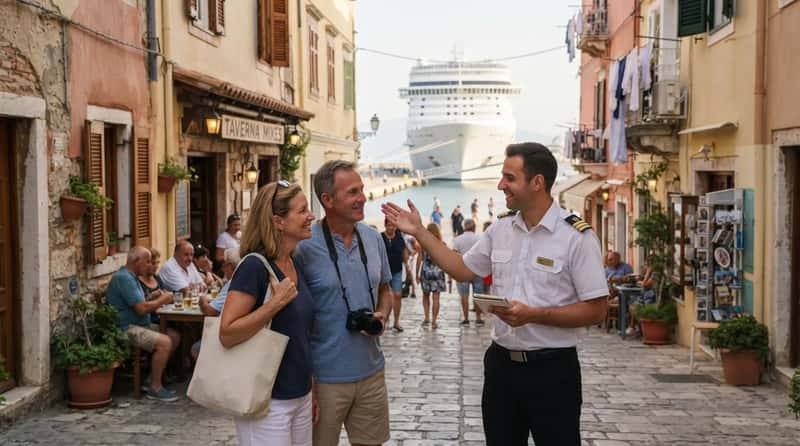
This is the one crew genuinely want you to ask about, and almost nobody does.
Crew know which restaurants serve the best food at local prices, and where the street food stalls are that most tourists walk right past. They’ve docked at the same ports dozens of times, so they know exactly which excursions are overpriced.
A five-minute chat with your cabin steward could save you $80 on a shore excursion and point you somewhere genuinely memorable.
Worth Knowing
- Crew usually know which shore excursions are the most marked up
- Stewards often know free, reliable Wi-Fi spots just outside the terminal
- The best local restaurants are frequently a short walk from the dock, not inside the tourist zone
- One short conversation can change your entire day in port
They also know where to find free, reliable Wi-Fi near the terminal, since certain cafes and hotels nearby often beat the ship’s own connection.
Nobody thinks to ask crew where they’d eat. That’s exactly why they think passengers miss the best part of every port.
#3 – Entertainment Staff Are Often Not Officially Crew at All
The singers, dancers, comedians, and musicians you watch every night hold a completely different status from the rest of the crew.
Many shipboard entertainers are contracted through third-party entertainment companies rather than the cruise line itself. That means different contracts, different rules, and different access to ship facilities.
This matters because it changes how they’re paid and how they’re treated if something goes wrong at sea. They’re visible to every passenger, yet technically outside the ship’s official crew structure.
American workers are rare in standard crew roles, but more common in staff positions like DJs, cruise staff, or musicians, often with better perks and shorter contracts.
The performer taking a bow tonight might be working under completely different terms than the person who cleaned your cabin this morning.
#2 – Crew Are Banned From Passenger Cabins, and the Penalty Is Immediate Termination
This rule is stricter than most passengers imagine, and it exists for very clear reasons.
Crew members are generally banned from passenger cabins unless they have a specific, documented operational reason to be there. Passengers are just as restricted from crew areas.
It’s about liability and power dynamics, a ship at sea can’t resolve disputes the way land does. Any crew member caught in a cabin without a valid reason faces immediate termination and removal at the next port, sometimes thousands of miles from home.
Many crew live with a constant, quiet fear of the sudden dismissal call, sometimes nicknamed the dreaded “6am knock.”
The line between passenger world and crew world is sharp and deliberately enforced. Which brings us to the one thing crew almost never get asked, and the one that matters most.
#1 – Crew Are Completely Cut Off From the Outside World for Months at a Time
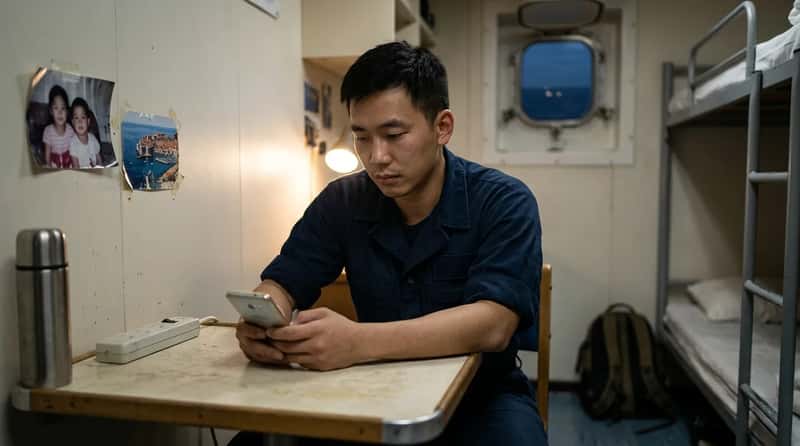
This is the detail that lands hardest when crew actually talk about it.
Crew members stop following news, sports, pop culture, anything happening back home. Internet at sea is often slow, expensive, or simply unavailable, so many lose track of current events entirely during a contract.
You’re really kind of isolated out there.
A former cruise ship crew member
While you’re texting pool deck photos, the crew member handing you a towel might not know what’s happening in their own country, or with their own family. A crew member from the Philippines on a nine-month contract might talk to their kids once a week, if they’re lucky.
There are documented cases of crew who hadn’t seen their children in three years, working contract after contract to pay for their education. That’s the reality behind the pressed uniform and the professional smile.
This is the thing crew almost never get asked about. It’s the thing that sticks with you long after you’ve forgotten the name of the ship.
Next time you’re onboard, try asking your steward one real question, where they’d actually go ashore for dinner. It’s a conversation almost no passenger has, and it might end up being the best tip you get the whole cruise.
Bonus: The Insider Move That Beats Cash Tips
Most passengers think cash is the only way to reward great crew. Crew themselves will tell you the post-cruise survey often matters more.
Cruise lines use those surveys to decide bonuses, promotions, extra shore leave, and even who gets invited back for the next contract, so a specific mention by name can carry more weight than a tip envelope.
- On day one, snap a quick photo of your steward’s or waiter’s name tag so you don’t forget it later
- Note one specific moment, like fixing a light fast or remembering a request without being asked
- When the survey email arrives after the cruise, write their full name and that specific detail, not just “great service”
- Do this for two or three crew members total, it takes under five minutes and costs nothing
This single habit can influence a crew member’s next contract more than a $20 bill ever could. It’s the tip crew genuinely wish more passengers knew about.