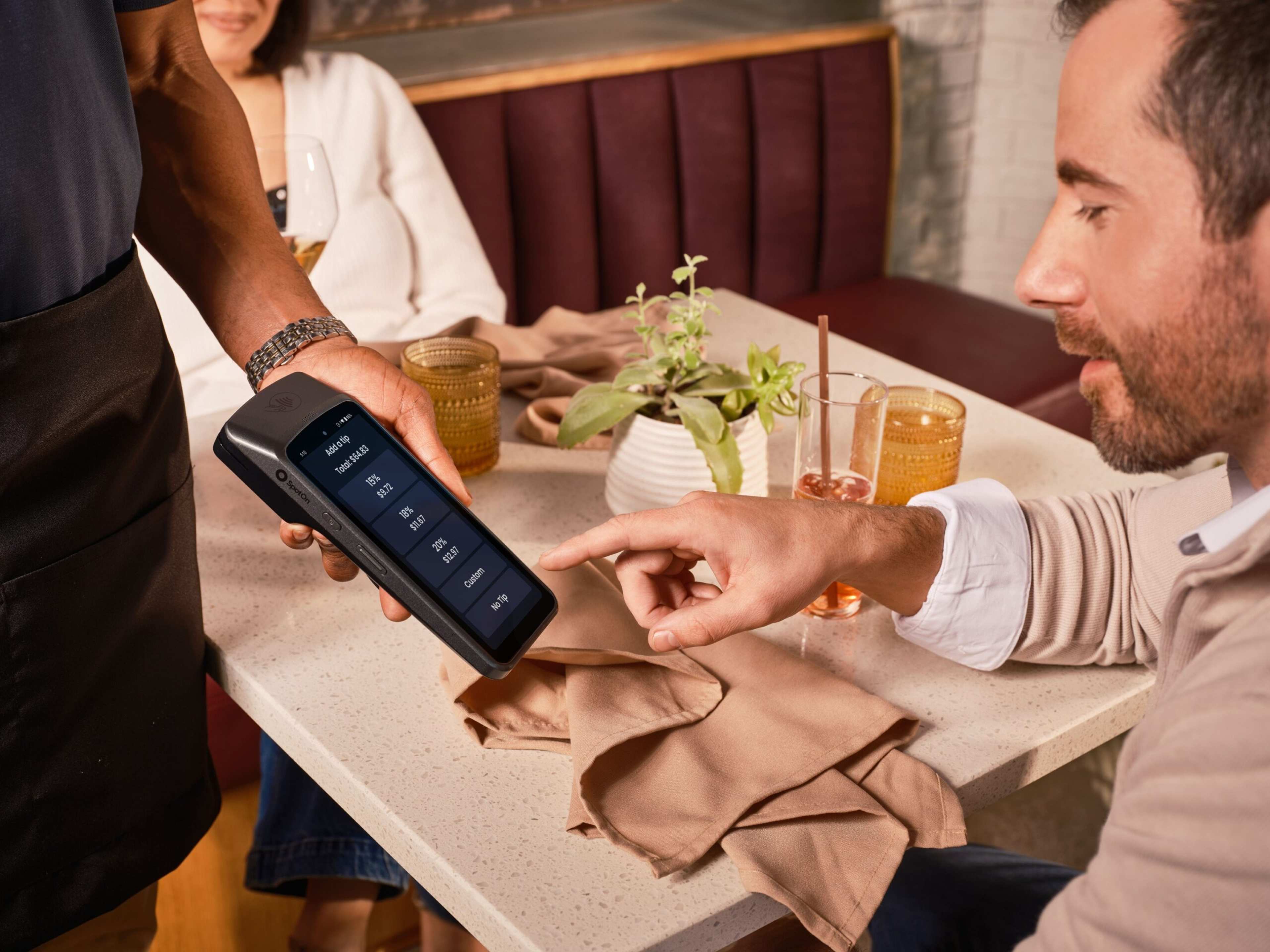

Walk into an American diner today and you’ll scroll through a QR code menu, plug your phone into a charging port, and tip via touchscreen before you’ve even tasted your food. Step back sixty years and the same diner would feel like a different country. The rituals, the unspoken rules, the social codes – all of it ran on expectations that most people under 30 have never encountered and wouldn’t recognize if it arrived with a side of hash browns.
Some of these habits feel genuinely charming in hindsight. A few are more complicated than they first appear. And at least one carried a weight of history that the chrome stools and neon signs never quite advertised. The one that surprises people most isn’t the smoking or the slang – it’s the one hiding near the bottom of this list.
#17 – Paying a Nickel to Control the Room’s Music
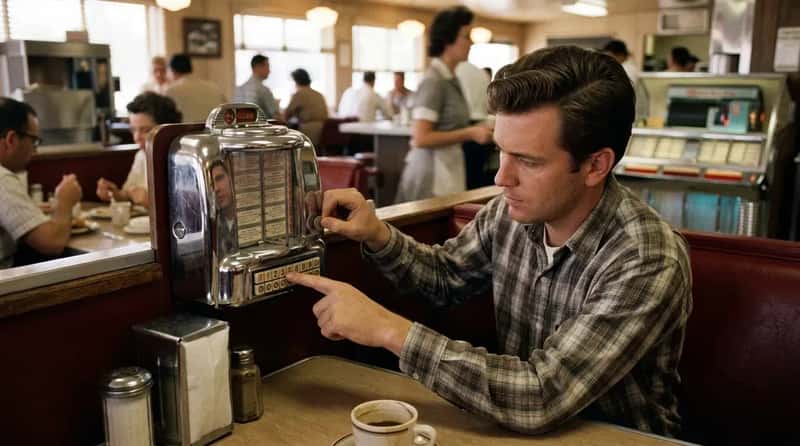
Before Spotify, before aux cords, before anyone could DJ from a pocket device, a diner’s soundtrack belonged to whoever had a nickel and got to the tabletop jukebox selector first. These wallbox selectors were mounted in each booth and along the counter, connecting to a main unit that filled the entire restaurant with whatever you picked – you weren’t listening privately. You were broadcasting to every booth and stool in the place, whether they liked your taste or not.
The unspoken rule was simple: whoever dropped the coin owned the next three minutes of everyone’s experience. Nobody asked permission. Nobody complained out loud. You just hoped the guy two stools down had better taste than you feared. By the 1980s, many diners quietly removed the machines to squeeze in more seating, and the carefully chosen soundtrack was replaced by the clatter of dishes. The shared musical moment – chosen by a stranger, experienced by all – vanished without much of a farewell.
Fast Facts
- A single play cost one nickel on early wallbox machines; later models moved to dimes and quarters
- The “Big Four” jukebox makers were AMI, Seeburg, Wurlitzer, and Rock-Ola
- Seeburg’s Wall-O-Matic wallbox, introduced in 1949, became standard in diners for the next two decades
- Jukeboxes played songs in mechanical queue order – not the order selected – so your nickel could wait behind several others
- Operators loved wallboxes because multiple customers would pay for the same song, stacking coins before it played once
#16 – Sitting at the Counter Was a Social Act, Not a Last Resort
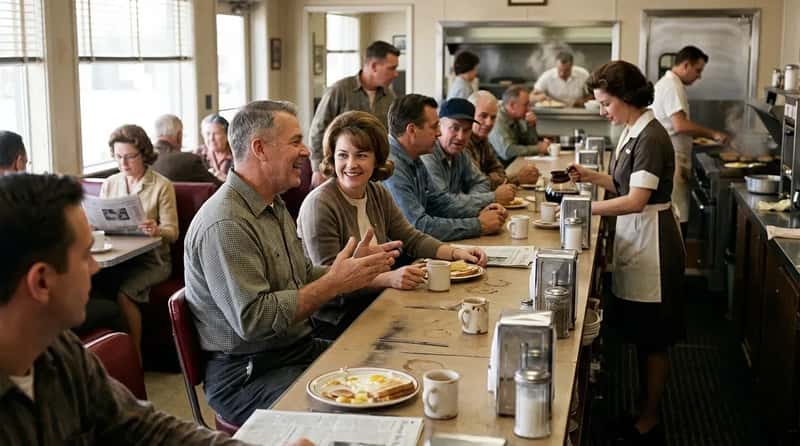
Today, if every booth is taken and you end up at the counter, it feels like a consolation prize. In the 1960s, it was the opposite. The counter was the engine room of the diner – where regulars landed every single morning, where strangers struck up actual conversations, where a waitress already knew your order before you unzipped your jacket. The booths were for families. The counter was for people who wanted to be part of something.
Counter seating was designed for quick turnover, but the regulars ignored the implied clock entirely. You were expected to talk – to the person next to you, to the waitress, to the short-order cook visible through the pass-through window. Many renovated diners have since reduced counter space or eliminated it entirely in favor of more tables, and the communal energy has quietly drained away. What’s left is a row of seats that people now choose only when there’s nowhere else to go – exactly backwards from how it started.
#15 – The “Blue Plate Special” Meant No Substitutions. Period.
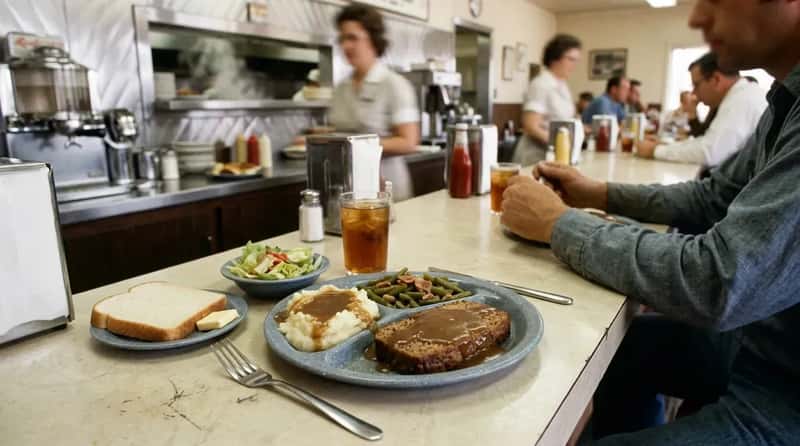
The Blue Plate Special wasn’t just a menu item – it was a contract. You ordered it knowing full well you got what you got: a hearty, low-priced meal, usually a main course of meat plus sides, available for a limited window during lunch or dinner. No swapping the green beans for fries. No asking for sauce on the side. The whole point was speed and economy, and everyone understood that going in.
“No substitutions” was a common and enforced policy, and the meal was attractive to restaurants because it let them use fresh inventory efficiently – components were pre-cooked and held on steam tables, which meant faster service and higher table turnover. Asking for modifications would have earned you a stare that could strip chrome. For a generation raised on “build your own bowl” apps and customizable everything, the concept is almost philosophically incomprehensible. You ate what was on the plate. The plate was not negotiating.
At a Glance
- Typical Blue Plate Special price in the early-to-mid 20th century: 35 to 50 cents
- By the 1950s, some menus listed complete meals at 50 to 75 cents including protein, sides, and bread
- The name likely traces to Blue Willow-patterned divided china plates widely used by restaurants of the era
- Origins may date to 1892 at Fred Harvey’s railroad dining stops, where trains paused only minutes
- By the late 1930s, an estimated one million Americans ate at least one diner meal daily – Blue Plate Specials led the way
#14 – Men Kept Their Hats On Until They Sat Down – Then Off They Came
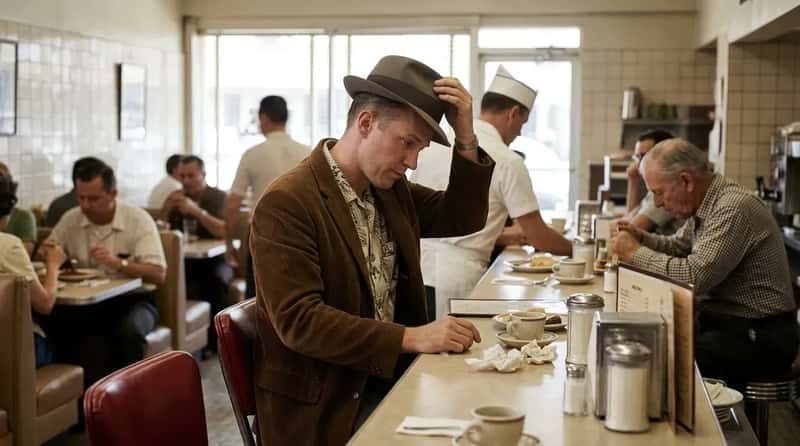
It sounds like a trivial detail, but hat etiquette at the diner counter was a fully loaded social signal. The moment you slid onto a stool or into a booth, the hat came off – no debate, no exception. This wasn’t just politeness. It was a public declaration that you understood the rules of shared space, and it happened automatically, the way people today silence their phones in a movie theater. Except it was enforced by nothing except social pressure, and social pressure worked.
Throughout the mid-twentieth century, men were expected to wear hats and treat them appropriately in every public setting. A man who kept his hat on through a meal was broadcasting something about his character, and it wasn’t flattering. Old photographs confirm it – businessmen at the counter, hats off, coffee in hand, looking as deliberate about it as anything else they did that day. Today almost nobody notices or cares. A full cultural reversal, accomplished in about two generations, with no announcement.
#13 – Diner Lingo Was Its Own Encoded Language
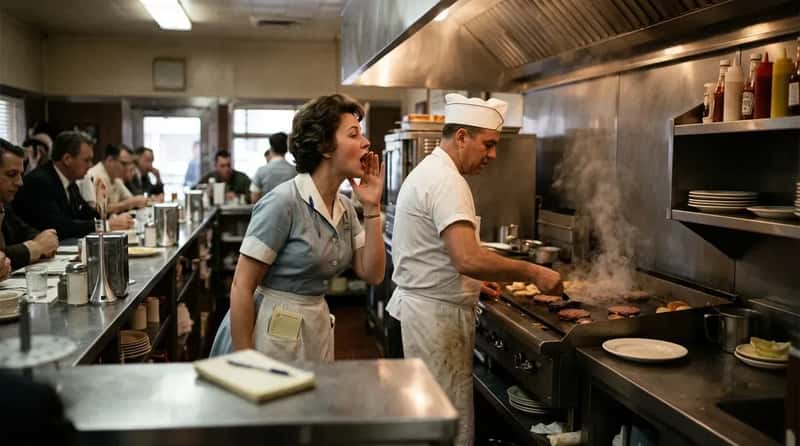
Walk into a 1960s diner and call out “burn one, drag it through the garden, and pin a rose on it,” and the cook would know immediately: a burger with lettuce, tomato, and onion. This wasn’t showing off. It was functional shorthand that kept orders flying across a packed lunch rush when there was no ticket printer, no screen, and no margin for error. Phrases like “Mississippi Mud” for mustard, “Skid grease” for butter, and “Frog sticks” for French fries were mnemonic tools built out of necessity and creativity.
None of it was written down anywhere official. The lingo passed from waitress to waitress, shift to shift, diner to diner – an oral tradition of food service that existed in no manual and appeared on no training video. A young customer today who overheard a veteran waitress calling out orders in fluent diner code would assume she was speaking a foreign language. Half the phrases have entirely vanished from American food service vocabulary, along with the culture that needed them fast enough to invent them.
Worth Knowing
- “Adam and Eve on a raft” = two poached eggs on toast
- “Nervous pudding” = Jell-O
- “Blond with sand” = coffee with cream and sugar
- “Wreck ’em” = scrambled eggs
- “Walk it through the garden” = add all the vegetable toppings
#12 – You Held Your Drink in Your Left Hand. Always.
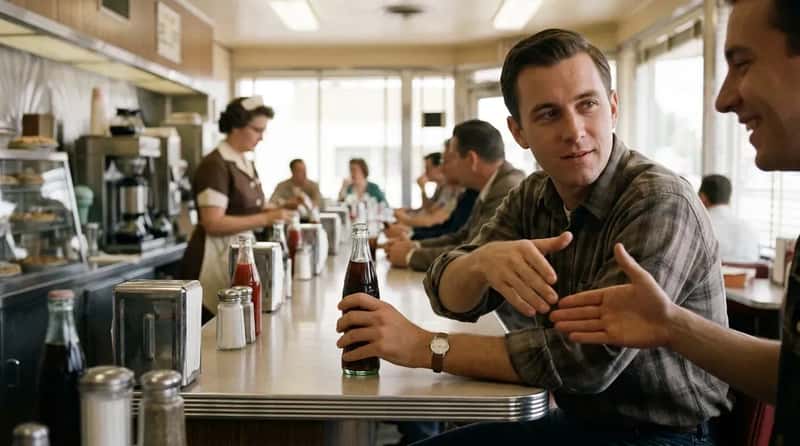
This one genuinely baffles people when they first hear it, but it was a real and widely followed rule. Whether you were a lefty or a righty, etiquette of the era dictated that you hold a drink in your left hand – because the right hand was your “social hand,” kept dry and available for shaking at any moment. At the diner counter, you might run into a neighbor, a boss, a customer, a friend. None of them wanted a cold, wet handshake.
The rule extended further: you couldn’t hold your bag with your right hand, and you certainly couldn’t muffle a sneeze with it. The entire point was that your right hand stayed clean and ready as a matter of basic social readiness. The habit is still encouraged today at business events and formal gatherings for exactly the same reason – but in the 1960s diner, it wasn’t occasional advice from an etiquette column. It was standard operating procedure, absorbed so completely that people followed it without thinking about why.
#11 – Teenagers Actually Went to Diners to Hang Out After School
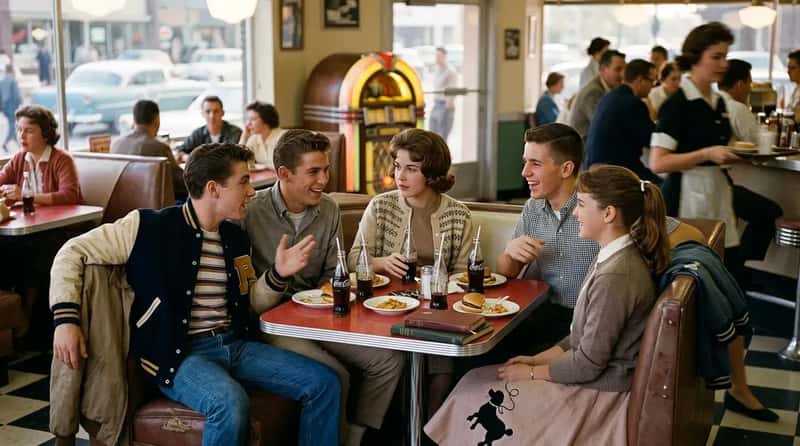
It sounds almost fictional now, but the diner was the genuine social hub for American teenagers in the early 1960s – not a mall food court, not a fast food chain, not a phone screen. After school, teenagers would flock to diner booths to argue about music, figure out who liked who, and process the day. The jukebox provided the soundtrack. The Coke cost a quarter. Nobody asked how long you planned to stay.
With postwar teen culture came a new kind of public space designed, unofficially, just for young people – and the diner filled that role before the mall ever existed. The social contract was simple: buy something small, occupy a booth, be loud, be young, be there. No cover charge. No membership. No Wi-Fi password. No one checking your screen time. That specific kind of low-cost, adult-adjacent freedom – where you were out of the house but not yet in the world – barely exists anywhere today, and it’s surprisingly hard to explain to someone who grew up without it.
#10 – The Waitress Knew Your Order Before You Sat Down
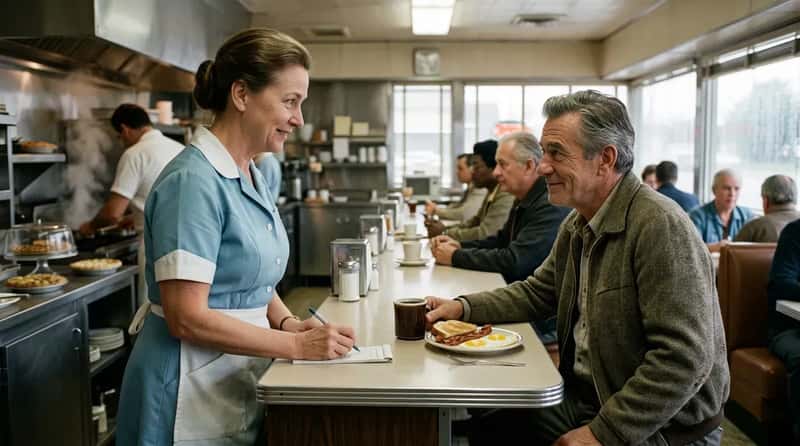
The concept of a “regular” meant something very specific at a 1960s diner. If you showed up three mornings a week, the waitress wasn’t handing you a menu – she was already writing down two eggs over easy and a coffee, black, before you’d unzipped your jacket. This wasn’t a performance of friendliness engineered for tips. It was a genuine community function, built slowly through hundreds of ordinary mornings.
The diner waitress of the 1960s served as an unofficial social anchor for her entire neighborhood shift. She knew who was having a hard week, who had a new grandkid, who used to take two sugars until the doctor intervened. The open kitchen layout – where customers could watch cooks working the griddle and servers pulling coffee – created a transparency that built real trust over time. That kind of relationship is nearly impossible to develop in today’s chain-restaurant model, where staff turnover is high and no one expects to see the same face two visits in a row.
#9 – You Could Smoke at the Counter While the Person Next to You Was Eating
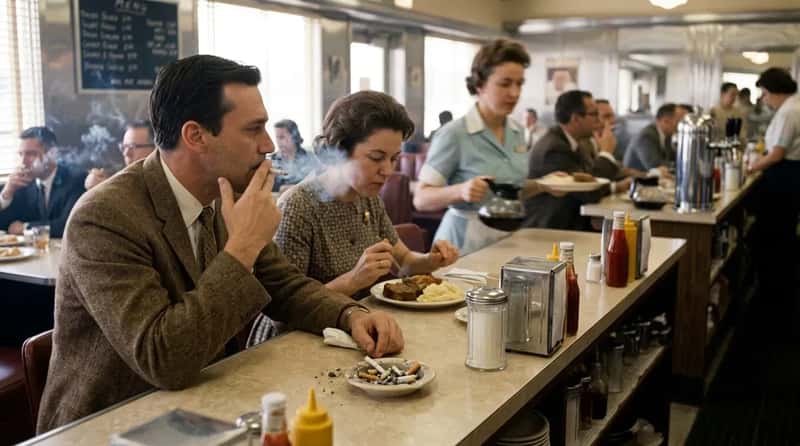
This is the single habit that most visibly shocks younger Americans when they see it in old photographs or film footage. Smoking at the diner counter – mid-meal, mid-conversation, in direct proximity to other people’s food – was entirely unremarkable in the 1960s. There was no designated section. There was no separate room. There was often an ashtray sitting right between the sugar shaker and the ketchup bottle, treated as standard table equipment.
Smoking in restaurants wasn’t banned in most U.S. states until the 1990s or even the 2000s, and in the 1960s it wasn’t a debate anyone was having publicly. Cigarette smoke was simply part of the diner atmosphere – layered in with the smell of coffee and griddle grease as a baseline condition of being there. Old photographs regularly show a man with a cigarette in one hand and a fork in the other, and nobody at the counter beside him looks remotely bothered. For anyone who has grown up with smoke-free public spaces as an absolute norm, the visual is genuinely jarring in a way that’s hard to shake.
Quick Compare
| Then (1960s) | Now |
|---|---|
| Ashtray between the sugar and ketchup | Smoke-free laws in all 50 states |
| No designated smoking section | Most bans extend to outdoor patios |
| No state restaurant smoking bans | Most states banned indoor smoking by 2010 |
| Cigarette ads inside some diners | Federal ad restrictions since 1971 |
#8 – The Pie Rotated Under Glass Right on the Counter
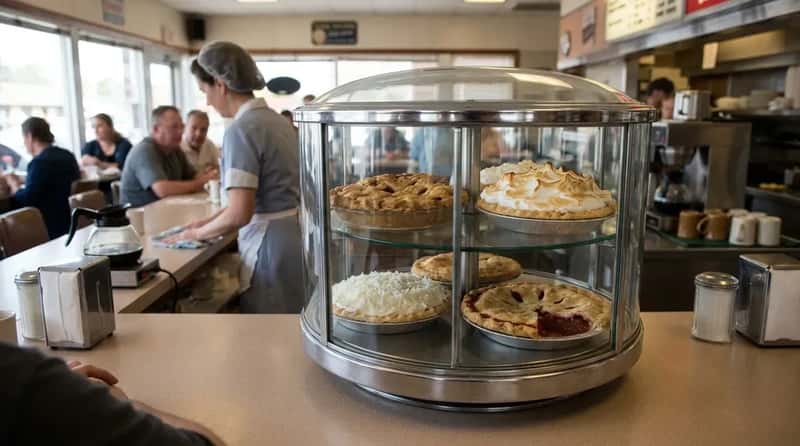
There was a specific piece of theater at the 1960s diner counter that has nearly vanished from modern life: the revolving glass pie case. It sat right on the counter, slowly spinning, displaying whatever the kitchen had baked that morning – lemon meringue, cherry, coconut cream, chocolate. Ordering pie wasn’t a decision you made from a written description. You pointed at what you wanted. The meringue was three inches high and right there.
The rotating display was a deliberate sales tactic, but it was also genuine diner spectacle. Nobody said no to pie they could actually see. The visual proximity made the upsell automatic – you came in for coffee and left with a slice because it was impossible to look away from. Today’s diners occasionally keep a stationary dessert case near the register, but the slow-spinning counter display with its quiet ceremony has largely disappeared, replaced by photographs in laminated menus that never quite do the real thing justice. There’s a difference between reading “coconut cream pie” and watching it rotate past your elbow.
#7 – The Tip Was Left in Cash, Face Down
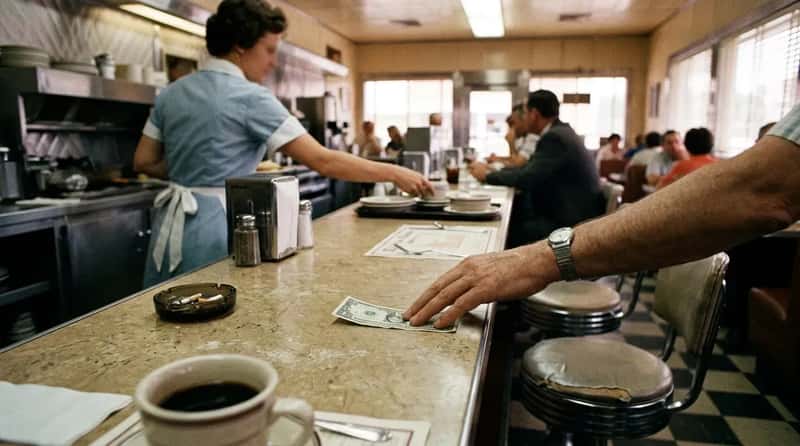
Tipping etiquette in the 1960s diner had its own specific physical ritual. There were no tip lines on receipts at informal diners – no touchscreens nudging you toward 18, 20, or 25 percent. You left cash – coins or a folded bill – face down on the counter or table after you paid. Face down was deliberate: it signaled clearly that the money was a tip, not forgotten change. It was a small but intentional gesture of respect directed at a specific human being.
In the 1960s, the physical act of leaving cash communicated something the tip screen never will – a direct, person-to-person acknowledgment with no algorithm in between. The server picked it up herself. No pooling formula, no percentage prompt, no manager involved. For a generation that has never carried cash to a meal and processes every transaction through a tablet, the entire choreography is invisible. But for the waitress on the other end of it, the difference between the two experiences was never invisible at all.
#6 – Diners Ran 24 Hours, and That Was a Sacred Promise
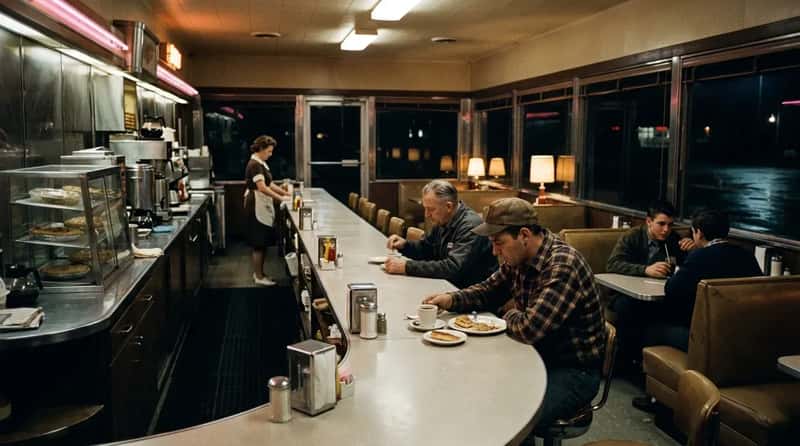
Round-the-clock service was once the hallmark of the American diner – not a selling point, but a baseline expectation. Truck drivers, factory workers coming off the night shift, insomniacs, teenagers too young for bars – all of them could count on hot coffee and a hot plate at 3 a.m. without a reservation, a dress code, or anyone asking what they were doing up so late. A diner that closed at night was barely a diner at all.
The 24-hour diner was one of the only truly democratic spaces in 1960s America. No minimum age. No closing time. No cover. Labor costs and shifting customer habits have since forced most diners to cut their hours dramatically, with many now closing by 9 or 10 p.m. – a quiet retreat from a promise that once felt permanent. An entire generation of night owls, third-shift workers, and people who just needed somewhere to sit lost their refuge so gradually that most of them didn’t fully notice until the lights were already out.
#5 – The Menu Was Regional and Seasonal, Not Standardized
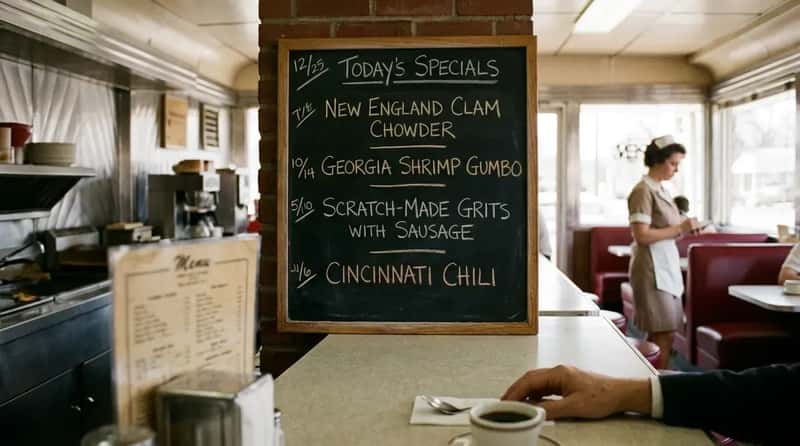
Ask a 1960s diner in New England what was good today and you’d hear about fresh clam chowder. Pull into a Southern diner at breakfast and expect actual grits, cooked from scratch. The Midwest had Cincinnati chili. The Gulf Coast had shrimp dishes that reflected what came off the boats that week. Eating at a diner once told you exactly where in the country you were – the menu was a geography lesson delivered on a laminated card.
Chain restaurants and national food service suppliers have since homogenized diner menus coast to coast, and the same frozen appetizers and standardized breakfast platters appear everywhere from Maine to Arizona. Many younger diners have simply never experienced authentic regional cooking preserved and celebrated in a local eatery – the kind where the cook knew the farmers and the menu changed when the season did. That loss is harder to quantify than a closed storefront, because most people don’t know what they’re missing until they stumble into the rare place that still does it the old way.
Why It Stands Out
- New England: fresh clam chowder and fish cakes were daily staples, not seasonal specials
- The South: scratch-made grits, red-eye gravy, and biscuits from actual lard recipes
- Midwest: Cincinnati chili over spaghetti, a dish that exists almost nowhere else
- Gulf Coast: shrimp and Gulf fish changed based on the week’s catch, not a corporate menu cycle
- Today’s chain-influenced diner menus are largely identical whether you’re in Vermont or Nevada
#4 – The Sit-In Was a Political Act Performed Over a Cup of Coffee
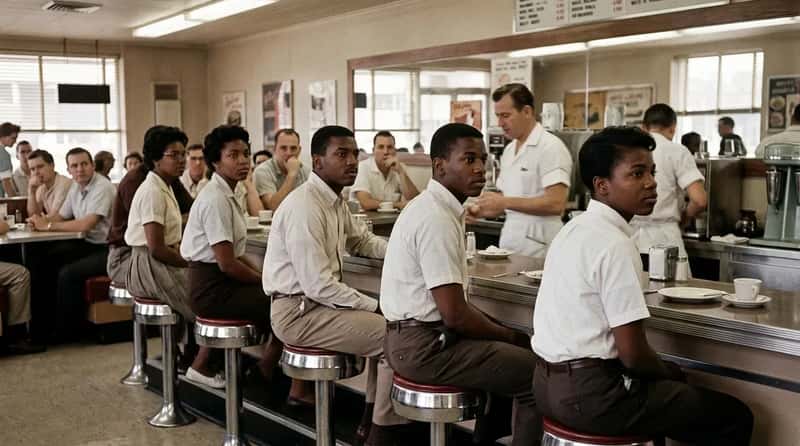
Not every 1960s diner habit was innocent nostalgia. The lunch counter was also a front line. In the early 1960s, segregation of public accommodations was still enforced across much of the country – seating at lunch counters was frequently restricted by race, with Black customers turned away, forced into marked-off sections, or made to eat standing up while white customers sat. The act of occupying a stool was, for many Americans, not simple at all.
Though lunch-counter sit-ins began as early as 1957, they drew national attention in 1960 when peaceful demonstrations at Woolworth’s lunch counters spread across the South. In 1961, students from Alabama’s Tuskegee University staged a demonstration at a diner that refused to serve them. The sit-in protesters weren’t making a dramatic gesture – they were doing the most ordinary thing imaginable, and being met with hostility for it.
We had the right to be served. We were going to exercise that right.
John Lewis, on the Nashville lunch counter sit-ins, 1960
That history lives in every counter stool, whether today’s customers know it or not. The diner counter was never just about food.
#3 – You Asked to Be Excused Before Leaving the Table
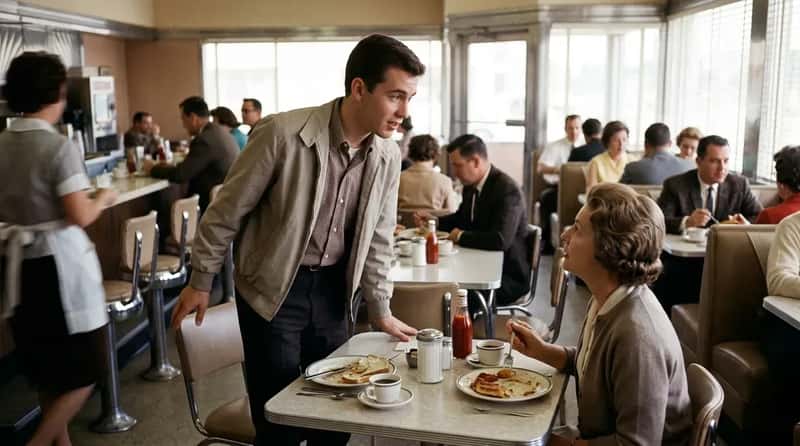
This wasn’t just a home rule that leaked into the diner. The general social expectation of the 1960s – that you didn’t simply vanish from a shared meal without acknowledging the people around you – extended to public dining too. A shared table created a temporary social contract, and you couldn’t just exit it unilaterally. The phrase “please excuse me” wasn’t a formality. It was a small acknowledgment that other people’s time and company had value.
In a diner setting, walking out mid-meal while your companion was still eating, or leaving a group without a word, carried real social weight. The habit traces back to Victorian-era dining rules that treated the table as a place for discipline and mutual respect as much as nourishment – and by the 1960s it was so deeply embedded that children absorbed it without being explicitly taught. Now it’s routine to watch someone glance at their phone, announce “I gotta go,” and disappear while the food is still warm. The contract dissolved so gradually that most people don’t remember agreeing to it in the first place.
#2 – Greek Immigrant Families Kept the Diner Alive When Chains Tried to Kill It
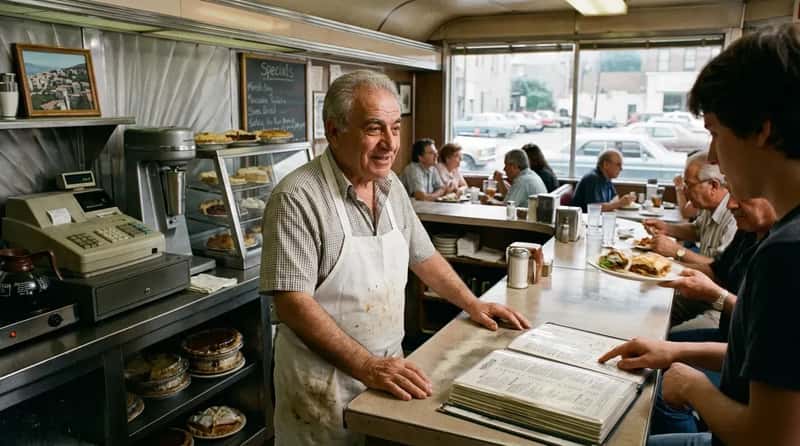
Here’s a piece of American diner history that almost nobody under 30 knows: the classic diner nearly died in the 1960s. The rise of fast food chains and standardized restaurant concepts posed a serious threat to the independent diner format – and what saved it was largely the investment of Greek immigrant families who saw something worth preserving. Greek immigrants moved into diner ownership by working their way up from dishwasher to proprietor, reinventing the format in the process.
Greek-owned diners became known for their famously expansive menus – sometimes covering 10 or 12 laminated pages – offering everything from pancakes to lobster under one roof, alongside distinctive interiors that gave the American diner a kind of unlikely grandeur. The reason the diner survived the fast-food revolution is almost entirely due to families who doubled down on the format when corporate America was abandoning it. The next time you’re in a classic diner with a menu that somehow includes both meatloaf and Greek salad, you’re sitting in the direct legacy of that choice.
Fast Facts
- Since the 1940s, most diners in New York City have been owned by people of Greek descent
- A 1972 survey found that 92% of restaurants in New York City and surrounding areas were Greek-owned or operated
- A 1996 New York Times report estimated about two-thirds of NYC diners were Greek-owned
- New Jersey has more diners than any other U.S. state – most are Greek-owned
- Greek immigrants often started as dishwashers or bus boys, saved wages, then bought out existing owners
- Coffee distributor John Vassilaros, a Greek immigrant, helped launch countless diner operators starting in 1918 by providing financial backing in exchange for coffee contracts
#1 – The Counter Seat Was Where America Processed Its Hardest Moments
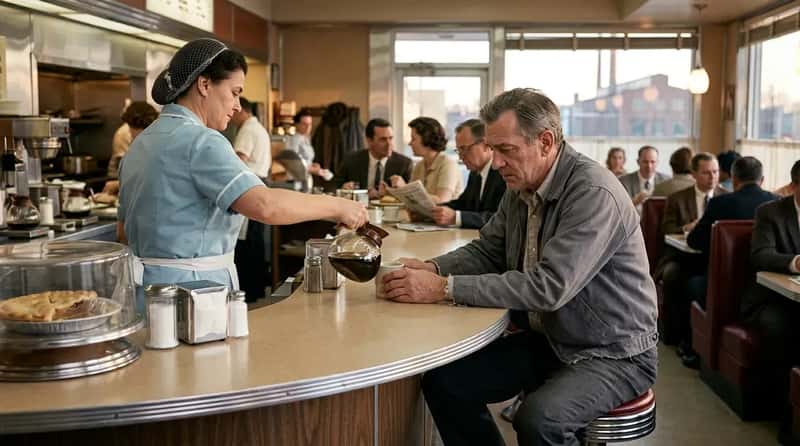
The diner counter in the 1960s was more than a place to eat. It was where a man sat alone after a funeral and a waitress refilled his coffee without asking. Where a family squeezed onto adjacent stools after a long road trip and nobody cared that the kids were noisy. Where a night-shift worker spent the only quiet hour of his day before going home to sleep. Many diners were historically placed near factories that ran around the clock, and their role as a place to decompress – to sit with your own thoughts inside a room full of strangers – was as important as anything on the menu.
Norman Rockwell understood this instinctively. His 1958 painting The Runaway placed a young boy and a kindly highway patrolman at the counter of an anonymous diner precisely because the setting communicated something universal: anyone could sit here, and no one would ask you to explain yourself. The counter carried both loneliness and belonging at the same time. It asked nothing of you except the price of a cup of coffee. In a country that has steadily replaced its third places with delivery apps and drive-throughs, that specific kind of unconditional welcome is the habit we’ve lost most completely – and the hardest one to get back.
These 17 habits paint a picture of an America that ate differently, socialized differently, and expected different things from a shared table. Some of it was genuinely better. Some of it – the segregation, the cigarette smoke, the rigid social codes – plainly wasn’t. But the diner at its best was one of the few truly democratic spaces this country ever produced: open to anyone with pocket change and a willingness to sit next to a stranger. That part is worth more than we gave it credit for while it was still here.